
~~
Martin Danao
Jesyl-Joy Deliquina Rodrigo
Richard Pastor
~~
Martin Danao
Michelle Papa
Joseph Pascua
Richard Pastor
Joel Samonte
Renee Santos
~~
Jon Basilio
Jemelie Barrera
Robert San Luis
Excel Navarrete
Jennifer Valdez
Christopher Navarro

Life in the rural regions of the Philippines reflect the Filipino people's love for song, dance and merriment. "Bahay sa Bukid" features a culture from the rice growing countryside. After a hard day, the villagers come together to celebrate their joy in work, give thanks for a good harvest, or sing and dance simply because it is a beautiful day.
Dances in the rural regions reflect a mixture of native and Western influence blended to form a unique art.
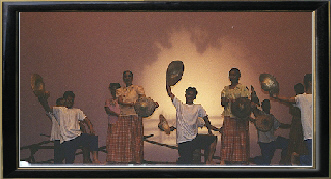
A medley of dances which portray rice farmers as they plant, sift and harvest rice.
*Sa Pista Ng Nayon*
Our cast expresses life in the countryside through popular native songs featuring singer - Leah Auditor.
*Gayong-Gayong*
A playful dance from the province of Aklan on the island of Panay. This dance is of a feast where one man nearly choked as a result of his gluttonous appetite. The dance is a playful kidding representing the feast-goers attempts to find help for the choking man.
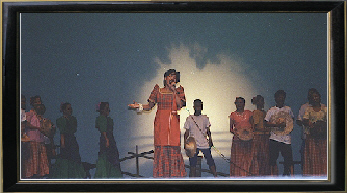
Leah Auditor presents a medley of traditional Philippine songs which have kept many rural spirits high.
*Pandanggo Sa Ilaw & Oasioas*
Dancers display their gracefulness by balancing three candlelit glasses on their heads and back of their hands as they perform waltz-like steps. Depicting fireflies in the night air, the dancers gradually swing the glasses inside the handkerchiefs providing a beacon for homecoming fishermen.
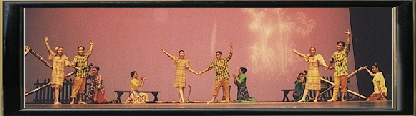
One of the world's most exciting folk dances, "Tinikling" takes its name from the long-legged "tikling" bird. The dance originated on the island of Leyte. The dancers imitate the tikling bird as they step between long bamboo poles. The bamboo poles are clapped together in an effort to trap the elusive tikling bird.
This suite of dances brings us back to the Spanish era in the 16th Century. When the Spaniards landed in the Philippines, they not only brought their Christian beliefs and way of living, but also their arts. Many of the Western European dances such as the waltz, the polka, and the jota were adopted by the Filipinos of that era adding their own unique touch.
"Jovencita" features a Spanish ballroom dance portraying a debutante ball in which the debutante takes us back in time.
The debutante ball opens with a dance which reflects the Iberian influence. This lively dance is a prelude to the evening's events.
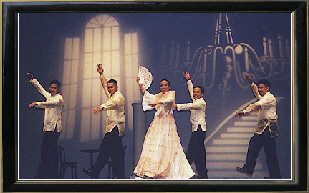
A lively dance in which the debutante selects her escort among the four eligible gentlemen.
*Valse*
A creative dance inspired by a "cotillon" where the dance opens with the introduction of the guests and the debutante and her escort.
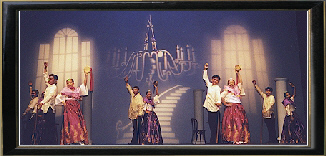
This dance concludes the evening of elegance and is inspired by the jota and paso doble.