
~~
Michelle Papa
Annalisa Padayhag
~~
Barbara J. Ele, Joel Jacinto, Fermin Longcob, Annalisa Padayhag, MIchelle Papa, Joseph Pascua, Renee Santos, Jobert Valdez
~~
Jon Basilio, Pamela Dela Cruz, Fernando Longcob, Catherine Navarro, Christopher Navarro, Josephine Siapno

Legend
The first man and the First Woman went up to the Mountains to make the First Home. There they bore many children who became the ancestors of the many diverse Pilipino tribes. The early people had an awareness of the unseen forces that governed the daily living.
DANCE, a form of worship, was a means for the early people to communicate their invitations to the gods to become a part of their lives. They hoped that through dance the gods would look upon them favorably.
*Pakong - Pakong is a small intrument made from bamboo. It is also called the balimbing or bungkaka. The baskets, or kayabang, are used to carry in the harvest. It is carried by placing the strap on the forehead with the basket on the back.
*Among - Among is a wedding dance where the prancing of the dancers is highly suggestive of a rooster circling a hen. The flute music opens the dance as the headhunter and his maiden unify their love for each other.
*Pinayegpeg - The villagers join the newlyweds in a rousing celebration of their unity.
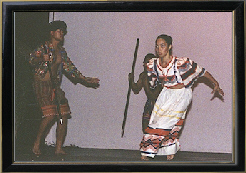
*Banog - This dance depicts hunters protecting their hen and chicks in Binaylan from a hungry hawk (see above pic). The hunters trap the hawk and kill it in the end.
*Kadal Blelah - "Kadal" meaning dance and "Blelah" a mythical bird of T'boli, located around lake Sebu in South Cotabato, Mindanao. The females mimic the steps of birds and the males attempt to catch the females with their shoulder cloth (sablay).
*Pandamggo - "A Dream". Dance of the Talaingod portrays a virgin mother bathing and cradling her newborn baby. She purportedly has dreamed she was to have such a baby.
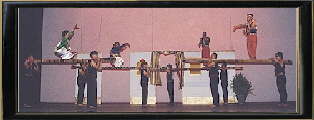
*Sua~Sua - A dance from Jolo meaning "orange plant", accompanied by a song and is performed holding open fans in each hand. Natives often repeat the dance over and over until they get tired or made to stop.
*Langka~Budjang - The only martial arts dance which includes women, the movements are flowing, graceful arm thrusts are characterized by restrained force. Although the dance has leaps and kicks, her feminine allure is maintained.
*Kzadoratan - A royal and graceful way of walking, sometimes made over into a dance and performed by the ladies-in-waiting of a Moslem Royal court.
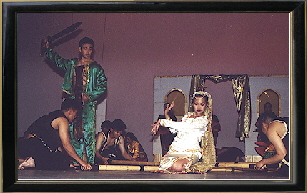
According to the Maranao legend, the Singkil derives its name from the feat of a certain Princess Gandingan. While she was walking in the forest, d'watas, or fairies, caused an earthquake and trees and rocks to fall. The Princess skipped nimbly from one place to another so that her feet did not touch the fallen trees and rocks. Prince Bantugan saw the frightened Princess. He ran and jumped over the trembling rocks in an effort to take her to safety.
This version of Singkil became the one performed by most folk dance troupes and is further dramatized by bringing in the flirtation between the prince and the princess. Originally, this dance was only performed for members of the Maranao Royal Family.
As the princess weaves in and out of the bamboo, she manipulates two bejeweled fans called apir. The princess is followed by an attendant who carries an adorned umbrella in every royal ceremony. The design on the umbrella depicts the rank of the princess.