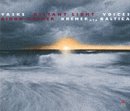
Peteris Vasks: Distant Light, Voices
Wea/Atlantic/Teldec - #22660
reviewed by Christopher Coleman for RTHK Radio 4
Track 1, 2:20 (Fade in)--5:43
We have been listening to a selection from Distant Light, a violin concerto by Latvian composer Peteris Vasks. Superbly performed by violinist Gidon Kremer and his Kremerata Baltica ensemble, this is the opening selection on this Teldec CD which also features Vasks' symphony for strings entitled Voices. Both works are permeated by a sense of melancholy created by rather soft dynamics, very simple textures, an extremely slow harmonic motion--often elaborating a drone or single harmony for a minute or more at a time, and beautifully expressive extended melodic lines. Vasks' music is very much in the tradition of more well-known Central European composers Henryk Gorecki and Arvo Part, even the Armenian-American Alan Hovhaness. Indeed, several moments of both works on this CD are remarkably similar (one might even say uncomfortably similar) to sections of Gorecki's Symphony of Sorrowful Songs. Vasks himself claims a strong influence from Polish avant-garde music, particularly that of Witold Lutoslawski. This influence is scarcely apparent in these pieces, however--they are for the most part extremely conservative, more reminiscent of Samuel Barber’s Adagio for Strings, with a touch of New Age sensibility.
Track 4, beginning -- 2:57 (fade out)
Vasks is largely self-taught as a composer, although clearly not adverse to closely examining those he admires for models. His formal musical training is primarily as a double bass player, and his knowledge of stringed instruments is clearly seen, as he achieves wonderfully rich sonorities. The writing is beautifully complemented by the outstanding performance of the Kremerata Baltica ensemble, a group of young musicians from the Baltic States of Latvia, Lituania and Estonia. This group was founded by violinist Gidon Kremer--the ensemble's unusual name derives from an earlier manifestation of Kremer's work known as the Kremerata Musica, which is of course a play on the term Camerata Musica, or Music Academy. Intonation and expression are impeccable, but perhaps most noteworthy is the gorgeous depth of tone the ensemble achieves. Kremer himself presents a sensational performance, fluently navagating the technical and virtuostic difficulties while creating a remarkable variety of tone color. The next example begins during the cadenza of Distant Light and includes the climax, showing not only Kremer's flair for the dramatic, but also one of the few passages in which the influence of Lutoslawski and the Polish avante-garde can be seen.
Track 1, 20:13--22:15
To my ear, the stylistic disparities here are too great to be completely successful in the context of the whole. The climax, described by Vasks as "aleatory chaos" represents only a few seconds of an otherwise almost entirely traditional composition lasting almost half an hour. It therefore seems more something artificially grafted onto the work than something achieved--a sort of Deus ex machina of evil rather than of delivery and redemption, if you will. Vasks' programmatic concern is the struggle of man for freedom from oppression--specifically the struggle of the Baltics for freedom from the Soviet empire. Oppression itself is not the subject of Vasks' attention, but nevertheless, that such oppression be represented by aleatory chaos is, frankly, cliched. This is the kind of gesture that beginning composition students make--and that it is wildly out of proportion to the rest of the work (and furthermore followed by a curious pastiche-updating of Liszt's Mephisto Waltz) makes it unconvincing and lacking in conviction. If only the oppression of the Baltic peoples by the Soviets were so short and readily abandoned. Vasks misses his chance to truly develop a meaningful climax out of the materials he has worked so successfully with up to this point. Having said this, though, it is the only miscue on the recording. Otherwise, performance and compositions are well worth repeated listening.
Our final example shows Vasks in a lighter, more playful mood than most of the recording. Here the influence of Bartok is readily apparent, in a passage containing elements of Latvian folk music.
Track 1, 11:01--12:39 (fade out)
Return to Music Criticism and Commentary