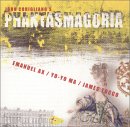
John Corigliano
Phantasmagoria
Sony Classics SK 60747
reviewed by Christopher Coleman for RTHK Radio 4
John Corigliano may be best known to classical music audiences for his First Symphony and his Clarinet Concerto. Both are dramatic works--the First Symphony is a programmatic work dedicated to those who have died of AIDS. On a CD titled Phantasmagoria you might expect similar dramatic flights of fantasy, excursions into the bizarre and unexpected. But this CD is for the most part very subdued, even though the common link to the four chamber works presented is fantasy. The first work, Fancy on a Bach Air for solo cello, is impeccably performed by Yo-yo Ma, whose gorgeous and intense tone quality keeps an extremely introspective piece interesting--I'd not like to hear this performed by a lesser player. In the liner notes Corigliano presents a moving story of the creation of the piece--it was originally intended as a wedding anniversary present for his friends Robert and Judy Goldberg. Their surname lead him to take the theme from J.S. Bach's Goldberg Variations as material; but Robert's death lead to a reconsideration of the work. There is no breastbeating, agonised sorrow in this piece--instead, it is a very slowly paced and subtlely beautiful hommage to his friend.
Track 1--beginning to 2:05, cut off at rest
Corigliano's craftsmanship is impeccable; he is the son of the former concertmaster of the New York Philharmonic and has been around art music all his life. The second work on the CD is his Fantasia on an Ostinato, based on the second movement of Beethoven's Seventh Symphony, and it also is primarily slow--not at all an effective following piece to the first work. Here Corigliano experiments with some techniques of minimalism. The piece seems to start and stop over and over, and there is an enormous amount of repetition. Once the piece finally establishes itself, some five minutes into a 12 minute work, there are some exquisitely delicate moments and Emanuel Ax gives an insightful interpretation of the work.
Track 2--fade in at 5:18--fade out at 8:30
Corigliano's five movement Etude Fantasy for solo piano follows, and finally there is some significant dramatic contrast. James Tocco launches into it with all the gusto it deserves and delivers a stunningly powerful performance. These pieces are etudes in the original sense of the word, in that each movement is a study of a specific technical problem, and yet each is also emotionally and dramatically satisfying. But the second movement reverts so soon to the subdued world of the rest of the disc, and the final movement, also quite slow, brings back some of the repetitious ideas of the previous piece in a way that simply invites tedium. Here's part of the sixth movement, Ornaments.
Track 6, 1:46-end
The final work is the Phantasmagoria for cello and piano, played by Ma and Ax, which also begins slowly! This work is based on music from Corigliano's opera, The Ghosts of Versailles. This is the most truly "fantastic" piece here, with hauntingly beautiful timbres from the cello, fragments and allusions to classical opera, and abrupt changes in character, tempi, texture. and dynamics. It is only slightly marred by a couple of passages in which Emanuel Ax forgets himself and does a Glenn Gould impersonation, singing along with his playing. These last two works are the real meat of the CD, but I feel that the disc's programming in the order presented, does them a disservice. At only 53 minutes the CD is a bit slight, too. But the performances alone justify it's purchase; I'd simply suggest not listening to the whole thing at a single sitting.
Track 8: fade in at 4:30--fade out after ca. 5 minutes
Return to Music Criticism and Commentary