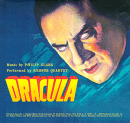
Dracula
Philip Glass
Wea/Atlantic/Nonesuch - #79542
reviewed by Christopher Coleman for RTHK Radio 4
Track 1: complete (1:12)
Dracula
That was Dracula, the title track of this CD, featuring music written by Philip Glass to accompany the 1931 film of the same name. In a rather interesting reversal of the typical situation, the music was written years after the film was made. Glass is riding the recent wave of interest in vampires that was probably spawned by author Anne Rice with her book Interview With the Vampire. The 1931 movie Dracula is not a silent film--there is dialogue, but the only music originally used was a selection from Tchaikovsky's Swan Lake played during the opening credits. I should preface my remarks by noting that although I have seen the film (lo, those many years ago) and heard the music, I have not experienced the two together, as Philip Glass intended. However, the folks at Nonesuch have released this as a CD, not as a DVD, and so we must judge it as best we can on that basis. The film, directed by Tod Browning and starring Bela Lugosi as the vampiric count, is a relic of an earlier time, like Dracula himself. It reflects an aesthetic approach that has become foreign to us; that we might even think naive. This movie is not a technicolor gore-filled splatterfest, not at all. No blood is shown, no corpses decay in slow motion. Indeed, Lugosi's Dracula doesn't even have fangs, and he meets his death out of camera view. Things are implied rather than revealed and explained in detail. And for this, Glass's music seems quite appropriate. It is picturesque--music for a film is so almost by definition. But it is a black-and-white picture, full of shadows concealing things unseen. Not for Glass a huge romantic orchestra in melodic ecstacy, or the full organ trembling a series of diminished chords. Instead, the music for Dracula is scored for string quartet alone, playing the typical minimalist arpeggios and harmonic formulae. At its best the music can be very interesting and completely appropriate to the scene, as in this selection depicting Dracula's driverless carriage transporting the film's hero, Jonathan Harker, to Castle Dracula.
Track 5, complete (2:11)
Carriage Without a Driver
The spinning wheels of the carriage are so clearly portrayed, and the sense of menace so obvious, that we don't actually need the visual images to recognize and respond to the meaning conveyed. Glass also opens up his composititional tool kit more widely than he usually does, which makes much of the music on this disc more interesting than much of his other work. Although melody is only ever present in the barest of shreds, Glass uses a quite wide dynamic range, a broader palate of tone colors and articulations and a more varied harmonic world than he does customarily. Listen to this next piece, called Horrible Tragedy. It is another example of the understated, quiet menace; and also quite different from what we've come to expect from Philip Glass.
Track 11, complete (1:22)
Horrible Tragedy
The unrelenting parallel dissonance, high register and soft dynamic create a very eerie and somewhat unpleasant sensation completely appropriate to the supernatural subject. However, I must say that although there is a lot of interesting music on this disc, there is also far too much that lacks any interest at all. Quite a lot of the middle of the disc is obviously there because the movie needed music, but without the context of the visual element of the film the music is like a mindless zombie. Almost half of the disc is made up of the kind of Glass's music that many classical music lovers have come to loathe--filled with endlessly repetitive arpeggios at a soft dynamic level using the same harmonic progressions over and over. Sure, it's good music to put on while you are reading a book or folding laundry--but too much of this music for Dracula is toothless. Before the demonic hand of marketing rose unbidden from its corrupt grave and took over the world of classical music, composers used to write suites. Suites are made up of only the best of the music from a longer piece. A suite from this CD would have been very welcome; but the evil marketing geniuses have decided that we need to suffer through the whole thing. Alas, here's a case where the aesthetic of reserve would have benefited both the music and the listener. Furthermore, the Kronos Quartet performs with questionable accuracy during some of the faster arpeggiated passages. But having said that, there is much of worth here, and not only for fans of Philip Glass. Approaching this music with appropriate expectations will reward the listener with a tasty bite. Let's close with the final selection on the CD, The End of Dracula.
Track 26: complete (4:06)
The End of Dracula