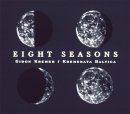
Gidon Kremer and the Kremerata Baltica
Eight Seasons
Wea/Atlantic/Nonesuch - #79568
reviewed by Christopher Coleman for RTHK Radio 4
Band 16: beginning to 2:41 Fade out
You've been listening to the beginning of Astor Piazzolla's Spring in Buenos Aires in an arrangement performed by violinist Gidon Kremer and the Kremerata Baltica ensemble. You may be familiar with the program on this Nonesuch CD entitled Eight Seasons; Kremer previously presented it to Hong Kong on one of the Arts Festival concerts. The concept is decidedly postmodern; Antonio Vivaldi's Four Seasons concerti written around 1725 presented in alternation with Argentinian composer Astor Piazzolla's Four Seasons of Buenos Aires, written almost 250 years later. In his notes for the CD, Kremer asks us not to think too much about irrelevancies such as categories of Classical or Pop, Modern or Baroque, but simply to embrace the sounds as a language of emotion. Let us, then, begin embracing: here is the end of the Piazzolla I played earlier, Spring in Buenos Aires, followed by the beginning of Vivaldi's Spring.
Band 16: 4:46 (fade in quickly)--5:39
Band 1: beginning--1:02 (fade out quickly)
But categorization and questioning are as natural for man as breathing; and music is not solely a sensory experience but also an intellectual one. True, we live in an age where Baroque and modern co-exist, and the true post-modernist does not just accept these eclectic juxtapositions, but considers their real worth to be in the newly-found relationships these juxtapositions reveal. So we must ask, do the Vivaldi concerti gain from their juxtaposition with the Piazzolla? Do the Piazzolla gain from the Vivaldi? Certainly the references to the Vivaldi in the Piazzolla become immediately obvious, as in the example we've just listened to. But beyond this, we become sensitized to the extent of Kremer's interpretation of the Vivaldi--he is perhaps a bit disingenuous when he asks us to simply accept, when so much thought has clearly gone into these performances. Better that we become aware of how crisply the Vivaldi is played, how percussive it is, how colorful and vigorous, and how expressive the tempo changes are--these interpretive details are not indicated in the score at all, but are clearly influenced by Kremer's work with contemporary music in general and Piazzolla in particular. Listen to the fascinating control of tone quality in these two short exerpts from Vivaldi's Winter, and also note the vigor of the rhythmic drive.
Band 13: 2:04--end
Band 14: beginning--end
These performances are definitely not for the purist, but I imagine that Vivaldi would have been extremely pleased with these interpretations, as he was a virtuoso violinist himself, well-known for his innovative playing techinques.
I've said relatively little about the Piazzolla pieces. They were written as four distinct works in the years 1964-1970 and not originally intended to be performed as a suite, although later Piazzolla did indeed put them together occassionally and perform them with his quintet. They are originally scored for violin, electric guitar, piano, bass, and bandoneon--an instrument much like an accordion. In the arrangements presented here, by Leonid Desyatnikov, they undergo a transformation even more radical than that of the Vivaldi, and so Kremer's presence in this project becomes almost like that of a third composer--this is not, as Kremer says in his notes "a dialogue of two geniuses", but rather a translation done by a third genius of their work in terms of one another.
Let us close with a bit more Piazzolla; here's the end of Autumn in Buenos Aires.
Band 8: 4:37 (fade in)--end
Return to Music Criticism and Commentary