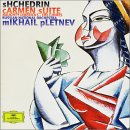
Shchedrin: Carmen Suite; Concerti for Orchestra #1, #2
DGG 471 136-260850
reviewed by Christopher Coleman
recorded at RTHK Radio 4 (Hong Kong) July 12, 2001
for CD Gallery hosted by Gladys Lau
Track 4: complete
It is very familiar music indeed, but somehow slightly askew. You might have recognized that excerpt as from Bizet's Carmen, but with an odd rhythmic reinterpretation and much more percussion than Bizet used. This is Russian composer Rodion Shchedrin's Carmen Suite, after Bizet, which was premiered as a ballet in 1967 in Moscow. Like so much music of that time and place, it was immediately banned; the grounds were that it was "an insult to Bizet's masterpiece and for its sexual treatment of the character of Carmen." Only through the intervention of Dmitri Shostakovich, no stranger to vagaries of Soviet critics himself, was the ban eventually lifted. Although Shchedrin, like Shostakovich (who was some 26 years his senior) struggled with the issues of artistic and personal freedom within the Soviet system, he eventually had great success. He succeeded Shostakovich as chairman of the Composers Union of the Russian Federation in 1973, and received both the USSR State Prize for Music and later the State Prize of the New Democratic Russia. Let's listen now to a bit of the final movement of Shchedrin's Carmen Suite.Track 13: beginning--fade out quickly after 1:10
Perhaps the listener can read into the dichotomies of the finale Shchedrin's conflicts between his personal desires and his public demands. But much of the piece is simply an exuberant and thrilling reinterpretation of Bizet--not only Carmen, but other bits of Bizet creep in, notably a lengthy selection from L'Arlesienne. All of it is recast in the light of a twentieth century sensibility regarding orchestration and style, somewhat more conservatively than his contemporary Alfred Schnittke. At times Shchedrin turns Bizet jazzy, and he always colors the music with brilliant writing for a vastly expanded percussion section. I find the result extremely enjoyable, and certainly the performance by the Russian National Orchestra, conducted by Mikhail Pletnev, is very good. The tone quality of the strings is rich and full, intonation impeccable, and the ensemble (with a very few minor exceptions) demonstrates a rhythmic precision that should be the envy of any group.Track 6: beginning to 2:35
In addition to the Carmen Suite, the listener is also given the first two of Shchedrin's four (to date) Concerti for Orchestra. Let's listen to a bit of the first of these, subtitled Naughty Limericks.Track 14: beginning--fade out at 4:00
The jazz influence is ever stronger here, with the pizzicato walking bass, the use of glissandi, and the jazzy drums. I'm also greatly reminded of Stravinsky, especially his "Circus" music. The CD notes tell us that the translation of the title, Naughty Limericks, is insufficient to give the full meaning of the original Russian, which carries a connotation of political satire and ridicule. These two concerti are a rather different conception of the form than the original Concerto for Orchestra by Bela Bartok. Whereas Bartok's idea is a grand lengthy multi-movement vision, Shchedrin's is almost insubstantial by comparison, at least in terms of length. Both are single movement pieces, and the longest of the two (his Second Concerto for Orchestra, subtitled The Chimes) is only 10 minutes long. This work, the last on the CD, is by far the most adventurous and difficult. Many listeners may want to skip that track, but I find it fascinating. Although dissonant, it is full of color and drama, with rhythmic energy reminiscent of the primitivist works of Prokofiev and Stravinsky. Listeners familiar with the works of Alfred Schnittke will also notice similarities to those pieces. Let's close with a few minutes from the middle of Rodion Shchedrin's Second Concerto for Orchestra, The Chimes.Track 15: fade in at 5:10--fade out at 7:53
Return to Music Criticism and Commentary