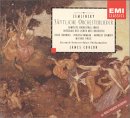
Alexander Zemlinsky: Complete Orchestral Songs
EMI Classics - #57024
reviewed by Christopher Coleman for RTHK Radio 4
Track 1: beginning--fade out at 3:33
The music of Gustav Mahler and Richard Wagner echoes strongly in that excerpt from Alexander Zemlinsky's orchestral song Waldgensprach (Forest Talk). Indeed, Zemlinsky is a little-known link in the line of Austrian/German lied composers stretching back to Schubert and through Richard Strauss. In a short time at the end of the 19th century, this musical world produced Gustav Mahler and Hugo Wolf, then Richard Strauss, Alexander Zemlinsky, and Arnold Schoenberg in succession. That Zemlinsky's works, few as they are, do not feature prominently in the modern repertoire is not for their lack of quality--Zemlinsky was a great composer, but unfortunately he wasn't a great composer often enough. His oeuvre consists of eight operas, three symphonies, and a relatively small number of chamber ensembles and songs--in fact, also like Mahler, Zemlinsky spent a large portion of his professional life as a conductor, which must have been a contributing factor in his limited compositional output. But when Zemlinsky is at his best, as in his Lyric Symphony, or here, in this excerpt from the second of his Two Songs for Baritone and Orchestra, his work is as fine as any of his contemporaries, and this is a highly recommended CD for fans of the genre.
Track 4: Fade in quickly at 7:49--fade out at 11:00
What a fabulous performance by Andreas Schmidt, with James Conlon conducting! This excerpt brings me to an oddity of this CD: it includes this fragment of a song cycle and a song for soprano and string sextet, both of which were abandoned by Zemlinsky uncompleted. Resurrecting the music of forgotten composers is one thing; but resurrecting the incomplete works of forgotten composers strikes me as a rather odd thing to do, but in this case, it works. Although time prevents me from playing a selection, certainly the song for Soprano and string sextet, originally intended as a companion piece for Arnold Schoenberg?s Verkarte Nacht, is a beautiful work worthy of attention. The Grand Gesture is not the only thing that Romantic music is about, and Zemlinsky is as compelling with the intimate caress as with the passionate spasm.
This more intimate approach, again probably derived from Mahler in his Das Lied Von Der Erde, is featured in one of the most interesting pieces on the disc, the Symphonic Songs, op. 20. These songs are based on the poetry of African-American writers of the 'Harlem Renaissance' about the black experience in America, particularly the experiences of oppression and death. These poems must have resonated strongly in Zemlinsky, who had recently lost his wife and who was soon to be forced to emigrate to America as a result of Nazi oppression. The cycle ends with a tremendously haunting scene of a white girl holding and kissing a black baby as they smile at one another on a beautiful summer day, while the corpse of a black man hangs from a tree, silhouetted by the sun. The poem is made all the more haunting by the simple language used--we are left to ourselves to feel the horror of the scene rather than having the details of the death grimace on the dead man's face told in exacting detail; and Zemlinsky captures this effect perfectly. I'll close with this, the last of Alexander Zemlinsky's orchestral songs.
Track 17: complete
Return to Music Criticism and Commentary