 |
|
|
|
|
|
|
|
|
|
|
|
|
|
|
|
|
|
|
|
|
|
|
|
|
|
|
|
|
|
|
|
|
|
|
|
|
|
|
|
|
|
|
|
 |
|
|
 |
|
Review (November 4, 1999) |
|
|
|
The levitation principle |
|
|
|
Vinyl rules! Analogue is king! SUJESH PAVITHRAN, in a bold attempt to levitate himself, is drawn to vinyl heaven by the magnetic forces of French high-end |
|
|
|
THERE used to be a time when the turntable was, cosmetically, a fairly straightforward piece of machinery--you had a platter straddling a spindle, atop a rectangular plinth that also incorporated a tonearm mount and the motor. |
|
|
|
The 80s, however, saw turntable engineers take that big aesthetic leap into the future, as if in response to an annoying little silver disc that made loud noises about being sonically superior ... we now know this isn't so, but let's not digress. |
|
|
|
 |
|
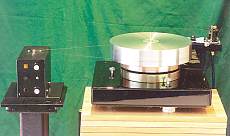
La Platine with le outboard motor ... now, where's that clamp? |
|
|
|
|
|
The point is, turntables today come in the most outlandish shapes and sizes, and many with outboard motor units. Witness, if you will, creations from SME, Michell, Wilson Benesch, Clearaudio and Oracle, to name just a handful of analogue proponents. A high-end record spinner in the living room is a better conversation starter than the ubiquitous CD player will ever be, my humble Michell Gyro Dec being a case in point. |
|
|
|
This week, we turn our attention to a turntable from France. The name won't be completely unfamiliar to AudioFile readers and AV Fest visitors--J.C. Verdier. The company makes two turntables (and loads of other electronics), the more expensive of which is the largely under-rated La Platine. After months of waiting, I finally managed to entice this fabulous analogue beast into my listening room. |
|
|
|
Features |
|
|
|
Verdier claims this is the "world's only magnetically levitated turntable system" ... you've read about this here, haven't you? Anyway, La Platine's design is based on the principle of magnetic levitation. The 19kg, non-magnetic platter is permanently levitated on the magnetic field created by two ring magnets on the plinth. Verdier says this effectively decouples the platter from the base and shaft; the company describes this as the "magnetic float" system. |
|
|
|
The plinth itself is a combination of high-density wood and steel plate, and will accomodate two arms (nine or 12-inch), one each on either of the rear corners. You can use radial or tangential arms on La Platine--the armboard is either blank or pre-drilled for SME arms. |
|
|
|
The base is suspended on three points via a combination of springs and air-dampers, while three oversized screws on top the plinth allow you to set the turntable's level. |
|
|
|
The two-speed DC motor (33 1/3 and 45rpm) is an outboard unit that must be placed on its own support about 22cm away from the turntable, and connects to the platter via a fragile piece of twine! |
|
|
|
Atop the spindle sits a cylindrical metal clamp sporting an array of strobe LEDs, one of its functions being an indicator of speed accuracy, which, with rpm selection, can be fine-tuned on the motor. I noticed La Platine settled down mere seconds after being powered on--Verdier claims speed accuracy of +/- 0.00025% and non-measurable rumble, wow/flutter or feedback. |
|
|
|
The whole system, with the plinth piano-finished in black lacquer, weighs close to 70kg, so setting up requires careful attention. Fortunately, the local distributor delivered and set up La Platine with the recommended tonearm and cartridge combination, so I only had to sit back and listen. |
|
|
|
Performance |
|
|
|
La Platine came with a 12-inch Morch DP-6 tonearm and Transfiguration Temper Supreme MC cartridge, a combination still vivid in my memory after my experience with it last year on the Holfi Matilda turntable (a much less ambitious work of analogue engineering than the Verdier). Phono stage was the Holfi Battriaa Signature Edition. |
|
|
|
Amps in the sessions included Unison Research Simply Four and Holfi Integra 8 Anniversary Edition integrated amps, driving Monitor Audio Studio 15 and Silver 7, and TDL Studio 1m loudspeakers. Connects and cables were Straightwire Virtuoso and van den Hul The Wind respectively. |
|
|
|
I recollect, with clarity, the Matilda/Morch/Temper combi's abilities. The cartridge delved deep into detail and the arm was very competent; it was perhaps the turntable that didn't always rise to the occasion. With La Platine forming the base for the Morch/Temper team, there's significant progress in presentation. |
|
|
|
Initial impressions of this French vinyl-spinner were how it stayed in tune and remarkably out of the way, with minimal additive or detractive qualities. Hence, the system chain, starting from software, and working down to the speakers, becomes very crucial. |
|
|
|
The La Platine/Morch/Temper combination is capable of retrieval down to the nether frequency regions--this was obvious when I was using the Integra 8 to drive the TDL, the only amp in my premises right now capable of kicking some butt with these cavernous monitors. Still, at some point, it became obvious that, while La Platine was steady as a rock in the bass area, the ancillaries downstream weren't always up to the job. |
|
|
|
But whether it was this amp-speaker set-up or the Simply Four driving either Monitor Audios, La Platine exhibited a stateliness in presentation that I couldn't always recall with the Matilda--then again, this turntable is over five times the price of the Danish one! |
|
|
|
There's a tangible layering of the sound stage that allows the listener to appreciate background detail even in the busiest of recordings. I used a variety of music material, from acoustic jazz to pop and rock, and La Platine, in tandem with its arm/cartridge, never faltered. |
|
|
|
Vocals and lead instruments are well projected, without being detached from the musical backdrop ... perhaps a tad relaxed, but very accurately defined and resolved. Hardly a hint of colouration is present across the frequencies, with a neutral midrange and crisp, nicely integrated highs. |
|
|
|
Reproduction of trumpet recordings have that bit of edge to keep the listener expectant--you know how it is when the trumpeteer's pitching is razor-sharp and you get the feeling your ears are going to hurt any moment? Well, this is how true La Platine remains to the recording. Vocals have that comfortably airy feel, bass intruments are tuneful and the percussive snap is just about right. |
|
|
|
The presentation, overall, is quite intimate without being too immediate--you tend to allow yourself to drift into the music after a few minutes, as the turntable gradually fades away and what remains is the music and the rest of the system, so discreet is La Platine in the chain. |
|
|
|
Conclusion |
|
|
|
Most of us wanting to enjoy the vinyl experience will have to settle for a budget British or Eastern European set-up. But if your hi-fi ambitions are matched by your bank balance, then surely the J.C. Verdier La Platine must rate an audition, alongside the more familiar eclectic competition from the US of A, England or Germany. |
|
|
|
As for the rest of the combination, I still think the Temper Supreme is a cartridge to die for, although perhaps you might want to step up a bit in the tonearm department--the Morch has its limitations here. |
|
|
|
As reviewed, we're talking close to 50 grand, so this one's obviously for the very wealthy. So if the moolah isn't an issue, audition ... heck, listen to it anyway and slaver! |
|
|
|
Model: J.C. Verdier La Platine turntable |
|
|
|
Price: RM33,000 (Morch tonearm, add RM3,290, Temper cartridge, RM11,800) |
|
|
|
Distributed by WISMA AUDIO CENTER (04-890-1366), 118-1-11, Island Plaza, Jalan Tanjong Tokong, 10470 Penang / also from (03-262-8034), Lot F120-125, City Square Centre, 182 Jalan Tun Razak, 50400 Kuala Lumpur / Website: www.wismaaudio.com.my / www.jcverdier.com |
|
|
|
For: Elegant record deck; radically different approach with extremely palatable results; never gets in the way; rock steady. |
|
|
|
Against:Price; you'll need to be careful with ancillaries. |
|
|
|
AudioFile © 1999, Star Publications (Malaysia) Berhad (No. 10894-D).
|
|
|
|
|
|
|
 |
|
|
|
 |
|
|
|
 |
|
|
|
To the La Platine Page
|
|
|
|
|
|
 |
|
|
|

|
|
|
|
|
times since November 15, 1999
|
|
|
|
|
|