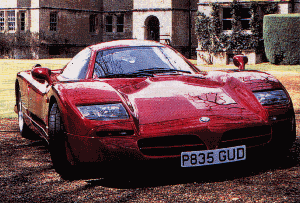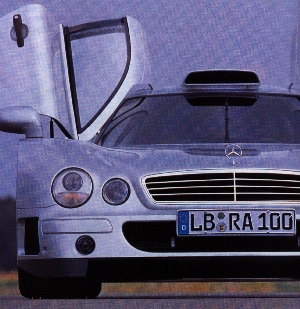
Typical isn't it? You've been waiting forever
for a no-nonsense, state-of-the-art $1 m supercar to keep your runaround
company in the garage and then two come along at once. Yes, Nissan and
Mercedes have entered the GT Championship fray (the series with the Le
Mans 24 Hours as its flagship race), with the road car versions now available
for ludicrously rich punters - both are priced thrupence ha'penny short
of the FIA limit for this type of car: a cool one million US dollars.
| It all started with McLaren's Fl back in 1994. In subsequent GTR guise, this was the racing
car that swept all before it in its first year on the GT Championship circuit.
Porsche responded with a lower lip you could perch a pint on and the 91 1 GT1.
Then Nissan
decided to give them a run for their money with the R390 GT1; it had a
disappointing first showing at Le Mans last year but it's unlikely that
anyone with a sufficiently wedged-up wallet will be submitting their roadgoing
R390 to 24 solid hours on the red line.
In road-going form (see On The Road, right), all that cash will afford you a two-seater, midengined supercar, boasting a lightweight, carbon fibre monocoque body armed with a 3.5-litre, twin turbocharged V8 motor which will strip the rubber from suitably huge tyres in no time via a six-speed, sequential gearbox. |
![]() |
![]() |
Mercedes'
offering, on the other hand, is billed as a 'high performance sports car
version of the new CLK coups'; in much the same way that the QE2 is a luxury
version of a rowing boat, that is. Like the Nissan, the CLK-GTR is a two-seater,
carbon fibre monocoque with a six-speed, sequential gearbox. Huge gouts
of carbon power come courtesy of the Vl 2 under the bonnet, bored out to
6.9 litres and good for 560bhp.
Performance figures are equally hard to come by at this stage, but will undoubtedly fall within the 'face-bending' category. I am happy to report, however, that the CLK-GTR will sport air conditioning, a stereo, his'n'hers airbags and the same seat-belt restraint system as you'll find on a bog-standard CLK. Though AMG
(Mercedes' performance car division) seem undecided as yet, it seems that
production could run as high as 50 cars being built at the rate of 20 per
year. It's not going to be easy to get your hands on one though, as all
of the cars have been pre-sold. But if you have reserved a seat in the
fastest road-going Merc ever, the closest we can get to a price at this
stage is the following from Merc themselves:
|
Anthony
ffrench-Constant
(c)1998 by Stuff magazine (UK)
On the road
FIA rules state that a racing car must be based
on its roadgoing original (which has to be on sale first), but thrashing
a racing motor around your estate would be highly illegal. Here's how the
cars differ:
A road car can hit around 2OOmph top whack. The
racing version will make it to around 220mph on the track.
The suspension on a road car is softer than the
ultra-firm setting on a Championship car.
Racing cars run on slick (racing) tires with
no tread (a certain nickable offence on your way to the pub).
A racing car doesn't have any creature comforts.
There's one carbon fibre seat, the interior is stripped out and there are
sixpoint seatbelts for safety. You'd expect more for $1m.