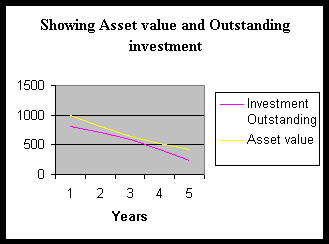
The lessor maintains his title over the asset which acts as a powerful collateral for him. Repossession of leased assets is more simple than of assets secured against a loan. Besides, the worth of the security is usually more than the amount of investment outstanding, and as the repayment period is shorter than the life of the asset, the gap between the asset value and the investment outstanding widens over period - see accompanying chart for illustration. Hence, a lessor becomes increasingly more secured as the lease matures.
Tax-planning
: Tax planning is believed to be one of the most potent reasons for global popularity of leasing: in most jurisdictions, lessor qualifies for depreciation claim on the leased assets (there might be conditions attached as to the attributes of such a lease). The lessor's tax advantage in a lease mostly compares favorably with the tax disadvantage - that is , the payment of tax on the element of principal recovery inherent in the lease rentals. Hence a lease would mostly result into a tax advantage - an advantage of tax deferment.
More profitable
: The pre-tax rate of return in leasing is usually more than in lending - this is difficult as a generalization but mostly true. The fact that the rate of interest in leases is not explicit but garbed in the rate of rentals may be one reason, or the other reason could be that the lessee is generally a weaker credit himself. Besides a better pre-tax rate of return itself, the lessor may look at the tax deferment as further enhancing his overall profitability.
High return on equity
: In many jurisdictions, lessors are allowed a very high leveraging ability, sometimes, even access to public deposits. High gearing, that is, ability to borrow a high amount relative to equity allows the lessor to earn a substantial return on shareholders' equity.
Lesser regulations:
Leasing companies are mostly subject to lesser regulation than bankers and other lenders. This is a substantial operational freedom.
No entry barriers
: In most jurisdictions, setting up a leasing concern has far lesser entry barriers than the hassles of setting up a bank.