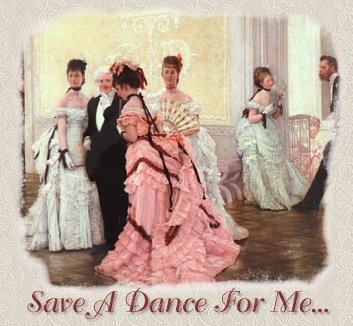

Dance cards also called "Ballspenden" which literally
translates as "ball-donates" have
been around for many years, as far back as the 18th century. There
are many wonderful
examples , made of precious metals and jewels that can still be viewed in
museum's around
the world.
The dance card, no matter when it was made generally consisted of a decorative
case which
opened to reveal a "book" that listed the various dance titles and composers
with a blank line which
would be filled in with the name of the person with which the lady intended
to dance. Listed in the card
could be from 10 and up to 20 or more dance titles. Attached somewhere to
the case was a pencil with
which to write a name. A decorative cord was attached to the case so that
the entirety could be
attached to the lady's ball gown.
Generally, the case that holds the card represents the sponsor of the ball.
The covers decorated
with objects depicted in a minature form, especially European dance cards.
American dance
cards were usually made by local printers from the city where the ball was
to be held.
The names of composers listed on dance cards could be: Schultze, Musard,
Lumbye, etc. however,
usually one third of the dances would be composed by Strauss. The King of
the waltz created the
music that made balls flourish all over the world. Without his wonderful
compositions and his
extraordinary following the ball would not have had the impact on the social
life of the era.
Important Dance Card
Guidelines
-
Dance cards were generally between 1-3" in
size, to prevent them from being too cumbersome.
-
The cards were usually made of either paper, metal,
wood, or some organic materials such as ivory.
-
Dance cards were used to record the order of the
event's dances and as a momento for the lady to keep.
|
Examples Of Dance
Cards
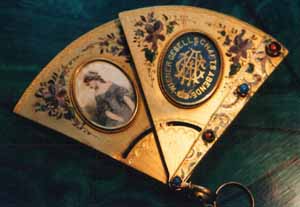 |
From Vienna, in script:
"Wiener Gessellschafts Abende"-
no date or makers name but top
quality gilded metal and
probably an early example, c1855
( judging by the gown).
The reverse holds the dance
card, pencil and next to the
finger holder is a "loop" for a
nosegay. |
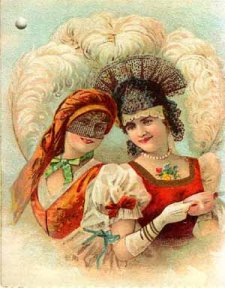 |
This dance card is from Milwaukee,
no title on the outer cover. The date
of 1892 and the German print inside
indicate a ball held for German immigrants.
Milwaukee had a large German immigrant
population at that time. |
 |
Dated January 26, 1893.
Studentenball, Vienna.
Materials: Fire gilt brass, velvet, corded silk,
early plastic, silk satin and paper.
Manufactured by August Klein. |
Return
To Main Index
Go Back To Romance Index
This website has been optimized for 800
x 600 monitor resolution and for 16 bit or better color.
Best viewed with Microsoft Internet Explorer 4.0 or higher or Netscape 4.0
or higher.
*Image used in the title is by James Tissot.
*Graphics created by Legend
Designz.
*For more information about dance cards visit,
The Dance Card
Museum
*Midi "Blue Danube" based
on waltz by Strauss.
Copyright © 1999-2000
Legend-Designz.com and Victorian
Charm, all rights reserved.
|