Art education 1.
Paired composition: "beetle and butterfly". Two images size A4, pencil, and watercolour.
Systematic recommendations:
At first, trained show examples of different lines. It is evident with entire their variety that they can be united into two groups: smooth, wavy and broken lines, angular. For convenience in the rotation they appropriate the concept of the nature: first - soft, by the second - rigid.
The flat images of different objects further are demonstrated. The attention of trainees is inverted to the fact that the outline is determining in the recognition of any figure on the picture. Since outline - this is line, therefore, it, and also object itself can have one or other "nature or another". Examples from the surrounding peace are given. We note on them that in the objects of living nature (for example, flowers, bird, and butterfly) predominates the soft nature, and in the minerals, the ossification, and the armours - rigid (just as in machines and mechanisms).
Then the images (figures, photograph) of different butterflies and beetles are heard by trainee. Is paid attention to the fact that the insect is strictly symmetrical (it is discussed the symmetry as about this structure of the object or composition, with which uniform parts are located on the identical removal from neutral than the axis). The characteristic properties of the device of insects show. The problem is posed: on the basis of pictures to carry out two works - one butterfly and one beetles. By the first is given purely the soft nature, the second - maximally rigid. All nonconformity's are removed.
Operation on the paper: We at first carry out the middle line of sheet, then we sketch the outline of the insect. It is filled up with the ornament, which consists of the spilled figures and the strips, each of which is the whole form, convenient for the colour filling. With the drawing of ornament, it is necessary to use special features of the structure of exterior form (i.e. to connect internal filling with the outline). The nature of ornament must be the same as at the outer boundaries of image.
Before beginning work by water colour several words about the colour. It will be bbeter to paint rigid form with cold colours, soft - in the warm ones. However, into the middle of figure, which presents composition centre, it is possible to introduce contrasting colours. The total quantity of local it is colour desirable to limit (not more than 6-8).
This and all subsequent watercolour tasks are carried out in the technology of the "filling", examined in theme 8 ("painting"). The fluidity of watercolour here is used, for which to plane table with the sheet of paper is given the inclination, equal, approximately, 45%. Filling technique is conducted "from top to bottom". To begin to write better from the bright tones, which then in the necessary places it is easy to overlap by darker. In this case composition centre fills with colour lastly.
On the fulfilment of picturesque stage, boundary of all it is colour and outer duct they are encircled by India ink. Finished image takes the planar, mosaic form.
Alex Fantalov.
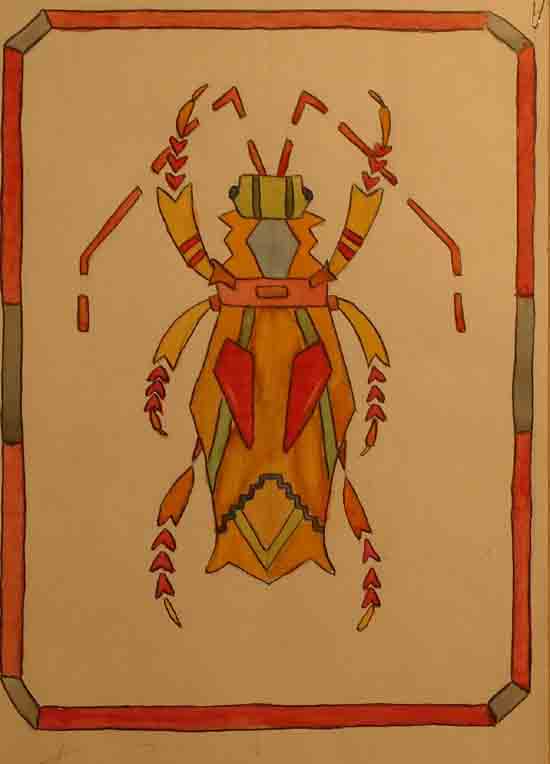
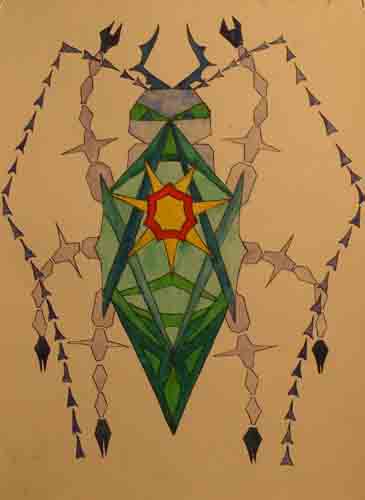
Galinskaya Svetlana. 11 years. "Beetle in by hot colouring". Legareva Olga. 12 years. "Beetle in the cold colouring".
Task: To give the first habits of decorative drawing, stylisation (to that understood as the development of the concealed nature of form; to describe about the colour range, about the contrasts (rigid - soft, warm - cold), to show as with their aid to isolate the composition centre of figure.
Lessons assume independent work.