|
|
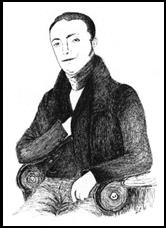 Thomas Lovell Beddoes [Beddoes’ Poems] Thomas Lovell Beddoes [Beddoes’ Poems]
1803-1849
poet and dramatist
Thomas Lovell Beddoes was born 30 June 1803 in Clifton, now
part of Greater Bristol, to Dr. Thomas Beddoes, a radical, Oxford-educated
physician, and Anna Edgeworth, the sister of the novelist Maria Edgeworth.
He spent much of his childhood in the comfortable and
apparently loving circle of his mother's family, the Edgeworths, in which the
world of letters and the imagination were prized. He was sent for
schooling at Charterhouse in London
and matriculated in Pembroke College,
Oxford, in 1820, from which his
radical and poetic fellow-traveler P.B. Shelley had been expelled eight years
earlier. It was during his undergraduate years at Oxford
that his first volume of poetry, The Improvisatore
(1821), and his first and only completed verse-tragedy, The Brides' Tragedy
(1822), were published.
After shifting from school to school, Beddoes earned his
medical doctorate in 1831, but he complicated his life by throwing himself
heart and soul into the liberationist politics of in the tumultuous era of
Post-Napoleonic Central Europe. He wrote anti-establishment pamphlets
in what was fast becoming his new language, German. The Bavarian
government banished him from the kingdom in 1832. The next year found
him in the haven of every European persona non grata, Switzerland,
which was to be his home for the rest of his life. He went to Zürich
and continued his career as an advocate of liberal causes until the political
winds changed in Zürich and he left in 1839. He returned to England
for the summer of 1840.
He was back in Switzerland
by 1844, this time in the city of Basel,
which he probably chose because he was friends with Dr. Alfred Frey, on the
staff of the hospital in Basel.
He also met a baker with aspirations for the stage, Konrad Degen, who seems
to have been the object of Beddoes' only amorous affections. He did his
best to further Degen's career, going so far as to teach him English.
In 1846, Beddoes returned to England
for his last visit to his native land. His behavior during the 10-month
sojourn was so abominable such that when he left for the Continent a year
later, most of his family and friends thought him mad.
Beddoes' last months were marred with professional and
personal tragedy. He and Degen located in Frankfurt
at first, but by 1848 they had quarreled and he returned to Basel.
The last act of his dramatic life is one of conjecture by various family
members and Beddoes scholars. As best can be ascertained, he had been
contaminated by a diseased cadaver in Frankfurt.
His health so deteriorated that his friend Dr. Frey convinced him to enter
the Basel hospital. In deep
despondency, Beddoes tried to end his life by severing a blood vessel in his
leg. The bleeding was stopped, but a later gangrene infection led to
partial amputation of the leg in October 1848. In January 1849, Beddoes
wrote his sister, explaining his condition as the result of a riding
accident. Sometime in that month, Beddoes secured a dosage of the
poison curari, and his body was found in his disheveled room on 26 January 1849, in his 45th
year. In a penciled note to an English friend, he called himself
"food for what I am good for—worms." He sent affectionate
remembrances to his sister and his English relatives, and he commissioned
Kelsall "to print or not as he sees fit" his literary
effects. He also made this sad assessment of his life: "I ought to
have been among other things a good poet."
The nature of Beddoes' hapless end was not made
immediately known to the world. Dr. Frey communicated to the poet's family
and friends that Beddoes' end, though distressing, had been from natural
causes. It was only when Beddoes' brother, dissatisfied with the saccharine
picture the poet's physician-friend painted of the events of January 1849 and
finding it incongrouous with recollections he and the family had of the
dissipated kinsman they had endured in 1847, pursued his own investigations
that the truth of his suicide began to emerge. The suicide note was included
in Beddoes' effects which eventually came into Kelsall's possession.
Sources:
www.nortexinfo.net/McDaniel/tlb.htm
|
|