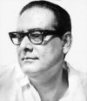
| Hemanta Mukherjee |
|
| Hemanta Mukherjee was born in Born in June 1920 in Benaras. As a little child Hemanta lived in a nondescript village called Baharu in Jainagar. It was in here that he developed a liking for music, thanks to his exposure to jatras and kabigaans. But soon he and his family shifted base to Calcutta. He left school to become a professional singer though he had no formal training in music. Studied under Phani Banerjee and Shailesh Duttagupta. In 1934, at the age of 14, Hemanta stepped into All India Radio. It was his friend Subhash Mukhopadhyay, the poet, who was instrumental in introducing Hemanta to AIR. Amar gaanete elo nabarupe chirontoni (Lyrics Subhash Mukhopadhyay, Music Kamal Dasgupta) was the song with which he began his innings. His mother was happy at his success but his father wanted him to become an Engineer. He joined Jadavpur University but the urge to sing made him an University dropout. |
|
| He released his first record in 1937 under the banner of Columbia Records, with the still popular Bengali number Janite jadi go tumi and Balo go balo more (Lyrics Naresh Bhattacharya and Music Shailesh Datta Gupta). He started singing Rabindrasangeet under the tutelage of Anadi Dastidar, initially singing mainly in the tradition of Pankaj Mullick. By the end of 1938, Hemanta had left everything and taken up singing as a full-time profession. Hemanta, to his credit, developed his own style of singing and, fortunately for him, it went down very well with the masses. Hemanta also had the opportunity to meet Tagore in Santiniketan in 1940. He had a brief but fruitful collaboration with Salil Chowdhury (1949-52) associated with the Indian People's Theatrical Association (IPTA). The enduring partnership of Salil Chowdhury and Hemanta Mukherjee was born in 1947, and they cut their fist disc Gaayer Badhu. The duo did not agree with each other on a very important point - orchestration. While Salil Chowdhury liked a 40-piece orchestra with big interludes and innovative sound effects, Mukherjee preferred recording with minimum music and the simplest of orchestrations. That is Salil Chowdhury did not use him when he converted these Bengali superhits into Hindi.He made his debut as singer in Bengali film with Phani Burma's Nimai Sanyasi(1940) and in Hindi with Iraada (1944). He got married to Bela Mukherjee in 1945. |
|
| Hemanta became a full-fledged music director in 1945 when he scored the music for two films, Purbaraag and Abhijaatri. It was only after he was successful in Bombay that Hemanta get the sort of recognition he deserved. He became "Hemant Kumar" from "Hemanta Mukhopadhyay" in order to identify himself with the Hindi speaking masses. Music for Jaal, Nagin, Bees Saal Baad, Khamoshi etc. were all superhits. He also composed extensively for Tarun Majumdar and the early films of Mrinal Sen. |
|
| Satyajit was also a gifted musician. He had grown up with an ear to Western Music. In fact in his early films he depended on stalwarts like Ravi Shankar, Ali Akbar Khan and Bilayat Khan. But he felt that though these were icons in their own fields they could not compose cinematic music. That is why from Teenkanya he started composing his own music. His music became a trademark and could usually be recognised in the films though sometimes quite repetitive. |
|
| Although he went on to become one of the most popular Bengali composers, his main fame derives from playback singing for Uttam Kumar, his baritone becoming a key ingredient of the star's romantic dramas; e.g., classic hits like Jhor uthechhe baul batash in Sudhir Mukherjee's Shapmochan, Nir chhoto khati nei in Niren Lahiri's Indrani, Ei path jadi na shesh hoi in Ajoy Kar's Saptapadi etc. Often partnered Sandya Mukherjee, female playback usually for Suchitra Sen. From the 50's onwards his voice incarnated Bengali middle-class romanticism, having an enduring influence on all male playback singers in that language since. All the films he did bore his distinctive stamp. |
|
| He composed tunes which everybody could sing, for which one did not require any formal training. In fact this inspired his critics claiming that as he had no classical base he shirked away from difficult tunes. He said the reason behind my simple tunes is that I want to reach the common people. He had a number of foreign tours and got a heroes welcome in West Indies where the people called him Frank Sinatra of the East. In 1985, he was awarded a D.Litt. by Vishwa-Bharati, and won the National Award (for Lalan Fakir ) and the Sangeet Natak Akademi award 1987. He passed away on September 26, 1989. |
|
| You may click on http://www.cs.utk.edu/~dasgupta/hemanta or www.ganguly.de/hemanta to listen to his songs. The songs are in Real Audio format. |
|
| The views in these pages are solely mine |
|
|
|