
"Rescue"
Artist Statement
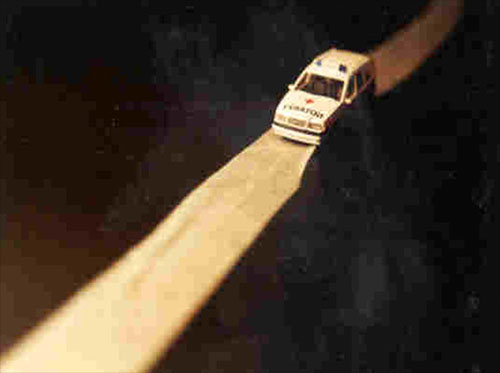
An ambulance is travelling
through imaginary environments and real ones, in the city and in the countryside.
The ambulance is going to rescue somebody or something.
It is not clear what has happened, but it is too late.
The ambulance must go faster, it has no more time.
It is constantly moving and the background is changing with that movement.
There is no drama in the pictures. They are peaceful and calm. Saturated
colours and the fact that the ambulance is a "toy" make them
seem joyfully.
The sad theme of the rescue is forgotten, but the rescue has started and
will never finish.
A rescue has begun.
There is an idea of simulacrum where the ambulance, which is a toy, shows
us a fictitious reality. The little truck goes on in a speedy way through
the countryside and cities. It is a circular story without a beginning
or ending.
There is no drama in the pictures, the dull rhythm and saturated colors
give us a quiet idea about a reality that doesn't exist.
The sadness of rescue is missing....
But the rescue has begun and will never end.
This is a distopian work related with the effort of the humanity to survive and how we are fighting against wars, hunger, violence and catastrophes.... andrea juan
An Accidental Journey / Corinne Sacca Abadi
From the times when the Korean Nam Yune Paik, and the German Wolf Vostel began with the practice of the artist's video, back in the year 1965, this sensitive and creative language has always offered new possibilities to young artists.
Andrea Juan began,
already in 1977, a series of photographic sequences with an ambulance
as a protagonist, which went through different situations, it drove in
the snow, on the roads, in the city or it appeared packed. Along this
way, the artist reached the operation room, and from there she began a
series of laparoscopic operations, where the body emerged in its total
carnal reality. The tools to heal attracted her fascination: long bistouries
and clamps penetrated the body, and thus the body became a poetic place.
Different kinds of clothing and videos recorded the artistic operation.
The times when Andrea Juan worked on the prints called; Models to rebuild
were left long ago, and so were the old woodcuts which were exhibited
and given out among the spectators, adding another poetic trace with a
video recording.
Violence is the key idea that goes throughout all her artistic career, sustaining a logical coherence. Yet, the reference is all the time more indirect: we get to it through the urgency and the action of saving a life. The notion of emergency and of imminent danger is the background of her latest work. Pain is only suggested, as blood was also absent in the previous work of the artist.
Two different and complementary videos will be projected in the room, generating a sound and image crossing that holds the unity of the concept. We are transported to several European countries and cities; we recognise Scotland, Germany and Austria. The action begins when a driver climbs into the ambulance and opens a route that will be shared with us. The reality we perceive soon splits up with a visual simulacrum: before our eyes the car becomes a toy-car, and, unaffected, continues the journey across the city. Now we perceive some visual obstacles: the lens has become opaque, and so have the sound and rhythm.
Andrea refers to silence and violence when the scenery becomes ambiguous and soon turns virtual and metaphorical. It is of little importance if the ambulance is of real existence or not. What is certain is the asking for help, as in other exhibitions when she photographed a lifejacket on a blue ocean: a beautiful contrast with the orange on the sea foam.
The car circulates fast, but it is now empty. The action of circulating is now more important than that of rescuing. The rescue that was begun by the ghastly driver heads to another kind of danger: that of stopping.
In the city we can perceive cultural signs rich in architecture, streets, shops and houses. The camera focuses on multiple crossroads that show day-to-day urban life. The high sound pollution that might undergo unnoticed because we are used to it.
The speed acquired by some images, eventually begin to regulate the rhythm when leaving the city. From the road everything is distant, our eyes capture the movement, and the image is now set by some limits: fixed points of reference in the window mark an order that breaks with monotony.
Green stains instead
of an image that has lost its shape now surround the ambulance. As in
a road movie, it must go on circulating; life accelerates
the rhythm, until a heavy with grey and white clouds sky falls. Day has
given way to dusk, and the camera focuses now on a green text that reads:
SOS
After that, silence and obscurity.
It is too late now; the artist might think...there is no possible rescue. We will have to undergo the experience. The movement does not cease. An ambulance without a siren looks for someone to rescue. It circulates around the city, travels along the roads, crosses towns... and follows the road. We can foresee there is no point of arrival. Each one of us circulates life as we can, and achieve, or not, its own rescue.
Corinne Sacca Abadi /
AACA (Argentine Art Critics Association)
AICA (International Art Critics Association)