|
The below Hans Amtmann interview quote was forwarded to me by
Gary Webster:
"Here is what Mr. Amtmann (who worked with Dr. Vogt in the Blohm
un Voss design department) wrote me and was also in his interview in
Aeroplane Monthly, March 1998:
This was not an exception, as every idea had to be drawn up and
discussed. Those
discussions required tremendous concentration and knowledge in almost
every field, which
made them very interesting. An unusual arrangement of the pilot's and
gunner's compartments
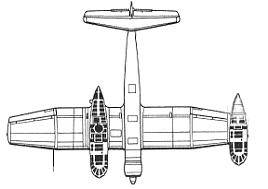
was suggested for a proposed bomber design, the P-163 project. This had
nacelles at each
wing tip, giving the pilot the best possible view and the gunners the
best field of fire. A
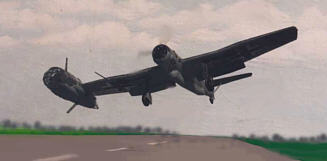
wingtip pilot's nacelle was tried on a BV-141 with excellent results.
After the war, when I was at Wright Field in the USA and working in the
Aero-Medical Lab, I
was shown a Boeing B-17 modified with a wooden nacelle on its starboard
wingtip. Because it
was an airworthy installation I was invited on a flight, and I was
surprised that it felt
exactly as if I was sitting in the centre of the aeroplane and flying
it. This proved to me
that the wingtip pilots position would be acceptable.
Hans Amtmann
1998
Follow-up:
The below info was added by Mr. A. Kyd-Rebenburg:
I just finished talking to Hans H. Amtman (94 and living in California)
over the phone about the Bv 141 with the wingtip nacelle. He said he had no
more documents concerning that plane but could remember seeing it on the
tarmac. The 141 in question had a second nacelle at the other wingtip but
without flight controls. It was flown only to test how it would feel like
to sit at the wingtip. Such an arrangement was duplicated at Wright Field
after the war when a wingtip nacelle (also without controls) was mounted to
the right hand wing-tip of a B-17. Mr. Amtmann sat in that nacelle on one
occasion and said it felt no different than sitting conventionally in the
middle of the plane.
On the regular Bv 141 he said Ernst Udet was so enthusiastic about the
flight characteristics of the Bv 141, that he ordered 500 planes after
testflying it. Eventually it did not come to that.
On the Bv 237 he said that the plane was actually ordered by the Air
Ministry but was not built because of political reasons.
Follow-up:
The below info was added by Mr. Lars Kambeck:
In the book "Chronik eines
Flugzeugwerkes, B&V 1932-1945" by Hermann Pohlmann, Motorbuch Verlag 1977
(ISBN 3-87943-624-x) there is an interview (very long) with Richard Vogt about the
project P163. He confirms the statement of Mr Amtmann. On page172 Vogt says to the
author: (my translation): "...that it is possible (=to contol an aircraft
from a wingtip nacelle) has been proofed by us before, when we equipped a BV141
with an additional crew cockpit and handled the plane from there."
He also tells about very good attitudes like the reduced drag on the
wingtips and the reduced need to construct the wings flexible, because the weigh
the plane is no longer on one side of each wing.
Interview with Richard Vogt.
Hermann Pohlmann: "Chronik eines Flugzeugwerkes" p.172
BV.P.163
"The rearrangement of using steel instead of light metal becomes the focus
of attention of our war-restricted aircraft production.
This is only possible - and even only in limited ways - with extended
research in buildingmaterial and construction.
But there is also another way: To look for ways of construction and shape
arrangements which have advantages that high regarding weight so that you can
afford to use steel as building material.
But you can not achieve this with only some minor modifications, instead you
have to take heart to perform an intervention in the whole
weight-distribution.
The total weight is considerably determined by the wing and the part of the
fuselage close to the wing.
In case of a conventional aircraft the major loads are assembled in the
fuselage and the mid-part of the wing. Balancing this with the forces and lift of
the outer part of the wing results in high bending-momentums (Germ:
"Biegemomente" - see graph) of the wing and because of that also in a high
dead-weight of the wing.
You can lighten this load-distribution radically by shifting a big part of
the loads out to the wingtips. We made it in an absolute unusual way when we
splitted up control and defence of the plane in different gondolas and
attached these nacelles to the wingtips. Both gondolas with a weight of about one
ton each reduced the bending-momentums at the wings's root by ca. 44% (see
graph).
Also in aerodynamic ways this design is not unfavourable: the position of
the gondolas at the wingtips reduce the wake turbulences on the outer part of
the wing and has positive influence regarding the lift.
(...) The remaining fuselage behind the engine can be used in the easiest
way as a well protected steel fueltank.
There remains the question if pilots can accept and handle this unusual
plane from a wingtip nacelle. That it is possible has been proved by us before
when we equipped a BV141 with an additional wingtip-cockpit and handled (!) the
plane from there."
|





 me anytime!
 BACK to BV.141 main page