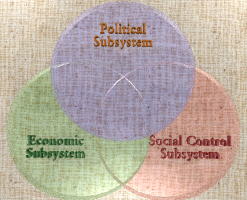
The discussion on Rebuilding Society is structured around the following model of society. This model is presented in many upper-level political science classes because of its excellent heuristic value. The construct has been attributed to Dr. T. Parson.
     A society can be broken down into three major, overlapping realms: the political system, the economic system and the social control system.
     The function of the economic system is to produce private goods and services that are critical to the overall quality of life. It is our economic activities that consume most of our time. It includes businesses, corporations, labor, etc.
     The function of the political system is to establish public policies/programs/services that people demand or that public officials perceive to be needed by the public. It includes all government institutions and policy makers.
     The function of the social control system is to develop norms, informal standards of conduct, mores, traditions, folk ways, and informal rules. It is needed for stability and order in a society. It includes family, community organizations and religious organizations.
     Each subsystem needs the other two to survive, thus any desire for change must touch all three realms.
     Some examples of how the economic system needs the political: enforcement of contracts; licensing of professionals; roads, bridges, airports, and other public infrastructure; persecution of criminal activities, patents, copyrights, and other protection of property rights; and regulation of worker/management disputes to just scratch the surface. The economic system also needs the social control system: workforce standards of conduct such as personal reliability, integrity, and honesty. The system would suffer if every one of its labor force were dishonest, thiefs who were constantly tardy or absent, and showed up unable to pay attention to their job.
     The political system needs the economic system: for the needed goods and services to function (desks, chairs, phones, etc); to generate taxable revenue; and to perform some of the key functions (such as building guns, tanks, and steel rods to build bridges with). The political system also needs the social control system: to instill positive attitudes toward the political system (eg. loyalty, pride, and sense of legitimacy); to instill values of self-control - no number of policemen and soldiers could stop the crime wave if EVERY person were to turn criminal.
     The social control system needs the economic system: people are easier to control if the economic system provides meaningful work and minimal benefits. When unemployment or underemployment rises, so too do crime rates - if people cannot meet their needs in legitimate ways, they will resort to uncivilized ways to meet their needs. The social control system also relies on the political system: the system falls back on the government to punish when people disobey. All of criminal and family law are formalized rules of conduct, most of which originated in the social control subsystem. Control is reinforced by the political system since our entire existence is entangled in it: passports, birth certificates, drivers license, diplomas, marriage certificates, divorce certificates, child custody, social security cards, death certificates - we find we need the political system just to prove who we are.
     In addition to each subsystem being dependent on the others, the subsystems overlap, such that many social components serve the purposes of more than just one realm. For example, schools could fall in the area where the social control system and the economic system overlap: children learn what behaviors are and are not acceptable in a society on one hand, and on the other are gaining greater earning potential by being better educated.


Return to Homepage

Click here if you want to send me a message.