The subject
of 'God' is something which is hard to discuss unbiased. Several questions
may or may not come to mind when one tries to discuss this subject:
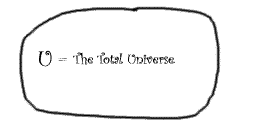
What did they tell you when you where a child? People kill and die for a certain view of what God is, and what God wants people to do. Some people believe that they are 'chosen', others that their version of God is the Universal Truth, which other people are yet to discover. Some swear by only one book, while others may accept hundreds of scriptures, others do not accept any written records at all. Religious matters are closely related to social structures. They are often more interesting from this social/cultural view, than from the view of the mystic, who are merely interested in the true nature of 'God'. By this I mean that 'Religion' is an almost purely social/cultural matter. The mystics (practitioners) from different traditions have no fundamental difficulties in understanding each other, therefore one can make a clear distinction between Mysticism and Religion. On this page I will discuss Religion from a Mystics perspective... Here is a coarse structure of different 'beliefs', what image, or model, people may have of God. Definition First we need to define the concept of 'the set of everything'. The word 'set' is used in the mathematical sense, where a set is a specified number of items. Each item can occur only once in a set, and this is exactly like in reality, where one item can only be in one location at once. We may, for instance, define the set of all people, or the set of all cars, or the set of all red cars, ot the set of all red cars built in the year 1965. A set is simply a defined collection of items or ideas or whatever, anything will do. It is also possible to define sets of sets, for instance the set of all sets with fewer than 10 items. Defining sets of sets leads to peculiar paradoxes, but I won't go into that here. 'The set of everything' is simply all things which exist. It is the total and complete universe, known or unknown. It is simply everything!! Any single item, every single atom or even elementary particle is in this set. Everything which we know and which we may some day know, and even that which we may never ever know is in this set. It is simply the Universe, and therefore I choose to call it by the letter U. There can be no items existing which does not exist in U. Whether U is supposed to contain also the past and the future I do not know, but since this is a castanedian site I will assume that U contains only everything which exists now, in the present. In other words... U is the present!
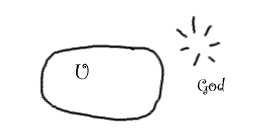
Now when we have defined U, we can begin to discuss the actual whereabouts of God. Lets begin with the some common Religions... Christianity Christianity is a religion which have been more defined by politics than by mystics or practitioners. As an example I would like to mention that the subject of reincarnation was dismissed from Christianity at the fifth church meeting somewhere around 500 AD. It was simply decided by voting, that reincarnation did not exist, or at least that it should not be a part of christianity. There where actually some cheating involved in the voting, but thats history :-) The christian view of God is somewhat like this:
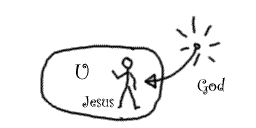
God is believed to be somewhere else than in the physical world U. What we have is a division between Spirit and Matter, common to most western beliefs and also to Judaism and Islam. In Christianity there is also the subject of Jesus, the son of God. Jesus is a male incarnation of God in U, on our specific planet. Jesus represents the Personal aspect of God. This may look a bit like this:
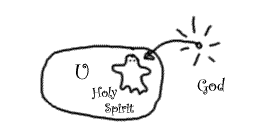
Then there are also the matter of 'the Holy Spirit', which is supposed to be some force interacting directly from God into this world U:
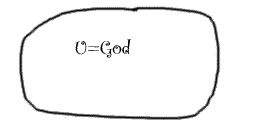
This division of God into Father, Son and Holy Spirit is called 'The Holy Trinity', the three aspects of God, the One and Only god. As an example of the politic development of Christianity, the Catholics may now refer to God as both 'Mother' and 'Father'. That God should be male only is a subject of an early misinterpretation from the Jewish Torah, the Old Testament. The Mystics View The Mystics of most traditions agree that U and God is the very same thing. The mystic believes that there are some kind of 'intelligence' or 'consciousness' in U. This is essential to the understanding of mysticism, and may be imaged like this:
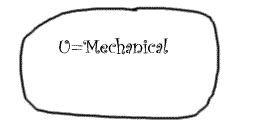
This means that the individual practitioner is actually part of God. Everything is divine, a part of God! Much of the practitioners work consists of trying to arrive at this realization, this awareness. Buddhism has this view of God, and so does, in an more indirect way, Taoism. Eastern religion in general shares this view. Pantheism is a western concept, trying to explain the mystics view that U=God. Pantheism says that 'God is in everything', as opposed to the mystics 'God is everything'. Pantheism is thus a way to try to mold the mystics and the eastern view into western dualistic terminology, but with little actual understanding. Here we may also mention Polytheism as opposed to (and generally considered inferior to) Monotheism. Polytheism means believing in several Gods, while Monotheism means believing in only one God. However, the mystic student will soon find out that the concepts are quite identical! In polytheistic religions, the different Gods are often just different Aspects of the one God. In Monotheism, we often se the same division into different aspects, see the Holy Trinity above. Hinduism is a polytheistic religion, but the plethora of different Gods and Goddesses are often considered incarnations or aspects of the One (Brahma, Shiva, Krishna, Holy Mother etc). The Atheist The Atheist takes pride in not believing in God. However, as we will se here, the Atheistic belief is simply a variant of the above. The Atheist has to agree that the above definition of U is correct. Thus he shares a view of the world with the mystic. The difference between a mystic and an atheist lies in the nature of U: The Atheist believes that U follows strictly mechanical and physical and or statistical laws, while the mystic believes that U has some kind of a 'subtle consciousness'. The Atheist does not believe in the paranormal, in faith/destiny or in magic. The Atheists view may be imaged like this:
The purely atheistic view becomes quite impossible after some real study of some mystic system. When the student becomes aware of the abstract quality of the world, the Spirit or Tao, the purely mechanistic view does not hold. Actually, nor will any rational sytem of arbitrary complexity... There is an interesting scientific view of God, which may be called 'a mechanical view of God'. This view accepts that god may have some kind of 'intelligence' in the same way that a human brain or an anthill may show some kind of intelligent behavior. (Note the broad definition of 'intelligence' here and above! Any abstract force controlling some event is called 'intelligence'.) Individual brain cells are actually quite stupid, but with a couple of millions of them it becomes a human brain. The individual ant does not have a clue about what needs to be done globally in an anthill, but together with a couple of hundreds or thousands of fellow ants the anthill may show intelligent behavior. In either case, the source of the intelligent behavior is unknown, but assumed to be the result of the interaction between a large number of 'primitive units'. In the same way the whole world, or maybe the whole universe, may show some kind of intelligent behavior, and this behavior is what can be perceived as 'the hand of God', divine intervention. This view is somewhat similar to the mystics view. Actually the two views may eventually reach the same goal, but they start at somewhat opposite ends... -oo-
References
|