Medieval Cathares
History
Chronology
of Medieval Rulers in and around Bosnia
Church
Councils
Short History of Bosnian
Bogomils
It was in Bosnia that the bogomils
greatest development took place. In the twelfth century they were already
very numerous there, and spread to Split (Spalato) and Dalmatia. Here they
came into conflict with the Roman Catholic Church. Tile title of the rulers
of Bosnia was Ban, the most eminent of these being Kulin Ban. In 1180 this
ruler was addressed by the Pope as a faithful adherent of the Church, but
by 1199 it was acknowledged that he and his wife and family and ten thousand
Bosnians had joined the Bogomil or Patarene heresy, otherwise churches
of believers, in Bosnia. Ninoslav, Prince of the Herzegovina, took the
same stand, as did also the Roman Catholic Bishop of Bosnia. The country
ceased to be Catholic and experienced a time of prosperity that has remained
proverbial ever since. There were no priests, or rather the priesthood
of all believers was acknowledged. The churches were guided by elders who
were chosen by lot, several in each church, an overseer (called grandfather),
and ministering brethren called leaders and elders. Meetings could be held
in any house and the regular meeting-places were quite plain, no bells,
no altar, only a table, on which might be a white cloth and a copy of the
Gospels. A part of the earnings of the brethren was set aside for the relief
of sick believers and of the poor and for the support of those who traveled
to preach the Gospel among the unconverted.
Pope Innocent III, with the help
of the King of Hungary, brought such pressure to bear on Kulin
an that, at a meeting (1203) between the Pope's envoys and the Ban,
accompanied by the magnates of Bosnia, at Bijelo Polje, "the White Plain",
where Kulin held his court, the Bosnian leaders agreed to submit to the
Roman Church, promised never again to relapse into heresy, but to erect
an altar and a cross in each of their places of worship, and to have priests
who should read the Mass and listen to Confession, and administer the Sacrament
twice a year. They agreed to observe fasts and holy days, that the laity
should cease to undertake spiritual functions, and that those who ministered
in spiritual matters should be the clergy only, who would be distinguished
from the laity by wearing cowls and being called brothers, and that when
these elected a Prior, they would apply to the Pope for confirmation. Heretics
were never again to be tolerated in Bosnia. Though, under pressure of the
threat of war, the Ban and rulers of the country made such an agreement,
the people entirely refused to accept it or to be bound by it in any way.
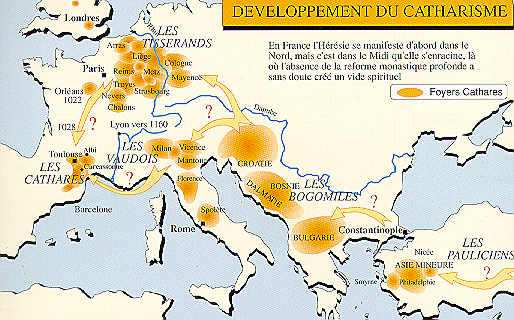 Brethren
in Bosnia had intercourse with their fellow-believers in Italy, in the
South of France, in Bohemia, on the Rhine, and in other parts, eaching
even to Flanders and England. When the Pope declared a crusade against
the Albigenses, and Provence was being wasted, fugitives found refuge in
Bosnia. Bosnian and Provencal elders consulted together on matters of doctrine.
Rumours were current that the spiritual movements in Italy, France, and
Bohemia, were all connected with a "heretical Pope" in Bosnia. This was
only imaginary, as no such person existed, but it showed that a strong
influence went out from Bosnia. An Italian Inquisitor, Reniero Sacconi,
living in the reign of Kulin, who, having been himself a "heretic", knew
more about them than most, calls them the Church of the Cathari, or pure-living,
a name used from before the time of the Emperor Constantine, and says they
extended from the Black Sea to the Atlantic.
Brethren
in Bosnia had intercourse with their fellow-believers in Italy, in the
South of France, in Bohemia, on the Rhine, and in other parts, eaching
even to Flanders and England. When the Pope declared a crusade against
the Albigenses, and Provence was being wasted, fugitives found refuge in
Bosnia. Bosnian and Provencal elders consulted together on matters of doctrine.
Rumours were current that the spiritual movements in Italy, France, and
Bohemia, were all connected with a "heretical Pope" in Bosnia. This was
only imaginary, as no such person existed, but it showed that a strong
influence went out from Bosnia. An Italian Inquisitor, Reniero Sacconi,
living in the reign of Kulin, who, having been himself a "heretic", knew
more about them than most, calls them the Church of the Cathari, or pure-living,
a name used from before the time of the Emperor Constantine, and says they
extended from the Black Sea to the Atlantic.
The peace which Kulin Ban purchased
by yielding to Rome was not of long duration, for he could not compel his
people to observe its terms. On his death (1216) the Pope appointed a Roman
Catholic Ban, and sent a mission to convert the Bosnians. The churches
of the country, however, increased the more, and spread into Croatia, Dalmatia,
Istria, Carniola and Slavonia. Some six years later the Pope, despairing
of converting the Bosnians by other than forcible methods, and encouraged
by the success of his crusade in Provence, ordered the King of Hungary
to invade Bosnia. The Bosnians deposed their Roman Catholic Ban and elected
a Bogomil, Ninoslav. For years the war went on, with varying fortune. Ninoslav
yielded to circumstances and became a Roman Catholic, but no change in
their rulers affected the faith and confession of the great bulk of the
people. The country was devastated, but whenever the invading armies withdrew,
the churches were found still existing, and the industry of the people
quickly restored prosperity.
Fortresses were erected throughout
the country "for the protection of the Roman Catholic Church and religion";
the Pope gave the land to Hungary, which long ruled it, but its people
still holding to their faith, he at length called a crusade of "all the
Christian world" against it; the Inquisition was established (1291), and
Dominican and Franciscan brothers competed in applying its terrors to the
devoted churches.
Meanwhile, the constant pressure
of Islam was becoming an increasing danger for Europe, and Hungary was
in the forefront of the fight; yet this did not awaken the Catholic countries
to see the folly of destroying a barrier between them and their most dangerous
foe, and the Pope wrote (1325) to the Ban of Bosnia: "Knowing that thou
art a faithful son of the Church, we therefore charge thee to exterminate
the heretics in thy dominions, and to render aid and assistance unto Fabian,
our Inquisitor, forasmuch as a large multitude of heretics from many and
divers parts collected, have flowed together into the Principality of Bosnia,
trusting there to sow their obscene errors and to dwell there in safety.
These men, imbued with the cunning of the Old Fiend, and armed with the
venom of their falseness, corrupt the minds of Catholics by outward show
of simplicity and lying assumption of the name of Christians; their speech
crawleth like a crab, and they creep in with humility, but in secret they
kill, and are wolves in sheep's clothing, covering their bestial fury as
a means whereby they may deceive the simple sheep of Christ.,'
Bosnia experienced a period of political
revival during the reign of Tvrtko, the first Ban to take the title
of King. He and Kulin are the two most prominent of Bosnian rulers. Tvrtko
tolerated the Bogomils, large numbers of whom served in his armies, and
he greatly extended his kingdom. Towards the close of his reign the
battle of Kosovo (1389) extended the Turkish rule over Serbia and made
the Mohammedan menace to Europe more serious than ever. Even this did not
suffice to stop persecution, and the Pope again encouraged the King of
Hungary, promising him aid against the Turks and the "Bosnian Manicheans
and Arians." King Sigismund of Hungary was successful in destroying the
Bosnian army under the successors of Tvrtko, and caused 126 Bosnian magnates,
whom he had captured, to be beheaded and thrown from the rocks of Doboj
into the river Bosna (1408).
Then the Bosnians, driven to desperation,
turned to the Turks for protection. Their chief magnate, Hrvoja, warned
the King of Hungary - so far I have sought no other protection, as my sole
refuge has been the king; but if matters remain as they are I shall seek
protection in that quarter where I shall find it, whether I thereby stand
or fall. The Bosnians wish to hold out their hand to the Turks, and have
already taken steps towards this." Soon afterwards the Turks and Bogomil
Bosnians, for the first time united, inflicted a heavy defeat on Hungary
at the battle of Usora, a few miles from Doboj (1415).
The struggle between Christendom
and Islam swayed to and fro on its long battle-front. But whenever the
Papal party prevailed, persecution in Bosnia began afresh, so that (1450)
some 40,000 Bogomils, with their leaders, crossed the frontier into Herzegovina,
where the Prince Stefan Vukčić protected them.
The capture of Constantinople in
1453 by Mohammed II, which led to the speedy subjection of Greece, Albania
and Serbia under the hands of the Turks, did not cause the negotiations
and intrigues for the conversion of the Bosnian Bogomils to cease. Sometimes
their rulers were won over to Rome, but the people never.
Therefore, as the end drew near,
we find Bosnian kings appealing to the Pope for help against the Turks,
which was only given on condition of fresh persecution of the Bogomils,
till at last (1463) when the Turks, who had been driven back for a time,
advanced again on Bosnia, the people refused their king any aid, and preferring
the Turk to the Inquisition, made no resistance to the invader, with the
result that within a week the Sultan took possession of seventy towns and
fortresses, in a country naturally strong for defense, and Bosnia passed
permanently into Moslem hands, to stagnate for four centuries under a deadening
system destructive of life and progress.
These "Friends of God" in Bosnia
have left but little literature behind them, so that there remains much
to be discovered of their doctrines and practices, which must have varied
in different circles and at different periods. But it is evident that they
made a vigorous protest against the prevailing evils in Christendom, and
endeavoured with the utmost energy to hold fast to the teachings and example
of the primitive churches, as portrayed in the Scriptures. Their relations
with the older churches in Armenia and Asia Minor, with the Albigenses
in France, Waldenses and others in Italy, and Hussites in Bohemia, show
that there was a common ground of faith and practice which united them
all. Their heroic stand for four centuries against overwhelming adversity,
though unrecorded, must have yielded examples of faith and courage, of
love unto death, second to none in the world's histories. They formed a
link, connecting the Primitive churches in the Taurus Mountains of Asia
Minor with similar ones in the Alps of Italy and France. Their land and
nation were lost to Christendom because of the inveterate persecution to
which they were subjected.
Scattered over the country, within
the confines of the old Kingdom of Bosnia, * but nowhere else, are numerous
stone monuments, often of great size — Bogomil tombstones. Sometimes one
stone stands alone, sometimes they are in groups, which in places may number
hundreds. It is estimated that there might be some 150,000 such monuments.
{* "An Official Tour Through Bosnia
and Herzegovina" J. do Asboth, Member of Hungarian Parliament.}
The people call them "Mramor", i.e.,
marble, or "Stećak" ", that which stands, or "Biljeg" a sign or landmark,
or "Gomile", an ancient tomb or mound. The very few inscriptions on them
are in the Glagolitic character. They are remarkable for the absence of
crosses or any symbols associated either with Christianity or Mohammedanism.
Where, as occasionally, such symbols are found, it is evident that they
have been added at a later date. The great majority of the stones are entirely
without inscription of any kind, the few inscriptions there are give the
names of the persons buried there. A few are elaborately carved with figures
illustrating the life of the people at that time, warriors, hunters, animals,
and varied ornamental designs. They are most numerous in the neighborhood
of Sarajevo, an immense group being found above the fortress, on the road
to Rogatica. One of the largest tombs stands alone on the Paslovatz Hill,
near the ruins of Kotorsko, a giant sarcophagus of white limestone, hewn
out of one solid block, together with the yet larger flag upon which it
rests; at a distance if looks hike a complete building.
Though they had so long resisted
both the Greek and Latin churches, many of the Bosnians yielded to the
Turks (who were at once their deliverers and their conquerors) and submitted
to Mohammedanism. Some rose to the highest positions in the Turkish service.
The family names of the present Mohammedan population of Bosnia preserve
the record of their origin, while testifying also to the steady process
of subjugation to Islam. Over the window of many a shop in Bosnia the traveler
will find the Bosnian or "Southern Slav" name united with a purely Arabic
or Turkish name which is generally placed before it. There are two distinct
words in daily use throughout Bosnia to signify Turk or Moslem, the one
meaning a Moslem of real Turkish or Anatolian origin, and the other a person
of Slav race who has adopted the religion of Islam.
Catharism in Medieval Europe

Fourth & Later Crusades

Chronology
of Medieval Rulers in and around Bosnia
Church
Councils
Medieval
Bosnian Kingdom