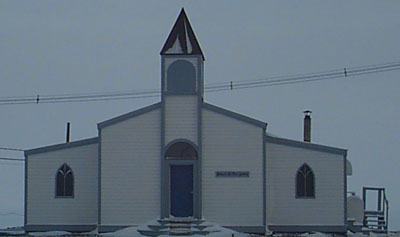
The above picture is a panoramic of McMurdo Station taken from observation hill. During the summer months the population of McMurdo can swell to the incredible size of 1200 people. During the summer of 1996/1997 the population was rather diverse, consisting of NSFA, ASA, NSF and Air National Guard personnel.
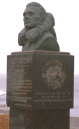


 Here I am on the summit of observation (ob) hill in
mid-March, with due South being just off
my right shoulder. The cross next to me was erected by the crew
of the Terra Nova just before their somber journey
North. The cross serves as a memorial to Scott, Evans,
Wilson, Bowers and Oates-the five men who perished on their return trip
from the South Pole. Their names are inscribed on the cross as well as
the end of Tennyson's Ulysses.
Here I am on the summit of observation (ob) hill in
mid-March, with due South being just off
my right shoulder. The cross next to me was erected by the crew
of the Terra Nova just before their somber journey
North. The cross serves as a memorial to Scott, Evans,
Wilson, Bowers and Oates-the five men who perished on their return trip
from the South Pole. Their names are inscribed on the cross as well as
the end of Tennyson's Ulysses. 'To strive, to seek, to find, and not to yield.' Albert, Lord Tennyson.
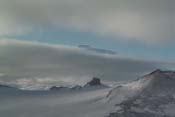
 Mt. Erebus covered by clouds in the east/northeast.
If you look carefully you can see the plume eminating from the cone. This is
southernmost "active" volcano on the planet. To the right of Erebus is a picture
of pressure ridges on the edge of the permanent ice shelf. The ridges are caused
by the tides. On the extreme right side of this picture is New Zealand's
Scott Base.
Mt. Erebus covered by clouds in the east/northeast.
If you look carefully you can see the plume eminating from the cone. This is
southernmost "active" volcano on the planet. To the right of Erebus is a picture
of pressure ridges on the edge of the permanent ice shelf. The ridges are caused
by the tides. On the extreme right side of this picture is New Zealand's
Scott Base.

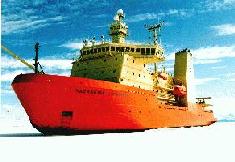 Monstrous fuel storage tanks
help to keep the United States Antarctic Program operating. Next to the fuel
tanks is the Research Vessel Nathaniel B. Palmer. The Palmer
was built in 1992 and is operated for the National Science Foundation by
ASA. The Palmer is capable of breaking three feet of level ice at
three knots. She is 308.5 feet long and can accomodate 39 scientists including
6-8 ASA staff and normally sails with a crew of between 20 and 24.
Monstrous fuel storage tanks
help to keep the United States Antarctic Program operating. Next to the fuel
tanks is the Research Vessel Nathaniel B. Palmer. The Palmer
was built in 1992 and is operated for the National Science Foundation by
ASA. The Palmer is capable of breaking three feet of level ice at
three knots. She is 308.5 feet long and can accomodate 39 scientists including
6-8 ASA staff and normally sails with a crew of between 20 and 24.