Shitajiki Collecting! An article done by Becca and Abel
The first, most obvious question is:
 What's a shitajiki? The simple answer is, a 'pencil board,' a slightly-smaller-than-letter-size piece of plastic or cardboard made to put under the top sheet of your writing pad so your writing doesn't mark the sheets below. All those mysteries where the intrepid detective discovers clues by checking the pad of paper? Wouldn't work nearly as well in Japan.
Shitajiki sell as office supply items for 100 to 250 yen in Japan, or sometimes are included as freebies in issues of various comics. What makes them collectible? The vast range of different images you can find. There are shitajiki made as tourist promotions, with pictures of different tourist sites such as Osaka castle. There are shitajiki with images of pop stars, Disney cartoon characters, trains, and sports stars. One of my favorite shitajiki has some commerical advertisement on the front, and the back has a beagle that says "My name is John. I am shy. I like beef." Admittedly I may be a little weird in that circumstance, but everyone who collects probably has one or two quirks. There is also a huge back catalogue of shitajiki with images related to anime and manga, since the teens who use them most frequently with their school notebooks are also the biggest anime and manga fans of many series.
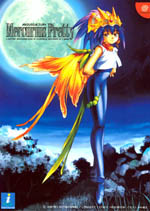 'Back Catalogue' shouldn't be taken to mean that all those shitajiki are still available - shitajiki are typically put out for a single pressing, occasionally for one or two more, and then discontinued. So if you don't get the shitajiki in that first release, you're left trying to track them down used or in odd dusty corners of unsold merchandise in niche shops, or on ebay. So starting to collect shitajiki can be a very frustrating hobby for the inability to find many images you might see on various sites or in other people's collections. It can also be expensive - shitajiki that come free in an issue of one comic might sell three years later for $40. Doujinshi shitajiki (made by fans) can sell for quite a bit too for their rarity, if they have images and series that are popular. One-time issue promotional shitajiki can cost a ton, and so can ones for popular series even if they were a wide professional release. I've seen single shitajiki go for over $200 on ebay. But as Abel Solas of USanime.net points out, it's still a lot more affordable than collecting cels, especially if you find a shitajiki early while it's still (fairly) widely available and cheap.
I enjoy talking with Abel about shitajiki; he's the biggest single shitajiki importer currently operating in the US, and also one of the most enthusiastic and knowledgeable collectors in the US. Abel had a lot of comments regarding shitajiki. "It doesn't matter if you have a small collection," he says, "you can look at anyone's collection, and even if you only have a few, you're a collector." If you enjoy the images on shitajiki enough to have a few of your own, you're a welcome member of the shitajiki collectors' club. Of course, that's a mixed blessing. Shitajiki collectors envy and covet each other's collections, and often end up in direct competition for one unusual item that more than one collector wants. But if you'd like to talk with some of those other collectors, Abel recommends the pencil board mailing list at pbcollectors @yahoo.com. You'll need to sign up for a free yahoo account and join the group - look under 'clubs' in the yahoo web site, and search for pbcollectors.
A quick detour before we talk more about Abel's comments on shitajiki - first, how do I recognize a shitajiki, and second, a quick primer on how to know your shitajiki's 'code' and some additional information that is typically tucked away on an edge of the board.
Shitajiki are typically about 8 ¼ x 10 ½ inches in size, just a little smaller than standard letter size. There are a few exceptions issued recently such as the Hunter x Hunter 'mini' boards, which are of a size to use with a notepad instead. Usually shitajiki are plastic, and about two millimeters thick, somewhat flexible but thick enough to be durable. The image is printed into the plastic itself as a celluloid image meshed with another layer. Occasionally shitajiki will be issued as promotional items in comic magazines, and in that case they are often mid to heavy weight cardboard that's printed with high-quality glossy images, usually double sided. Bootleg shitajiki can also be issued in cardboard - real ones should be thicker, higher quality in printing, and additionally will typically be of manga stories, not anime ones, since they come with manga magazines and promote manga stories. The only exceptions I have are some thin highgloss cardstock weight full-color promo cards for Zoids and SD Gundam, which came in boy's manga, and advertise the toys rather than the story itself. Promo shitajiki normally have the name of the publisher on them, whether Clamp or Nakayosi or Ciao. If you find a thin weight, poorly printed cardstock type shitajiki without ownership information, it's probably not real but a bootleg. Bootlegs do not accrue value as legitimate items do, as most serious collectors don't really care to have most of them in their collection.
 Variations on shitajiki include double-sided shitajiki, clear shitajiki (very pretty - most are opaque), die-cut shitajiki (very unusual), shitajiki with sparkles in the plastic, matte vs. glossy shitajiki, textured shitajiki (very rare), the plastic and cardboard types, new 'collectors shitajiki' that are a little thinner and numbered and issued in packs like collectible cards.
The vast majority of shitajiki are released by Movic company, but aside from the magazine promos, you might find shitajiki made by Animetopia, Fujimi Collectibles, Showa Note, Seika Note, and a few other companies. Some artists, such as Clamp, occasionally do their own boards and the back will just have Clamp's copyright on it. General release boards with company copyrights might be done by the artists themselves or just by a generic artist in their style, as many of the Card Captor Sakura boards are. Abel notes that all shitajiki images have to look great, because "people will buy crappy-looking cels but not crappy-looking shitajiki." Doujinshi shitajiki are done by various doujin circles, and Abel has gone to Comiket and picked up a number of promotional shitajiki there. He's had the normal wait in line - two hours to get into Comiket and then another three in line for favorite artists. Most circles at Comiket don't do shitajiki, as it's too expensive and people in Japan don't go crazy collecting shitajiki, phone cards are more popular. You don't have a way to identify in advance where you might find shitajiki, either, you just have to look for groups you know you like and go to see if they have them this year. These items can be superhard to get even in Japan if you miss them at the Comiket; and in America it's even tougher. Abel noted that the recent Shogakukan Inu Yasha board had a print run of only 5,000 and it won't be reprinted because it's not worth it to Shogakukan to pay the money to Movic to relicense it, even though there are millions of fans who love the series. Abel notes that what used to be the industry practice of print runs of 10,000 is now print runs of 3,000, licensed for sale for a set amount of time, so that any leftovers end up warehoused and not for sale. Even for commonly professionally released boards, they're released in small quantities and once they're gone, they're gone, so you have to know what you're looking for and looking at to know what's a good deal, and then move on it fast.
One thing that's important to know about shitajiki is when they were released. Some people on ebay will list boards as 'rare' that are current and easy to find on various sites, while for other shitajiki you might not realize that it's an older hard to find board and it might go right by without bids. One thing that can help a lot is how to 'read' the board codes. Professionally released boards will have codes that look a lot like one of these examples.
1. Movic 1203 0020 09 0900D
2. Movic 1203 0020 09 0900
Reading number one, we can find, in order of importance -
The date the board was released (0900, or September 2000)
A letter indicating that this was the fourth in the set of boards released that month (note, this doesn't tell us whether any more boards were released after letter D)
The company name (Movic)
and a few less important items for our purposes (read on)
On the second you see an example of a board that was the only one released in that month, so there's no letter. If it had been the third of five or so, it would have had a C at the end of the date where this one has none.
Hitting Abel up for information on one example of the current company codes for Movic yielded this explanation:
Where it says '1203 0020-09-0900D,' 1203 is the number to ID the series, 0020 identifies the item type (shitajiki) - something that looks a bit like a shitajiki is a card case, which is a lightweight art print in a clear case, and it won't have this code number, 09 is a new addition that indicates this is the ninth board release from this company for this series, and 0900D means it's the fourth board released in September of 2000. The number to indicate how many previous boards there were (09) was only added in a few items in 1996, and was more widely implemented in 1998. Sometimes this is good for collectors, but it can also make you crazy to know there are three boards from a given series when you've only seen two. And of course, since it's recent, many boards don't have it and you can't use it yet as any kind of universal information.
Sometimes there will be a few additional letters at the end of the board code - Abel notes that FE means it's a Fair (event) board. EV is for a larger event, but Seika note also had batch letters including KY, KJ, KS, and S, and we don't know for certain what the company was keeping track of with those letters, perhaps which plant manufactured them. I find a lot of KY and KT boards in Hong Kong, which may just be a coincidence.
Not every company has the date code. Fujimi tried it for a while, but dropped it because they don't release boards for any one series often enough to make it useful to them - too bad, because it's a good indicator to a collector of how old a board may be.
Back to Abel's notes! Abel notes that shitajiki, while durable enough to use as writing items, are tremendously fragile in the eyes of collectors who would like a perfect item. They are very easy to scratch - just taking the plastic off can scratch it, so very few shitajiki do not have the fine scratches you can see if you hold it and turn it in the light. Shitajiki that stay in their original light plastic wrap can develop marks when the wrap has air bubbles flattened against the board. Weight friction and movement in a heavily packed binder can mark the shitajiki while it's in storage. You can warp or scratch your board - don't pack them tightly, don't stack them too high. You can really scratch the fine surface of these boards with a hair. Honest and educated dealers on ebay will often advertise their boards as 'lightly scratched,' which might be the tiny marks left just from moving the board around or shipping it. Things that say 'highly scratched' are going to be noticeably scratched to an untrained eye.
For effective storage of shitajiki, you can keep them in the original plastic and in storage cartons, or another option is to keep them in Silver Age size sheet protectors in binders. Shitajiki colors shouldn't fade unless you leave them in the sun for a long time, and they can take a pretty wide range of temperatures (though obviously if you're at a heat that melts plastic they'll melt), but movement and weight can be killers.
The best reference for existing shitajiki is Shitajiki Online at www.shitajiki.com. They are trying to build their shitajiki database (with images) continuously, and while the archive is far from complete, it grows steadily. You can submit your own scans of your own shitajiki to the webmaster as well if they're not already on the site.
How do you get shitajiki? Online at various stores is one option - always compare prices between all the places you can, and look frequently for updates both to continue gathering price comparison information and to catch any updates done on a given day; rare items go fast! Some online sources include:
www.usanime.com - frequent updates when Abel makes his trips to Japan, a wide selection, decent prices and some really unusual items he finds at comiket.
www.darkharbor.com - Noriko often gets oddities and unusual things, and it's a good place to check often as noted above, as many times she'll get one of a type and when it's gone she can't get more.
www.splashpagecomics.com - extremely nice people who try to get new items and are beyond fair about trying to sell those items at base price -they do not raise the price on items they bought at retail because they know they're very usual or hard to find. If they have to buy at high price they may sell at high price, but if they buy lower, they sell lower.
www.luthienenterprises.com - more nice folks, and the Canadian exchange rate makes things much cheaper for us, keep that in mind while you read the prices. Your invoice will be in Canadian dollars but your credit card bill in American.
Another option is at ebay. Check those codes for dates! Something listed as rare might just be new in the market, and the date code will help you to know that. Knowledgeable dealers will know where the board came from and include that in their description if it's a promotional item. Anyone posting a board should be able to send you the code and copyright information from it if you inquire, even if they're inexperienced enough that they don't post it in the first place. If someone is selling a board that is cardboard and has no magazine info on it or copyright info on it, be suspicious, it's likely pirate garbage. Ebay sellers may also list a card case as a shitajiki, or jumbo trading cards as boards, when they're actually cardstock trading cards. Another new item on the market is a mouse sheet, that looks like a shitajiki, but is think and so flexible you could roll it up - it's designed to use as a lightweight highly portable mousepad. Watching ebay rates over a period of time can give you a (slightly inflated) guideline for what various boards may be worth in the market.
What determines a board's worth, anyway? The popularity of the series has a major impact. If it's a popular series, then the rarity of the board also comes into major play. Production run and popularity in Japan impact rarity in the US, as does the age of the board. Condition impacts its worth as well. But Abel says that the objective side is just one facet - you can think about how much it would cost to go to Japan to get it, and all the factors above, but you really also end up with a subjective value judgement on how much you want it. That's the final determining factor on a board's worth. Being as knowledgeable as possible about the price the board generally goes for can just give you a guideline on whether you're able to get it for less than you'd be willing to pay maximum. If you want a lot of boards, that difference can add up fast. Abel keeps a sense of humor about it, and priced a widely available, low demand, hard to move at $5 Mitsukake Fushigi Yuugi board for $300 last convention. Oddly enough, it didn't sell, but I have a feeling he would not have charged that much even if it had.
You can also involve others in the hobby - you'll have an additional person to search and trade with, but not only will you end up with a trading partner, but a competitor. And someone who will blame you for life for their poverty and need for more space in their life to store their expanding pencil board collection.
One thing mentioned earlier is the occasional incidence of multiple print runs for one board. Second or third print runs may have different back sides, or might just change colors a bit since ink is very hard to reproduce in exactly the same shade as the first print run. Sometimes they just flat out print in a different color, and it's more obvious than the shading difference of different inks for the same colors. This will be difficult to compare unless you're handling high volumes of shitajiki, because you've got to have multiple print runs of one board in your hands to compare. The company import sticker location may change as well, the sticker style might change, the sharpness of the printing might change (this takes some experience and a lot of purposeful looking to learn to recognize), and the back of the board might change images entirely. Even if you can spot the differences, you're not likely to know which was first unless you got the first one when it first came out to know it's the original style. Usually the first print has more color, but there are exceptions, and the back side on second prints is often sharper and more bold. Which print is worth more varies - The Vampire Princess Miyu board, for instance, had a much larger first print run than second, so for a collector, the second print run is actually worth more.
Abel notes that distribution of boards varies widely within Japan. Osaka often gets the old boards, so it's a good place to hunt for old cheap stuff. Mandarake in America will probably stop buying shitajiki for the fans; they rarely have unusual ones any more. Some examples of really tough ones to get - Kbooks boards you can only get if you fill out a credit card application and live in Japan. Comiket sells sets made especially for each convention, at a limit of two per person.
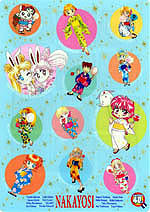 One highly rare and sought after board mixes superdeformed Rayearth and Sailor Moon characters together, to celebrate the Nakayoshi 40th Anniversary. You can probably imagine the battles waged over that one (speaking of which, I'd love to find one myself). There may be grand opening releases for store outlets, or ones that you have to send away for with a certain number of whatever premium coupons within a certain time frame. Even more aggravating, certain collectors in the US have decided to try to build complete binders of nothing but one rare board, taking them out of the market for anyone else (these people have too much money and time on their hands and not enough consideration for other collectors).
But, on the other end of the scale, there are boards released in great quantities that are available for $5 each when they first come out. Take the time to look around and get to know the market, but if you focus on getting boards that make you happy, you'll have a collection you can be proud of.
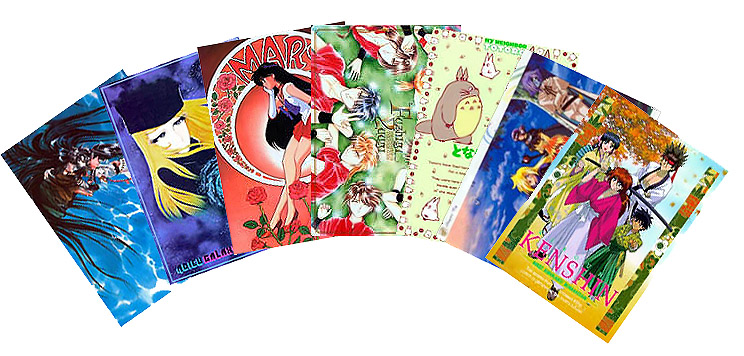
Images used are from www.shitajiki.com and are copyright the respective rights owners. Shown here only for informational purposes.
Return to the Main trading page