Of all the charitable activities undertaken by the Trust
during the last three years, the one that stands out, is the provision of
drinking water to the people of Ananthpur District, Andhra Pradesh.
It is a known fact that
the problem of drinking water in India is acute. Of a total number of
about 13 lakh habitats, 4 lakh habitats are either not covered at all or
only partially covered. It is therefore very appropriate that the Trust
has taken the initiative for providing safe drinking water through the
"Sri Sathya Sai Water Supply Project", which has become a model for other
districts in the State and the Country.
The SRI SATHYA SAI WATER SUPPLY PROJECT for Ananthpur district was undertaken during the years 1995-97. Ananthpur district one of the most chronically drought affected areas in the country, where the available ground water has high fluoride content. It is in fact in the context of such high fluoride content that the project was designed to make use of surface water from the Tungabhadra Canal.
This project is unique in many ways. It is the first of its kind in the country in its scope. Secondly, it is the first project totally funded by a Charitable Trust. Thirdly, it has been completed in a record time.
The Sri Sathya Sai Water Supply Project in Ananthpur District consists of the following:
I. Comprehensive Protected Water Supply Schemes involving Infiltration Wells and Collection Wells and associated pumping behind Chitravathi Balancing Reservoir at Peddakotla and Chinnakotla villages. Sources for other infiltration wells also include Pennar and Hagari River.
The first major scheme using water from the infiltration wells is located at Peddakotla village in the bed of the Chitravathi Balancing Reservoir known more familiarly as Parnapalli reservoir. This scheme has four infiltration wells with a sand depth of about 5 to 6 metres and it serves more than 80 villages from Peddakotla to Prasanthi Nilayam.
This Peddakotla-Prasanthi Nilayam sector of the Chitravati Balancing Reservoir scheme involves pumping of about 12,000 litres of water per minute with the use of three motors of 200HP range and the associated pumps. There is hundred percent standby, that is, another three motors installed. The total length of pipeline from Peddakotla to Prasanthi Nilayam is about 105 kms.
The other major scheme is Chinnakotla-Kadiri sector, where there are four infiltration wells having about 8 metres sand depth and serve more than 90 villages with potential for addition of another 150 villages.
Besides the above two major schemes, there are seven other infiltration well schemes located at Pamidi, Teetakal, Budimepalli, etc. These provide for direct pumping from the infiltration wells without provision of a collection well. The number of villages covered by these schemes is 91.
II. Direct pumping from Pennahobilam Balancing Reservoir.
The Pennahobilam Balancing Reservoir scheme, which is a third major scheme, has been designed to provide water for two sectors namely Kalyandurg and Atmakur. 125 villages are covered in these two sectors.
We have provided for rapid sand-filter system, as raw water is pumped from the reservoir. Because of the nature of terrain and the pressure of water to be led into the pipes, we have provided for a substantial length of Cl pipes in these sectors using 500 mm diameter and 450 mm diameter. The capacity of rapid sand filter is 25 Million litres per day. Normally, rapid sand filter systems are provided for urban water system but in this case, we have provided for the first time such a big system for rural water supply.
III. Comprehensive Water Supply Scheme (CPWS) through 7 Summer Storage Tanks covering 97 villages has also been completed under the project.
Summer storage tanks having an area ranging from 30 to 100 acres have been constructed to draw water from the Tungabhadra High Level Canal during the flow period and store and utilise the same during canal closure periods. Thus, the supply of water will be ensured throughout the year. Slow sand filters are constructed for treatment of water before the water is pumped into the distribution system.
IV. Individual Protected Water Supply Scheme (PWS) covers 290 villages. These involve drilling deep borrowers, construction of storage tanks and installation of complete pipeline networks.
This project, completed at a cost of Rs.223 crores is predominantly for the benefit of rural people.
However, people in the urban areas are also covered under this project. The population covered by various schemes under the project is about ten lakhs. The number of villages covered is about 773 and the number of municipalities covered is three.
The total length of pipes laid, of various sizes ranging from 80 mm to 600 mm diameter under these schemes, was about 2500 kms. It was indeed a massive work.
All these
major schemes involved laying of large diameter pipes. Procurement of this
large diameter pipes from factories, which are situated at long distances,
such as Maksi near Indore, Jaipur, Ahmedabad, Pune, Aurangabad and Mayanur
near Trichy had to be made. The suppliers of large diameter pipes had to
engage a number of trucks on daily basis. It was found that even these
large number of trucks were not sufficient to meet the needs of the
project within the stipulated time and it was found necessary to bring
them by train also. This involved deployment of a number of cranes and
trucks for unloading and loading operations.
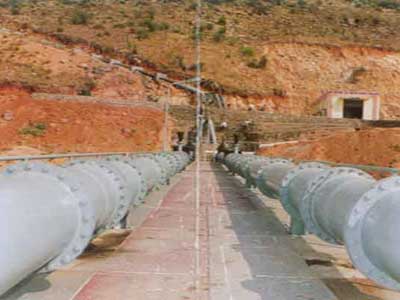
Considerable time and cost were saved by unloading the pipes at the various reaches of the trenches cut for laying them. At the height of construction phase, one could see large diameter pipes on the road margin, as far as eyes could see for kilometres together. The logistics involved were indeed complex. More than thirty two thousand truck loads and five hundred railway wagonloads of materials were procured and most of them procured in a period of about six months.
The total length of pipes laid, of various sizes ranging from 80 mm to 600 mm diameter under these schemes, was about 2500 km. It was indeed a massive work.
The large diameter pipes also required handling by cranes in many places because of the weight. There are pipes, which are about 1.5 Tonne each, and to lay them in places which were slushy due to rains was indeed a difficult job. However, with the ingenuity and resourcefulness of the engineers concerned, this was done within the time. The design provides for a large number of valves and some of them weigh even as much as 1 Ton. To place them in position was also quite a difficult task calling for skills and patience.
The scope of the machinery used will be evident from the figures involved, namely, nearly five hundred crane months, two hundred and fifty porcelain months and one hundred and fifty JCB months. The approximate quantity of earth excavated for trenches and other works was about 22 lakh cubic metres. The concrete used was more than 45000 cubic metres.
Apart from such heavy use of machinery, there was also significant utiltisation of manpower. The total number of men employed at the peak phase of construction of the project was about 55,000 per month and later continued to be around 30,000 per month for more than a year which helped provide gainful employment to the people of this district.
Taking into consideration the power supply position it was considered necessary to provide for high capacity, diesel generators in various locations to enable continuous pumping and accordingly they have been provided.
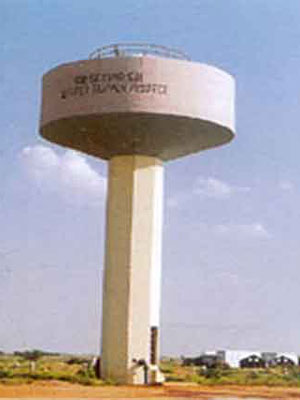 The project also involved construction of about 275
overhead service reservoirs, 125 ground level service reservoirs and
installation of more than 1000 precast cisterns. Besides, the project also
involved construction of 20 sumps with capacities of about 10 to 20 lakh
litres, and a dozen reservoirs at the top of hillocks, with associated
piping to be done on steep slopes calling for deft handling of heavy
pipes. This was truly a Herculean task.
The project also involved construction of about 275
overhead service reservoirs, 125 ground level service reservoirs and
installation of more than 1000 precast cisterns. Besides, the project also
involved construction of 20 sumps with capacities of about 10 to 20 lakh
litres, and a dozen reservoirs at the top of hillocks, with associated
piping to be done on steep slopes calling for deft handling of heavy
pipes. This was truly a Herculean task.
Looking at the project as a whole, one feature that characterises it most is the time frame. Other features are there - such as the diverse nature of the schemes, their technical complexity, they being spread over a considerably vast area, their cost and being funded by a charitable trust - all these add up in their totality to a unique project.