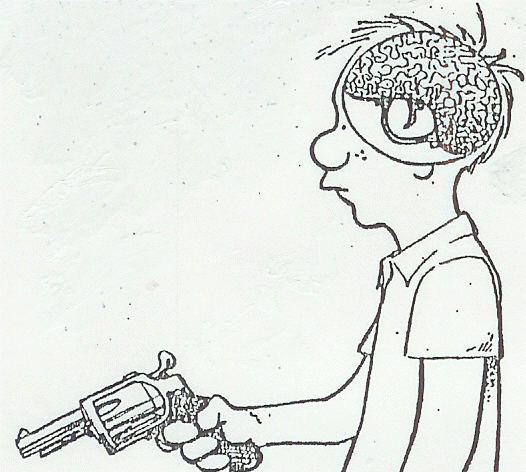
The immature brain
Biology
and other people develop our moral
judgment
By Daniel R. Weinberger
Andy
Williams, the boy held in the Santana shootings, is 15. Many other school
shooters have been about the same age or even younger. And the brain of a I5-year-old is not mature particularly in an area called
the prefrontal cortex, which is critical to good judgment and the suppression
of impulse.
The human
brain has required many millenniums and many evolutionary stages to reach its
current complex status. It enables us to do all kinds of amazing and uniquely
human things: to unravel the human genome, to imagine the future, to fall in
love. .
As part of
its capacity for achievement, it must also be able to exercise control that
stops maladaptive behavior. Everyone gets angry; everybody has felt a desire
for vengeance. The capacity to control impulses that arise from these feelings
is a function of the prefrontal cortex.
This is the
part that distinguishes our brain most decisively from those of all other
animals, even our closest relatives. It allows us to act on the basis of
reason. It can preclude an overwhelming tendency for action (for example, to
run from a fire in a crowded theater) because an abstract memory ("don't
panic") makes more sense. It knows that all that glitters is not gold.
Without a prefrontal cortex, it would be impossible to have societies based on
moral and legal codes. .
Sometimes
violent behavior may be adaptive (for example, in self-defense), in which case
the prefrontal cortex will help plan an effective strategy. However,
controlling violent impulse when they are maladaptive can be very taxing duty
for the prefrontal cortex, especially if the desire for action is great or if
the brain is weakened in its capacity to
exercise
such control.
. Many
factors can impair the capacity of the prefrontal cortex to serve its full
impulse-control function: for example, neurological diseases that kill cells in
the prefrontal cortex, head injuries that damage these cells, alcohol and
drugs that impair their function and biological immaturity. ..' . . . , ',
The inhibitory functions are not present at
birth; it takes many years for the necessary biological processes to hone a
prefrontal cortex into an effective, efficient executive. These
.processes are now being identified by scientific research. They involve how
nerve cells communicate with each other, how they form interactive networks
to handle complex computational tasks and how they respond to experience. It
takes at least two decades to form a fully functional prefrontal cortex. .
Scientists
have shown that the pace of the biological refinements quickens considerably in
late adolescence, as the brain makes a final maturational push to tackle the
exigencies of independent adult life. .
But the evidence
is unequivocal that the prefrontal cortex of a 15-year-old is biologically
immature. The connections are not final, the networks are still being
strengthened and the full capacity for inhibitory control is still years away.
The
15-year-old brain does not have the biological machinery to inhibit impulses
in the service of long-range planning. This is why it is important for adults
to help children make plans and set rules, and why institutions are created to
impose limits on behavior that children are incapable of limiting.
Parents
provide their children with a lend-lease prefrontal cortex during all those
years that it takes to grow one, particularly when the inner urges for
impulsive action intensify.
Adolescents
have always had to deal with' feeling hurt, ashamed and powerless. In the face
of ridicule, they may want revenge. Thirty years ago, a teenager in this
position might have started a fight, maybe even pul1ed a knife If he was afraid that he could not defend himself, he might
have recruited a tough guy to help him out. One way or another, he would have
tried to teach his tormentors a lesson. Very likely, however, no one would have
died. But times have changed, and now this angry teenager lives in a culture
that romanticizes gunplay and
may well himself have access to guns.
I
doubt that most school shooters intended to kill, in the adult sense of
permanently ending a life and paying the consequences for the rest of their
lives. Such intention would require a fully developed prefrontal cortex, which
could anticipate the future and rationally appreciate cause and effect.
The young
school shooter probably does not think about the specifics of shooting at all.
The often reported lack of apparent remorse illustrates how unreal the reality
is to these teenagers.
This brief
lesson in brain development is not meant to- absolve criminal behavior or make
the horrors any less unconscionable. But Williams, like other adolescents,
needed people or institutions to prevent him from being in a potentially deadly
situation where his immature brain was left to its own devices.
No matter
what the town or the school, if a gun is put in the control of the prefrontal
cortex of a hurt and vengeful 15-year-old, and it is pointed at a human target,
it will very likely go off.
Daniel
R. Weinberger is director of the Clinical Brain Disorders Laboratory' at the
National Institutes of Health. This article appeared in the New York Times.
HOW DO YOU
LOCK THIS TRIGG£R. SAC BEE