The Saxophonists
This page has devoted the
information on biggest jazz saxophonists, from the dawns up to the last
musical tendencies.
Sidney Bechet
saxophonist and American clarinettist (New
Orleans 1897-Garches 1959). He learned to play the almost all instruments
of the jazz with preference for the clarinet and above all for the soprano
saxophone. He began to become to appreciate in the 1923 with the
Blue Five of Clarence Williams, he therefore approached more times in Europe,
where already in the 1919 had favorably impressed. Returned in the United
States, he played with the formation of Noble Sissle and he directed numerous
own complexes. After the II world war settled in France, becoming the idol
amatory and the pole of attraction of all the jazzes initiatives.
Ornette
Coleman
alto sax,
trumpeter, violinist and American composer (Fort Worth, Texas, 1930). Of
poor family, he study music from self, creating an original and irregular
language. Marginalized from the connect, he is forced to make works humble,
until when he has way of affect the first disks (1958-61), that arouse
sensation and scandal. His shouted jazz and grieved, of incisive melodic
strength, rebellious to each obligation and symmetry, he becomes his laws
alone, taking away from the listener all the points of orientation. The
members of his quartet improvise with spontaneity on the base of simple
schemes and of the intuitive mutual agreement. The new style takes name
from the work-apparent Free Jazz (1960), a
collective checked improvisation, for two quartets, that he covers a whole
long playing. In the 1962 C. he form a trio, that does a sever music and
lyric, and he composes a page "classical" for quartet of arcs. Timid man,
senseless from the aroused clamor, he for two years retire at home; he
reappears in the 1965, always with the trio, having also learned to play,
against all the rules, violin and trumpet. His music appears animate hour
from furious tangles. Until at 1973 C. he play in quartet or trio. In the
1972 perform Skies of America, for orchestra symphonic and soloists jazz,
more elaborated again times, apex of his style. Little after C. he completes
a turn still controversial: he adopt electric tools and rhythms of the
rock, in the attempt of englobe it in his synthesis of all the music. The
new group brings the imprint of the tumultuous personality of C., but he
don't boast original soloists. Figure between the tallest of the jazz he
has opened wide immense horizons.
John Coltrane
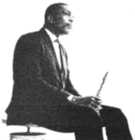 tenor
sax and soprano, American composer
(Hamlet, North Carolina, 1926-New York 1967). After an along and dark apprenticeship
in groups jazz and rhythm and blues, he has called (1955) in the quintet
of Miles Davis. To the beginning, to shame of a bright and original sonority,
his improvisation is scholastic; then however he play for brief time (1957)
with Thelonious Monk, he begin to direct own groups and to compose themes
complicated; he return therefore with Davis, in a sextet (1958-59). Of
hit, in a sudden catch fire of the inspiration, C. at first door to tallest
virtuosity the language of bebop school (Giant
Steps, 1959); then a quartet forms (with McCoy Tyner to the piano and Elvin
Jones to the battery) between the most original of all the jazz, stayed
joined six years; and he finally breaks with the past, he goes toward the
modal improvisation (My Favors Things, 1960).
With the work of the modal period (1960-64) C. unites ideally again to
the African and Islamic ancestors: on a repetitive theme, elementary, and
also slightly varied, he throws himself in long improvisations, from the
effect thrilling hour, hypnotic hour. In the last creative season (1965-67)
C. he approach way his to the free jazz, realizing
a series of masterpieces: the infernal Ascension,
kind of shouted sabbah for eleven improvisors; Meditations,
in which phases of heat to the limit of the trance alternate to moments
of ecstatic peace; and finally Expression,
that would have perhaps marked the beginning of a new phase, more meditative,
if the death has not arrived at sudden.
tenor
sax and soprano, American composer
(Hamlet, North Carolina, 1926-New York 1967). After an along and dark apprenticeship
in groups jazz and rhythm and blues, he has called (1955) in the quintet
of Miles Davis. To the beginning, to shame of a bright and original sonority,
his improvisation is scholastic; then however he play for brief time (1957)
with Thelonious Monk, he begin to direct own groups and to compose themes
complicated; he return therefore with Davis, in a sextet (1958-59). Of
hit, in a sudden catch fire of the inspiration, C. at first door to tallest
virtuosity the language of bebop school (Giant
Steps, 1959); then a quartet forms (with McCoy Tyner to the piano and Elvin
Jones to the battery) between the most original of all the jazz, stayed
joined six years; and he finally breaks with the past, he goes toward the
modal improvisation (My Favors Things, 1960).
With the work of the modal period (1960-64) C. unites ideally again to
the African and Islamic ancestors: on a repetitive theme, elementary, and
also slightly varied, he throws himself in long improvisations, from the
effect thrilling hour, hypnotic hour. In the last creative season (1965-67)
C. he approach way his to the free jazz, realizing
a series of masterpieces: the infernal Ascension,
kind of shouted sabbah for eleven improvisors; Meditations,
in which phases of heat to the limit of the trance alternate to moments
of ecstatic peace; and finally Expression,
that would have perhaps marked the beginning of a new phase, more meditative,
if the death has not arrived at sudden.
Coleman Hawkins
American saxophonist (Saint Joseph, Missouri,
1904-New York 1969). Of bourgeois family, he played first time in public
to 17 years with the singer Mamie Smith. he in the orchestra of Fletcher
Henderson became, inspired from the colleague Louis Armstrong, the first
big improvisor of tenor sax: with the furious
solo in Stampede (1926) he gave to the tool, then rare, the dark and aggressive
voice today popular. he with Henderson matured a tortuous and baroque style;
he then moved (1934) in Europe, where he affected splendid disks with mediocre
orchestras from dance, and he experimented duets and cameristic trios.
Returned in country (1939) he was bare from the big public in a disk affected
for case, Body and Soul (2 million of copies). Disgusted from the banality
of the bebop, he entered contact with the Turkish young people of the bebop,
he helped them, he affected with them; he also conceived a passage for
sax solo, Picasso (1948). From the 1950 the taste moved toward the light
stamp of the rival Lester Young, and H. he seemed finished. But he returned
in scene (1954), indomitable big old, without fear the challenge of gamest
innovating: John Coltrane, Sonny Rollins, Eric Dolphy. A sad personal circumstance
caused some (1966) to a fast psychic collapse. Man animated from a continuous
thirst of progress, H. he has left solo of impressive internal grandeur.
Steve Lacey
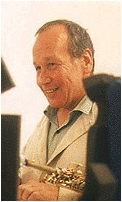 saxophonist
and white American jazz composer (New York 1934); actually Steven Lackritz.
Expert of the soprano sax, that has brought
again in the jazz after decades, has elaborated a poetic lunar and solitary.
In the his vast discography has collaborated with all the big of the contemporary
jazz.
saxophonist
and white American jazz composer (New York 1934); actually Steven Lackritz.
Expert of the soprano sax, that has brought
again in the jazz after decades, has elaborated a poetic lunar and solitary.
In the his vast discography has collaborated with all the big of the contemporary
jazz.
Gerry Mulligan
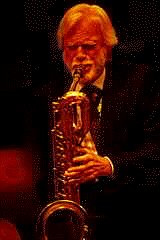 baritone
sax, American composer and music director of jazz orchestra (New
York 1927-
baritone
sax, American composer and music director of jazz orchestra (New
York 1927-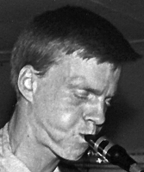 1995).
He play fist time in public in the 1948 participating to any famous recordings
of the orchestra of M. Davis; he achieved big notoriety in the 1952, when
he founded to San Francisco with the trumpeter Chet Baker, the contrabassist
Bob Whitlock and the drummer Chico Hamilton a quartet that acted in the
circle of the cool jazz, emerging however
for the multiplication of the instumental effects and for an use a great
deal more frequent than the counterpoint. He in the 1955 directed a sextet,
applauded also in Europe, and he in the 1960 formed a big orchestra; he
in the 1968 united to the pianist D. Brubeck. he from the 1978 played with
the Concert Jazz Band. He is considered the best soloists of jazz on his
intrument.
1995).
He play fist time in public in the 1948 participating to any famous recordings
of the orchestra of M. Davis; he achieved big notoriety in the 1952, when
he founded to San Francisco with the trumpeter Chet Baker, the contrabassist
Bob Whitlock and the drummer Chico Hamilton a quartet that acted in the
circle of the cool jazz, emerging however
for the multiplication of the instumental effects and for an use a great
deal more frequent than the counterpoint. He in the 1955 directed a sextet,
applauded also in Europe, and he in the 1960 formed a big orchestra; he
in the 1968 united to the pianist D. Brubeck. he from the 1978 played with
the Concert Jazz Band. He is considered the best soloists of jazz on his
intrument.
Charlie Parker
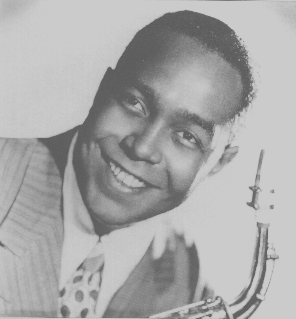
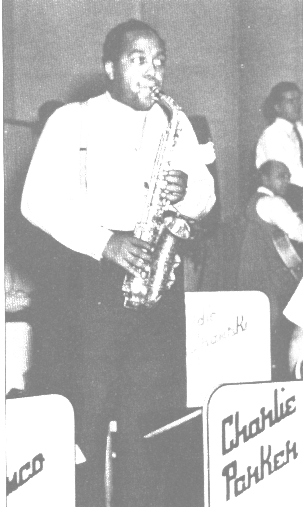 saxophonist
and American composer (Kansas City, Missouri, 1920-New York 1955). Of humble
family, he revealed an intense intelligence from child, but he don't endow
musical. he learned to play the sax to the high school, for three years
an uncertain dilettante stayed; already then contracted the vice of the
drug. he after a period of intense study of the alto
sax became (1937) a shod professional and he began to the search
of ideas new improvisative working with orchestras of conventional style
(Jay Mc Shann). In the course of a life by now vagabond and chaotic, he
began to point (1940-43) a new language, cool, of amazing wealth and complexity:
this style, then called bebop, would have revolutionized the jazz. Treatise
from the connects with a kind of doubtful respect, P. realized with completeness
his ideas only in the 1945, after have met the trumpeter Dizzy Gillespie
and other young people of similar ideas. In the 1945 the disks and the
concerts of P. and Gillespie made know the bebop,
lifting violent polemics between he connect, public and criticism. Marked
already from the drug and from a deep loneliness, P. he had a crisis of
folly during the incision of Lover Hand (1946). Sheltered in a psychiatric
hospital, he recovered; he in the 1947-48 directed a quintet with Miles
Davis, and he crossed his more serene and fertile season (Out of Nowhere,
Parker's Mood). But the public didn't accept the new jazz: well soon P.,
with his uneasy and introspective music, a bulky character became. He didn't
know neither he wanted to adapt itself to the times and, apart from two
European tournées and any isolated concert, he confined to a disenchanted
routine. His physical decline was sudden. P. a giant of the jazz is, biggest
at the same time improvisor to Louis Armstrong. His musical mind fed only
I with him listen to; he didn't have way ever of study composition, like
he would have wanted. He didn't can express with ample orchestral and formal
means: all his fantastic ideas owed spend in the pipe of a sax.
saxophonist
and American composer (Kansas City, Missouri, 1920-New York 1955). Of humble
family, he revealed an intense intelligence from child, but he don't endow
musical. he learned to play the sax to the high school, for three years
an uncertain dilettante stayed; already then contracted the vice of the
drug. he after a period of intense study of the alto
sax became (1937) a shod professional and he began to the search
of ideas new improvisative working with orchestras of conventional style
(Jay Mc Shann). In the course of a life by now vagabond and chaotic, he
began to point (1940-43) a new language, cool, of amazing wealth and complexity:
this style, then called bebop, would have revolutionized the jazz. Treatise
from the connects with a kind of doubtful respect, P. realized with completeness
his ideas only in the 1945, after have met the trumpeter Dizzy Gillespie
and other young people of similar ideas. In the 1945 the disks and the
concerts of P. and Gillespie made know the bebop,
lifting violent polemics between he connect, public and criticism. Marked
already from the drug and from a deep loneliness, P. he had a crisis of
folly during the incision of Lover Hand (1946). Sheltered in a psychiatric
hospital, he recovered; he in the 1947-48 directed a quintet with Miles
Davis, and he crossed his more serene and fertile season (Out of Nowhere,
Parker's Mood). But the public didn't accept the new jazz: well soon P.,
with his uneasy and introspective music, a bulky character became. He didn't
know neither he wanted to adapt itself to the times and, apart from two
European tournées and any isolated concert, he confined to a disenchanted
routine. His physical decline was sudden. P. a giant of the jazz is, biggest
at the same time improvisor to Louis Armstrong. His musical mind fed only
I with him listen to; he didn't have way ever of study composition, like
he would have wanted. He didn't can express with ample orchestral and formal
means: all his fantastic ideas owed spend in the pipe of a sax.
Wayne Shorter
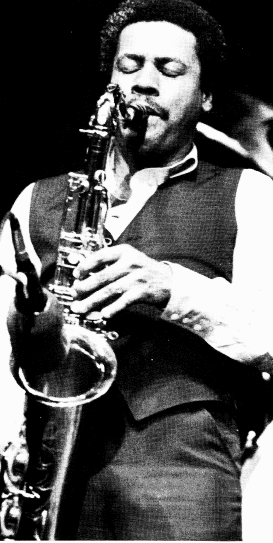 saxophonist
and American composer (Newark 1933) .Partito to 16 years with the clarinet,
he has gone on to the tenor sax before enter
to the university from New York, in the 1952. he has revealed itself (1960)
with the Messengers Jazz of Art Blakey, of which sax has stayed way and
musical director until at 1964, adjourning the style and the repertoire
and writing themes of big melodic charm (Children of the right Night).
In the 1965-70 right arm of Miles Davis has stayed, pushes it toward a
new type of modal jazz,
fact of complicated accords, joined from harmonic thin bonds, sometimes
hidden; masterpiece of the kind is Nefertiti. Together he to Davis is been
then moved (1969) toward the rock influences (Super Nova, Odissey of Iskra),
adopting the soprano sax, on which he exhibits
a lovely and lyrical style. he has founded (1970) ogether with Joe Zawinul,
the Weather Report, will result most popular group jazz-rock;
in him his personality appears however less vigorous. Interesting his following
incisions, almost entirely electric, between which Native Dancer (1975),
atypical solo album, clearly inluenced from the Brazilian-Southamerican
music. Lyric soloist, laconic, partly influenced from John Coltrane, S.
composer from the melodic slim but seductive and expressive manipulating
vein of the more complex harmonies is above all. Big the weight of S. on
the current neo-bop emerged during the years '80, whose more meaningful
exponent is Branford Marsalis.
saxophonist
and American composer (Newark 1933) .Partito to 16 years with the clarinet,
he has gone on to the tenor sax before enter
to the university from New York, in the 1952. he has revealed itself (1960)
with the Messengers Jazz of Art Blakey, of which sax has stayed way and
musical director until at 1964, adjourning the style and the repertoire
and writing themes of big melodic charm (Children of the right Night).
In the 1965-70 right arm of Miles Davis has stayed, pushes it toward a
new type of modal jazz,
fact of complicated accords, joined from harmonic thin bonds, sometimes
hidden; masterpiece of the kind is Nefertiti. Together he to Davis is been
then moved (1969) toward the rock influences (Super Nova, Odissey of Iskra),
adopting the soprano sax, on which he exhibits
a lovely and lyrical style. he has founded (1970) ogether with Joe Zawinul,
the Weather Report, will result most popular group jazz-rock;
in him his personality appears however less vigorous. Interesting his following
incisions, almost entirely electric, between which Native Dancer (1975),
atypical solo album, clearly inluenced from the Brazilian-Southamerican
music. Lyric soloist, laconic, partly influenced from John Coltrane, S.
composer from the melodic slim but seductive and expressive manipulating
vein of the more complex harmonies is above all. Big the weight of S. on
the current neo-bop emerged during the years '80, whose more meaningful
exponent is Branford Marsalis.
Sonny Rollins
tenor sax
and American composer (New York 1930); to the century Theodore Walter Rollins.
he has play adolescence (1948) with the big of the bebop
(Bud Powell, Miles Davis, J. J. Johnson), revealing a sonority of enormous
power and a greath safety, fusion of the influences of Coleman Hawkins
and Charlie Parker. Good lends reveals a doubtful and uneasy character;
he retire (1954), he then return in scene entering the quintet of Max Roach
and Clifford Brown, that with him the group-symbol of the becomes hard-bop.
Flowing, game, mocking improvisor, he love choose sweet and calm tunes
and maltreat it with fury. Disappeared Brown (1956) stays with Roach, affecting
different disks, and pointing out the jazz the by of a solismus from the
ample and elaborate developments; the Freedom Suite (1958) any is the vertex.
The growth of John Coltrane and Ornette Coleman set him new doubts; he
follows a second withdrawal (1959-61) of it. he reenter Bridge (1962) with
The, revealing a new style, peaceful, chopped, broken from anxious silences
and mysterious hisses. This approach to the free
jazz leads to the grandiose East Broadway Run Down (1966), enigmatic
and unsociable work as his creator, that, almost intimidated from the his
same audacity, he retire still. Returned in scene (1970), R. he has adopted
rock colors and rhythms, without the his transcendental solismus any is
touched. Fearless, it is been select thick anonymous companions, for throw
in volcanic disputes, sometimes behaviors to rhythm of calypso (St. Thomas).
Best recent work is Soloscope (1985), monologue in which the ideas of all
his career has thrown to the air and remixes. From time the figure of R.
like teacher of the jazz improvisation is not more in doubt.
soon other information on the contemporary saxophonists.
and new images!