Tecnical Corner
 E-Mail with what you want have published on this
page: interesting discoveries, compared problems, or also
"experiments" particular, and you to brief term will
find them on this page, to disposition of all.
E-Mail with what you want have published on this
page: interesting discoveries, compared problems, or also
"experiments" particular, and you to brief term will
find them on this page, to disposition of all. Add or Discuss a Subject: Insert Data with Form
Through I of the proofs that I could have effected have noticed as I am different the sonorous return of the same mouthpiece (with same reed) with ligatures of different characteristics: a ligature in metal "he produces" a sound very brighter respect to an in fabric, but it makes the softer and easier sound. Everything depends on what one want to be gotten or he from what must be played. However the decision then will depend from factors tightly personal: the discourse that I am carrying ahead is indicative, in fact each could have of the he diverged feeling and different opinions on the subject.
A mouthpiece in metal has a very brighter sound than one in ebonite, but decisive reveal yourselff the inside form of the chamber often, beyond that to the facing and of the tip opening. Has happened me of try metal mouthpiece with chamber of particular form that had a darker sonorous return than some mouthpiece in ebonite, but often the result depends on the peculiar characteristics of each.
I have departed from a simple observation:
my Otto Link 8* for alto sax, with his original metal ligature, had a very bright and pleasant sound, but I have noticed soon of the "upside-down of the medal": the issue in some cases became hard, above all in the passage between low register and acute register, in the more low notes, and in the case in which the dynamic extended to the piano. The beautiful then came with dynamic more definite, we tell that to the strong seemed me of play a trumpet. The sound lost his characteristics and expired of quality: thing that I after all have then verified also on the soprano sax.
Do I have had the impression that metal and metal don't go so much at the same time good, and through of the "experiments" that could I have made modifying of the ligature that I had and trying of the others new, do I have arrived at to the conclusion that with a fabric ligature, since the plastics ligature for saxophone are that cannot be found (do they make it?), is the sound more compact and soft, tonguing have facilitated, do disagreeable effects be avoided owed to the combination metal mouthpiece - metal ligature. After all the sound results still more pleasant, also if this depends much from the kind of music that is performed: the sound of themetal mouthpiece, any it is the ligature, in a classical context results inadequate, also if creed this made it is the result of a certain mentality that I between the other don't share, more that of objective observations.
For a ebonite mouthpiece I instead would recommend a good binding in metal, above all you wants to revive the sound, make it brighter, holding but the softness and the typical comfort of the ebonite: obvious that often a good ebonite mouthpiece also with the metal ligature will have a darker sound than one in metal of equal characteristics.
I use ligatures of the BG, in as the metal plate that has inserted revives the sound more, maintaining the characteristics of a fabric ligature at the same time. The closings have seemed me more solid than those of the other brands in commerce.
I would be very happy if anybody wants to intervene on this matter.
E-Mail to the author.
Thank you.
One of the bigger problems that they torment all the saxophonists are know like compare the varied reeds in commerce. Often in fact the varied houses have a system of numeration of the "strength of reed" independent for each product: for example Rico causes more types than reeds, like LaVoz, Hemke, Rico Royal, all with systems of different numeration as like for Vandoren V5 and Java. Compare a brand as regards the other caused from the same house result as extremely difficult , show up us then between a firm and the other. The only sure system is proceed for attempts... solution however rather expensive...
For fortune sometimes is been able to find of the comparative charts that, though they must be taking with the pliers, they could be of help. Here under any found a published of the Vandoren:
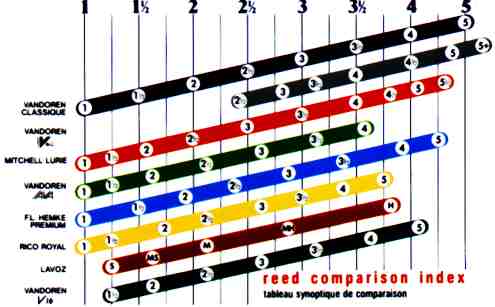
In succession: Vandoren Classique, Vandoren V/2, Mitchell Lurie, Vandore Java, F.L. Hemke, Rico Royal, LaVoz, Vandoren V16
I could tell that for personal experience (for the low values) this chart is fairly precise, I have correctly verified Vandoren Classique with Hemke and Vandoren Java, finding a good correspondence to the middle suitable values, independently from the type of saxophone.