
| Grooming Your Miniature Schnauzer |
|---|
First you will need a pair of electric dog clippers. Andis and Oster are good brands, which come with a standard #10 blade which can be used to do the entire dog, or you can also use the #15 blade for shorter cutting in certain areas if desired. I have also used the less expensive Andis clippers that have an adjustable blade length on the one clipper and they do a good job also. You may also use a pair of mini clippers (various brand names) and/or short blunt nose scissors for detail work between the eyes and between foot pads. You will also need a slicker brush, pin brush, a dog comb, a pair of shears and also a pair of thinning shears. You need a good dog shampoo which you can get at any good pet store, and detangling spray may also be helpful for small mats. A skin conditioning spray is also beneficial. You may need hemostats for pulling ear hair out of the ear canal if it gets too thick and out of control. You can get a good all around ear cleaner from your vet to keep the ear canals healthy. You will need a pair of nail clippers; we prefer the scissors type for better control, and also some styptic powder in case you nick any nails to stop the bleeding. And last but not least, you will need a doggy toothbrush and doggy toothpaste. The human kind will just irritate your dog's mouth and make him salivate profusely! You also may use a descaler for plaque buildup.

|
Grooming supplies 1:1) Andis clippers (#10 blade) 2) Andis clippers (adjustable blade) 3) Clipper cleaning brush 4) Mini clippers 5) Clipper oil 6) Slicker brushes 7) Shears 8) Thinning shears 9) Small blunt nose scissors 10) Pin brush 11) Steel combs 12) Flea comb |
|
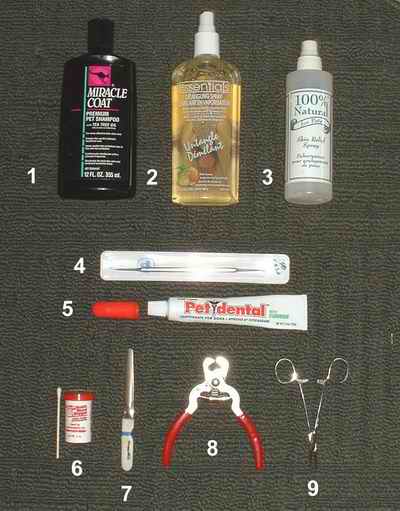
Grooming supplies 2:1) Dog shampoo 2) Detangling spray 3) Skin conditioner 4) Tooth descaler 5) Doggie toothbrush and toothpaste 6) Styptic powder 7) Nail file 8) Nail clippers 9) Hemostats |
Your dog's teeth should be brushed every day to prevent tooth decay and gum disease. Using toothpaste made specifically for dogs, put some on a dog toothbrush. We prefer the kind that goes over your finger so that you insert your finger with the *brush* into the dog's mouth and gently massage your dog's teeth and gums. Use a gentle circular motion. Do just a little at first to get your dog used to it, and slowly work your way up to doing the entire mouth. Just a few minutes each day can save you many *dental* dollars in the future!! Despite our best efforts brushing teeth, sometimes you will still see plaque buildup. If your dog is cooperative you can use a descaler to remove this. It is best to get your vet to show you the proper technique.

|
Your miniature schnauzer's furnishings should be combed every day or two to prevent the hair from matting. First brush upwards on the leg hair with the slicker brush or pin brush, and then double check for mats by combing the furnishings in an upwards direction, starting on the top of the leg and working your way down the leg, about an inch at a time. You want to be sure that all mats have been removed. You can use detangling spray if needed to make the job easier. While lifting each front leg, the armpits and belly hair should be thoroughly brushed and then combed. The eyebrows should be combed down towards the nose, and then the beard should be combed forwards from under the chin, and from the top of the nose down towards the floor. You may also use the pin brush along the shorter back coat to keep it neat and tidy and to stimulate the skin. Your mini schnauzer should always be thoroughly combed out both before and after his bath to prevent any matting. Use of a flea comb will help detect fleas or flea dirt.
My first rule of thumb is never clip against the grain of the hair, as you can cause severe razor burn, which can lead to infections which can be very difficult to clear up. Remember to oil your clipper blades often while you groom. Use a clipper brush to keep your clipper blade free of excess hair while you groom. If you have the clippers with the adjustable blade, I would use the shorter length to clip the head and ears. You can still use the #10, or if you prefer a #15 blade can be used for a closer cut.
(head and eyebrow pictures are of "Remi")
Beginning above the eyebrows and going to the back of the skull between the ears, clip all hair above the eyebrows.
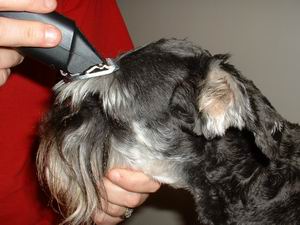
Placing a thumb at the front base of the ear and holding the ear back out of the way, clip sideways/downward one clipper width between the ear and the eyebrow.
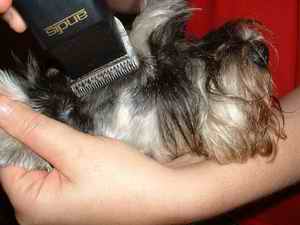
Holding the ear safely out of the way, clip from the corner of the eye, along the cheek to the base of the ear.

Using your hand to pull all beard hair forward, clip the cheek from the beard hair to the side of the neck under the ear.
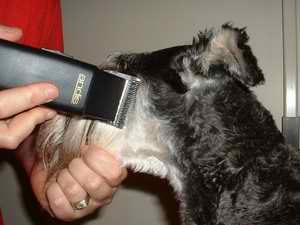
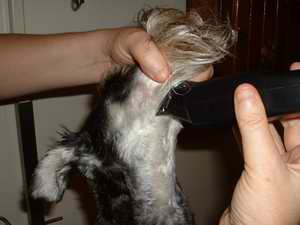
Then clip from the under side of the beard down the throat. Make sure that when the dog's head is raised, the edge of the beard is even all the way around the muzzle.
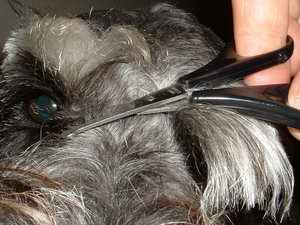
A "triangle" is scissored or clipped with mini clippers between the eyes about a half inch wide, coming down to the inside corner of each eye. Any excess hair or eyelashes under the eyebrow should be tidied up so the dog's vision is not impaired. This should be done with short blunt nosed scissors.
 |
 |
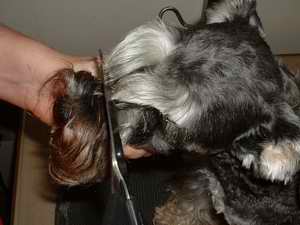
The hair on the top of the muzzle is parted but should never be shaved! The eyebrows are combed forward and cut at a sharp angle to the outside corner of the eye, the innermost hair being the longest.
 |
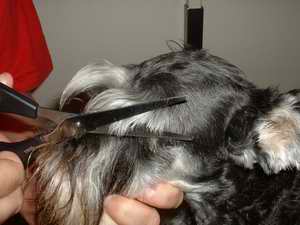 |
The length of the longest part of the eyebrows should be cut to approximately one-half the length of the muzzle. Any loose hairs around the outer eye can be trimmed with scissors.
 |
 |
Usually the beard is not trimmed, but if is too thick, bulky or hard to manage, it can be thinned out with thinning shears and any straggly hairs can be cut off.
Be very careful when clipping the ears, as inexperience or carelessness can result in cutting the dog, with bleeding that can be controlled only with styptic powder and pressure. I am talking about uncropped ears as none of my dogs are cropped. An ear should be clipped with the direction of hair growth while holding it firmly and supporting it with your fingers from underneath. Be especially careful with the flaps of skin at the front base of the ear as it is a very easy spot for the clipper blade to catch on the edge of the ear. If the ear is kept taut, there is less likelihood of injury. Always clip from the center of the ear outward toward the ear edges. The ear edges should have loose hairs scissored, and if your dog's ear canals are thick with hair then you may have to pull some using the hemostats. If your dog's ears are not overly hairy in the ear canal then there is no need to upset the dog and yourself by needlessly pulling the hair out; in my vet's words....."if it ain't broke don't fix it"!! If the inner ear flaps or canals appear dirty or have waxy buildup, use an ear cleaner from your vet.
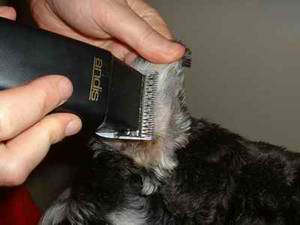 |
 |
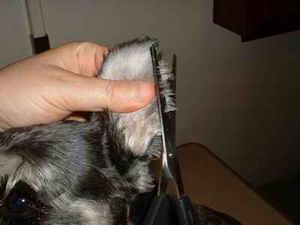 |
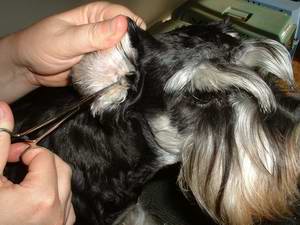 |
canal with hemostats |
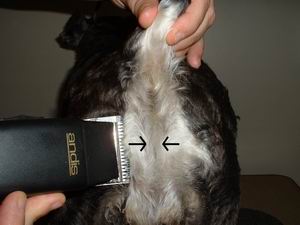
Using the #10 blade or the longer length if your blade is adjustable, clip with the hair growth, starting where the back of the skull meets the top of the neck, and clip the entire back all the way back to the tail. The neck and chest is clipped downwards from the chin under the beard to a point approximately level with the elbows. Be careful to clip in the direction of hair growth if there are cowlicks on the forechest. Thinning shears may be used to blend the clipped area with the longer hair. You can leave a little longer fringe on the forechest between the elbows if desired but you should not leave a full apron or bib, just as there should not be a lengthy skirt around the body. Going from elbow to rear leg, clip from the top to the bottom of the rib cage until you are about level with the elbows. Make sure to leave some hair fringe at the base of the loin right in front of the rear legs so the dog does not appear to be too *tucked up*. Using one hand to hold the leg furnishings folded to the inside of the rear leg, clip the remaining hair on the outer thigh downwards, following the outline of the leg down to the stifle and then curving rearward to about two fingers above the hock. Next clip the entire tail. Then facing the dog's bum, start at the outside edge of the right upper leg and clip inwards to the center line under the bum. The start at the outside of the left upper leg and clip inwards to the center line to meet where you just clipped. Raising each rear leg, clean the scrotum or vulva area making sure not to clip down onto the inner leg area more than and inch or two.
(Remi, who is pictured below, has two week old babies, and therefore all her belly hair and fringe have been trimmed for ease of nursing.)
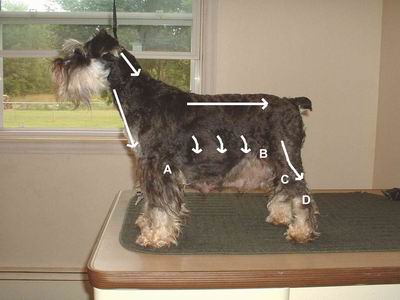 |
A) Elbow B) Loin C) Stifle D) Hock |
 |
Hold the dog with his front legs resting over one arm, forcing the dog to place all of his weight on his hind legs. Clip an the area of the groin from the navel to the vulva or scrotum. Clip to the sides, leaving a bit of fringe at the loin area but not on inner thighs. With the dog once again standing normally on all fours, lift one front leg, and use scissors to trim belly fringe hair, starting from just below and behind the elbow, and continuing back to a point where the loin and rear leg fringe meet. Repeat on the other side. If the dog is long legged, you may leave the belly fringe hair a little longer to make the dog appear more balanced, but you should not leave a full skirt around the body. Now check and see that both sides are the same length.
Usually the dog's legs should be washed and blown dry before trimming. Blow dry while brushing upward with a slicker brush, and then comb through all furnishings to be sure there are no mats. The hair is combed out with a slight fluffing motion to insure that the hair stands straight out from the leg. Having said that, I usually just comb out mats, fluff up the hair and trim it without washing first. I have nine schnauzers to do so I do not bother bathing and blowdrying beforehand unless I am looking for a very *finished* look such as for photo sessions. I guess it just depends on how much time you have and how much of a finished look you are after.
Trim around the edge of the front feet to form a circle, sort of like a cat's paw, trimming as close as possible to the front nails. On the front legs, use scissors to trim from the elbows down to the feet, trying to shape the leg hair to resemble cylinder shape, or poles. Hair at the sides of the elbows should be kept fairly short and the hair should increase somewhat in length as you go down the leg. Keep thinking *circular* as you trim the leg, although looking from the front or side it should appear to be a straight line from the elbows down to the feet. Rear legs are basically the same from the hock down. Thinning shears can be used to blend the outer thigh with the leg fringe so that the outside of the rear leg looks like a continuous straight line from the thigh down to the foot.
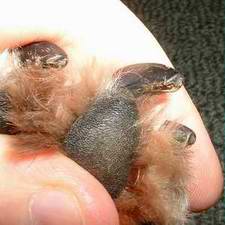
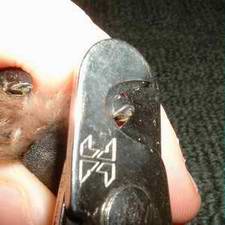
Trim all hair from between the large foot pad and the toe pads of the bottom of the foot by either clipping or scissoring, and the nails are trimmed as short as possible by lifting each foot up and cutting the nails from the underside.
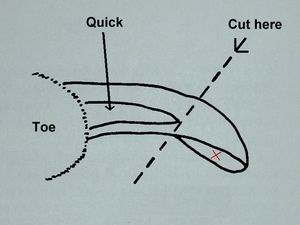
To clip the nails just take off little snips at a time until you are sure how far you can safely go. Usually you will be okay if you stop when you see a little dark circle (the beginning of the quick) appearing in the center of the nail as you cut. Also if you look at the front of the underside of each nail, there is an open hollowed out area (marked X on the diagram). Usually the quick does not grow beyond the beginning of this area and it is usually safe to cut as shown on the diagram. Styptic powder should be ready in case you nick the quick and it starts to bleed. Nails should be trimmed every two weeks at least, preferably once a week; if the nails click as the dog walks, they are probably too long. |
 |
 |
 |
 |
Your miniature schnauzer should be bathed only as often as necessary, using any good dog shampoo. Human shampoo can upset the PH balance of your dog's skin. Bathing too often can dry out the skin and cause problems. It is a good idea to wash the dog's beard and leg furnishings at least once a week to keep them clean. The beard may be washed more frequently, if necessary. You should never get water in a dog's ears as it could cause ear infections, and be careful to keep shampoo out of your dog's eyes. The inside corner of each eye should be wiped clean daily with a damp cloth to clean any accumulated *eye boogies*. (A favorite word at our house..lol.) Lukewarm water should be used while shampooing, and be sure that you rinse, rinse and rinse again so that all shampoo is out of the coat. Traces of shampoo left behind can cause dry flaky skin.
If it becomes too difficult to keep your dog properly combed, it would be easier on you and your dog if you keep the entire dog including the furnishings shaved short. You may also use a comb attachment with your blade (if you have one) to shorten the leg furnishings while leaving a little length. However short you clip your dog, it is still easy to keep the eyebrows looking nice if you decide to shave everything else. When grooming is complete, a skin conditioner sprayed lightly all over will keep your dog's skin healthy and smelling fresh. Keep in mind that these grooming tips are for pet miniature schnauzers, and are for the ease and comfort of both owner and dog. Show grooming is another entity entirely, and if that is what you are after, then you should talk to an experienced handler or breeder to guide you in handstripping methods.
The most important thing to remember: have fun and enjoy your miniature schnauzer!!!!!!!
 |









