Critical
Cyberliteracies:
What
Young People can Teach us About Reading and Writing the
World
Michele Knobel and Colin
Lankshear
|
Keynote paper presented at the National Council
of English Teachers' Assembly for Research Mid-Winter
Conference. New York, February 22-24, 2002.
|
introduction
Almost all educators in the U.S. and elsewhere
seem to agree that the advent of personal computing, the internet,
digital cell phones and other person-to-person and group-to-group
communication media have changed what it means to learn, know and do
things. Governments around the world, for example, are committing
vast amounts of money to developing "learning societies" (cf., Blair
1999) and "information economies" (e.g., NOIE 2001), and are
committed to bringing about "digital inclusion" for all citizens
(Rhode and Shapiro 2000).
Not surprisingly, young people in developed
countries, born in the Atari and Space Invader years and later, have
grown up with a host of new technologies that appear as
"natural" to them as cars and televisions appear to us
(Bennahum 1998, Rushkoff 1996, Tapscott 1998). Demographers predict
that by 2005, there will be roughly 77 million internet users under
18 years of age (Burke 1999). At present:
- 45 percent of households (approx. 11 million)
in the United Kingdom have computers, with these households
spending an average of 8 hours a week on the internet (Oftel
2002)
- Canadian families with children under
18-years-of-age spend an average of slightly more than 32 hours a
week online, and 67 percent of all Canadian households have at
least one a personal computer. Of the families surveyed, almost
half of the children aged from 5 years and under through to 15
years use the internet on their own (Ipsos-Reid 2002)
- In 2001, online chat rooms were found to be
"especially popular in urban Brazil, Sweden, and urban China",
where over 8 out of every 10 young people (of those aged 12 to 24
years) have used them (Ipsos-Reid 2001: 1).
- A recent AOL survey of almost 6000 U.S.
teenagers found that 81 percent of those surveyed aged between 12
and 17 years used the internet (for emailing and instant
messaging) as their first choice for communicating with others
(Pastore 2002).
- Approximately 3 million teenagers (aged 12 to
17 years)--one in four teenagers--in the US use instant messaging
services (IMs) (Lenhart, Rainie and Lewis 2001).
- According to a number of surveys, "in
mid-2001, 65 million youths between 5 and 17 were online from home
in Europe and America", which boiled down to 12 percent of
Europe's entire online population comprising teenagers aged 12 to
17 years, and children under 12 years--as of December 2000--making
up online populations at a rate of "6.9% in the US, 5.1% in the
UK, 4.3% in Spain, 3.3% in France and 1.7% in Germany" (Kaplan
2001: 2).
Interestingly, and despite rapid advancements in
speech-based digital technologies--particularly where instant
messaging services are concerned--much of the cyberspace life of
young people is text-based: email messages, discussion board
postings, instant messages, chat space, virtual world conversations,
and so on are still mostly written. The proliferation of new
paralinguistic symbols such as emoticons--key strokes such as colons,
semi-colons and parentheses to depict emotions; the compression of
idioms in the form of acronyms, such as LOL for "laughing out
loud", IMHO for "In my humble opinion", or numbers and
letters as in "C U l8ter" in place of "see you later", and "R U OK?"
in place of "Are you all right?"; semiotic languages, such as that
used in some internet-based episodic games, and the like, make
writing online a complex social practice.
Of course, when literacy is conceptualized as both
a situated action and a socially recognised practice concerning "ways
with words" (Gee 2001), reading and writing mediated by new digital
technologies become even more complex because the sites for situated
action are dispersed across time and space (e.g., via asynchronous
email) and the "rules" or "language games" associated with different
online practices develop, shift and metamorphose into other new
literacy practices. An example of this comes from one of the three
cases we discuss later in this paper: Plastic. Plastic--whose tagline reads,
"Recycling the Web in real time"--is an online forum devoted to
posting the "best content all over the Web for discussion" (Plastic
2002: 1). One of the most striking things about Plastic is the way users employ
seemingly conventional practices--such as subject lines in
postings--to create new ways of conveying information. For example,
many people who post a comment in response to a showcased story
begin their
message in the subject line and continue it in the body of the
message, instead of following other (older) people's guidelines for
writing succinct and informative headings, subject lines, and other
"microcontent" (e.g., Neilsen 1998). A subject line in a Plastic
comment might read: "one of the biggest problems I see", with the
body of the message beginning, "with multi-polar world orders is
that, historically, they donít work very well to maintain the
peace" (port1080, 3 February 2002). This approach to information
delivery sometimes calls for new ways of reading posted comments--in
this case, for example, instead of skimming the subject line, more
attention needs to be paid to what it is actually being said.
Then there's Banja
(www.banja.com), an episodic online game that makes
language barriers in physical space redundant via a semiotic language
that the characters "speak" to each other. For example, dialogue
between characters may have them arranging to meet later that
night--with the text comprising a watch face and moon, an animated
arrow pointing to an icon of a hand-in-hand male and female, and
another animated arrow pointing from the male and female icon to an
icon of the local poolside bar.
These new ways of reading and writing come with
new ways of looking at and understanding the world--although critical
literacy pedagogy has long been interested in the relationships
between language, power, social practice and access to social goods
and services, very little attention has been paid to developing
critical pedagogies that take into account the new literacies being
enacted by young people in cyberspace each day. Much attention from
government and others has been paid to the need to "police and
protect" young peopleís uses of the internet (cf., critiques
in Goodson et al. 2002) and to saving young people from themselves;
however, very little research attention has been given over to
examining the critical literacies young people are already using in cyberspace by
dint of their detailed "insider" knowledge of how the social spaces
of the internet work to exclude some people and not others, or how
the internet can be put to use in presenting their informed critiques
of political and social events and practices.
In the remainder of this paper, we focus on
critical literacy as a practice of production, rather than of
consumption. We use three case studies of young people using the web
as "insiders" to practice critical literacy in organic
and informed ways, and suggest ways in which cases like these could
be used to develop research programs that focus on critical literacy,
as well as pedagogies that approach critical literacy and cyberspace
from an "insider"--rather than an "outsider" perspective.
critical literacy: beyond the
missionary position
One of the key tenets underpinning critical
literacy is that it is something that can be "taught" and "learned".
Evolving from the intersection of critical theory and pedagogy with
literacy studies, critical literacy is concerned with critiquing the
relationship between language, social practice and power. In this way
it differs somewhat in focus from critical pedagogy--the latter is
interested in developing and practicing ways of teaching
critically;
A critical pedagogy examines what is
taken for granted (e.g., having principals for schools or selling
medicine for profit) and what is accepted as business-as-usual (e.g.,
letting a test score keep people out of a job, or women letting men
think the idea was theirs). Further, a critical pedagogy works at
figuring out where the taken-for-granted, business-as-usual came
from, what itís connected to, and whose interests it serves
(Edelsky 1999: 15).
Critical literacy, on the other hand, foregrounds
the role of language in establishing and maintaining
taken-for-granted, business-as-usual. It closely examines the ways in
which language practices carve up the world according to certain
socially-valued criteria (and not other sets of criteria); draws
attention to inequities; and calls for a rethinking of theories
considered "natural" or unassailable. Thus, critical literacy can be
conceptualized as:
[a]nalytic habits of thinking,
reading, writing, speaking, or discussing which go beneath surface
impressions, traditional myths, mere opinions, and routine cliches:
understanding the social contexts and consequences of any subject
matter; discovering the deep meaning of any event, text, technique,
process, object, statement, image, or situation; applying that
meaning to your own context (Shor 1999: 20).
Critical literacy makes a large investment in
critiquing the ideological nature of language and language use--or
discourses--in
people's everyday lives.
Critical literacy is concerned with knowing
something through and through--in order to get at the kinds of "deep
meanings" referred to by Shor, students need to be well-informed
about an issue and from a number of different perspectives. "Deep
meaning" here does not refer to some essential, albeit craftily
"hidden", message buried within texts that requires careful eyes and
a quick mind to extract. Rather, deep meaning refers to the results
of a careful process of comparing and contrasting a range of accounts
concerning an event, moment in time, action, circumstance, and the
like and evaluating the results in relation to who has access to what
kinds of social goods and services (i.e., power), by what means, and
in relation to what or whom. For example, without knowing something
of the history of Western science and its long-term close ties with
Christianity that viewed science as a sure way of knowing more about
the miracle of creation and thus was a strategy for becoming closer
to God, it is difficult to understand current assumptions made by
many scientists concerning their unquestionable right to push the
envelope where physics and genetics are concerned (cf., Noble 1999,
Wertheim 1996).
Paulo Freire defines power as tied intimately to
practices of "naming the world" (cf., Friere 1972). Those with power
are able to affix names to physical objects as well as to people,
practices and things. Thus, an enormous, well-populated southern
continent is named Terra
Nullis--empty land--by a small group of
wandering White explorers from the north; the teeming and powerful
Tenochtitlan is renamed Ciudad de Mexico by a small group of Spanish
mercenaries; non-English speaking people are still regularly given
English names by the English-speaking or choose to adopt one; and so
on. "Naming the world" extends to processes of making "natural
seeming" certain circumstances (and not others), outcomes, historical
and contemporary inequities, and the like, as well. Naming the world,
as we have written elsewhere (Lankshear and
Knobel 1998: 1), thus refers to
"moments" in the intricate practices and processes whereby "what
counts as being/doing/saying/believing/etc. X is established and
reinforced (is transmitted, enculturated, learned), and where norms
and criteria shaping access and allocation are played out and/or
resisted".
Returning to Western science for an example,
Margaret Wertheim (1996: 148) illustrates how a critical literacy
perspective can throw into high relief moments in history when
so-called "truths" are shored up by means of ideology and
interest-serving interpretations--despite conflicting or even
erroneous empirical evidenceóand explain how thoroughly
ideological and interest-serving the practice of Western science has
always been.
Soon science itself was enlisted to
the complementarian cause [a movement in the 1700s claiming men and
women were different, but complementary] as practitioners in the
emerging field of anatomy searched for scientific evidence of women's
intellectual inferiority. After careful measurement, anatomists
"discovered" that women's skulls were smaller in proportion to their
bodies than men's. Thus, they said, the facts demonstrated that, as
thinking beings, women were inferior to men. The problem with this
deduction was that women's heads are actually larger in proportion to their
bodies than menís. When anatomists were forced to concede this
point in the nineteenth century, they did not thereby conclude that
women had better brains; instead they interpreted the relatively
larger head as a sign of incomplete growth. Cranial size was seen to
indicate that women were closer in essence to children, whose heads
are also proportionately larger. Thus, again, women were construed as
mentally inferior to men (original emphasis).
Others committed to reading and writing the world
critically have critiqued how ideological constructions of
differences can become naturalized and accepted as "the way things
are", including empirically refuting scientific claims made on behalf
of causal relations between intelligence and race (e.g., Gould 1996,
Kincheloe, Steinberg and Gresson 1996), wealth and hard work (Fischer
et al. 1996), gender and technology (e.g., Haraway 1991, Stone 1996),
boys and literacy failure (Rowan et al. 2001), and so on.
The practice of critical literacy in schools tends
in the main to be text-based (cf., Kamler 2001, Knobel and Healy
1998). Ideally, texts, whether they be written, spoken, visual,
multimodal, etc., are invitations to explore, compare and critique
issues, topics, events, representations, and the like, and to engage
in cultural action to "rewrite" these texts differently: to show them
for what they are and to challenge and contest them. Critical
readings of texts aim at identifying the representational and other
material effects of texts, and critical rewritings of texts are
"moves" to redress these effects by encoding alternative
possibilities. Critical action is a commitment to bringing about
social change or transformation for the good of as many people as
possible. In other words,
The critical dimension of literacy is
the basis for ensuring participants can not merely participate in a
practice and make meanings within it, but can in various ways
transform and actively produce it (Lankshear and
Knobel 1998: 1).
Over the past decade, critical literacy education
has moved from the left-most margins of education into
left-of-center-stage and in so doing has spawned a wave of journal
articles, books and conferences. However, in the main, the focus has
been on text analysis processes, whether as taught in a class, or
applied to some text (e.g., newspapers, textbooks, interview of
conversation transcripts, books and brochures). Paradoxically, and
despite the largely textual and graphical mode of the internet, very
few critical literacy practitioners have engaged publicly with
analysis and critiques of textual and other social practices in or
connected with cyberspace outside of gender analyses of
video/computer games, online multi-user chat and gaming spaces, and
technology-related subjects in school and college and the like (cf.,
AAUW 2000).
Indeed, much of what we see in terms of critical
analyses of internet-related practices are nothing more than the
direct transfer of existing text analysis procedures from book space
to cyber space. However, this approach fails to take into proper
account the huge shift entailed in being a meat space text user and a
cyber space text producer and what this signifies for critical
literacy practices. This absence of engagement is odd, especially
when seen in the light of government ministers', educators' and
parents' "police and protect" activity where young people and
computers are concerned. Website and email filers, "walled
gardens" that separate out carefully-screened "safe" internet
spaces from non-safe spaces, and tracking software are common
approaches employed in saving children and young people from
predators, obscene images, and distraction from the school task at
hand (cf., Lankshear and Knobel 2002).
In what follows, however, we argue that in order
to better understand how to approach a critical literacy education
for current times, we need to examine in detail the critical literacy
practices that are already being
enacted by young--including the
disenfranchised and the socially well-endowed--people on the internet and what
these can tell us.
Critical literacy and new
technologies
The extent of the challenge facing critical
engagement with literacy in the new technology contexts is evident in
a recent observation by Manual Castells (1996: 328). Castells speaks
of the current technological revolution having created a "Super Text
and a Meta-Language" that integrates "the written, oral and
audio-visual modalities of human communication" into a single system
for the first time in human history. According to Castells, the
increasing integration
of text, images, and sounds in the
same system, interacting from multiple points, in chosen time (real
or delayed) along a global network, in conditions of open and
affordable access, does fundamentally change the character of
communication. And communication decisively shapes culture, because
as Postman writes, "we do not see reality as 'it' is, but as our
languages are. And our languages are our media. Our media are our
metaphors. Our metaphors create the content of our culture." Because
culture is mediated and enacted through communication, cultures
themselves, that is our historically produced systems of beliefs and
codes, become fundamentally transformed, and will be more so over
time, by the new technological system (Castells 1996: 328. The
reference is to Postman 1985: 15)
In short, reading and writing as meaningful
practice is always inherently bound up with some way or ways of being
in the world. The tools or technologies of literacy (from print to
computers) are always situated and employed within contexts of
practice which permit certain productions of meaning and constrain
others (Gee, Hull and Lankshear
1996).
Castells' Super-Text--the coalition of language,
communications and media, multimodal text production--upsets
conventional critical literacy approaches to text analysis that at
best engage with text and images, but that generally set aside sounds
and actions and their intertextuality, and at worst, treat multimodal
productions as a meat-space printed text (cf., Kress et al. 2001).
Similarly, his identification of a Meta-Language as a mode for
talking about Super-Texts, insists on conceiving the converging
modalities of online spaces as involved in iterative processes of
communication, production, and representation.
One of the most pervasive myths or metaphors
concerning cyberspace--and which emanated originally from
meatspace--has to do with claims that the non face-to-face nature of
cyberspace will have/does have an equalising effect on
users--breaking down, among other things, barriers of race, class,
and differently abled-ness. This was succinctly captured in a
now-famous cartoon by Peter Steiner for the New Yorker (Steiner 1993: 61),
whose punchline reads, "On the Internet, nobody knows you're a dog"
(see Figure 1).
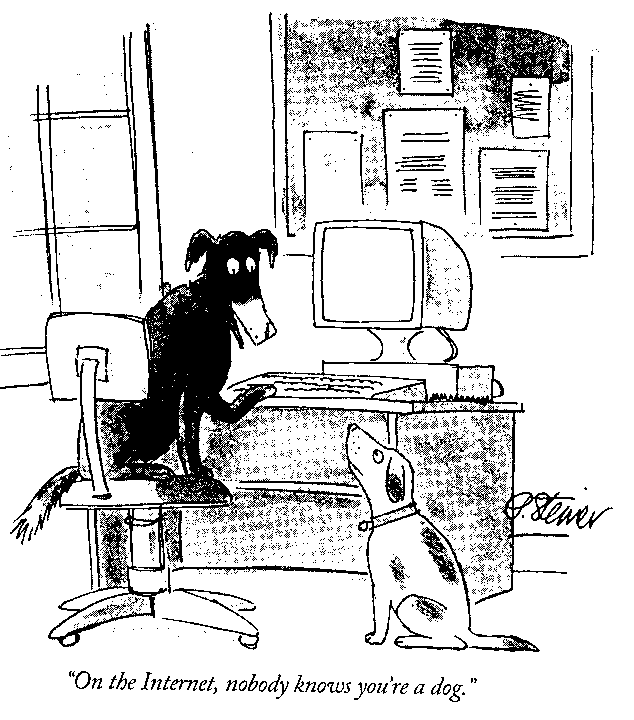 Figure 1. Steiner, P. (1993). The New
Yorker. July 5. 69(20): 61.
Figure 1. Steiner, P. (1993). The New
Yorker. July 5. 69(20): 61.
The point of the cartoon is that it doesn't matter
what you look like--you don't even have to be human--because when
you're "on" the internet no-one can see and judge you according to
your appearance and physical abilities. However, this is actually far
from the case. Long-term computer and internet users, or long term
participants in a particular social space on the internet, can spot
newcomers in a nanosecond based on their online practices, the words
they choose, and other status markers that donít often carry
much eight in meat space, but that have become amplified in cyber
spaces.
eBay, the hugely
popular and ground-breaking person-to-person online auction website
(www.ebay.com)eBay and the eBay discussion lists are
quickly spotted and identified by oldtimers or insiders by the
questions newcomers ask, or the practices they engage in on
eBay itself. For
example, from the discussion list concerning the feedback and ratings
system used on eBay by sellers and buyers to evaluate goods and payments
transactions, one disgruntled oldtimer spells out for newbies the
"right" way to act:
Attention Newbies...Way too quick
on the Negs....
<<ebay ID>> †(10) (view
author's auctions)
3:54pm February 8, 2002
I have noticed a disturbing
pattern. A lot, Iím not saying all, of new people with (0)
feedback are WAY too impatient. They wait 3 days and donít
hear from their buyer and/or seller, then leave negative
feedback.
Something needs to be done about
this...these people need to be educated. If you are new to ebay,
DONíT do this. There are honest people out there, who, for
some reason or another, donít have access to their email or
internet 24/7 like you seem to think.
Also, ebay clearly states that
before leaving negative feedback you should try to contact the seller
via other means first. Remember that people look at your feedback as
well. Just because you have a (0) doesnít mean that people
donít look at the feedback that you have LEFT.
Leaving negative feedback for
someone who doesnít deserve it is almost worse than being a
deadbeat bidder.
Please show courtesy and patience
and make the bidding experience more fun for all. This is supposed to
be fun, not a drag.
The poster of this message identifies key
characteristics that are--at least in the eyes of this seller--signal
flares for "newbie" status: having no feedback themselves, being
impatient, judging harshly, needing to be educated, and seeming to
think sellers have round the clock access to email.
Likewise on Plastic, "outsider" status is
signaled unequivocably by non-registered members being forced to use
a default alias--"Anonymous Idiot"--when posting comments to a
discussion. In addition, the practice of flaming--sending scorching
messages in response to a posting considered ignorant or extreme--and
the presence of regular message posters combined with less regular
participants clearly mark off the boundaries between different groups
of Plasticians.
These meta-language signals--meaningful
combinations of words, representations and actions--show that far
from being the kind of democratic community envisaged by cyberspace
pioneers (e.g., Rheingold 2000), the internet requires users to not
only keep their wits about them, but also to juggle complex
Super-Texts (combining graphics, rating scales, comments or
evaluation statements, reading previous postings before hitting
"send" on one one's own keyed-in message, knowing stuff or knowing
how to get knowledge about stuff, etc.), to watch, listen, read,
reflect and commit to full membership before others will take the
newcomer seriously.
insiders/outsiders
This characteristic of the social spaces of the
internet resonates with John Perry Barlow's conception of new
technology take-up. Barlow, occasional lyrics writer for the Grateful
Dead and co-founder of the libertarian Electronic Frontier
Foundation, has suggested three related distinctions which have to do
with modes of controlling activity in social spaces (e.g.,
controlling values, morals, knowledge, competence, etc.). These
distinctions can be used to distinguish between a mindset that sees
the contemporary world as being essentially the same as before, just
more technologized, and a mindset that approaches the world as having changed
fundamentally in important respects under the impact of the
information revolution.
Barlow's first distinction is between paradigms of
value operating in "physical" space and information/cyber space
respectively. In physical space, says Barlow, controlled economics
increases value by regulating scarcity. To take the case of diamonds,
the value of diamonds is not a function of their degree of rarity or
actual scarceness but, rather, of the fact that a single corporation
owns most of them--and can regulate or control scarcity. Within this
paradigm, scarcity has value. We might note here how schools have
traditionally operated to regulate scarcity of credentialled
achievement--including literacy "success". This has maintained scarce
"supply" and, to that extent, high value for those achievements that
are suitably credentialed. In the economy of cyberspace, however, the
opposite holds. Barlow argues that with information it is
familiarity, not scarcity, that has value. With information,
it's dispersion that has the value,
and itís not a commodity, itís a relationship and as in
any relationship, the more thatís going back and forth the
higher the value of the relationship.
Barlow claims that people don't get this if they
are coming from the industrial-era model (Barlow in Tunbridge
l995).
Barlow's second distinction is between different
ways of looking at well-known issues and concerns associated with
cyberspace. He uses the examples of pornography on the Net and Bill
Gates' apparent manoeuvre to gain control of the internet by bundling
Microsoft's Internet
Explorer browser software with Windows
95/98. There are very different ways of looking at these concerns
depending on whether one comes from the physical space/industrial
mindset or from the alternative mindset associated with understanding
cyberspace. For example, with respect to pornography on the Net,
Barlow rejects the imposition of gross filters. To begin with, they
cannot work, because Net-space simply cannot be controlled in that
way. The more elaborate the filter, the more elaborate the schemes to
find ways around it, and the more powerful these resistances become.
Barlow advocates more local, individualized filters that work on the
principle of people taking responsibility for their choices and
deciding what "noise" they want to filter out.
If you have concerns about your
children looking at pornography the answer is not to eliminate
pornography from the world, which will never happen; the answer is to
raise them to find it as distasteful as you do (Barlow in Tunbridge,
1995: 4).
Similarly, in response to public fears of
Microsoft controlling netspace, the point is that the internet "is
too complex for any one person or organization to create the software
for it" (ibid.). Software development will continue to be organic, to
be shared and dispersed; the development of the open-source Linux
operating system is case in point. Short-term domains of control and
influence will undoubtedly exist, but they cannot become total or
monopolistic because of the very nature of the space.
Barlow's third distinction is between people who
have been born into and have grown up in the context of cyberspace,
on the one hand, and those who come to this new world from the
standpoint of a life-long socialization within physical space, on the
other. We will refer here to the former as "insiders" and the latter
as "outsider-newcomers". This distinction marks off those who
"understand the Internet, virtual concepts and the IT world
generally" from those who do not; that is, it distinguishes between
two very mindsets in relation to new technology use. Newcomers to
cyberspace don't have the experiences, history and resources
available to draw on that insiders have; nor do they have the "deep
understandings" of how different online communities operate, which
actions are socially sanctioned in general, and which are specific to
a particular site or service. And so, to that extent, they cannot
understand the space as insiders do. Barlow believes this distinction
falls very much along age lines. He claims that, generally speaking,
people currently over the age of 30 are outsider-newcomers, whereas
those people currently under the age of 30 are more likely to be
insiders in terms of understanding what the Internet, virtual
concepts and the IT world generally is, and having a real "basic
sense" of how it operates (Barlow in Tunbridge 1995: 3).
Barlow's distinction between insiders and
newcomers is particularly important where cyberspaces and critical
literacy are concerned. Too often, critical literacy teachers forget
or overlook the critical literacies many students bring with them to class and go
about "teaching" critical literacy as though it is something new for
all students. Youth-generated content on the internet, however, shows
us that this is not the case, and that the internet provides the
perfect venue for posting written and visual critiques of inequitable
or disenfranchising social practices that occur in meatspaces as well
as in cyberspaces. Indeed, not all young people need to be "saved"
from themselves through careful and costly filtering and surveillance
systems, and nor do they need to be taught how to use email or
construct websites effectively. Indeed, so-called "minority" students
usually have no need to be taught about a "mainstream" which is most
times clearly visible to them (cf., Prakash and Esteva 1999). Of
course, many children do need to be made more responsible for their own actions on
the internet--and aware of the potential consequences of these
actions--but for now, we argue that there is much to be learned about
critical literacy practices from young cyberspace "insiders" that at
present is not taken into serious account by most adult "newcomers"
to these same spaces.
In what follows, we describe three very different
insider examples of critical literacy practice. We use these examples
to identify key moves in constructing a critical literacy that is
grounded in a thorough and close knowledge of social practices within
different cyberspaces.
chris raettig and the very
important company
The difference between insider and newcomer
practices in cyberspace was thrown recently into high relief by an
exchange between a powerful multinational company and a young man (22
years old)--Chris Raettig--who grew up in a small working class
village in Yorkshire, and now runs a personal website out of a tiny
studio apartment in a suburb of London. Early in 2001, Raettig put
together a webpage of corporate anthems (in the form of hyperlinked
MP3 files). "Corporate anthems", according to Raettig, are "rousing
songs created and recorded by large businesses (for reasons best
known to themselves)" that are "so bad, they [are] good" (Raettig
2001: 1). The webpage was an instant and widespread success, with
people sending in even more anthem files and other websites linking
directly to Raettig's page. This interest in turn attracted a hubbub
of commercial media interest locally, nationally and internationally.
After only a few weeks, Raettig was forced to take down the
hyperlinked music files--leaving only the webpage online--because he
simply did not have enough bandwidth to support the size to which the
webpage had grown (40 megabytes worth of sound files) or the number
of hourly visitors the website was attracting (ibid.). At about the
same time, Raettig received an email from Frank Dunne--"senior
manager of global brand and regulatory compliance" at KPMG, a
financial advice company--whose corporate anthem had featured on
Raettig's website (ibid.). This email read:
FIRST NOTICE
Chris,
A recent audit of Web sites, to
which KPMG is hyperlinked, has revealed that
www.corporateanthems.raettig.org contains a link to KPMG's Web site,
www.kpmg.com. Please be aware such links require that a formal
Agreement exist between our two parties, as mandated by our
organization's Web Link Policy.
We have been unable to locate
records that correspond with an Agreement that permits the linking of
our two Web sites. A relationship may already have been established
with one of our KPMG professionals, in which case we would ask that
their name be provided. If a Web Link Agreement has not yet been
arranged, please feel free to pursue this course of action. However,
we would ask that you please remove the KPMG reference and
corresponding link from www.corporateanthems.raettig.org in the
meantime.
Thank you for your prompt
attention to this matter.
Regards,
Frank Dunne
Sr. Mgr., Global Brand &
Regulatory Compliance
(201) 505-3611
IB&RC Guidelines link:
www.gpp.kworld.kpmg.com/ERM/ (Raettig 2001b: 1)
The genre, tenor, phrasing and business discourse
of Frank Dunne's letter to Raettig may prove powerful in the
meatspace world of old literacies; however, Dunne seriously
underestimated the insider status of Raettig where cyberspace
practices are concerned. Raettig replied,
frank,
i'm not quite sure how a policy
on your part translates into action being required on mine. my own
organisation's web link policy requires no such formal agreement. the
free associative nature of hyperlinking has always been and remains
the central characteristic of the world wide web. one which i would
hope kpmg would be able to embrace - given their decision to make use
of the medium - even if it fails to increase shareholder value, or,
indeed, your vision of global strategy.
if every hyperlink used on the
web required parties at both sides of the link to enter into a formal
agreement, i sincerely doubt that the web would be in existence
today.
however feel free to forward a
copy of your web link guidelines for my review. i shall be taking no
further action at this time.
best regards,
chrisr. (Raettig 2001b: 1)
Raettig posted the email exchange to his website
and, if anything, the media attention was even more frenzied than it
had been prior to the email from KPMG, with the webpage where he had
posted the email exchange between him and Frank Dunne receiving in
excess of 120,000 visitors, or "hits", in the first 36 hours (ibid.),
wide international media coverage (cf., Manjoo 2001), and spawned
countless comments on discussion boards (e.g., Metafilter 2001).
Many of these discussions mercilessly picked apart
at the seams the business discourse used by Frank Dunne in his email
to Raettig, and drew on additional research of the KPMG website and
the like. For example, one poster did a hyperlink search and found a
long list of other websites that linked to the KPMG site--leaving it
to readers to surmise whether or not they, too, had received "first
notice" warnings from Frank Dunne. Another critiqued what he called
the "cheesy intro" on the KPMG website (posted on Metafilter 2001:
1). Yet another poster tested the browser compatability of the KPMG
website after finding a claim on the KPMG website that the company
was interested in demonstrating a close familiarity with new media
and internet technologies. She found that the site didn not work at
all in one browser, would not load in another after cookies (ISP
tracking tracking numbers) were declined, and that the website did
not have any contact telephone numbers listed for the company's
Interactive Division (posted on Metafilter 2001: 1). The "First
Notice" heading on Dunne's email also proved a popular target, with
one poster exclaiming: "FIRST
NOTICE blah! What's their SECOND NOTICE? 'Okay, we warned
ya. Now we're gonna send a big burly guy named Lefty to your house so
he can break both yer legs!' ... if they don't like [the way] the Web
works, get off the Web" (ibid.).
Some of the critical literacy practices
demonstrated by Raettig in his reply to Dunne included checking "the
full set of mail headers, and at least [satisfying] myself as to its
authenticity as a message from the kpgm.com domain" (Raettig 2001a:
1). Subsequent media research and reporting also showed that a Frank
Dunne did indeed exist as an employee of KPMG. Other critical
literacy practices included having insider knowledge of how the
internet functions ("hyperlinking is a central characteristic of the
of the world wide web"), understanding that there is no such thing as
a legally enforceable "web link policy", knowing how to go about
countering an attempt by outsiders to control internet space
(formally regulating hyperlinks would bring about the demise of the
internet), that websites--and the hyperlinks among them--are not
always motivated by profit and gain.
In short, Raettig demonstrated in his reply to
Dunne that he is clearly able to read and write the world of online
spaces and practices as an insider, and in ways an outsider
like Dunne cannot. Indeed, Raettig himself incisively sums up the
"outsider/newcomer" status of KPMG: "it's quite amusing to me that an
organization like kpmg is prepared to demonstrate its lack of
judgement not once (re: that godawful heartfelt anthem) but twice
(displaying a staggering lack of understanding of the web)" (Raettig
2001a: 1). The irony here, of course, is that Raettig does not regard
himself as particularly "politicized", but he does recognize when a
large company is trying to "put one over" him, and, in this case was
able to draw on his understandings of how the world works in
countering these companies' strategies. Not only that, but the medium
of the internet provided Raettig with a resource for alerting regular
readers of his web-based journal--or weblog--of KPMG's "outsider"
moves and mediated a range of fora where others could report and
discuss the event.
Teaching critical literacy in classrooms requires
teachers to know a lot about the world and how it operates (cf.,
Edelsky 1999, Lankshear 1997, Shor 1999). Cases like this remind us
of just how much teachers need to know in order to engage effectively
with cyberspaces and critical literacy. Simply knowing how to
critique the representations of gender in a magazine advertisement or
how to analyse the discourses at work in a newspaper article are no
longer enough. Taking on critical literacy practices in cyberspace
within the classroom will require many teachers to work hard at
obtaining insider--or, at the very least,
insider-like--understandings of a wide range of internet practices.
Worse Than Queer
Mimi Nguyen, 26 years old, is an Asian-American
feminist anarchist, self-described "disaffected grrrl punk rocker"
and the creator of a range of zines including the hardcopy
Slander and the
online Worse Than Queer (Nguyen 2002a: 1). Zines grew out of the 1970s punk rock
scene as fans put together "fanzines" about their favourite
band--biographical details, appearance dates and venues, album
reviews, and the like. These small-run magazines, or just
"zines" for short, were originally typed texts that were
cut and pasted by hand into booklet form and then mimeographed
(Knobel and Lankshear 2002). These zines were distributed during
concerts or via networks of friends and fans. Gradually, these zines
evolved into more personalised locations of expression--and their
topics and themes ranged far beyond the punk rock scene. These days
zines come in all shapes and sizes, forms and media:
Some are just a page or two, others
much longer. They can be photocopied or finely printed, done on the
backs of discarded office papers or on pricey card stock, handwritten
with collages or designed on a computer using different fonts. They
can be purchased for anywhere from ten cents to ten dollars; some are
free, or just the cost of a stamp (Block and Carlip 1998: 4)
And, increasingly, zines are being published on
the internet. Nguyen can be readily considered a pioneer in the
cyberzine world--her zine has now been online for over 5 years (a
long time in the zine world, and even longer where cyberspace is
concerned). Nguyen's cyberzine--and hardcopy--zine grew out of her
desire to network with people of color in the punk music scene
who--like her--were struggling with identity issues. She uses her
cyberzine to deconstruct "Asian-ness" as an anarchist, feminism as a
bi-queer, and race in general as a young graduate student at Berkeley
University. Her goal is to reinscribe long-standing assumptions about
Asian women by refusing to submit to the "Oriental sex secrets" and
"Suzy Wong" Asian personae people foisted upon her (cf. Nguyen in
conversation with Vale 1997: 54): Nguyen includes drawings of herself
on her website depicting herself as a punk rocker complete with
piercings, as shaven-headed and toting a gun, and in martial arts
poses that are definitely "in your face".
Nguyen's writing and artwork are loud voices of
protest, as are her other projects such as exoticize this! (see Figure 2),
a virtual Asian-American feminist community she founded in the late
1990s, and a 1997 compilation zine titled, Evolution of a Race Riot. This
zine was and is "for and about people of color in various stages of
p[unk]-rock writing about race, 'identity', and community" (Nguyen
2002a: 1).
just try it. go ahead.
 exoticize my fist.
|
Figure 2: Front page image from exoticize
this!
(members.aol.com/critchicks)
Mimi's zine work includes a focus on finding ways
to draw attention to assumptions and stereotypes of Asian and
Asian/American women at work in popular media. This includes
critiquing texts in 'underground' magazines that profess to be
anti-establishment and pro-young people (e.g., Maximumrocknroll 1998, issue
198), but that often simply perpetuate images of Asian women as sex
toys or as exotica. She also carries her message in strong,
line-drawn images she creates herself for her online and offline
zines. By these means, Nguyen is creating a space for herself that
grows directly out of the her everyday life as a punk, bi-queer,
Asian/American woman who grew up speaking Vietnamese in Minnesota and
who in the past few years has given over her shaved head and combat
fatigues for red lip gloss and spiky heels. Mimi does not claim that
she is speaking for, or even to, everyone and refuses to make
concessions to non-Asian readers of her zine.
[Mimi] wrote about how someone didn't
enjoy her zine because they claimed they "couldn't relate" (being
some hip white riot grrl type), but Mimi says "duh, of course you
can't relate" (Squeaky n.d.).
Nyugen publicly acknowledges that she maintains
her online weblog-cum-journal, Worse Than
Queer, to "keep [her] critical tongue
sharp and to get the Web's immediate feedback" (Hua 2000: n.p.).
Excerpts from her weblog reveal a deep-seated ability to reflect on
her experiences in theorized ways, which in turn point to the need
for an iterative critical literacy that does not exclude critical
theory, colonial theory, minority theory and the like from critique.
I prepared for the "third wave feminism" panel at
Practicing
Transgression. I wore my
mother's brown leather knee-high boots from the late 70s, black
stockings, the tan shirt dress referencing Girl Scout or office
drone, and a black sweater. I forced a linear narrative out of my
life to make it easy, to organize my thoughts in an arbitrary and yet
deliberate manner. I wrote this story down (call the tabloids: "I was
a punk rocker and feminist theory saved my life") and read it out
loud to a crowded, wood-paneled room. I felt too warm and out of
place. I don't think I perform "woman of color" very well (Nguyen
2002b: 1).
Nguyen's critical literacy practices are semiotic
as well as more conventionally textual--and the medium of the
internet enables her to reach a wide and diverse audience that might
not otherwise read her commentaries or see her images. Mimi does not
shy away from the deep meanings of texts that try to neatly
categorise her as "Asian-American", "feminsist", "punk rocker" and
reminds us that all inscriptions are "up for grabs" and critique.
Nguyen also locates herself within a community of online ziners and
webloggers--popularly known as "bloggers" (Barrett 1999)--by
including hyperlinks within her text to friends' websites, commenting
on recent events in their lives (e.g., being arrested for using the
"wrong gender" toilet, breaking up with a boyfriend), and helping to
create an interconnected web of solidarity and identity-freedom often
missing from the meatspace lives of the people she hyperlinks to. The
internet, it seems, is providing a much-needed non-institutional
medium for a range of people to combine text, images, and social
critique with a sense of connectedness to others.
plastic.com: recycling the
internet
Despite a long-running moral panic that video
games and computers will generate generations of people unable to
read and write or function socially (e.g., Vincent 2002), a range of
online community-based services are proving just the opposite. One of
these sites that specifically targets an 18-30 year old crowd--part
of Barlow's new technology "insider" group--is Plastic. Plastic (www.plastic.com) began in January, 2001, with the aim of being a "new
model" of news delivery, and promising "the best content from all
over the Web for discussion" (Schroedinger's Cat 2002: 1). In short,
this new model of news delivery puts "the audience in charge of the
news cycle as much as possible without devolving into the kind of
ear-splitting echo chamber that's turned 'community' into such a
dirty word" (Joey 2001: 1).
Estimates place the number of regular Plastic
users at around 15,000 (McKinnon 2001: 1). The Plastic community
comprises anyone and everyone, but judging by participants'
usernames, the comments posted and the historical and cultural
reference points used, the majority of participants appear to be male
(although more and more woman are beginning to participate
regularly), American, and mostly 20-and 30-somethings. Although the
gender imbalance--and the ways in which women are "represented" in
different discussions--are fascinating in and of themselves and
worthy of extended analysis and critique, we have chosen instead to
focus on the critical literacy potential afforded by
community-generated discussion sites like Plastic. In general,
participants--or, as they like to call themselves,
"Plasticians"--tend to be self-styled members of an erudite, ironic,
and "plugged in" crowd, interested in quirky takes on anything
newsworthy, as well as in serious and informed discussion of current
events.
One of the most striking things about
Plastic is its
rating and filtering system which participants can use to screen out
comments with low ratings, and read only those rated highly, thereby
saving themselves time in sifting through postings that are worth
reading and those that are not. Although Plastic emulates a long-existing
technology news and discussion website service devoted to a
technogeek audience--Slashdot.com--it is "new" in the sense that it turns "push media" like
email-posted newspaper headlines and news websites on their heads by
having members propose--and publicly comment on--content: "Plastic's
original contribution is a forum to discuss the diverse news pieces
it promotes. At Plastic, readers' comments are what it's all about"
(Barrett 2001: 1).
Items are written up by users and can be submitted
for consideration to one of 8 topic categories: Etcetera,
Film&TV, Games, Media, Music, Politics, Tech and Work. Those
people whose news items are accepted for posting and/or who post
comments on the website are awarded ratings on two dimensions. One of
these is "karma", which is used to rate a participant as an active
member of the community relative to the number of newsworthy or
interesting postings--both in terms of submitting stories and posting
comments on stories--she or he has made to the site overall. A karma
rating of 50 or over generally elevates the poster to the prestigious
role of (volunteer) submissions editor status.
The other rating system used on Plastic--and which is linked
directly to karma--is peer moderation that operates on a scale of -1
to +5 maximum for a posting overall. Non-registered posters are
allocated an initial rating of "0" when they first post a comment,
while the rating baseline for registered users is +1. Moderation
points are awarded by Plastic's editors and by a
changing group of registered Plastic members who have been
randomly assigned the role of moderators by Plastic's editors. Each
moderator is allocated 10 moderating points to award to posted
comments on a Plastic news item, and the possible ratings each
moderator can award are:
|
Whatever 0
Irreleveant -1
Incoherent -1
Obnoxious -1
Astute+1
Clever +1
Informative +1
Funny +1
Genius +1
Over-rated +1
Under-rated +1
|
The moderation points awarded to each post are
tallied and the final score is automatically updated and posted in
the subject line of the message for readers to see. In other words,
"if four or five moderators think a comment is brilliant, it may end
up with a +5; useless comments are moderated down to a -1" (Plastic
2002b: 2).
This ranking practice is based on formal
recognition by the site that users cannot read everything that is
posted on a topic. With a peer ranking system in place, users can set
filters to screen out postings that fall outside a ranking range of
their choice. For example, setting the filter threshold at +3 means
only those comments that have been moderated and score at or above +3
will be displayed. Conversely, setting the filter threshold at -1
means every comment posted will be displayed. Plastic offers this
ranking and filtering function as a means for helping users practise
selective reading and to help enhance the quality of postings to the
site.
The rating and filtering system on Plastic directly mediates
responsible and informed intellectual exchange--users are quick to
pick up on gaps in the logic of others' arguments, flaws in the
accuracy of cited information, and grammatical and punctuation
errors, and to call for evidence in support of posters' claims, and
so on. For example, mischief (2002: 1) comments in response to a
story in the politics section of Plastic about George W. Bush's plan
to expand citizen service programs:
What kind of program will this be? Mandatory
or volunteer? If people wanted to volunteer, they would just do it
already. That is the meaning of "volunteer", but Balzar shoots
himself in the foot with his statement, "Teaching good deeds is not
the point. Expecting them is." What does he mean by "expecting"?
Later in this same discussion, ddp42 (2002: 1)
points out some anomalies in relation to this proposal and others
made by George W. Bush:
This administration seems to have a split
personality.
Be alert for terrorists - but get
back to normal.
Buy, Buy, Buy to help the economy
(presumably this requires some considerable amount of work time for
those fortunate enough to have jobs) - but spend your time in
community service.
--What about protesting against a
war, a nuclear power plant, some environmental degradation? Surely
these are often actions of citizens concerned about the nation's
health, safety, quality of life. Do they count as "community
service?"
And Phaedrus responds to another poster in the
same discussion (quotes from this poster are in italics in Phaedrus'
post and the convention is maintained here as well):
Is encouraging volunteerism a good thing? If
it is, what do you care is GWB's motivations? If said motivations are
bad, must I give up volunteering? Think about it.
I have thought about it. Let me
give you an example of why oversimplification of the sort you've
indulged in here can be a bad idea. Good idea: everyone should have
car insurance. 15 years ago, this was promoted by the insurance
industry in California, and was generally accepted as a good idea.
Subsequently, a law was passed making it mandatory to have auto
insurance, with a fine if you didn't. The result was that insurance
rates skyrocketed, and the very people who were promoting the idea
got rich. Sometimes, ideas that look good on the surface have complex
underpinnings that you only understand if you stop and consider the
motives of the people promoting said ideas. Sorry if I destroyed your
idea of the world as a simple, black-and-white kind of place.
As for Bush's motivations in
joining politics, believe me there are far easier ways to "look out
for your own interests" than setting yourself up to be pissed on by
all and sundry. Who needs the aggravation?
Not if you want to affect policy in
such a way that you and your rich friends can manipulate the system
so you can benefit at the expense of other people. Bush has always
been rich; he just wants to make sure that he stays that way.
Discussions on Plastic rarely reach a consensus
opinion on a news item--and discussions can be a polyphony of voices
sharing equal line and byte space and equally contributing to
broadening readers' perspectives on an issue. On the flipside,
Plastic is just
as easily a tit-for-tat exchange of snide, personal attacks. And of
course, the moderation and karma system on Plastic does not necessarily
ensure a harmonious community of users. "Meta-discussions" involving
litanies of complaints about being moderated down a point, or "modded
down" unfairly--or being a victim of "downmod" attacks, where a
moderator flushes out all your postings and moderates them down
regardless of content--are common. And, despite some posters loudly
and repeatedly protesting that they do not care about their overall
karma, karma ratings--and the moderation system overall--are indeed
"a new arithmetic of self-esteem" on Plastic (Shroedinger's Cat 2002:
1). At stake is public recognition of a poster's incisive mind,
keen-edged humour, "innate hipness", and of being "plugged in"
(Plastic 2002a: 1).
Nevertheless, despite the darker side of the
Plastic community, most users would rather have the rating system
than not. As MayorBob, a well respected member of the Plastic
community, explains: "The nice thing about the karma [rating system]
is that, when you're not getting downmod assaulted, you do get a
little feedback on whether you are making sense or getting your point
across" (MayorBob 2001: 1). This is an important insight for
educators interested in promoting critical literacy in classrooms. In
the rush to ensure that all students have a "voice" in class, we
cannot overlook our responsibility to ensure that what students are
saying makes good logical sense, is well-informed from a range of
perspectives and verified information sources, and is well worth
listening to. Otherwise, teachers risk having students being silenced
outside classroom contexts by those who expect real critique and
discussion rather than uninformed commentary.
Giving a real voice to students--one that will
make others sit up and pay attention--requires teachers to equip them
not only with a range of critical literacy tactics (e.g., Knobel and
Healy 1998); but also with a range of meta-level understandings of
how to:
- Construct effective arguments in ways that go
beyond a hackneyed five-part structure (e.g., able to identify and
evaluate empirical, conceptual and normative claims; able to build
a logically sound argument; able to use cohesive ties to maximum
effect)
- Support claims with evidence or references to
authoritative sources
- Locate, compare and evaluate information
sources
- Develop situated criteria for evaluating other
peopleís arguments and information sources, and
- Look for the "deep meaning" in what someone
says (cf., Knobel and Lankshear 2001).
It also includes creating a supportive and
respectful environment where students are not afraid to critique what
peers say, or to have the arguments they put forward critiqued in
informed ways. In addition, any critical literacy teaching that
engages with online spaces needs to also equip students with the
wherewithal for quickly summing up the nature of socially valued
practices and ways of speaking/doing within an online community in
order to be able to participate seamlessly as an
"insider", rather than having to suffer criticisms for
not acting or speaking/writing in a "proper" manner. The
kinds of ethnographic methods for tapping into local cultural
knowledge developed in the work of Shirley Brice Heath (e.g., 1983)
and Luis Moll (e.g., 1992) remain directly relevant to critical
literacy pedagogy.
It goes without saying that dynamic relationships
exist between technologies and the practices in which they are
employed. On one hand, the development of new technologies creates
conditions in which people can change existing social practices and
develop new ones, as well as change and develop new literacies that
are integral parts of these new or changing practices. On the other
hand, these practices simultaneously "constitute" the technologies
involved as cultural tools, and shape what they mean and, indeed, what they
are within the
various contexts in which people use them.
Literacy and technology are never "singular",
never the "same thing". "They" are always "so many things" when in so
many hands. The same alphabetic code can be used for writing notes to
one's children or for publishing sophisticated experimental findings
in learned journals. It can be used for writing good wishes to
friends and for writing extortion notes to intended victims. The same
kind of ambiguity and range is open to practically any tool or body
of knowledge and information we care to name. The same is true of
more specific literacies, including different forms of peer feedback
and rating systems and the effects they have on texts and spaces. We
need only to think of the uses to which various kinds of referees'
reports can be put for the point to be perfectly clear. The
particular "silicon literacy" of producing (or withholding) content,
ratings and feedback shares the formal character of all literacies
(different people put it to different uses, understand it
differently, etc.). It is susceptible, then, to the same "play" of
moral, civic, and emotional forces--the way that people are and how
they live out their (in)securities, pleasures and pains, values and
aspirations, and so on.
conclusion
Educators cannot hope to engage in critically
literate ways with the new social spaces of the internet without
working at knowing "how to make the next move" in the language game
of cyberspace. A key element associated with insider practice of
critical literacy activity in cyberspace is tied directly to the
Wittgensteinian notion of "knowing how to go on" in the absence of
rules and prior experience (Wittgenstein 1953: 105). "Knowing how to
go on" conceives knowing as making, doing and acting in the process
of becoming fluent in, or having mastery of, something (Lankshear,
Peters and Knobel 2001). Chris Raetting is exemplary in demonstrating
what it means to know "how to go on" in the absence of precedents or
already-established social mechanisms (and, flipside, KPMG provides
us with the perfect example of mistakenly thinking "how to go
on" is the same in cyberspace as it is in meatspace).
What the three cases we have presented in this
paper suggest is that the internet affords viable spaces and for a
for producing or
enacting
critical literacy. Too often in classrooms critical literacy becomes
an exercise in critical literacy consumption on the part of students,
with little room for students to suggest their own approaches to
critiquing power, language use and social practices. These three
cases are not unique on the internet, but they do signal at least
some of the things teachers are likely to need to know--about the
internet, how it is or can be used, how to conduct oneself while in
it as a newcomer and as an insider, etc.--if their classroom critical
literacies are to have any purchase in the lives of students.
bibliography
AAUW (American Association of University
Women) (2000). Tech-Savvy: Educating Girls
in the New Computer Age. Online
http://www.aauw.org/2000/techsavvybd (accessed15 February 2002).
Barrett, C. (1999). Anatonomy of a WebLog.
CamWorld. 26
January. Online. http://www.camworld.com/journal/rants/99/01/26.html (accessed 2 February 2002).
Barrett, A. (2001). Plastic.com Invites Visitors
to Shape the Site. PCWorld.com. Monday, January 22.
Online http://www.pcworld.com/news/article/0,aid,39013,00.asp (accessed 10 February 2002).
Bennahum, D. (1998). Extra Life: Coming of Age in Cyberspace. New York: Basic Books.
Blair, T. (1997). Connecting the Learning Society:
The Government's Consultation Paper on the National Grid for
Learning. Online http://www.dfee.gov.uk/grid/consult/ (accessed 26 July 2001).
Burke, B. (1999). Meeting Gneration Y.
NUA Analysis.
July. 1(84). Online http://www.nua.ie/surveys/analysis/weekly_editorial/archives/1999/issue1no84.html (accessed3 February 2002).
ddp42 (2002). Right message (maybe)ówrong
messenger? Plastic. Online http://www.plastic.com/article.pl?sid=02/02/14/0128256&mode=nested&threshold=1 (accessed14 February 2002).
Edelsky, C. (1999). Making Justice Our Project: teachers Working Toward
Critical Whole Language Practice. Urbana,
IL: National Council of Teachers of English.
Fischer, C., Hout, M. Jankowski, M., Lucs, S.,
Swindler, A. and Voss, K. (1996). Inequality by Design: Cracking the Bell Curve
Myth. Princeton, N.J.: Princeton
Unviersity Press.
Gee, J. (2002). Millennials and Bobos,
Blue's Clues and
Sesame Street: A
Story for Our Times. In D. Alvermann (Ed.), Adolescents and Digital Literacies. New York: Peter Lang (in press).
Gee, J., Hull, G. and Lankshear, C. (1996).
New Work Order: Behind the Language of New
Capitalism. Sydney: Allen and
Unwin.
Gilster, P. (1997). Digital Literacy. New York: John
Wiley & Sons Inc.
Gould, S. (1996). The
Mismeasure of Man. New York:
Norton.
Goodson, I., Knobel, M., Lankshear, C. and Mangan,
M. (2002). Social Spaces/Cyber Spaces:
Culture Clash in Computerized Classrooms.
New York: Palgrave Press (in press).
Haraway, D. (1991). Simians, Cyborgs, and The Re-invention of
Nature. New York: Routledge.
Heath, S. (1983). Ways
With Words: Language, Life and Work in Community and
Classrooms. Cambridge: Cambridge
University Press.
Howe, N. and Strauss, N. (2000). Millennials Rising: The Next Great
Generation. New York: Vintage Books.
Hua, V. (2000). The zine scene. San Francisco Examiner. 19
November. Online http://www.sfgate.com/cgi-bin/article.cgi?file=/examiner/hotnews/stories/12/Bzines.dtl&type=business (accessed 25 July 2001).
Ipsos-Reid (2001). Talking into the Unknown. Media
release. Online http://www.ipsos-reid.com/media/content/displaypr.cfm?id_to_view=1159 (accessed 2 January 2002).
Ipsos-Reid (2002).
Canadian Families and the Internet. Online
http://www.ipsos-reid.com/media/content/displaypr.cfm?id_to_view=1405 (accessed 2 February 2002).
jbou (2002). "I was wrong about Bart".
Plastic. Online
http://www.plastic.com/article.pl?sid=02/02/13/1731211&mode=nested (accessed13 February 2002).
Joey (2001). Anatomy of a Plastic Story.
Plastic. Online
http://www.plastic.com/01/01/15/0223203.shtml (accessed10 February 2002).
Kamler, B. (2001). Relocating the Personal: A Critical Writing
Pedagogy. Albany, N.Y.: State University
of New York Press.
Kaplan, D. (2001). Kids, Teens and The Internet in
the Developed World: A Synthesis of Existing Surveys. Online
http://www.newuses.net/docs/Kids,%20Teens%20and%20the%20Internet.doc
(accessed 2 February 2002).
Kincheloe, J., Steinberg, S. and Gresson, A.
(Eds.) (1996). Measured Lies: The Bell
Curve Examined. New York: St Martin's
Press.
Knobel, M. and Healy, A. (1998). Critical Literacies in Primary Classrooms. Newtown, NSW: Primary English Teaching
Association.
Knobel, M. and Lankshear, C. (2001).
Maneras de Ver: El Analisis de Datos en
Investigacion Cualitativa. Morelia:
Instituto Michoacano de Ciencias de la Educacion.
Knobel, M. and Lankshear, C. (2002). Cut, paste,
publish: The production and consumption of zines. In D. Alvermann
(Ed.), Adolescents and Digital
Literacies. New York: Peter Lang (in
press).
Kress, G., Jewitt, C., Ogborn, J. and Tsatsarelis,
C. (2001). Multimodal Teaching and
Learning. London: Continuum.
Lankshear, C. (1993). Curriculum as literacy:
reading and writing in "New Times". In B. Green (Ed.),
The Insistence of the Letter: Literacy
Studies and Curriculum Theorizing. London:
Falmer Press. 154-174.
Lankshear, C. (1994). Critical Literacy. Canberra:
Australian Curriculum Studies Association.
Lankshear, C. (1997). Changing Literacies. Buckingham:
Open University Press.
Lankshear, C. and Knobel, M. (1998). Critical Literacy
and New Technologies. Paper presented at
the American Education Research Association Annual Conference. San
Diego. April.
Lankshear, C. and Knobel, M. (2002). Young
children and the National Grid for Learning. Journal of Early Childhood Literacy. 2(2). (forthcoming).
Lankshear, C., Peters, M. and Knobel, M. (2001).
Information, knowledge and learning: Some issues facing epistemology
and education in a digital age. In M. Lea and Nicoll, K. (Eds.),
Distributed Learning: Social and Cultural
Approaches to Practice. London:
Routledge.
Lenhart, A., Rainie, L. and Lewis, O. (2001).
Teenage Life Online: The Rise of the
Instant-Message Generation and the Internetís Impact on
Friendships and Family Relationships.
Washington, DC: Pew Internet and American Life. Online http://www.pewinternet.org/reports/pdfs/PIP_Teens_Report.pdf (accessed 3 February 2002).
McKinnon, M. (2001). One Plastic Day.
Shift Magazine.
9(4): 1-3. Online http://www.shift.com/mag/9.4/html/9.4feature001.asp (accessed10 February 2002).
Manjoo, F. (2001). Big stink over a simple link.
Wired. December
6. online
<http://www.wired.com/news/print/0,1294,48874,00.html>
(accessed 15 January 2002).
MayorBob (20020). "This kind of karma attack has
happened". Plastic. Online http://www.plastic.com/media/01/10/03/2149248.shtml (accessed13 February 2002).
Metafilter (2001). Letís make today Link
KPMG Day. Metafilter. Online http://www.metafilter.com/mefi/12831#comment (accessed 15 January 2002).
mischief (2002). Vaporware. Plastic. Online http://www.plastic.com/article.pl?sid=02/02/14/0128256&mode=nested&threshold=1 (accessed 14 February 2002).
Moll, L. (1992). Literacy research in community
and classrooms: a sociocultural approach. In R. Beach, J. Green, M.
Kamil and T. Shanahan (Eds.), Multidisciplinary Perspectives on Literacy
Research. Urbana, IL: NCRE/NCTE.
211-244.
Neilsen, J. (1998). Microcontent: How to Write
Headlines, Page Titles, and Subject Lines. Alert Box. September 6. Online
http://www.useit.com/alertbox/980906.html (accessed 3 February 2001).
Nguyen, M. (2002a). Manifesto for my revolution.
Worse Than Queer. Online http://www.worsethanqueer.com/slander/intent.html (accessed 16 February 2002).
Nguyen, M. (2002b). Front Page. Worse Than Queer. February 13.
Online http://www.worsethanqueer.com (accessed 16 February 2002).
Noble, D. (1999). The
Religion of Technology: The Divinity of Man and the Spirit of
Invention. New York: Penguin.
NOIE (National Office for the Information Economy)
(2000). Strategic Framework for the
Information Economy. Online http://www.noie.gov.au/projects/information_economy/strategic_framework/index.htm (accessed 3 February 2002).
Oftel (Office of Telecommunications) (2002).
Consumers' use of Fixed Telecoms Services:
Oftel Residential Survey. 7 November 2001.
London: Office of telecommunications. Online http://www.oftel.gov.uk/publications/research/2002/q7_fixed_res.htm#c2 (accessed 2 February 2002).
Pastore, M. (2002). Internet Key to Communication
Among Youth. Cyberatlas: Big Picture
Demographics. Online http://cyberatlas.internet.com/big_picture/demographics/article/0,,5901_961881,00.html
(accessed 2 February 2002).
Plastic (2002a). Plastic. Online http://www.plastic.com (accessed 13 February 2002).
Plastic (2002b). Guide to Moderating Comments at
Plastic. Plastic. Online http://www.plastic.com/moderation.shtml (accessed 13 February 2002).
Phaedrus (2002). Re: I am amazed by the bitterness
and cynicism ... Plastic. Online http://www.plastic.com/article.pl?sid=02/02/14/0128256&mode=nested&threshold=1 (accessed 14 February 2002).
Prakash, M. and Esteva, G. (1998). Escaping Education: Living as Learning Within Grassroots
Cultures. New York: Peter Lang.
Raettig, C. (2001a). Analysis and thoughts
regarding kpmg (warning: maximum verbosity!). Chris Raettig--Personal Website.
Online. http://chris.raettig.org/email/jnl00040.html (accessed 15 January 2002).
Raettig, C. (2001b). Re: KPMG Web Link Policy -
1st Notice. Chris Raettig--Personal
Website. Online http://chris.raettig.org/email/jnl00036.html (accessed 15 January 2002).
Rheingold, H. (2000). The Virtual Community. Boston,
M.A.: MIT Press.
Rhode, G. and Shapiro, R. (2000). Falling Through The Net: Toward Digital
Inclusion. Washington, C.D.: U.S.
Department of Commerce, Economics and Statistics Administration, and
the National Telecommunications and Information Administration.
Online http://www.ntia.doc.gov/ntiahome/fttn00/Front00.htm#Mineta (accessed 2 February 2002).
Rowan, L., Knobel, M., Bigum, C. and Lankshear, C.
(2002). Boys, Literacies and Schooling: The
Dangerous Territories of Gender-based literacy Reform. Buckingham: Open University Press.
Rushkoff, D. (1996). Playing the Future: How Kids' Culture Can Teach Us to
Survive in an Age of Chaos. New York:
Harper Collins.
Schroedinger's Cat (2002). First
Plastiversary--Happy Birthday, Plastic! Plastic. Online http://plastic.com/article.pl?sid=02/01/09/0235209&mode=thread&threshold=0 (accessed 15 January 2002).
Searle, C. (1998). None
But Our Words: Critical Literacy in Classroom and
Community. Buckingham: Open University
Press.
Shor, I. (1999). What is critical literacy? In I.
Shor and C. Pari (Eds.), Critical Literacy
in Action: Writing Words, Changing Worlds.
Portsmouth, N.H.: Boynton/Cook.
Stone, A. (1996). The
War of Desire and Technology at the Close of the Mechanical
Age. Boston, M.A.: MIT Press.
Tapscott, D. (1998). Growing Up Digital: The Rise of the Net
Generation. New York: McGraw-Hill.
Tunbridge, N. (1995). The Cyberspace Cowboy.
Australian Personal
Computer. September. 2-4.
Vincent, N. (2002). Anarchoterrorists cut their
teeth on video games. Los Angeles
Times. January 31. Online http://www.latimes.com/news/printedition/California/la-000007741jan31.story (accessed 1 February 2002).
Wertheim, M. (1996). Pythagoras' Trousers: God, Physics and the Gender
Wars. London: Fourth Estate.
Wittgenstein, L. (1953). Philosophical Investigations.
London: Basil Blackwell & Mott.
back to work
index / back to
main index