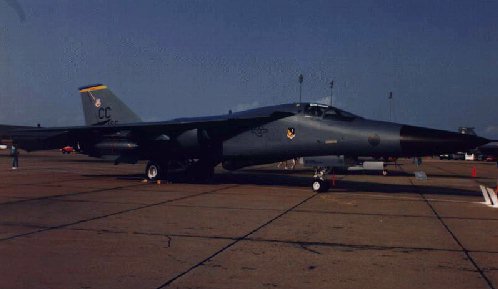
The controversial F-111 was developed out of the TFX program. The program called for a joint service tactical fighter with a requirement of long range interception and deep strike indicator. The F-111 introduced the sweep wing concept and escape capsule. It also housed the ill powered TF-30 engine. The F-111 has received a numerous amount of criticism from both the media and congress especially for the F-111B program for the Navy. The F-111 probably had received more criticism then any other aircraft in the jet fighter era but it has matured into one of the most combat lethal operational aircraft in the USAF inventory. The F-111 design was not, as everyone though back then, a disastrous failure. The early problem associated with F-111 was that it was a very advanced aircraft, which incorporates a lot of then unproven technology and the lack of spare parts available also hindered the operation. The 474th Tactical Fighter Wing at Canon, New Mexico, which later moved to NELLIS AFB at Nevada was the first Wing to receive the F-111.
In March 1968, 6 F-111A left Nellis AFB to participate in the Vietnam war under project Combat Lancer, the project was a disaster for the F-111 which saw them being pulled out in November after losing a considerable amount of F-111. One of the major reason of the loss was that the F-111 has not completed its operational test program and its entry to the war was premature. The F-111 did not saw action again in the Vietnam War until September 1972. The F-111 finished its deployment in 1973 when the cease fire was signed, the F-111 has flown more then 3000 sorties and is cable of carrying 5 F-4 phantoms bomb load and doesn't need any fighter escort or ECM support aircraft. The F-111 proved to be a superior strike fighter for the USAF but now, most F-111models are not in service with the USAF anymore. Although the F-111 did not have an official nickname until its retirement, the F-111 was commonly known as "Aardvark" for its long nose.
|
F-111A | a total of 141 F-111A was delivered. It participated in the Vietnam campaign (Linebackers) before being pulled out. |
|
F-111B | the controversial naval fighter never succeeded. Its heavy weight and high carrier landing approach never made it suitable for naval operation. The cancellation of the F-111B led to the birth of the VFX program and later the mighty F-14 Tomcat. |
|
F-111C | from 1973, Australia received 24 F-111C; the C version was an intermediate version of F-111A, the F-111B, and the FB-111A. The F-111C inherited the F-111B larger wingspan and obtained 8 hard points. |
|
F-111D | The F-111D was powered by a pair of Pratt & Whitney TF30-P-9 engines, each rated at 12,000 lb.s.t. dry and 18,500 lb.s.t. with afterburner. It also housed digital avionics. The F-111D proved to be quite successful but the D version proved to be maintenance intensive and was officially retired in late 1992. |
|
F-111E | Due to the delay production of the D class. The Airforce decided to go ahead with the E version. The E version included the TF30-P-3 turbofan engine and AMP-avionics upgrade. The E version is the only early generation F-111 still operating in the USAF. |
|
F-111F | the F version was the last version of the F-111 model for the TAC. It introduced a less sophisticated, but more reliable avionics system and a pair of up rated TF30-P-100 engines. The F-111F participated in the Libyan strike, it also participated in the Gulf War attacking Iraqi C&C. The F-111F proved to be very successful. |
|
F-111G | the G version is just FB-111A converted into tactical configuration. Australia also bought 6 F-111Gs. |
|
F-111K and TF-111K | ordered by the UK but due to budget strains the order was canceled. |
|
FB-111 versions | The FB-111 A and B is an all-weather strategic bombing version, The FB-111 was the first F-111 to carry the Triple plow II intake. FB-111 H was proposed to compete against the B-1B lancer but never got off the paper. |
|
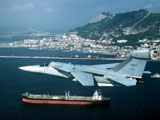
EF-111 Raven | manufactured by Grumman the Raven is used as the airforce primary ECM aircraft.
|
The F-111 has variable-sweep wings that allow the pilot to fly from slow approach speeds to supersonic velocity at sea level
and more than twice the speed of sound at higher altitudes. Wings angle from 16 degrees (full forward) to 72.5 degrees (full
aft). Full-forward wings give the most surface area and maximum lift for short takeoff and landing. The F-111 needs no drag
chute or reserve thrust to slow down after landing.
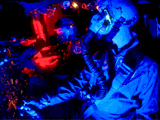
The two crew members sit side-by-side in an air-conditioned, pressurized cockpit module that serves as an emergency escape
vehicle and as a survival shelter on land or water. In emergencies, both crew members remain in the cockpit and an explosive
cutting cord separates the cockpit module from the aircraft. The module descends by parachute. The ejected module includes a
small portion of the wing fairing to stabilize it during aircraft separation. Airbags cushion impact and help keep the module afloat
in water. The module can be released at any speed or altitude, even under water. For underwater escape, the airbags raise the
module to the surface after it has been severed from the plane.
The aircraft's wings and much of the fuselage behind the crew module contain fuel tanks. Using internal fuel only, the plane has
a range of more than 2,500 nautical miles (4,000 kilometers). External fuel tanks can be carried on the pylons under the wings
and jettisoned if necessary.
The F-111 can carry conventional as well as nuclear weapons. It can carry up to two bombs or additional fuel in the internal
weapons bay. External ordnance includes combinations of bombs, missiles and fuel tanks. The loads nearest the fuselage on
each side pivot as the wings sweep back, keeping ordnance parallel to the fuselage. Outer pylons do not move but can be
jettisoned for high-speed flight.
The avionics systems include communications, navigation, terrain following, target acquisition and attack, and suppression of
enemy air defense systems. A radar bombing system is used for precise delivery of weapons on targets during night or bad
weather.
The F-111's automatic terrain-following radar system flies the craft at a constant altitude following the Earth's contours. It
allows the aircraft to fly in valleys and over mountains, day or night, regardless of weather conditions. Should any of the
system's circuits fail, the aircraft automatically initiates a climb.





 Inside F-111
 EF-111A Raven
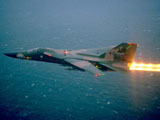 F-111F flying over England
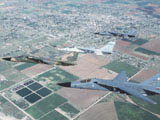 EF-111 and F-111E/F in formation

 Get your own Free Home Page