| The New Mass
The new Mass differs from the old first and foremost in its rubrics and prayers. Many gestures such as the sign of the cross, kneeling, striking the breast, and genuflections, which were originally employed to express reverence and faith have been removed or significantly curtailed, and many ancient prayers such as those recited at the foot of the altar and at the Offertory have either been removed or replaced with what many traditionalists argue are ugly formulas that do not express the Catholic Faith.
The Offertory prayers compared:
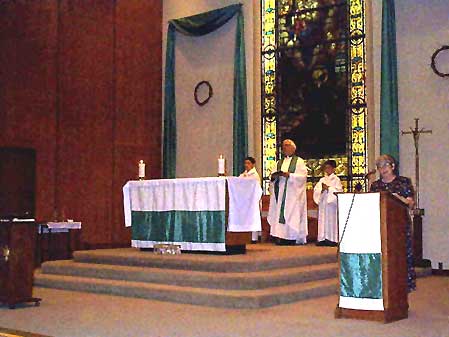
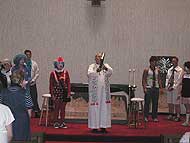
A great deal more emphasis is placed on the community in the new Mass and this can be seen in its general externals. For instance, the altar generally faces the people and need only be a simple table design. The priest prays in an audible voice in the language of the people, and he is encouraged to behave like an entertainer. Laypersons are encouraged to enter what was formerly the sanctuary and assume many of the roles formerly reserved for the ordained (e.g., the readings of scripture or distribution of Holy Communion). And less concern is given to the costly nature of appurtenances such as vestments, chalices, and patens. Prior to Vatican II much more emphasis was placed on the glory and honour of God, and much less on the community. The altar faced east, the priest prayed with his back to the people, often in an inaudible tone, and the whole Mass was conducted in sonorous Latin. The sanctuary was cordoned off from the main body of the church by a rail or screen in the style of the Holy of Holies in the Jewish temple, and laypersons were not allowed to enter there without special permission. A great deal of emphasis was placed on the resplendence of furniture and appurtenances. For instance, the altar needed to contain the relics of a Saint, it had to be made of stone, mounted above steps and built under a crucifix, and it was to be adorned by such things as a throne, a reredos, gradines mounted with candles, and three altar linens. Appurtenances such as vestments, chalices, and patens, also had to be of a costly nature — the latter had to be at least gilt if not gold.
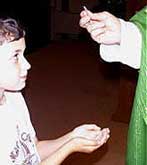
Traditionalists also take issue with the idea that laypersons can now touch the consecrated host. Prior to Vatican II the priest alone was allowed to touch the host. Communion was distributed directly on the tongue, and the priest was not allowed to separate his thumb and forefinger out of respect for the particles of the host until after an ablution. In fact, laypersons were not even allowed to touch important items used on the altar such as the paten and chalice.
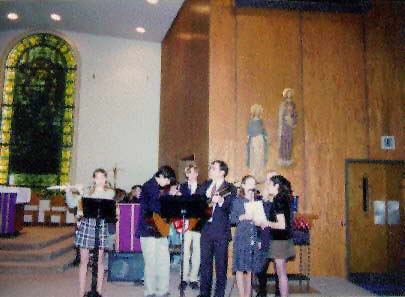
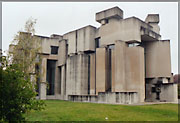
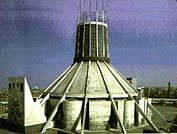
Other matters traditionalists often take issue with are the general design of modern churches, comportment within them, and music. They argue that modern churches built specifically for modern worship are no longer of a splendorous design built to the glory and honour of God, instead they generally resemble utilitarian function rooms. They argue that people are no longer encouraged to comport themselves in a respectful manner in church — they dress inappropriately, even scandalously, and they no longer maintain a respectful silent before the Blessed Sacrament, all of which indicate a catastrophic loss of faith. As for music, many traditionalists deplore the use of theologically questionable hymns and music of a pop style, which many deem base. Prior to Vatican II Gregorian chant and sacred polyphony were used in the Roman Rite. Vernacular hymns were tolerated after Low Mass, but they were of a more dignified and devotional nature.
Extremes:
Some traditionalists also question the Sacramental validity of the new Mass. Transubstantiation is the belief that the substance of bread and wine are changed into Christ's body, blood, soul, and divinity in the Mass, and the Church teaches that three things are essential for transubstantiation to be effected: form, matter, and intention. 'Form' are the words used to effect transubstantiation, 'matter' the physical bread and wine, and 'intention' the inward intent of the priest. If either of these things is lacking then the Mass is invalid. Some traditionalists argue that, since the words of consecration have been changed in the new Mass, then the Mass is objectively always invalid. Others point out that, often in the new Mass incorrect matter such as buns or grapejuice are used instead of bread and wine, therefore it is often invalid. While others point out that a lack of faith is so prevalent among modern priests that the intention to actually bring about transubstantiation is lacking, and, again therefore, the new Mass is often invalid.
The prayers of Consecration of the Wine compared:
|