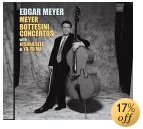
Concertos For Double Bass ~ Edgar Meyer
Sony - #60956
ASIN: B0000667R3
reviewed by Christopher Coleman for amazon.com
5 stars for performance, 3 for composition = 4 starsSome instruments have a depressingly small repertoire; the double bass is unquestionably one of these. Although Beethoven wrote gorgeous sonatas for cello and piano, he was not tempted to try a solo work for the cello's big brother. Neither Tchaikovsky nor Mendelsohnn put pen to paper for a Concerto for Bass and Orchestra; it did not occur to Brahms to follow his Alto Rhapsody with an instrumental version down several octaves. And so bass players must either scour the music archives for works by second or third tier composers, write something themselves, or play transcriptions of works originally composed for their more popular cousins. Edgar Meyer has previously given us the latter, with his performances of the Bach Cello Suites. In this CD he tries both the two former approaches, composing two concertos, and resurrecting two works by the Italian Giovanni Bottesini (1821 - 1889). Bottesini was himself a bassist, and only incidentally a composer. He was a contemporary of both Richard Wagner and Giuseppe Verdi, but his music is firmly rooted in the Classical period, with little apparent interest in the harmonic, melodic and rhythmic innovations of his time. As such, it is at best pleasant music, rather like mediocre Haydn. Meyer spices up the Bottesini by adding his own cadenza, which helps quite a bit. Meyer's cadenza in the last movement of Bottesini's Second Concerto for Double Bass and orchestra is the unquestionable highlight of the piece.
Edgar Meyer is probably best known to Classical music lovers for his collaborations with Yo-Yo Ma and Mark O'Connor on the Appalachian Journey and Appalachia Waltz CDs. Like Ma, O'Connor, and any number of current virtuosi from Nigel Kennedy and Richard Stolzman to Vanessa-Mae, he branches out to a wide variety of styles, from Jazz to Bluegrass to Classical, often blending two or more approaches in a single piece. But in this CD Meyer plays a more straightforward role. Listeners hoping for the unbridled Americana of some of his other projects may be disappointed. Although an occasional bluesy inflection or jazzy syncopation comes through, on the whole these works are grounded in the Classical or neo-Classical tradition. George Gershwin's Rhapsody in Blue is a hundred times jazzier than either Meyer concerto contained here. Meyer's Double Concerto for Cello, Double Bass and orchestra is the more accessible of his two concerti. Even here the context is not pure jazz or blues, though; for example the second movement contains the most overtly jazzy passage in the CD, with Meyer's pizzicato bass counterpoint to Yo-yo Ma's cello melody. Even here the jazzy passage is surrounded by an odd patchwork of contrasting musical textures, one almost minimalist, one somewhat reflective of sixteenth century counterpoint.
There is no question of Meyer's virtuosity as a performer. He has technique to spare, an impeccable sense of intonation and a real mastery of his admittedly awkward instrument. That he often fingers pitches with only a single digit to create a more "vocal" sound, makes his performance more astounding. But as an apparently self-trained composer (the Sony website only mentions his bass teachers and nothing about any composition studies, and I've been unable to find any information about such), Meyer ranks only somewhat better than Bottesini. What technique he has as a performer, he lacks as a composer; and compositional technique is one of those things you don't appreciate until it is missing. Like Bottesini, Meyer is essentially conservative, and these pieces too often lack a strong sense of drama and gesture; furthermore the basic material is neither harmonically nor melodically compelling. His compositional strengths lie in his superb understanding of his solo instrument and in creating interesting textures and rhythms. Like fellow performer/self-taught composer Mark O'Connor he relies too often on repetition as the main method of development. After you've heard the Meyer Concertos you are more likely to be impressed with his playing than you are to hum the tunes--as display pieces they are wonderful, but they don't attain greatness. Again, at its best the music is quite pleasant and enjoyable, but I doubt it will have a lasting appeal for most listeners. Certainly the Meyer Concerti are not the equal of the Dvorak Cello Concerto, the Beethoven "Emperor" Concerto, the Mendelsohnn Violin Concerto; nor do they achieve the quality of twentieth century works like the Bartok Piano Concerti or John Corigliano's Clarinet Concerto. Bass players will have to keep waiting for their masterpiece. But while they are waiting, we can still enjoy Meyer's fabulous performances on this disc.