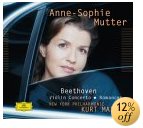
Beethoven: Violin Concerto, Romances; Anne-Sophie Mutter, Kurt Masur, New York Philharmonic
Universal - #471349
ASIN: B00005OC0G
reviewed by Christopher Coleman for amazon.com
From the opening subdued timpani notes to the final glorious romp, violinist Anne-Sophie Mutter and the New York Philharmonic directed by Kurt Masur give us a thoroughly convincing performance of the Beethoven Violin Concerto. Called "the greatest young musical talent since the young Menuhin" by conductor Herbert von Karajan, Mutter has become one of the preeminent performers of our time. Although twentieth-century music is her specialty, Mutter is equally at home with the great Romantic and Classical music. This CD groups the Beethoven Violin Concerto with his two lesser-known Romances for Violin and Orchestra. Predating the larger work, these Romances have the character of the inner, slow movement of the concerto; introspective and melodic rather than bombastic virtuoso display. Lovely as these works are, especially the second Romance, it is surely Mutter's performance of the Concerto that is the selling point of the disc.Beethoven above all composers balanced the various musical parameters--relying not solely on melody and harmony, but also exploiting the drama of rhythm, spacing, texture and dynamics. Mutter's work in contemporary music has given her a special sensitivity to these techniques that serves her well here. In particular, her use of timbre and delicate awareness of timing is enviable, as she subtlety varies her sound according to the music's dramatic goal. Performing on a Stradivarius violin, Mutter carefully balances aggressive stridency, transcendent darkness, and crystalline lyric soaring. How anyone could imagine that Mutter is incapable of performing with a light touch, as one of the previous reviewers has commented, is inconceivable to me. Mutter is surely aware of the particular challenges of the piece--in the liner notes an interviewer specifically comments "though it isn't a virtuoso concerto, many violinists consider it perhaps the most difficult one in the entire literature", to which Mutter replies, "Yes, that's right" and then continues at length about those difficulties.
I do have one serious disagreement with one of Mutter's claims in her notes, that "Beethoven always had trouble writing a beautiful melody." (This in response to the question, "How do you feel about the melodies of the first movement") Nonsense, pure and simple, albeit often repeated nonsense, probably first uttered by Leonard Bernstein. It is certainly documented fact (from his remaining notebooks) that Beethoven worked on certain ideas at great length--the opening of the first string quartet occurs in embryonic form in a notebook predating that quartet by ten years. Some melodies have a certain naivety, such as the Ode to Joy theme--but considering the multiple counterpoints set to it, such simplicity is inevitable. Further supposed evidence for the argument is that the nature of certain first movements are scarcely melodic at all, most notably that of the Fifth Symphony. How could a composer incapable of writing a beautiful melody compose the theme of the SECOND movement of the Fifth Symphony, or the Third Symphony, for that matter? Or the Pathetique Piano Sonata, first and second movements? To think that Beethoven wrote this way because he could not write a decent melody is not only to ignore the evidence, but also to totally misunderstand the technique involved and the greater artistic vision. For Beethoven, a first movement was often more motivic rather than melodic--the difference being that a motive is the shortest recognizable musically meaningful statement (often only two or three notes), and a melody or theme is considerably longer. A theme may or may not contain motivic writing; but motives, to be effective, must be introduced at the beginning of a piece. Imagine the beginning of the Fifth Symphony if it were instead the second movement, and a long, melodic movement had preceded it--the result would be an artistic disaster. It is not that Beethoven could not write such a tune, he could and often did; it is that he did not always feel that such themes were appropriate to his opening rhetoric.
Nonetheless, Mutter performs superbly, and Kurt Masur and the New York Philharmonic are her equal partners. They support Mutter's artistic vision completely. Very highly recommended.