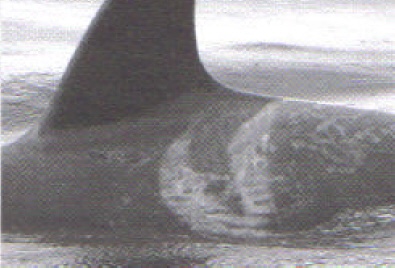
Bare Facts: Female ~ Born 2000 ~ Mother Sutlej ~ Father Unknown ~ Children None ~ ID Open saddle patch; thick curved fin
Springer, possibly (and probably) the most famous northern resident of them all, has a story unique to her. She is known the world over and is a favourite of researchers, whale watchers, and practically everybody else.
Her story starts when she was born. Her mother was Sutlej (A45), and she was born in July, 2000. Sutlej had already had one calf, A68, who died in its first year. Everyone hoped her second calf would fare better.
In September the same year, Springer was seen with her mom as usual. Sadly, that would be the last time anyone saw her with her mom-or saw her mom at all.
In summer 2001, Springer wandered with Gpod whales off Vancouver Island; highly unusual, but it was about to get even more so. In January 2002, Springer appeared in Puget Sound.
Puget Sound is part of the southern resident's area-so what was Springer doing there? Researchers realized almost immediately that she was in trouble. Sutlej had been declared dead, leaving Springer as an orphan, when she should've still been nursing. She wasn't healthy, and she wasn't getting enough to eat. She also really, really liked boats. Especially the huge ferries that could easily hit her.
Things looked grim for the playful little orphan. While a debate began in both the USA and Canada over whether humans should interfere, and how, Springer captured the hearts of everyone. She was called many names; Annie and Boo being two popular ones.
As one researcher involved explained, if they interfered and Springer died or it didn't work, everyone would say, "Why didn't you just leave her be?" But if they didn't get involved and Springer died, everyone would say, "Why didn't you help her?"
Finally a decision was reached. In the first rescue operation of its kind, anywhere, the NMFS (US National Marine Fisheries Service) caught Springer and transported her to a pen, on June 13, 2002.
Veterinarians ran tests on Springer to determine her health. If she had a sickness that could spread in her home population, no one was willing to risk the population, and the rescue wouldn't happen. When the results came in negative, and they realized Springer could go home, everyone was overjoyed.
Nobody wanted Springer to get used to people, because they planned to release in the wild. To feed her live salmon, they injected the fish with antibiotics, to help her failing health, and released them into the pen.
Finally Springer was healthy enough to go home. On July 13, 2002, Springer was placed on a boat and taken 650 km to Johnstone Strait, BC. She crossed the border to cheers from surrounding boats.
Springer was placed in another pen in Johnstone Strait. She was a very energetic little whale, although still small from her lack of food for so long. Now the researchers faced another problem-when to release her completely? They were waiting for whales to go by, but should they release her to the first whales that went by, or to her closest relatives?
It seemed as though the whales knew their plight. The next day, Springer's great aunt Yakat and family-some of her closest relatives-came right by the pen. Everyone was thrilled.
Springer and the whales called back and forth constantly, Springer getting so loud researchers had to take the headphones off. A split-second decision was reached: Springer was going free.
Researchers steered her to the opening of the pen, placing suction-cup tracking devices for data collecting on her back. With a wriggle, Springer shot away into freedom.
But, it wasn't exactly perfect. As one researcher said, "It was so Springer-like. She got halfway out, then said, 'Look! Kelp!' and stopped to play with it."
Eventually, Springer met up with the A11s. They all seemed cautious, uncertain. They mingled a bit, then they went one way and she went another.
So it wasn't perfect. Springer was still trying to cuddle up to boats. She bounced from one whale family to another, spending time with them all. Researchers monitored her progress, hoping against hope that she would find a solid family to stay with during the dangerous winter months. If not, she may not survive.
Boaters and whale-watchers were asked to stay away from her.
While Springer spent time with many families, two females thankfully took on the role of her mother. Her cousin Nahwitti, one of her closest relatives and just the age to have her first calf, took Springer as her own. The little orphan also spent considerable amounts of time with Nodales, a fellow orphan who was also just maturing, and who had raised her little brother when their mom died. While Springer didn't stick to them like glue, like most calves, they watched out for her and made sure she was safe most of the time. Nodales was even seen herding Springer away from boats! But would it be enough to help her through the winter?
Then, on October 6, 2002, researchers watched Springer mingle with a large group of A-pod whales. That was the last time that year the whales were seen.Now all anyone could do was hope that the pods took care of the little orphan during the winter.
On July 9, 2003, Springer arrived back in Johnstone Strait with a whole bunch of A-Clan whales. Everyone was delighted to see her looking energetic and healthy.
For the rest of the summer, Springer did her lets-move-from-family-to-family thing again. However, she spent considerable amounts of time with her great-aunt Yakat and Yakat's kids Skeena and Nahwitti. She hadn't completely bonded though-one day, she was observed traveling alone again.
On September 2, 2003, Springer was with her grandmother and great aunt as they left for the winter. Once again, everyone nervously waited her return.
On June 28, 2004, Springer showed up again. She was with Yakat, Nahwitti and Skeena, and she was healthy and playful. She also spent much of that day traveling with three other orphans, albeit grown-up ones: the three famous brothers, Cracroft, Plumper and Kaikash took a turn babysitting. What a site it must've been, her little fin sandwiched between the towering fins of the brothers!
For the rest of the summer, Springer spent 99% of her time with Yakat and family. It appears that she is now a solid member of the A11 family!
When they left for winter again, everyone had high hopes. It appeared that Springer was solidly with her family. And on February 20, 2005, the A11s showed up in Johnstone Strait! It was highly unusual, and everyone was delighted to see Yakat, Nahwitti, Skeena and Springer traveling through the Strait.
Now, summer 2005, Springer and family have returned once again. It seems that the rescue was a complete success-it took a while, but the A11 matriline now consists of four whales, not three! Springer and family have shown up a few times on the OrcaLive cameras.
Springer is easy to identify. Not only is she the smallest in her pod, but she has a distinctive 'open' saddle (see above) that looks like a check mark. This is very common in southern residents, but very rare in northerns.
Springer's voice is also easily identified. She makes a very distinctive call that only she makes. A low, high, low sound that no other orca makes. Interestingly, her mother also made that call. Maybe it's Springer's way of saying, "See, I DO belong in this family!"
Springer's story is a success story for all the whales. She's a sweetheart and a symbol for her species. And happily, she's back with her pod. It wasn't only the researchers who rescued her (though they did an amazing job)-without Nodales and later Nahwitti adopting the little one, Springer would never have survived.
The amazing little calf is now five years old! She's healthy, but rather small, probably because she was undernourished as a calf. Look for her and family on the OL cameras!
SPRINGER UPDATE: OrcaLab recently posted an update on Springer's latest escapades. Springer arrived on June 22 in the Strait, along with A4s, A5s, and A12s. She wasn't seen specifically, but she was heard! She was heard many times afterward, but not seen. On July 7, researchers got worried when Yakat, Skeena and Nahwitti passed by without Springer! Thankfully on July 8, Springer showed up with the A12s, who were close behind her family. She was probably just playing with her younger friends. On July 9, Springer finally showed up tucked between Yakat, Skeena and Nahwitti. She traveled with her family for the rest of the summer, and they spent a lot of time traveling with the A8s. Springer especially enjoyed hanging out with Sonora (A42) and her little one A79. The two pods also joined up with the A12s for a bit, but then wandered off again. This year, the two matrilines spent most of their time in eastern Johnstone Strait, instead of near OrcaLab, which researchers found unusual. On September 6, Springer and 59 other orcas left the Strait area in a playful group. Researchers now assume her family has left for the winter. According to OrcaLab, Springer now fits in so well with her family, she's just like a regular five-year-old! Go Springer!:)