Orcas are the top predator in sea. They can take down any animal, and are not afraid of going after large land animals either (moose)...in fact, some researchers question whether the orca can actually feel fear. It has no reason to, in the wild.
This page will explore the problems orcas face. Despite being some of the most powerful creatures on the planet, orcas are in trouble, mostly at the hands of humans. These are some of the threats facing them.
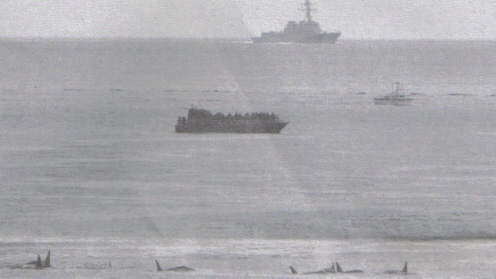
Above, the J-Pod of the southern residents passes by the Navy destroyer USS Shoup.
Navy sonar has long been suspected of bothering whales and dolphins. Scientists have argued long and hard over whether the sonar impairs the whales or not.
Orcas aren't immune to this; in fact, lately they've been right in the middle.
The Navy uses active sonar to scan the ocean with intense sound, sort of like flooding a dark room with light. They use the sonar to detect enemy submarines.
That would be great, but it has consequences. Since whales and dolphins have such sensitive hearing and rely so heavily on their OWN sonar, the Navy's sonar seems to cause problems.
Often, sonar causes confusion, perhaps impairing their own sonar system, and the animals often strand, or collide with boats.
More rarely, but still possible, is when bubbles form in tissue, causing damage to lungs and ears, and sometimes death.
The most often known side-effect of Navy sonar exercises is when cetaceans (whales, dolphins and porpoises) in the area end up stranding, or at least leaving the scene.
Above is a photo of one instance where killer whales were concerned. The USS Shoup was conducting sonar exercises in May 2003, in Haro Strait, where at the same time Dall's porpoises, harbour porpoises, minke whales, and the entire J-pod were hanging out.
The sonar was so loud that observers on San Juan Island could hear them in the air, 16 km away. The minke whale and many porpoises left the area at high speed; later, 11 porpoises were found dead. Experts said that the sound-based trauma may have contributed to their death.
What happened to the orcas? They stopped feeding and grouped together, staying at the surface the entire time.
The salmon of BC are the heart of the ecosystem. For such an ugly fish, it is an amazing animal. Orcas rely on the salmon for food; so do people.
That's why, if we're going to protect the orca, we have to protect the salmon.
Salmon farms, in all technicality, should be a great idea. They would be, except for some of the ways that they are farmed.
The salmon in the BC salmon farms are Atlantic salmon. Atlantic salmon are big, strong, and aggressive. And a lot of them have escaped.
When Atlantic salmon escape, they filter into the ecosystem and start to mess it up. For one thing, they take over the Pacific salmon's habitat; for another, they're aggressive, and stronger than the Pacific salmon. They eat their food and spread diseases that Pacific salmon aren't equipped to fight.
The BC salmon farms could be handled much better. The Atlantic salmon are too many to too little space; they're practically on top of each other. Because they're so close, they spread disease like wild-fire. Which means it could easily get passed on to the wild salmon.
They also are invested with sea lice. While sea lice is natural and would not normally prove a problem for the wild salmon, usually the sea lice die as they enter fresh water. However, when they attach to the Atlantic salmon and breed and survive, then jump on young wild salmon heading back out to sea, it spells big trouble. The young wild salmon don't make it to the sea-they end up stunned and lifeless before they even hit ocean water.
Salmon farms aren't that great for humans either. For instance, farmed salmon are usually high in PCBs (see below). Also, most of the nets in the farms are painted with Flexgard XI. The problem with this paint is that it carries this warning: "Toxic to aquatic organisms. Do not contaminate water. Do not allow chips or dust generated during paint removal to enter water". Which is just great, considering that the paint flakes off from the nets and the salmon might eat it.
Gunfire is a problem to the natural wildlife, though not that much. Because seals love the salmon, and birds also find it as free food, they get bullets in the head. While resident whales ignore the salmon farms, the transients see it as a free meal too: the seals go to the salmon farm, the transients meet them and eat them. But gunfire hasn't increased much, and as far as we know the transients have escaped unscathed.
Finally, there is also the problem of seal-scarers. While orcas seem to completely ignore the salmon farms (odd, as they could be an easy source of food), seals think of them as buffets. Which doesn't really go over well with the salmon-farmers.
Seal-scarers are also known as AHDs, or Acoustic Harassment Devices. They are designed to cause pain and frighten away predators; one AHD gave off a signal that was 194 decibels. To put that in perspective, a jet engine taking off at close range is 140 decibels.
It has been proven that AHDs make porpoises flee the area. In Echo Bay, some months after the AHDs were installed, the resident orcas disappeared. The AHDs were right where the orcas hunted the salmon; they left. Transients just went after different seals, but they too disappeared.
Around 2000, thanks to the amazing work of Alexandra Morton, AHDs were turned off around Echo Bay. Six months later the whales returned. Seal-scarers are unfortunately still used along the rest of the coast, however.

Above; Chimo the white killer whale and her mom Scajaw during their capture, from Orca The Whale Called Killer by Erich Hoyt.
Thankfully, captures from the wild for the marine park business are no longer a threat to the whales of Canada and USA. Unfortunately, while most countries no longer capture whales, Russia still issues permits. In 2003, a whale died in a Russian capture. The one whale that was taken to a marine park, died 28 days later.
Just recently, during summer 2005, Russia attempted another capture. They took their boat out, but a typhoon forced them to return relatively quickly. They went out after the typhoon and tried again, but they returned to the city after failing to capture an orca. I find it outrageous that they are still attempting to capture orcas in this day and age, when breeding programs and going so well, and we know so much about the complex lives of these animals.
Orca captures were, and are, brutal things. Usually, the orcas are driven into a bay or inlet where nets can be drawn around to trap them. Loud noises and small explosives are used to corral them. Young orcas, which are usually what captors are after, are separated from frantic mothers, and lifted out of the water to marine parks.
Usually these marine parks try their best to take care of the animals, but inevitably, the orcas will dry out a bit on the trip, which results in the whiteness you may see in old capture photos.
The mortality rate for these captures are alarming. Often more orcas die than are captured.

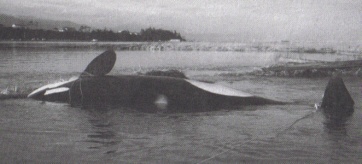
Above; from Orca: The Whale Called Killer by Erich Hoyt, a transient stranded on a beach, being cared for by grey whale researcher Jim Darling.
Unlike other marine mammals, such as sperm whales or pilot whales, orcas do not strand very often. In fact it is relatively rare. In Argentina, when orcas purposefully strand on beaches to catch seals, they sometimes get stuck, although they usually know how to free themselves.
One mass stranding is known for sure, in the 70s on the west side of Vancouver Island. An entire pod stranded and died. Another well-documented stranding was when an unidentified transient male (see above) stranded on Vancouver Island. Despite attempts to save it, the whale eventually died. It is thought he was hunting and went too close to the shore.
These incidents, however, are rare, and it is likely that stranding is not much of a threat to orcas.
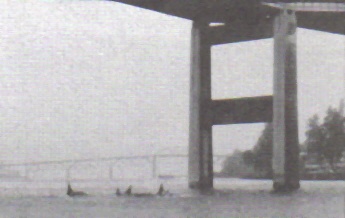
Above; from Issue 6 of the Blackfish Sounder, the trapped L-Pod whales go under the bridge to freedom.
This threat is unusual indeed. Orcas have been known on occasion to wander into unknown territory, and then seemingly not know how to leave. A group of offshores once rode the tide into a small bay, and when the tide turned, they panicked. Apparently unable to find their way out, the group, tragically, died.
In another incident, on October 21, 1997, 19 whales from Lpod crossed under a bridge and entered Dyes Inlet, a small inlet that these whales were never seen in before. They stayed there for many days and researchers began to get worried. It is possible that they were intimidated by the shadow and noise of the large bridge. Whale-watchers poured onto the water and harrassed the whales cluelessly. 26 days later, the whales were beginning to look depressed and in poor health, and researchers were getting worried. On November 19, the whales headed determinedly towards the bridge, turning around twice. Finally they headed towards the bridge with two females and Faith (L57) in the lead. They stopped at the bridge, but the two females seemed fed up and went under the bridge, breaching on the other side. Finally, all the whales had gone under except for a female and calf. Two of the whales that had already gone through went back, and together they swam to freedom. Minutes later the whales were completely gone, out porpoising exuberantly in deeper water.
There have been many incidents where whales have gotten 'trapped'. It seems that they view things such as rapids or kelp beds, as barriers in their mind. Sometimes the whales die, of stress, or other things. And when the whales are 'freed', they usually go hyperactive and excited, clearly happy to be out.
Why are such well-coordinated creatures, who are usually so in tune with their environment, allow themselves to be trapped by harmless things? Who knows? But it is certainly a worry when they do.
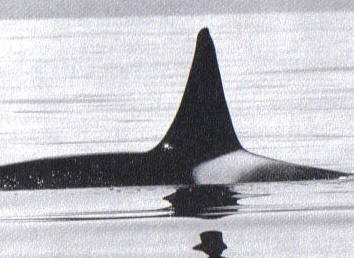
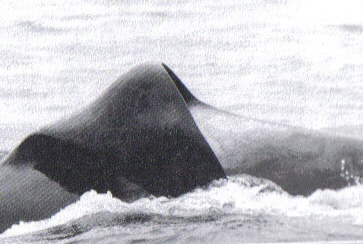
Above; on the left is a photo of an Alaskan resident whale which bears the ID number AB3. On the right is the same whale, AB3, after the Exxon Valdez oil spill.
The Exxon Valdez is a depressing chapter of the whales in Alaska. On March 24, 1989, the tanker Exxon Valdez hit Bligh Reef. Over 11,000,000 gallons of oil was spilled into Prince William Sound, Alaska.
Within weeks, 1900 km of coastline was full of oil. The cold temperature of Alaskan waters slowed down the releasing of toxic gas that oil gives off when it first spills into water. People cleaning the oil off beaches passed out from fumes. The Alaskan waters slowed it down so much, it was extremely toxic for a week.
The animals of the Sound were hit with brutal force. 300 harbour seals died immediately, and the population has been declining ever since. Thousands of birds died. Herring eggs and spawning salmon were poisoned with oil; that generation of both fish became sterile, deformed, and many died.
The whales were also hit. The AB resident pod in Alaska was near the Exxon Valdez a week after it first spilled oil. Since then, the AB pod has become the only resident Alaskan pod to decline in population: they have since been dying out at twice the normal rate. Fourteen members, out of 36, have died since the spill.
Even more tragically, the AT1 pod, a pod of transient orcas who are genetically distinct, were seen in the oil, surfacing through the layer of it. Half of the pod has since died. More on the AT1 pod below.
The thing about oil spill is that the effects are amazingly long-term. Whales breathe in the fumes, crippling them with chronic respiratory problems, that will eventually kill them. Because whales are so close, when a mother dies, young children and even adult sons die as well.
The effect of the Exxon Valdez on the orcas of Alaska was so dramatic, one mother moved herself and her children to another pod, a healthy one. That is something we have never seen resident orcas do.
Speaking of long-term, there are still more consequences. In 2001, 10,000 gallons of oil were found, buried beneath beaches. This oil had been damaging the eco-system the entire time; otters were ill with liver damage, harlequin ducks had ingested the oil.
Seals have declined, making it harder for the transients to find food. Orcas' fins have collapsed after the oil spill (see above, and he's not the only one). One pod may be doomed to extinction.
Oil spills are some of the most deadly and tragic happenings we can cause. And the effects are ridiculously long-term.
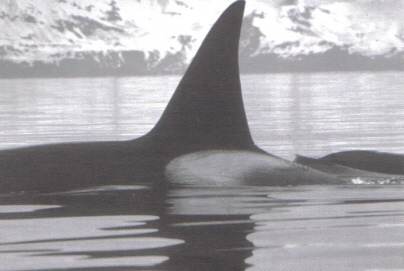
Above is a photo of one of the whales in the AT1 pod. Below is their story.
The AT1 pod, in 1988, was a group of transient orcas that lived in Prince William Sound, Alaska that had 22 whales. The AT1s are unique whales; unlike most roaming transients, they stay in Prince William Sound and the Kenai Fjords, they don't interact with other whales, and they are genetically distinct, meaning they don't breed with other whales.
These fascinating creatures were already in a spot of trouble then, with a decline in the seal population (their food), and high levels of PCBs (see below).
In 1989, however, things took a turn for the worse. When the Exxon Valdez spilled it's oil, three members of the pod were seen swimming literally through the oil. The rest of the pod was likely nearby.
The effects were disastrous. 11 whales died within 2 years of the spill, and three more since. How many whales are left in this once-large pod? 8.
Besides that, the oil spill and the high levels of PCBs have contributed to a very low level of new calves. In fact, no new calves have been seen in the AT1s since 1984! There are now two females that are the right age for breeding and two males. The future hope for this unique group of whales depends on them.
Unfortunately, while they are designated as 'depleted' under the US Marine Mammal Protection Act, and NOAA Fisheries is developing conservation plans, and researchers are trying to keep the pod going, there is a huge chance this genetically unique population of orcas is doomed to die out.
PCBs are possibly the worst threat to the survival of the orcas of BC and Washington. And PBDEs are quickly becoming a serious threat as well.
What are PCBs, you ask? They are polychlorinated biphenyls (no wonder we call them PCBs), thick oils that were made for use in electrical transformers and industrial lubricants. The problem with PCBs is that they don't break down. When they sneaked into the eco-system, PCBs looked for fatty tissue to bind to. PCB particles attached to small particles on the muddy floor of the sea. Then they worked their way up through the food chain. As they are eaten by plankton, which are eaten by fish, which are eaten by bigger fish, which are eaten by seals, which are eaten by transients....known as bioaccumulation, this process means that the higher the animal on the food chain, the more contaminated they will be. And who's higher than the orcas?
In the 1970s, thankfully PCBs were banned from many countries (that's including Canada and the USA). Today, PCBs are still used in other parts of the world, particularly Asia. Alarmingly, the PCBs from Asia travel thousands of km and still end up falling into other oceans! Besides this, more than 200 kinds of PCBs are still in Canada-in rivers, oceans, and soil.
So we've established that orcas are threatened by PCBs. But just how threatened?
Well, orcas are what they eat. Because orcas gain PCBs from what they eat, let's look at the PCB levels in their prey. Salmon seem to pick up PCBs mostly in the open ocean. When they leave for the ocean, salmon tend to have about 1 microgram, whereas when they return, they have about 190 micrograms!
But that's still not too much, right? But consider this: an orca eats around 150 kg of salmon every day!
What else do orcas eat? Well for transients, let's look at seals. Transients are even more likely to accumulate loads of PCBs, because seals are also top predators! Therefore, they have high levels as well. An adult male seal in the Strait of Georgia can have about 50 ppm (parts per million) of PCBs.
So just how high are the levels in orcas? Well the northern residents are faring the best. They have the lowest levels of PCBs.
Southern residents have higher levels, possibly because they're eating very contaminated salmon which live near the industrialized areas of BC and Washington, while the northerns stick to more inhabitable terrain. An average male southern resident will carry around 146 ppm of PCBs. The average Canadian carries 0.7 ppm of PCBs.
Males are more contaminated than females. This is because the PCB level in orcas rise as they grow older. However, when a female orca has a calf, she passes the poison through her milk into her calf. After she stops having calves, the PCB level rises again. This is why many female orcas' first calves die. The more calves she has, the less PCBs she has. So, say, the third calf has a better chance of surviving, because she'll have flushed the PCBs mostly out of her system with the first two calves. Because the males don't have this to lower their levels, they are extremely contaminated. This may be why so many males are dying, which is causing problems for breeding.
And what about the transients? Well, they are officially the most contaminated marine mammal in the WORLD.
The average male transient carries 251 ppm of PCBs. That's around 250 times higher than most humans. One male transient was determined to carry 775 ppm of PCBs, while the female below, CA189, topped the charts at around 1000 ppm!!!
PCBs can have a lot of effect on orcas. They might interfere with the reproductive system, or cause deformation. They also make the orca more venerable to infections-which may have been why Everett (J18) and Nootka (L51), two whales that washed up dead in 2000, died of their infections to wounds.
Finally, what are PBDEs, you ask? They are polybrominated diphenyl ethers, and they are used as flame retardants. Yes, you read that right. They're still used in North America and around the world.
Like PCBs, PBDEs build up in fatty tissue and go up the food chain. There has been an increase in PBDEs in the environment over 20 years, and a recent study showed that the prey of harbour seals in Puget Sound were surprisingly high. Not good, seeing as the southern residents hunt there too. We'll be watching to see what happens with PBDEs.
Below is a photo of the body of Californian transient whale CA189, who died after stranding, and who had a disturbingly high level of PCBs.