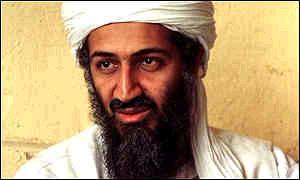
Osama Bin Laden: Has called for a holy war
against the US
Osama Bin Laden is both one of the
CIA's most wanted men and a hero to many young people in the Arab world.
He and his
associates were already being sought by the US on charges of international
terrorism, including in connection with the 1998 bombing of American
embassies in Africa and last year's attack on the USS Cole in Yemen.
|
Shadowy figure |
|
Born in Saudi
Arabia Fought against
Soviets in Afghanistan Ploughed
inherited fortune into armed activities Rarely seen in
public Reported to have
at least three wives |
In May this year
a US jury convicted four men believed to be linked with Bin Laden of plotting
the embassy bombings in Kenya and Tanzania.
Bin Laden, an
immensely wealthy and private man, has been granted a safe haven by
Afghanistan's ruling Taleban movement.
During his time
in hiding, he has called for a holy war against the US, and for the killing
of Americans and Jews. He is reported to be able to rally around him up to
3,000 fighters.
He is also
suspected of helping to set up Islamic training centres to prepare soldiers
to fight in Chechnya and other parts of the former Soviet Union.
Sponsored by
US and Pakistan
His power is
founded on a personal fortune earned by his family's construction business in
Saudi Arabia.
|
Attacks linked to Bin Laden |
|
1993 World Trade
Centre bomb 1996 Killing of
19 US soldiers in Saudi Nairobi and Dar
es Salaam bombs 2000 Attack on
USS Cole in Yemen |
Born in Saudi
Arabia to a Yemeni family, Bin Laden left Saudi Arabia in 1979 to fight against
the Soviet invasion of Afghanistan.
The Afghan jihad
was backed with American dollars and had the blessing of the governments of
Saudi Arabia and Pakistan.
He received
security training from the CIA itself, according to Middle Eastern analyst
Hazhir Teimourian.
While in
Afghanistan, he founded the Maktab al-Khidimat (MAK), which recruited
fighters from around the world and imported equipment to aid the Afghan
resistance against the Soviet army.
Egyptians,
Lebanese, Turks and others - numbering thousands in Bin Laden's estimate -
joined their Afghan Muslim brothers in the struggle against an ideology that
spurned religion.
Turned
against the US
After the Soviet
withdrawal, the "Arab Afghans", as Bin Laden's faction came to be
called, turned their fire against the US and its allies in the Middle East.
Bin Laden
returned to Saudi Arabia to work in the family construction business, but was
expelled in 1991 because of his anti-government activities there.
He spent the
next five years in Sudan until US pressure prompted the Sudanese Government
to expel him, whereupon Bin Laden returned to Afghanistan.
Terrorism
experts say Bin Laden has been using his millions to fund attacks against the
US.
The US State
Department calls him "one of the most significant sponsors of Islamic
extremist activities in the world today".
According to the
US, Bin Laden was involved in at least three major attacks - the 1993 World
Trade Center bombing, the 1996 killing of 19 US soldiers in Saudi Arabia, and
the 1998 bombings in Kenya and Tanzania.
Islamic front
BBC
correspondent James Robbins says Bin Laden had "all but admitted
involvement" in the Saudi Arabia killings.
Some experts say
he is part of an international Islamic front, bringing together Saudi,
Egyptian and other groups.
Their rallying
cry is the liberation of Islam's three holiest places - Mecca, Medina and
Jerusalem.
Analysts say Bin
Laden's organisation is very different from the groups that carried out
bombings and hijackings in the past in that it is not a tightly knit group
with a clear command structure but a loose coalition of groups operating
across continents.
American
officials believe Bin Laden's associates may operate in over forty countries
- in Europe and North America, as well as in the Middle East and Asia.
The few
outsiders who have met Bin Laden describe him as modest, almost shy. He
rarely gives interviews.
He is believed
to be in his 40s, and to have at least three wives.
