Philippine Combat Aikido Federation
Parañaque Chapter
Recognized by Philippine Combat Aikido Federation, Inc.
A very small percentage of karate practitioners attain this advanced level of technique. The karateka (karate stylist) must let his body find the most efficient and economical way to punch through diligent, rigorous training and thousands of repetitions with the appropriate state of mind.
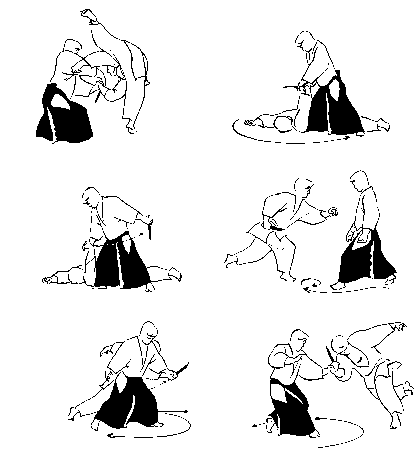
This concept is very similar to aikido. The majority of aikido techniques, Seagal says, are based either on a square, triangle or circle. When a person first starts practicing, he will execute techniques formed on a square. After six months or a year of diligent practice, he will graduate to the triangle. Eventually, between one and two years of training, he will be introduced to the circle. At this level, all techniques are taught efficiently and economically with the least amount of power. The circle evolves to a flowing, continuous spiral.
So, while the first few years of aikido and karate training are interpreted differently, the evolution of the techniques is quite similar. In its own way, each style graduates from a more structured, hard and rigid state to a more relaxed, efficient and economical state. Aikido and karate have somewhat different ranking systems, but each adheres to the dan (black belt) concept, which indicates similar technical, mental and spiritual states. Both systems are based on a lifetime of practice and self-evolution.
Morihei Uyeshiba (often called O-Sensei), the founder of aikido, was very mystically and spiritually oriented. Seagal believes O-Sensei formed his ranking system based on the concept of an ancient Shinto crest. He said the nine circles around the outside of the crest all represented planets. The middle circle represented divine heaven on earth.

Note: best viewed at 800x600 resolution.
Send mail to combat_aikido@yahoo.com with questions or comments about this web site.
Copyright © 2000 Philippine Combat Aikido Federation - Parañaque Chapter
