and, if you look closely, there's a tiny dot near Sherando Lake that designates Love.
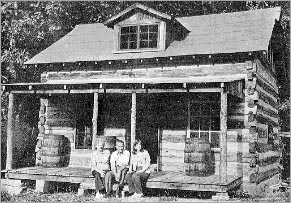
The old Love Post Office in Nelson County, half a mile from the Augusta County line on State Road 814, is still standing. In its ramshackle condition, beset by tall weeds and brambles, it is little more now than a memory. You can still see it, though, sitting slightly askew off the road and every now and then, it crops up on some local artist's canvas to be displayed at an art show and discussed by various souls who want to know where Love, Virginia, is.
Around 1894, this area now known as Love Gap was called Meadow Mountain. The mountainous area, thickly forested now, was once lush rolling meadows with spectacular views from every knoll. Cattle and sheep grazed lazily and freely. The hundred and some inhabitants at that time made their living off the rocky soil. They were a sturdy breed of people who were mostly related to one another.
At one time the tiny village had, in addition to the post office, a blacksmith shop, a couple of country stores, a grist mill, several churches, a sawmill and a one-room schoolhouse.
Social life in those days was mostly family gatherings, church services, corn shuckin's, applebutter boilin', quiltin' bees, hog killin', house raisin', and makin' music. The music was mostly foot stomping and fiddle playing. Most of the men knew how to play the fiddle or a banjo (banjer), and many played the spoons. When a tragedy occurred everyone showed concern and helped out in some way. If a house or barn burned, men, women and children were there to help out. There was a story told about a community house that was on fire. There were some slop barrels nearby and, having nothing else to douse the fire with, they used the slop barrels to put it out!
When someone died, the funeral was usually conducted in the home. The remains were hauled by horse and buggy to the church graveyard or to a private burial ground. There are several private cemeteries in Love. Another story was told of a coffin being hauled by horse and buggy to the church cemetery. The hill up the mountain was very steep and somewhere along the way, the coffin slipped out of the wagon and when the haulers got to their destination, the coffin was gone!
The churches were small and crude, with wood-burning stoves and oil lamps and attendance was always good. Even the hound dogs were allowed to lay quietly in the back hall room. In addition to making a living on their own land, many of the farmers went elsewhere to work to supplement their income. Some worked in nearby apple orchards, while others cut wood and hauled extract. Some of the men and women hunted and gathered "sang" (Ginseng) and picked wild berries to sell.
Trips to town were few and, except for extreme necessities, the mountain folk of Love didn't need or want to go to town.
In 1939, a big change occurred in this area. The change came when the Blue Ridge Parkway was instigated and severed the tranquility of these quiet mountain people, who had lived their whole lives isolated from the onslaught of progress and the eyes of the world. Many people resented the building of the parkway, plowing its way through their private land but, realizing the inevitability of it all, actually took jobs with the Parkway project to provide more income for their families. But with the extra income, came the restlessness of spirit to have more and, after the Parkway was completed, many of the young people left the mountain to seek jobs for a seemingly better life in town.
It wasn't until 1946 that Love even had a paved road. The pavement ended at the Sherando Lake entrance and beyond that had been a winding dirt road with several streams to ford.
At the time when the Parkway came through, the Love post office had an influx of new business and activity when it became a delivery point for workers on the parkway and construction crew.
There are several stories on how Love got its name. It has been said that there was a rivalry between certain families and because of this there seemed to be a never-ending feud over the years. However, during a church revival, the feuding familiar "saw the light" and, to seal their new-found affection for each other, they decided to name the community "Love."
The second theory, and possibly the most well-founded one, came from Hugh Coffey, who at that time was Post Master in the Meadow Mountain area. Because there were too many letters in the name Meadow Mountain to put on a postal stamp, the Government was pressing for a shorter name. At that time, Hugh Coffey's young daughter, Lovey, was stricken with typhoid fever and died at an early age, giving him the inspiration to submit the new name of "Love" in memory of her.
Mr. Coffey was the first Post Master and served until the year 1919, when Gordon L. Everitt and his wife, Peal, took over the appointment. The Everitts lived in the 12x20 frame house which included a general store and the post office proper. A small counter at the right side of the entrance door is still there today amongst the old post office ruins.
Because Mr. Everitt was a farmer as well as a post master, a small police whistle was hung from a chain outside the door latch and one small shrill blast would bring him in from the fields.
As years went by, Love became a popular place on Valentines Day. It was, in fact, known as Cupid's Capital. People came from everywhere wanting the extra effect of the postal mark "Love" on their special valentine card. This service was in effect until the middle of the forties when, with the final stamp of Gordon Everitt's hand, came the close of one small post office and the unique service it provided.
The population of Love today is around 89 residents (give or take a few). Unlike a hundred years ago, when it was a bustling community with a post office, country stores, grist mills, etc., it is now only a smattering of homes, some old and some new, a local newspaper, artist, wood sculptor, mountain cabin rentals and a lodge, two churches, a portion of Big Levels Game Refuge, a Ranger Station, Sherando Lake Campground and Back Creek which flows gently down Meadow Mountain to blend itself into other merging streams which finally plunge into the South River. In dry weather it doesn't make it that far.