Ramblings on water divining
|
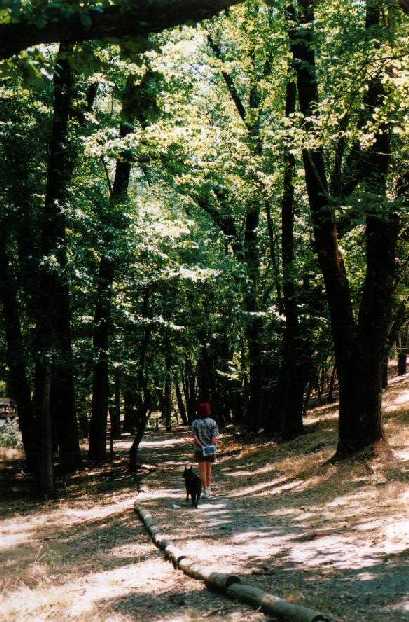
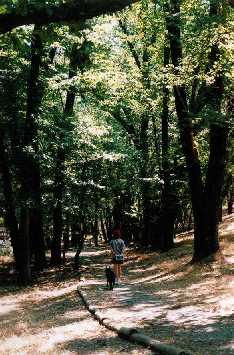
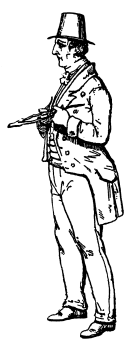
The person in the photo could be divining, but isn't.
Wirrabara Forest, South Australia
|
We think of ourselves as rational beings, but at this time when science
has reached enormous heights, so called 'new age' beliefs are rife and
most of the old superstitions are still active in some minority or
another. Many
people believe that a successful site for a well can be chosen by a gifted
person walking over the land with a 'divining rod'. Belief in astrology and
in the efficacy of many forms of medicine not supported by valid evidence is
common.
Written about September 2001; placed on its own page 2004/02/25;
modified 2008/05/16
Feedback welcome, email daveclarkecb@yahoo.com
|
|
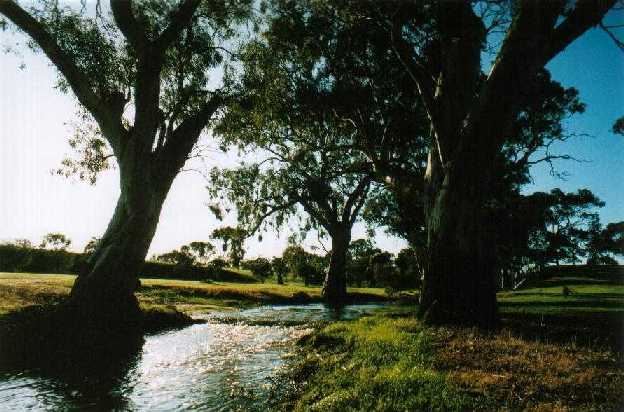
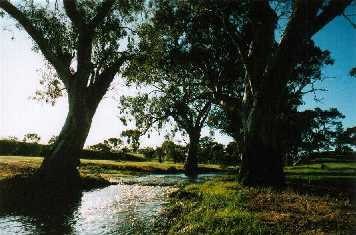
A rare flow of water in the Crystal Brook, South Australia.
Recharging the subsoil and perhaps an aquifer or two
|
 The self-deception of being able to locate groundwater (underground water) by
walking over the ground with either a forked stick, one or two bent
wires, or a pendulum is generally called water divining in Australia
and water dowsing or water witching in the USA. It is a superstition
that many people do not recognize as such.
The self-deception of being able to locate groundwater (underground water) by
walking over the ground with either a forked stick, one or two bent
wires, or a pendulum is generally called water divining in Australia
and water dowsing or water witching in the USA. It is a superstition
that many people do not recognize as such.
-
I have worked in the groundwater field for about thirty years.
I have never seen or heard of a convincing demonstration of
divining.
-
I have read of many scientifically conducted studies into divining.
I have never read one that indicated that it worked.
-
Groundwater is very common, almost ubiquitous. For example clays can
contain up to 50% water, although they will not yield a significant
amount to a well. Do divining rods discriminate between water
contained in clays and water contained in sands, gravels, and
fractured rocks?
|
|
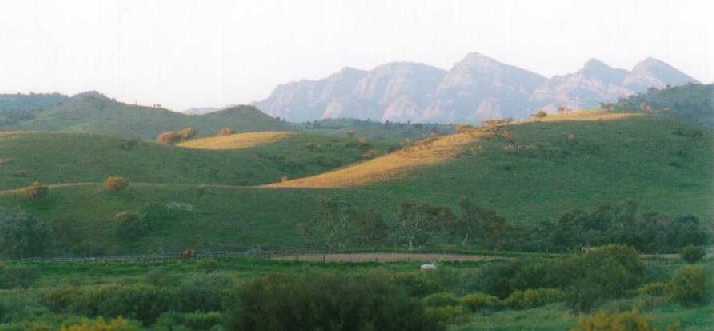
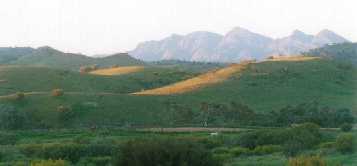
How many deluded diviners have walked their wires or forked sticks
across country like this in the Flinders Ranges of South Australia?
|
-
Diviners usually talk of finding narrow underground streams. In most
geological settings these do not exist. The many diviners that I
have talked to seem to believe that these streams are less than a
metre wide and are spaced every hundred metres or so across the
landscape. If this were true, then in my work locating well sites,
because I ignore these 'streams', my
success rate in selecting well sites would be less than one percent;
however it is more like 40%. (I most often select well sites in the
Australian desert.)
-
There are only four known forces in nature: electromagnetism,
gravity, the strong and weak nuclear forces. Of these, only the
first two are significant over the distances people usually deal
with. (The force exerted by wind or water currents is due to the
electromagnetic forces between the electrons 'attached' to the
molecules of the fluids and those of the body they are interacting
with. A similar thing applies when one solid body presses against
another: the force comes from negatively charged electrons reacting
against each other.) Scientific instruments are much better at
measuring these forces than are unassisted people. Why can't any
instruments measure the 'force' that the diviner claims to feel?
In all other fields Man has been able to produce instruments that
are more sensitive and more reliable than the Human sense of feel.
- The Australian Skeptics Association has a standing
US$10 000
prize for
anyone who can demonstrate that they can effectively divine water
beneath the ground. No-one has ever claimed the prize, although many
have been tested after agreeing to the terms of the test.
(The Australian Skeptics Web site referred to above also mentions a prize of
$40 000, but seems unclear about whether this was a once only, or a
standing offer.)
- The
James Randi Eductional Foundation has a "One Million Dollar Paranormal
Challenge" "to anyone who can show, under proper observing conditions,
evidence of any paranormal, supernatural, or occult power or event".
I believe that this includes water divining/dowsing/witching, but I am not
sure on this point.
|
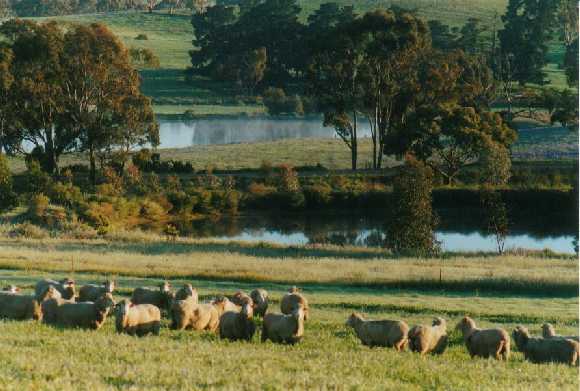
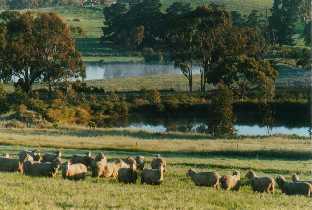
Well fed woolly sheep and a full farm dam. It's a good year at
'Elysium' in the Clare Valley of South Australia.
Less call for diviners in a year like this.
|
-
Then there is the old saying; "If you're so smart, why aren't you
rich". If I could reliably divine groundwater I could be a very rich
man. I'm sure numerous diviners are just as clever as I am, many
would be more clever; why haven't they taken advantage of their
skill? As an example, suppose a new mining town requires a water
supply in a difficult groundwater area. If I had the skill I could
contract to select sites at $2000 for each successful one, while I
would pay the drilling costs for any failed wells. The mining
company would be foolish not to accept my offer, and I could not
fail.
- Finally, some say that it has been demonstrated that wells
drilled on sites chosen by divining have no better a success rate
than those drilled elsewhere. I'd go further, wells drilled on
divined sites have a poorer success rate than when the sites have
been selected by rational means. See
divining success rate below.
- There are no skills that come naturally to us and do not
need training and practice; are we to believe that divining is unique in this
way? We cannot walk, swim, garden, hunt, work wood, work steel, even dig a
hole in the ground without learning how. Yet diviners, we are told, just
have the 'knack'?
Recommended Internet sites on this subject are:
James Randi and
The Skeptics Dictionary by Robert Todd Carroll.
Carroll discusses the Scheune or barn test which some claim proves that
there is some scientific validity in divining.
|
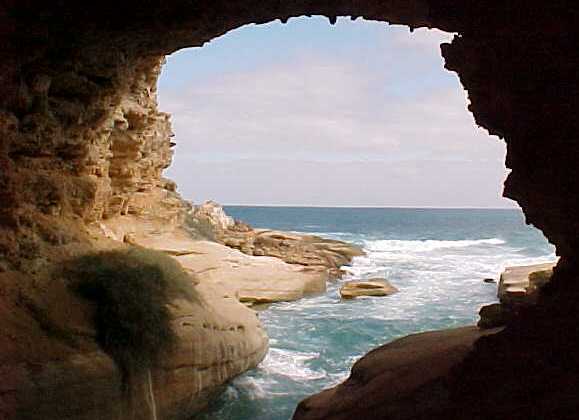
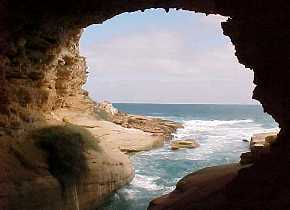
A limestone sea cave in Southeastern South Australia
Limestone country like this is the only place that you may really find the
underground 'streams' that the diviners generally believe are all over the
place.
|
-
Does the 'force' diviners feel only propagate vertically? Why should
it? Why shouldn't it propagate at 45 degrees from the vertical in
some places and 60 degrees in others; or in different directions at
different times? How can anyone know how it propagates? Yet, in my
experience, all diviners assume it propagates vertically.
-
I met a man who claimed to be able to divine for both precious opals
and water. He said that the rods worked for opals in country where
you would expect opals and worked for
water where you would expect water. I
find this incredible (especially when one considers that groundwater
can be found almost anywhere). I think it was Pliny who recorded
that some people believed they could divine for metals. How do these
people learn to discriminate between - for example - water, iron, and
aluminium, all of which occur almost everywhere. (Presumably
divining rods didn't respond to aluminium until it was discovered.
It is now known to be the third most common element in the Earth's
crust.)
-
There are so many different methods. Some people use a forked stick,
some use 'L' shaped wires, some (mainly in the USA?) use a pendulum.
Some claim to be able to divine over a map - they don't even need to
go to the land where the water supply is required.
-
Some people claim to be able to differentiate between fresh and
saline groundwater. Yet how did they learn to recognize a salt
stream and a fresh stream? Did they attend a water divining school
where they were taken over a known salt stream at one place and
a fresh stream at another place so that they could learn the
difference? Or is it just some sort of 'gut feeling'?
- Others claim to be able to detect moving water,
but not still water; apparently they don't know how very slowly most
groundwater moves.
- One man who claimed to have the gift explained why diviners are never
rich with the theory that when any diviner asks money for using his
power he looses the power.
What a wonderful explanation!
Some errors of diviners
I believe the following may be of interest as examples of errors
that I have heard from those who believe in divining.
- Any diviner can find a water pipe. In fact tests such as
those conducted by the Australian Skeptics show that diviners cannot
detect water pipes.
- A diviner told me that he detected two streams that
cross each other. I asked him if they were at different depths. He
said no, the same depth. How does one stream cross another? Can
the reader imagine one surface stream (river, creek) crossing
another?
Some divining history
From R.W. Raymond in a paper contained in the transactions of
the American Institute of Mining Engineers, 1883, and in United
States Geological Survey Mineral Resources, 1882, wrote of
divining and diviners as follows:
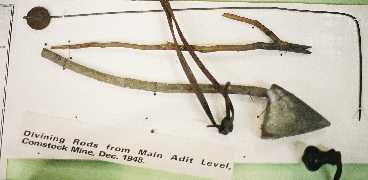
|
|
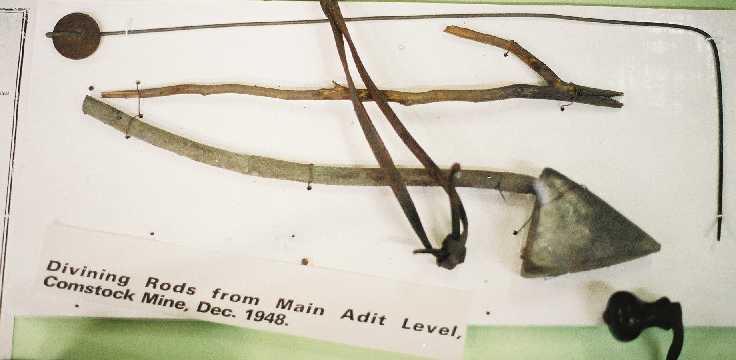
Divining rods dug out of an abandoned mine and
exhibited at Zeehan Mining Museum in Tasmania.
|
"The Scythians, Persians, and Medes used them. Herodotus
says that the Scythians detected perjurers by means of rods.
The word rhabdomancy, originated by the Greeks, shows
that they practiced this art; and the magic power of
Minerva, Circe, and Hermes or Mercury is familiar to classical
students. The lituus of the Romans, with which the augurs
divined, was apparently an arched rod. Cicero who had
himself been an augur says, in his treatise on divination,
that he does not see how two augurs, meeting in the street,
could look each other in the face without laughing. At
the end of the first book of this treatise he quotes a couplet
from the old Latin poet Ennius, representing a person from whom
a diviner had demanded a fee as replying to this demand
'I will pay you out of the treasures which you enable me
to find.'
Marco Polo reports the use of rods or arrows for divination
throughout the Orient, and a later traveller describes it among the
Turks. Tacitus says that the ancient Germans used for this purpose
branches of fruit trees. One of their tribes, the Frisians, employed
rods in church to detect murderers. Finally, if we may trust Gonzalez
de Mendoza, the Chinese, who seem to have had everything before
anybody else, used pieces of wood for divination."
Divining success rate: A major study in NSW,
Australia
There is no body of evidence, so far as the writer is aware, so
valuable for assessing the claims of divining as that which has been
gathered and recorded by the Water Conservation and Irrigation
Commission of New South Wales in connection with the shallow drilling
carried out for settlers in central New South Wales. The drills
are operated by the Commission, and the drill foreman has to report
at the outset of the work whether or not the site has been divined.
The settlers are not influenced in any way in the fixing of bore
sites, and some of them have made their own selection, while others
have taken the advice of diviners. From these reports the Commission
has compiled the following table, which deals with all the boreholes
drilled between 1918 and the end of 1943.
| Classification of Boreholes
| Divined
| Not divined
|
| Number Drilled
| Percent
| Number Drilled
| Percent
|
| Bores in which supplies of serviceable water, estimated at
100 gall. per hour (approx. 0.12 L/sec) or over, were obtained
| 1284
| 70.5
| 1474
| 83.8
|
| Bores in which supplies of serviceable water, estimated at
less than 100 gall. per hour, were obtained
| 184
| 10.1
| 93
| 5.3
|
| Bores in which supplies of unserviceable water were
obtained
| 87
| 4.7
| 60
| 3.5
|
| Bores which were absolute failures, no water of any kind
being obtained
| 268
| 14.7
| 131
| 7.4
|
The districts within which these boreholes were drilled
have a yearly rainfall ranging from nearly 30in. (app. 750mm) to under
15in. (app. 375mm) in the extreme west."
"The northern part of the area embracing the boreholes lies largely
within the Great Artesian Basin, with a consequent material reduction
in the risk of failure. Yet it will be seen that the proportion of
failures at divined sites is nearly double that at sites not divined,
while the percentage of highly successful drillings is far greater at
sites not divined than that at the divined sites. The very large
number of boreholes embraced in the tabulation corrects the deficiency
that has been felt by those who have tried to discuss divining in
the light of the records dealing with a small number of cases,
some of which may have been selected, and omitting any reference to
the failures that must certainly have occurred.
End of extracts for Geological Survey of SA Bulletin
From the table above, one should perhaps call in a diviner to
select a site, and then make a point of drilling somewhere else to
maximize one's chances of success!
Home
On this page...
Divining history
Divining success rate
Geological Survey of SA
Introduction
It does not work
Other questions and curiosities
Top