|
Home Index |
Over a period of 15 years (1980s, early 90s?) Sadam Hussein's regime killed 400 000 Kurds in northern Iraq. The USA government seems to have found this quite acceptable at the time; Hussein was a useful ally against Iran.In August 1990 Hussein invaded Kuwait. It seems that Hussein had expected US approval, in exchange for assured oil supplies. However, after trying tough sanctions, the USA invaded in 1991 and forced the Iraqi army out of Kuwait. The US forces convincingly demonstrated that they were greatly superior to the Iraqi army. At the time there was disagreement about whether the US should have continued and removed Hussein from power; however the US did not have permission from the UN to do more than remove the Iraqi forces from Kuwait, and they did not want to sour their relations with friendly Arab nations such as Egypt and Saudi Arabia.
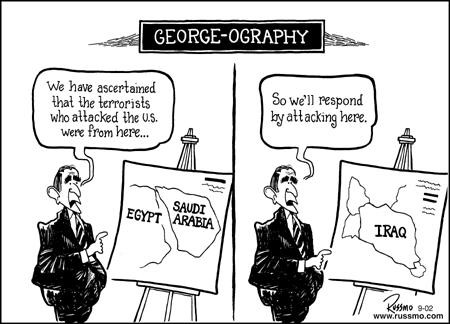
The US administration continued to consider removing Hussein's regime from power and following the September 11, 2001 terrorist destruction of the World Trade Center Twin Towers in New York, they decided that they had sufficient excuse to do so.
Although there was never any evidence of a link between the Iraqi regime and September 11th, the USA invaded Iraq in March 2003. This invasion was illegal under international law which, since the Treaty of Westphalia in 1648, has held that one nation must not invade another except in the case of an undisputable and immediate threat from the invaded nation. It was no more justified than was the Nazi invasion of Czechoslovakia and Poland in the early part of World War Two.
In May 2005, 88 members of the US Congress signed a letter to US President George W. Bush calling on him to answer questions about a secret US - UK agreement to attack Iraq. This was in response to a document that recorded talks between Bush and British Prime Minister Tony Blair that took place in 2002. In these talks Blair "discussed the need for America to 'create' conditions to justify the war."
Five years on it seems reasonable to ask this question; what answers can be given?
The Iraqi people have certainly lost the war; their country is in ruins and chaos, 650 000 Iraqis killed and two million Iraqi refugees in Jordan and Syria. (Since writing this another estimate has been made from a poll by Opinion Research Business, 1.2 million deaths due to hostilities in Iraq since 2003. See Wikipedia.)Civilisation has lost the war; I suspect we will never know how much damage has been done to archeological sites and how many irreplaceable relics have been lost in this land that was one of the greatest cradles of civilisation.
I've no doubt the environment has lost the war; when people are fighting wars the environment always gets little concern.
World peace has lost the war. The hatred created by this war will be coming back to haunt us for decades.
|
|
|
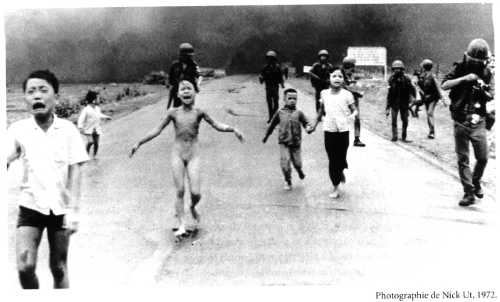
Nick Ut's famous Pulitzer prize winning photo of the little girl who had
been burned by napalm bombs dropped on a Vietnamese village by US war planes.
|
Of course the USA has lost the war. They have achieved nothing other than make millions of people throughout the Arab world and the Islamic world hate and mistrust them more than ever.Even if the war in Iraq has been lost, has anything been achieved in "The War Against Terrorism"? Surely not. Terrorism is used by desperate people who feel they have no other way of getting what they see as justice. Of course terrorism is often counter-productive. But you can't win against terrorism by using guns and bombs, it's not that simple. The Iraq war has made most Arabs and most Muslims mistrust the USA more than ever; it has made a great many people hate the USA. It has created a new generation of terrorists.
My country, Australia, has lost the war. Prime Minister Howard never had any right to involve Australia in the Iraq war; the great majority of the Australian people were against it. Australia was never a target of terrorists until Howard involved us in the US's wars of world domination. Between this war and Howards pig-headed refusal to do anything about greenhouse I suspect he will go down in history as one of the most disastrous prime ministers, and this as one of the blackest periods, in my country's history.
The only winners have been those companies that picked up all the easy money that was supposed to be spent on rebuilding Iraq. The USA failed to direct the billions of dollars to where they should have gone, instead a big part of the money went into the hands of the corrupt. No-one will ever know where literally tonnes of money went because it was handed out as cash; there is no 'paper trail', auditing was either lacking or inadequate. This money came from the sale of Iraqi oil, and should have gone to rebuilding Iraq.
2007/01/31Billions of dollars from Western taxpayers have been spent in attempts to improve Iraq's infrastructure. Most of it seems to have been intercepted by corrupt contractors, politicians, and/or members of the US military. Iraqi hospitals, roads and power and water supplies go from bad to worse. The state of most Iraqi infrastructure is much worse than before the invasion.The US administration is, of course, not interested in trying to expose and prosecute the corrupt officials and dishonest contractors. To do so would publicise the depth of the problem and the magnitude of the fiasco. They will hide the facts as long as possible.
Where is the outrage in the taxpayers? Why are they so apathetic?
2007/01/16In 2006 the killing continued. In January 2007 the UN released figures indicating that more than 34 000 civilians were killed and more than 36 000 were wounded in 2006.George W. Bush is pressing the Iraqi government to work harder to bring peace and stability to the country. He is saying that the Iraqis are responsible for their own country.
The US administration is now saying, in effect,
"We and our puppets have made a huge mess
of your country. We have tried to bring peace but found that we are
incapable of it. Now it is up to the Iraqi government to clean up the mess."
2006/10/12650 000 deadA study by Dr Les Roberts and a team from Johns Hopkins University in Baltimore, USA and recently published in The Lancet, stated the total number of deaths in Iraq since the invasion was around 650 000. The study was based on a survey of 1849 households at 47 random locations in Iraq.
Of the 650 000 deaths, about 600 000 were violent deaths. Of these,
56% were caused by gunshots, 13% by car bombs, 14% by other explosions and
13% by air strikes. 31% were directly attributed to Allied forces, 24% to
other causes, and 45% to unknown causes.
Oct. 2004 and Oct. 2006The results of an extensive study into the number of civilians killed in the 2003 Iraq war and its aftermath was published in the prestigious journal The Lancet October 2004; it estimated that 100 000 Iraqis have died as a result of the coalition invasion. In October 2006 the same journal published an estimate of 650 000 Iraqi civilian deaths, based on a larger survey.2006/01/14Nearly three years on from the invasion of Iraq what has been achieved? International Living.com ranked Iraq as the country with the worst quality of life among the 193 countries that it looked at. The whole index can be viewed at Quality of life index. The 'weapons of mass distruction' that Iraq was supposed to have had proved not to exist. There has never been any strong evidence linking Iraq to international terrorism. The only possible remaining justification for the invasion, then, would be the freeing the Iraqi people from the dictator Sadam Hussein and giving them better lives. Now we see that they have the worst qualities of life in the world!2004/11/01Nearly 3000 civilians were killed in the September 11th attacks on the USA. The results of an extensive study into the number of civilians killed in the 2003 Iraq war and its aftermath have just been released; some 100 000 Iraqis have died as a result of the coalition invasion. Osama bin Laden was responsible for the former, Gorge W. Bush (with Tony Blair and John Howard) was responsible for the latter. Who can claim to be 'good' in this? Who can say that right is on their side?2003/04/01One of the major items of evidence that Saddam was developing nuclear weapons was his supposed attempt to buy yellow-cake from Niger and special aluminium tubes (for enriching uranium). The documents that were claimed to prove this were pronounced forgeries by the International Atomic Energy Agency's director, general Mohammed El Baradei. (The Weekend Australian, 2003/03/29). |
|
Home Top Index |
How does the US invasion of Iraq compare to Nazis Germany's invasion of Czechoslovakia and Poland?Ever since the beginning of the Second World War the people of the nations that won that war have condemned Germany for its unjustified actions in the invasion of Czechoslovakia and Poland, the acts that started WW2. The nations that invaded Iraq (chiefly the USA, Britain and Australia - The Coalition of the Willing) had no more justification for their invasion of Iraq than had Germany for its invasion of Czechoslovakia and Poland.The German people - unlike the USians, Britains and Australians - never did democratically elect their government to power, the Nazis got into power by devious methods, so it is more justifiable to place responsibility on the people of the Coalition for the invasion of Iraq than to place responsibility for the invasion of Czechoslovakia and Poland on the German people. The people of the Coalition nations bear even more responsibility for the actions of their governments because every one of them re-elected the same governments following the invasion of Iraq. I believe that this is a shame that will lie heavily on the peoples, not just the governments, of the Coalition for many years to come. |
|
Home Top Index |
 The USA sold Iraq
many of its weapons. The USA places little
importance on the UN, and ignores the UN when it suits the USA;
in fact President Bush went to war against Iraq
in contravention of the most fundamental rule of the UN: that
no nation should invade another without either, the agreement of the
Security Council, or an immediate and urgent threat.
The USA sold Iraq
many of its weapons. The USA places little
importance on the UN, and ignores the UN when it suits the USA;
in fact President Bush went to war against Iraq
in contravention of the most fundamental rule of the UN: that
no nation should invade another without either, the agreement of the
Security Council, or an immediate and urgent threat.
I believe there were a number of real reasons the USA wanted a war against Iraq:
|
Home Top Index |
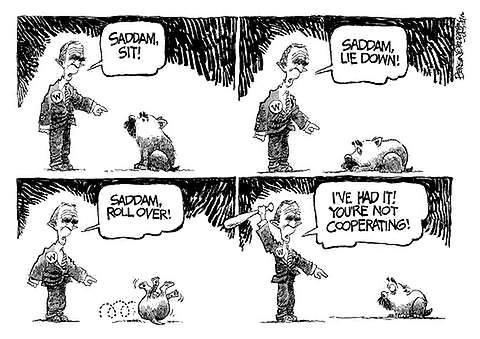
Related miscellaneaUN weapons inspectorsAustralia's Prime Minister John Howard used to say that the single most compelling piece of evidence that Saddam Hussein is up to something nasty is that he will not allow UN weapons inspectors in. Mr. Howard won't allow UN inspectors into Australian prisons or detainment camps; what should the rest of the World conclude about that? But even after the weapons inspectors were allowed in and found nothing, Howard still wanted to go to war!
US love affair with oil |
|
Home Top Index |
The Geneva Convention obliges an occupying force to keep order. The Coalition failed to do so. The Iraq National Museum, with its irreplaceable treasures dating back to Sumer, the oldest civilization on Earth, was looted. Two major libraries were burned on April 15th. Other looting was widespread.
On 2003/09/25 The New Zealand News reported that:
Authorities estimate more than 10,000 artefacts are still missing from the museum, and many will be lost forever, but about 3500 have been recovered. Some have been found in Britain, the US, Italy and Jordan.
Added on 2003/04/12
Saddam and his supporters seem to be beaten. No-one was surprised that the Coalition won. The question is, what now? Will the coalition, who so efficiently destroyed the Hussein regime, now help the Iraqis rebuild, or will they leave chaos behind them?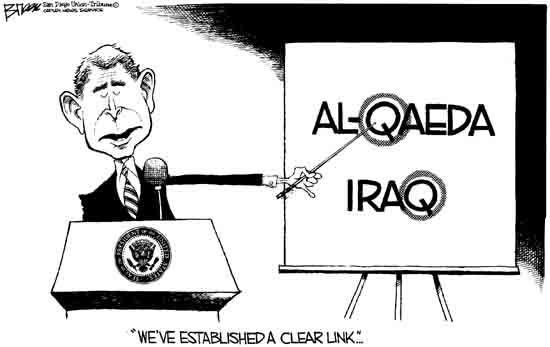
At present looting is rampant and aid agencies are unable to work because of lawlessness. Hospitals are under attack by looters and we hear of doctors having to carry weapons. Having removed all Iraqi authorities the Coalition has left a power vacuum and seams unable or unwilling to provide any form of law enforcement.
What condition will Iraq be in a year from now? A nation wracked by civil war with law only in a few major cities? (In Afghanistan Kabul is the only place with any real rule of law.) Or will it be on the road to freedom and democracy? How many Iraqis will have died as a result of the war?
It will be a year or perhaps several years before a judgement can be made on whether the war achieved anything good. We can only hope that there will have been more good done than harm.
|
Home Top Index |
If we become involved in a war with Iraq the costs will go on
long after John Howard has ceased to be Prime Minister.
Some 13 million cluster weapons were used in 1991. About 10% of them failed to explode imeadiately. Many of these are still present and pose a major danger to Iraqi civilians.

|
|
Symbolising Australia's status as a puppet of the USA |
A retired defence chief has accused the Government of "madness" in pursuing war against Iraq.Former [Australian] Chief of Defence Admiral Alan Beaumont said yesterday there was no justification for war without UN backing and little justification with it. He warned the campaign could be long and bloody and he slammed the Government for saying it would be brief with low casualties. "This is bloody mad," he said. "I don't understand how it is in the national interest to kowtow to the US." Admiral Beaumont said Australia now was fully integrated into US war plans and would be unable to back out. He had discussed the war with about 30 former top brass. "No one I know supports the Government's position, not one," he said. His predecessor as defence chief during the 1991 Gulf War, General Peter Gration, warned war without the UN could lead to breakdown of the world order.
RSL national president, retired Major General Peter Phillips said: "Without UN backing we shouldn't be going."
| On a lighter note...
"I don't see the problem. If the Yanks want Saddam to give up his weapons of mass destruction, why don't they just issue a recall notice?" |
Messrs Bush, Blair and Howard: this world of ours used not to be too bad a place. But in a few months you three have managed to divide and frighten not just your own people but the whole world as well -- including the UN -- and in the process jeopardised everyone else's economies.Just look at what's already happened to the world price of oil and stock markets in almost every country. For God's sake, stop before you three provocateurs wreck everything. Just lock yourselves up of a while. Yours in Despair.
Gration states that Iraq cassualties of the first Gulf war were higher than most people know, he said:
"They sustained between 50,000 and 120,000 military deaths, with perhaps up to three times that number wounded. Direct civilian deaths numbered between 3,500 and 15,000 with a further 110,000 dying later from war related causes including economic collapse, infrastructure damage and the collapse of the health system. In the decade since 1991, the combined effects of the war and the subsequent sanctions have impacted heavily on the health of the Iraqi people, which remains poor. A new conflict would hit hard, as the baseline is far lower than in 1991."
A shorter and very informative PDF version of the Medact report can be downloaded from Medact_Iraq_report. (Medact is a health professionals organisation challenging barriers to health. "We highlight the health impacts of violent conflict, poverty and environmental degradation, and with others act to eradicate them.")
|
Home Top Index |
Incapacitating chemicals kill as well as incapacitate. In a hostile situation it is impossible to get the dosages right: too much chemical and death results rather than incapacity. Remember the gas that the Russians used when Chechen rebels held 700 hostages in a theatre in Moscow; it resulted in the death of more than 100 hostages.
An artical in The Scientific American of Feb 2003
(Storm before the calm: Can knockout gasses really be nonlethal?)
stated that it may never be possible to use
chemical incapacitating agents safely.
ABC on-line polls about Feb. 10th:
"Do you believe there is a case for war against Iraq?" -
25 212 votes were counted; yes 11%, no 89%.
"Should Australia take part in a war against Iraq?" -
58 108 votes; yes 10%, no 90%.
|
Home Top Index |
The after effect is bound to be hatred and a desire for revenge. The 'War on Terrorism' will cause an increase in terrorism.
A letter from the 2003/02/22 issue of The Australian is instructive:
What the world needs in order to reduce terrorism is more understanding and more help for the unfortunate; not more bombs and missiles.
The protest by so many people in Western countries against the proposed bombing of Iraqi civilians has been met with surprise and joy by Muslim newspapers worldwide, as a quick survey of the web shows. Far from helping Saddam Hussein, as John Howard claims, this display of human solidarity is the best counter to the hate-mongers and religious fanatics on all sides. The only person who wants a war more than George W. Bush is Osama bin Laden (remember him?)
He will have fewer recruits among the disaffected because of the millions of marchers who showed their concern for humanity, regardless of creed.
Bob Haworth, Armidal, NSW
|
Home Top Index |
The war will have long-lasting ill effects on recruiting in the Australian Defence ForcesI am old enough to remember the Vietnam war. I might have served, but my "marble didn't come up". At the beginning of Australia's involvement in Vietnam a large majority of Australians, as I recall, were supportive of that war. It was later, when the US started bombing the north and poisoning the forests, and when everyone started to wonder who we were really fighting and who we were supporting and what we were achieving, and who were the good guys and the bad guys, that support declined. In this war the Defence Forces are being sent to fight a war that is very unpopular with the Australian people from the beginning, a war that is immoral and illegal, and a war that will probably be counterproductive in the long term. Who would want to serve in the ADF if they know they might well be sent to fight an unwanted and unjust war? Recruiting will suffer for decades. |
"The cause of falling recruitment numbers and low morale in the Australian army must be identified and rectified."The cause must be identified? I would have thought it fairly obvious. What inspiring arguments could the recruiters put forward?"With the failure of a $500 million recruitment drive, other avenues must be explored to maintain numbers in military service."
"Join Australia's military forces and help the good old USA in its unjustified, immoral and illegal wars for global dominance and control over the World's petroleum supplies. Do a stint in Iraq, the Vietnam of the twenty-first century. Help John Howard in his glorious quest to be George W. Bush's right hand man."
| Nation | 109 tonnes | Share of world total | Comment |
|---|---|---|---|
| Saudi Arabia | 36.0 | 24.9% | Osama bin Laden's native country. Fifteen of the nineteen Sept. 11 hijackers were Saudis. Many islamic fundamentalists. |
| Iraq | 15.2 | 10.7% | The centre of attention |
| United Arab Emirates | 13.0 | 9.3% | Overall authority is held by the Supreme Council of seven emires, each of whom is an absolute monarch in his own state. The UAE supported Iraq against Iran, but supported the US in the 1991 Gulf War. The leadership is pro-Western while anti-American Islamism is strong in the populace. (From SBS World Guide, 10th edition) |
| Kuwait | 13.3 | 9.2% | "Saved" by USA previously |
| Iran | 12.3 | 8.5% | USA supplied Iraq with chemical weapons that were used against Iran |
| Total Middle East | 93.4 | 65.3% | Could be destabilized by the war |
| Venezuela | 11.2 | 7.4% | Politically unstable |
In spite of Saudi Arabia's oil wealth poverty has recently started becoming apparent. The ruling family, which imposes a medieval style of monarchy on the country, is terribly corrupt and greedy. Serious political instability is a distinct possibility in the not-to-distant future. If the current Saudi Arabian Government is overthrown and is replaced by a fundamentalist Islamic government, as in Iran, it is quite possible that they might get together with the other Muslim nations and place an oil embargo on the USA.
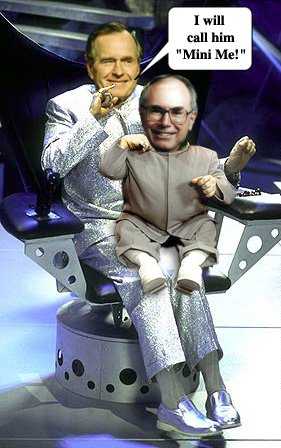
|
Home Top Index |
A quote from Sydney Morning Herald, 26 February 2003
International law recognises two bases for the use of force. The first, enshrined in article 51 of the United Nations charter, allows force to be used in self-defence. The attack must be actual or imminent.The second basis is when the UN Security Council authorises the use of force as a collective response to the use or threat of force. However, the Security Council is itself bound by the terms of the UN charter and can only authorise the use of force if there is evidence that there is an actual threat to the peace (in this case, by Iraq) and that this threat cannot be averted by any means short of force (such as negotiation, further weapons inspections etc).
Members of the "coalition of the willing", including Australia, have never presented any persuasive arguments that an invasion of Iraq was justified under international law.