
|
|
|
Home Index |
|
Home Index |
|
|
I will spend little time here explaining what the Peak Oil concept is all about or in providing evidence for it; those things are well covered elsewhere on the Net. I am mainly interested in what it might lead to.
In July 2005 oil prices were around US$61/barrel, by July 2006 they were around US$73 and in November 2007 they reached US$96. At these later levels coal liquefaction is economically viable. It seems inevitable, considering society's thus-far very slow response to greenhouse, that as the price of natural petroleum continues to rise coal liquefaction will gradually take over as the main source of liquid fuels. Governments should be looking ahead at minimising the environmental harm involved in this pollution-producing process; I suspect that most are not.
Other potential sources of liquid fuels that producers will consider are tar sands and shale oil. The global reserves of these are much larger than remaining reserves of conventional petroleum. However, they tend to have greater environmental impact and particularly will increase greenhouse carbon dioxide production unless they are developed with great care. There is little gained if we survive Peak Oil, but destroy our environment in the process.
The best thing that can be done to reduce the effects of Peak Oil is to reduce our consumption of just about everything. We should all be pressuring our governments to pass laws to promote energy conservation and minimisation of waste. We will have to cut our use of petroleum and the earlier we start the better.
We – individuals, industries and governments – should be
moving toward
sustainable
forms of energy generation.
Many of the
actions
that will reduce greenhouse gas production will also slow our use of
petroleum.
|
The upper graph at the right, from the Uppsala site, shows the Uppsala group's record of past liquid and gaseous petroleum extraction together with estimated future extraction up to 2050. This shows that extraction is expected to peak in about 2013; other studies vary on exactly when the peak may occur, some placing it as soon as 2008.
(The formal reference for the Uppsala study is "The Study of World Oil Resources and the Impact on IPCC Emissions Scenarios, Anders Sivertsson, Uppsala Hydrocarbon Depletion Study Group, Uppsala University, Sweden, www.isv.uu.se/uhdsg".)
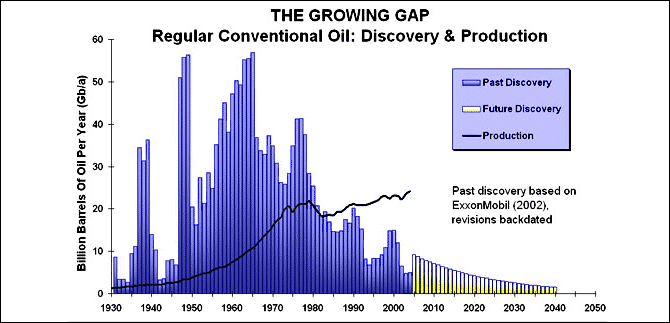
The lower graph at the right, from An Introduction to Peak Oil (Phil Hart, original data attributed to ExxonMobil), shows that the total size of the oil fields discovered world-wide has tended to decline since about 1965.
Other sources report that the amount of oil discovered fell below the amount being consumed in 1960 and has continued to decline since then.
If one looks at the size of the oil fields discovered one also finds that all the really big fields were discovered years ago and smaller and smaller fields are being discovered in recent years.
My impression is that there is no doubt that a peak and following decline in petroleum supply is coming soon, the question is only one of when. As the supply declines we can expect the price to steadily, and probably rather steeply, rise.
So, what else happens as the conventional sources of petroleum run out?
Considering the threat of Climate Change associated with the enhanced Greenhouse Effect, the ideal would be to shift to sustainable fuels, perhaps primarily hydrogen. Unfortunately the world is nowhere near being ready to do so.
|
Home Top Index |
Unconventional liquid fuel sourcesAs conventional, pumpable, petroleum supplies decline people will tern to alternative sources. There are several of these, and most are at least potentially more damaging to our atmosphere and our climate than conventional petroleum. |
Oil shaleOil shales are very fine-grained rocks, composed largely of clay, that contain bituminous material. Unlike conventional oil-bearing geological formations, the oil in the shales will not drain out under gravity, nor can it be mechanically removed from the rocks. It is removed by a process called pyrolysis in which the oil shale is heated to 450-500º C in the absence of air to drive the volatile substances from the shale. Additional processing must follow before useable liquid fuels are obtained.Reserves are huge. Estimates range up to over a trillion (1000 000 000 000) barrels of oil world-wide. For more detail see Wikipedia, which is the source for most of the above. |
|
The process was developed in oil-hungry Germany in World War Two and later
used in the economically embargoed apartheid South Africa. There are at
several processes that can be used to produce liquid fuels from coal.
The bituminous grades of coal are the best for liquefaction.
Estimates for the oil price at which coal liquefaction becomes viable vary from around US$30 to US$60 per barrel. As I write (July 2005) the oil price is US$61. For more detail see Wikipedia, which is the source for some of the above. |
|
Home Top Index |
|
Coal gasification is the production of combustible gases, such as carbon
monoxide, hydrogen, and methane from coal. The gases produced are used as
fuels, gaseous fuels being generally more convenient to use than solid coal.
The coal is milled, dried and pulverized. It is then fed into a gasifier reactor, and at high pressure and temperature it is converted into synthesis gas (syngas: mainly carbon monoxide and hydrogen). Fuel gas for domestic and commercial use was produced by this method in many places before 'natural gas' from petroleum fields became more economical. |
|
Similar to oil shale,
above, except that the host rock includes a large
proportion of sand with the clay. The clayey sands contain bitumen which
can be extracted using hot water and floatation. Usable liquid fuels can
then be extracted from the bitumen.
For more detail see Wikipedia, which is the source of some of the above. Two relevant reports are available from the Uppsala Hydrocarbon Depletion Study Group: A crash program for the Canadian Oil Sands Industry (240KB pdf format), and a Thesis entitled Canada's Oil Sands Resources and Its [sic] Future Impact on Global Oil Supply (1.3MB). (They are Swedish after all. You can't expect them to be experts in their field and in English as well. I remember a report I did once, I wrote the title as "Observations on the Groundwater of the Clare Valley", on the finished report it came out as "Observations on the Groungwater of the Clare Valley"; embarrassing!) |
|
Three hundred years ago firewood was mankind's main source of heat.
It still is in the less developed parts of the world.
Liquid and gaseous fuels can be produced from firewood and other organic matter, for example garden waste and shit. Firewood has a roll to play in providing an alternative energy source to petroleum, but, while it is a renewable resource, it is quite impossible to grow enough firewood to replace petroleum at current rates of consumption. |
|
Home Top Index |
You can get the impression from the media that Peak Oil is all about a
single moment when oil production will start to decline and prices will
shoot up catastrophically. It is certainly not that simple. There are
many inter-related factors that will effect our use of oil.
|
|
Home Top Index |
|
The USA establishment over-estimates the world's oil reserves so that it
can bargain with OPEC (The Organisation of Petroleum Exporting Countries)
for lower oil prices.
If OPEC nations knew how little oil remains they would raise their oil
prices.
It is greatly to the advantage of the USA (the biggest oil consuming nation
in the world) to convince the OPEC nations that we are nowhere near
Peak Oil!
What applies to the USA also applies to other oil importing nations (most Western nations). Hence we have a world in denial about the impending peak of oil production. What happens when OPEC nations realise they are sitting on a resource that is hugely valuable and very limited? One could speculate. |
|
The first, simplest, and cheapest thing that you should do is to reduce your
consumption of energy-intensive products. As it is difficult to know what
products are energy-intensive, your first move might be just to not buy what
you don't really need.
As the price of oil goes up everyone would be wise to try to reduce their requirement for oil. This applies to direct and indirect consumption. You would also be well advised to reduce your dependence on gas, as the price is likely to be closely linked to that of oil. By indirect consumption of petroleum I am thinking of such things as electricity from oil or gas fired power stations. What can you do?
CostsMost of the changes that I am suggesting are going to cost something. On the other hand, making the changes early is likely to be less expensive than trying to make them later; as petroleum prices go up, so will costs of production, and many other costs and prices will follow.Change to a fuel efficient car before the sale price of your big car falls drastically because no-one wants it. Costs can be minimised by buying second hand and being inventive. |
|
Home Top Index |
Of course complete self-sufficiency is not only impossible, it is undesirable. A functional society would not consist of a whole lot of people trying to be independent of all other people; self-sufficiency would ideally mean self-sufficient local communities rather than self-sufficient individuals. However, getting a community organised is not easy and most of us can manage a limited amount of personal self-sufficiency. Most of us would have room for a few fruit trees (especially if we replace some lawn or ornamental garden plants). By placing solar photovoltaic (electricity generating) panels on your roof you will reduce your dependence on the electricity grid. Consider running a few chooks (some call them chickens). Chooks can be run in a small area – a suburban back yard for example – will consume kitchen scraps, and will supply you with both eggs and meat. For those with a bit of spare cash, you could think about buying some land and getting more seriously into raising food and fuel plants; and perhaps running some livestock: a few pigs, sheep, goats, cows, rabbits, whatever. Sheep can provide wool – which can then be turned into clothing – in addition to meat, goats and cows can provide milk and meat. By fuel plants I mean trees for firewood. In South Australia, where I live, gum trees (Eucalypts) can produce useful amounts of firewood in under ten years; they have been successfully introduced to many other countries with temperate climates. A backyard (or front yard for that matter) vegetable garden will certainly give you some self-sufficiency. If growing crops, try to consider how much energy input they will need. Some crops, I believe, consume more energy than they yield 211; if grown using the highly industrial modern methods. You should also consider things like water supply. The electricity supply for running a pump may become less reliable in the future. Can you put in rainwater tanks or a well? If you have more space perhaps you can build a dam? Building a cellar will provide a place where things can be stored at a constant temperature while, unlike a refrigerator, not needing any input of energy to operate. It will also provide you with a place where you can escape the heat on those exceptionally hot summer days when the electrical grid goes down. Failures of the electricity supply are likely to become more frequent as the oil supply fails. |
|
Life after the oil crash
by Matt Savinar. The
Prepare
page on this site provides many links giving information on getting ready
for the collapse of the oil age.
Wikipedia has a page on Peak Oil. The Uppsala Hydrocarbon Depletion Study Group in Sweden specialise on the Peak Oil problem. There is a detailed page by Dr Colin J. Campbell entitled Peak Oil: an Outlook on Crude Oil Depletion. |
|
Home Top Index |