Gannett News Servlce.
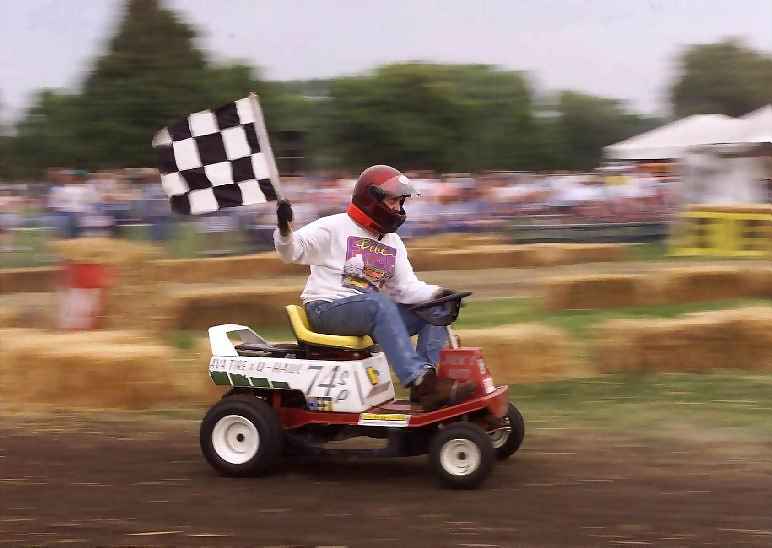
| Randy Hollrah, 43, of Ava, takes the checkered flag in Lisle,
III., to win
an event at the STA-BIL National Lawn Mower Racing Series. |
Racing lawn mowers originated in a tavern conversation
27 years ago in England.
Gannett News
Service
LISLE. III. — In the first lawn mower race in West Sussex, England, some 27 years ago, a push mower won. Today, the British scoot around the track like greyhounds on riding mowers outfitted with chairs that resemble recliners.
Wearing shirts that read “The British Empire Strikes Back,” eight racers made a maiden voyage in July to this Chicago suburb. They came to claim what is theirs: an odd European import gaining popularity in the United States.
“Back home we exchange a lot more paint than your fellas,” says England's Colin Fox, 32. “It's about being aggressive, not dangerous. The difference is a fine line.”
The sport's brainchild is Irishman Jim Gavin, a jovial 62-year-old travel agent from West Sussex. He was organizing cross-country car rallies in 1973 when he decided to find a cheaper motor sport. Talking in a pub one evening, he and some friends decided to organize a race of carbine harvesters, which would have been about as awkward as racing giraffes.
“There were only two harvesters in our county and the farmers wouldn't let us use them,” Gavin recalls. “So we decided to use something everyone had — lawn mowers.”
The British today race antiquated mowers called “lawn bugs,” favored for their light weight and low center of gravity. Racers use unmodified 8 horsepower engines and round turns accelerating.
U.S. racers use large mowers, some with modified 20 horsepower engines, and are forced to brake at every turn. In two “Rider Cup” races in Lisle, the British defeated the U.S. team, taking the top four finishes in one race, and first and third in another.
Like with the U.S. circuit, no prize money has been offered in Britain. But unlike the U.S. circuit, the British won't think of it. One mention and they all look at you as though you've blasphemed the Queen Mother.
“No prize money,” Gavin says quickly, echoing his
racers, a motley mix of cesspool workers,
truck drivers, body shop owners, doctors, dentists, engineers.
“Money would make it competitive for the wrong reasons.
You'd have people racing for the prize instead of racing just to compete.”