METAL
SIDE: Do you still listen to Revenant’s early materials from the 80’s?
What do you think about them now? METAL
SIDE: Many young people who are now devoted Death or Thrash Metal maniacs
have idealistic vision of the underground from the 80’s. They think that
its features were brotherhood, disinterested support… Was the scene as
good and supportive as they think? REVENANT:
I am suspicious of any such ideas. What I object to them most is that they
are an anthropological way of thinking about the history. In other words,
it is a way of thinking about the scene in terms of people, instead of
music. What those people did not see was the violence and youthful stupidity
of the scene. They also did not see how that violence also held things
together and inspired us to compete, or the importance of other factors,
like how we changed the physics and technique of our instruments, the endless
hours of rehearsal, etc..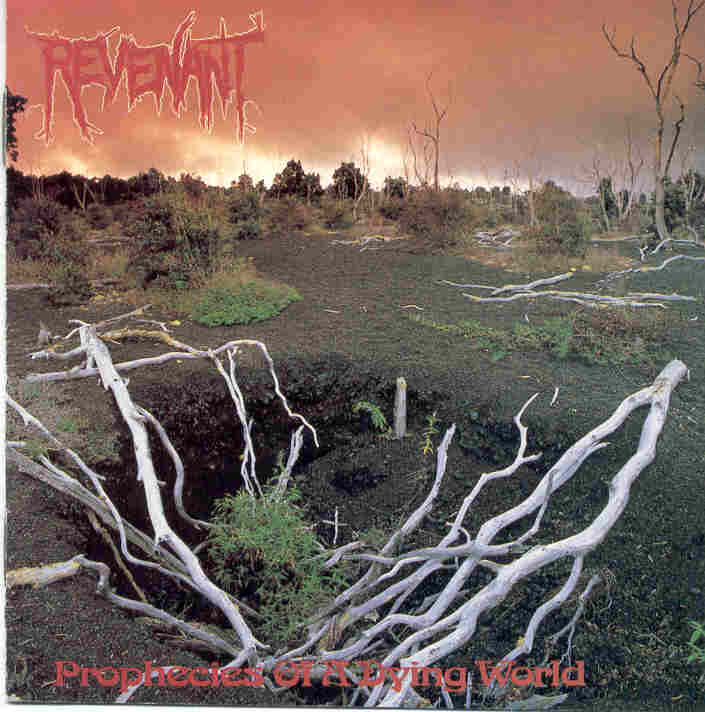 Our
demos, and those by other bands – Immolation, Ripping Corpse, Prime
Evil – built a scene from nothing. We had no peers to emulate.
Our
demos, and those by other bands – Immolation, Ripping Corpse, Prime
Evil – built a scene from nothing. We had no peers to emulate.
I
would also draw a distinction between idealism and nostalgia. Nostalgia
is often a dream invented by people who were not involved in a place or
event – it is a distorted view of history. On the other hand, idealism
belongs to the people who build a scene, such as we did. Nostalgia distorts
history; idealism has no history. Both are dangerous things.
Both
nostalgia and idealism ignore the most important thing: the music. We were
all making crazy music, and in the end, the music matters most. Yes, it
was an interesting scene, with plenty of dramatic action: but it was, above
all, a music scene and not a fucking social club. The physics and
technique of the music are more interesting. For example, when I visited
the Morbid Angel house in Tampa in 1989, Pete was strapping weights to
his ankles and hands when he played drums. He was training himself physically
to play fast. Or the guitarists in Ripping Corpse, Sean and Erik, they
used to file down coins to use as guitar picks. That is how they achieved
their style. Will, our drummer, liked to drink a bottle of wine onstage
in between songs. In retrospect, I know why he didn’t play well on “Prophecies”
– he didn’t drink wine in the studio.
METAL
SIDE: When I heard “Overman” I was really surprised.
It is very good material but I expected a bit different style, simply the
continuation of “Prophecies…”, especially that
the latest compositions written for this album, like “The Unearthly” were
the fastest one. However, on “Overman” you slowed
down. Why? Did you change the style because fast Death Metal wasn’t as
popular as two or three years earlier or simply did you evolve as musicians?
REVENANT:
Revenant had two rhythmic gears: slow and fast. Sometimes we explored both
in a single song, while at other times we separated them. The first two
songs on Overman are a continuation of tracks
like “In the Dark of the Psychic Unknown” from the ‘Prophecies’ record.
We were not satisfied with the slower material on Prophecies (among other
things), so we concentrated on improving that area in our music. The third
song, “Long Red Sleep,” is the only mid-tempo song we ever composed. The
last track, “Exalted Being”, is actually a great deal like “The Unearthly”,
only faster and heavier.
We
entered the studio with six songs for Overman,
but we did not include two of them: “The Burning Ground” and “The Faithless,
III.” Those were both very fast and heavy songs, but they would have disrupted
the conceptual continuity of the other four songs, how they worked with
the title, etc, so we left them off.  We
left the recordings and mixes unfinished. The result is a stronger CD and
Erik Rutan did a superb job mixing it.
We
left the recordings and mixes unfinished. The result is a stronger CD and
Erik Rutan did a superb job mixing it.
I
don’t know how to answer the final question. We never made music like anybody
else, period. Just listen to the bands that came out of the old New York/New
Jersey scene – Suffocation, Ripping Corpse, Immolation, Incantation, Mortician, Nokturnel–
not one of them sounds like any of the others, and they all changed from
one recording to the next. It was a very diverse scene, and the music was
always changing. Overman is just a glimpse
of what we were doing at the time. We certainly weren’t following any trends.
METAL
SIDE: Working on the release of "Overman" you
co-operated with E. Rutan. Why did you choose
him? Did you know him from the old times? Do you stay in touch with many
musicians with whom you played gigs in the 80's and 90's?
REVENANT:
Erik Rutan was the best person for that
job. We wanted the CD to capture a certain mood, and Erik understood that
best. He is a rigorous engineer and producer.
The
fact that he is an old friend only made communication easier.
I
stay in touch by attending concerts. A few years ago Immolation and Six
Feet Under were playing near the University in Pittsburgh. I was teaching
in the afternoon and I was wearing one of my fine Italian suits. I walked
over to the club when I was finished. I immediately ran into Chris Barnes,
who I hadn’t seen since he left Cannibal Corpse. He stopped when I said
hello, and then he said “Holy Shit - Veg!”
The guys in Immolation were not surprised at all – I was showing up at
their concerts wearing short hair and suits for a few years already, even
before I moved to Pittsburgh.
Anyway,
I stay in touch by going to shows. I don’t call people or write them often,
or show up for Christmas, if you know what I mean.
METAL
SIDE: There’re more “lost” Revenant’s tracks recorded between “Prophecies…”
and “Overman”. Are they in the vein of the full-length
album or rather the EP?
REVENANT:
There is no comparison to either one. The songs we wrote from 1991-1994
were certainly the heaviest material we ever composed. Revenant was not
always a very good studio band, but we were a devastating live band. The
“lost” recordings capture the live atmosphere of the shows. We are currently
mixing that material now for Extreem records
(Spain). They will release a CD early next with all the demos, 7-inch recordings,
and live songs. Everything will be remixed and remastered.
METAL
SIDE: Why did you wait so long to present “Overman”?
This material was worth the immediate release… It would be hard to believe
that you couldn’t find a good record label to release it. But knowing metal
business unfortunately everything is possible…
REVENANT:
Thanks. We didn’t shop the material to labels. Like I noted earlier, it
was just for us. We are pleased that it reached a larger audience without
the intervention of a record label, but I have to remind you that it was
a very personal project for some of us.
METAL
SIDE: There is a chance that we will hear previously unreleased material
already next year. Could you tell us more about these plans?
REVENANT:
Yes. Dave from Extreem Records/Avulsed approached
us with the idea of emptying the Revenant vault. The CD is entitled “The
Burning Ground” and it will feature many unreleased tracks, alternate versions,
and remixed versions of ALL the Revenant demos. It is going to have excellent
packaging and a great insert booklet with tons of old photographs, flyers,
lyrics, and other material. Where we only pressed “Overman”
for ourselves, “The Burning ground” is dedicated for the fans. It will
contain the music they always wanted from us – the best stuff.
METAL
SIDE: Your materials were recorded ten and more years ago. Now you can
have different approach to music. Have you some ideas what could be changed
in your old tracks if you could re-record them?
REVENANT:
I would not change any of the 7-inch or demo recordings, and I think Overman
is a perfect E.P. I would change one thing:
the entire ‘Prophecies” record. We should have waited one year longer,
abandoned some of the older material that was written when John was still
in the band, and worked in a different studio.
METAL
SIDE: I read your interview for German webzine (www.voicesfromthedarkside.de)
in which you emphasized that there won’t be any new Revenant’s recordings.
Why? Don’t you have new ideas? Do you like other kinds of music now that
would not fit old Revenant’s styles? Don’t you have time? I’m asking about
this so importunately because I’m sure that many people would like to hear
new Revenant’s material.
REVENANT:
Sorry, but no. I know that Will would do
it tomorrow if he had the chance, but unfortunately for him, the Dave,
Tim, and I live very far away. I would only do it if Tim paid to bring
us all to rehearse at his house in Sweden.
METAL
SIDE: All Revenant’s recordings that I heard are not only very good but
also very original. How were you working on your music? Had you a special
songwriting method?
REVENANT:
We were meticulous, slow, and patient. We spent a very long time writing
music, and then it would evolve for years after the first draft. We rehearsed
constantly, about three-four days per week, every week of the year, and
as individuals we would spend the rest of the time working on riffs and
assembling them. I also had lyrics to write, and I was slow with those
as well. Sometimes I would begin with a phrase, and change it over and
over. Sometimes I would start with a single word, and build the lyrics
from there. Sometimes I would begin with a single riff, and simply elaborate
it. It took me the entire summer of 1989 to write ‘Distant Eyes,’ but it
all started with that first, slow riff.
METAL
SIDE: Why did you disband Revenant in the mid 90’s? Were you tired of the
scene or simply had other challenges in your life?
REVENANT:
I decided to return to school and earn a Master’s Degree in Literature.
I left the band in the middle of the first year of study, then I went to
study and stay with some of my family in Italy in 1995. When I came back,
it was over – Tim was in Florida playing in Hateplow,
and Dave and Will were doing other things.
METAL
SIDE: Do you think now that Revenant achieved everything what you could
achieve? When you signed a deal with Nuclear Blast it seemed that very
soon you would become one of the most popular US Death Metal bands. I think
that you never achieved such position, that your great music was underrated.
REVENANT:
That old scene only produced one truly great death metal band, and that
was Immolation. The rest of us, especially Revenant and Ripping Corpse,
were too strange to become popular. We never played music to be popular.
We played music because we loved music. Beyond that, we didn’t care about
anything, and especially not about what people expected of us.
As
for “Prophecies,” I see now that we were probably too young to make a record.
It was all too fast. With the exception of “The Unearthly,” the “Prophecies”
CD was a failure. The European tour, on the other hand, was a huge success.
Listen to the soundboard recordings from those concerts – they are brutal.
METAL
SIDE: What bands were the biggest influences for you when you started playing
Death/Thrash Metal? What do you listen to nowadays?
REVENANT:
I grew up on classic rock. Led Zeppelin are
the greatest rock band of all time, period. Sabbath and AC/DC were a big
influence, but Zeppelin was the world. I also listened to the Doors, Hendrix,
Janis Joplin, the Stones. All great stuff,
and I am not ashamed to admit it. Listen closely to Overman
– there are many references to those bands. There is a Beatles reference,
and a Peter Gabriel reference, to name a few. Listen to the soundboards
from the Prophecies tour – our intro music was Pink Floyd. We would play
“One of these Days” from “Meddle,” and cut it right after the voice says
“One of these days, I’m going to cut you into little pieces.”
The
first thrash bands that I liked were Metallica,
Slayer, Whiplash, Voivod, and Celtic Frost.
I later got into the great German bands, especially Sodom. But my roots
were always in classic rock. Other people often laughed when they had to
ride in the Revenant van. Will was listening to Rush, or I was listening
to The Doors, or Dave was listening to the Allmann
Brothers, or whatever.
METAL
SIDE: Tell us something about your musical life after Revenant’s end. Were
you in other bands? If you were, what did they play? What happened with
other band’s members?
REVENANT:
yes, I did play in another band, but we had no name. It was different from
Revenant. Maybe I will ask Tim to place some of the recordings on the Revenant
website some day. It was very heavy stuff. We sounded something like Ministry.
METAL
SIDE: What do you think about the current Death/Thrash metal scene? Is
it worth to call it “original”?
REVENANT:
I am not in a position to comment. I really have little or no idea. A young
guy from a local college contacted me last year and asked for an interview,
and I was surprised by how well he knew the history of the old scene. This
much I can say – there are a few very good bands making very good music.
Nile is great, Hate Eternal is great, etc.
Even the old bands are making good music. The last Morbid Angel record,
“Heretic,” was their best ever.
METAL
SIDE: Are you interested in the politics? What do you think about the rivalry
Bush – Kerry? Many US musicians, not only who play Heavy Metal, seem to
support rather Democrats. Republicans don’t have as strong support in show-business.
What are the reasons of such situation? I guess that we can’t simply say
that Democrats are more music-friendly than Republicans…
REVENANT:
That’s a very unusual way of looking at it. I guess the old myth about
the music of the 1960’s never died. The reality is that most music fans
in the United States are very conservative people. They hate anything that
is really new. And Republicans are very strong in some music scenes here,
especially rock and country. And they are slowly taking over Hollywood,
again, like they tried to do in the 1950’s. It is a very sad situation.
It makes me miss people like Frank Zappa very much. We should have cloned
him.
As
for politics, some people complain there is too much of it in the world
today. I disagree – there is not enough. What passes for politics these
days is mere opinion. Everybody should shut up for about five years. In
the meantime, they should read the major political thinkers – all of them,
from Plato to Hobbes, and from Machiavelli to Marx. Then maybe they would
speak only if they have something intelligent to say, and keep their stupid
opinions to themselves.
METAL
SIDE: You are also the translator of Italian literature. One can read one
of your works visiting Revenant’s website. Let me ask you very prosaic,
maybe even trivial question: what is more difficult, to compose good music
or to write a good novel? On which of these fields is it easier now to
be original?
REVENANT:
That is the best question I have ever been asked. I simply cannot answer
it.
I
can say this – ask me again after I have finished a novel! In the meantime,
read Thomas Mann.
METAL
SIDE: Many critics say that Death and Thrash Metal bands have very simple,
childish, trivial lyrics, sometimes in bad taste. Do you think that is
fair opinion? How was it in Revenant’s case? What were your favorite topics
that you expressed in your lyrics?
REVENANT:
Moralists are so boring. The world is filled with them. They base their
worthless judgments on absolute categories. That sort of criticism is pointless.
Like I said earlier, everybody should just keep silent for about five years,
and, in this case, study modern poetry and the lyrics of modern music before
they open their mouths again.
There
are two styles in rock and metal lyrics. One style is very subjective and
psychological. “Paranoid” by Black Sabbath is the best example. But that
style is a watered down version of the style that Jim Morrison was writing
for The Doors. In the early stuff, this style was irrational, but later
it hardened into a human figure or social phenomenon, like a serial killer.
An excellent later example might be “The Ripper” by Judas Priest. You can
trace a line from “The Ripper” through Slayer’s lyrics to Cannibal Corpse
and Macabre. All the religious and satanic lyrics belong to this style,
too.
The
other style is objective and concerned with elaborate stories and myths.
It can be historical, like some Iron Maiden lyrics, or it can be fantastic
or futuristic, like in Voivod lyrics. My
lyrics belonged to this second school, but with one exception- I read too
much philosophy when I was young, so there is a metaphysical streak in
some of the early lyrics. Some of them are just nonsense. They seemed very
profound at the time, and they changed in later years, but they still tried
to use the Revenant character to create myths and stories. I was very much
influenced by certain literary styles at the time, especially gothic writers,
sci-fi, and fantasy writers, and I tried to synthesize it all into the
concept of the “Revenant.” To this day, the best lyrics I wrote were for
the song “The Burning Ground.” They were exceptional, because I was able
to combine the mythology with a historical event in that song – the Chernobyl
meltdown.
METAL
SIDE: Thanks for the interview.
REVENANT:
Thanks for the good questions.