The Nahverteidigungswaffe - Citations
|
|
|
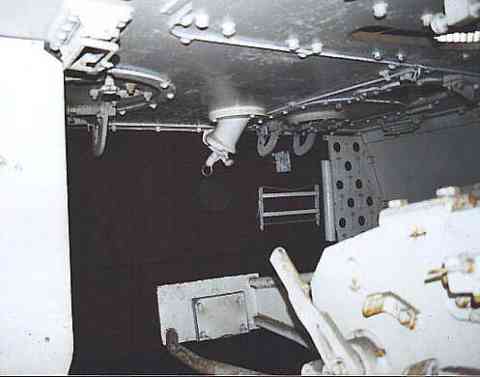
This shot shows the mounting in the Jagdpanzer IV Zwischenlösung (intermediate solution) that had the new Jagdpanzer superstructure mounted directly on an otherwise normal Panzerkampfwagen IV. Of note here is the proximity to the commander's hatch which indicates the commander must have been responsible for its use. |
Preface
This is a collection of selected relevant citations concerning the Nahverteidigungswaffe. Every addition to this list is welcome. Please feel free to contact us if you have new relevant data concerning technical specifications of the Nahverteidigungswaffe or the Sprenggranatpatrone 326 LP and the Sprenggranatpatrone Z.Z. (Zeitzuender - time fuze).
Thomas L. Jentz, Hilary L. Doyle "Germany´s Tiger tanks: D.W. to Tiger I" Schiffer Military History Books, 2000
3.4.2.24 Nahverteidigungswaffe (Close Defense Weapon)
A Nahverteidigungswaffe was mounted in the roof at the left rear (at the same time as the 40 mm thick turret roof, starting in March 1944). The Nahverteidigungswaffe was used to fire the Sprenggranatpatrone 326 Lp (explosive shells), Schnellnebelkerzen 39 (quick smoke candies), Rauchsichtzeichen orange 160 (orange smoke signals), and Leuchtgeschossen R (flare signals) with the Zundschraube C 43 St (propellant charge). The Nahverteidigungswaffe, aimed at a fixed angle of about 500, could be traversed 3600. An armor plug could be inserted into the bore to seal it when not in use. The Sprenggranatpatrone 326 Lp with a 1 second delay fuze was propelled out to 7 to 10 meters and exploded about 0.5 to 2 meters above the ground. Individual fragments flew in a circle for up to 100 meters. All turret hatches and openings were to be closed when this round was fired.
The Nahverteidigungswaffe (close defense weapon) was mounted in the roof at the left rear (introduced at the same time as the 40 mm thick turret roof, starting in late March 1944 with Fgst.Nr.250991.
3.4.2.1 Nebelwurfgeraet (Smoke Candle Dischargers)
In June 1942, Wa Pruef 6 provided instructions for mounting triple Nebelwurfgeraet (smoke candle dischargers) facing forward on each turret side. Although Nebelwurfgeraet were not yet available, starting in August 1942 Wegmann prepared the turrets by welding the mounting brackets to the turret sides and drilling holes for firing circuit wiring so that the troops could mount Nebelwurfgeraet themselves. Complete Nebelwurfgeraet were mounted at the assembly plant starting in October 1942. Troops at the front reported that Nebelkerzen (smoke candles) hit by small-arms fire were set off in the Nebelwurfgeraet. In calm wind conditions, the smoke enveloped the Tiger, causing a loss of visibility and sometimes incapacitating the crew. Because of this hazard, Nebelwurtgeraet were no longer mounted on the turret sides (starting with Turm Nr.286 in June 1943).
3.4.2.11 Minenabwurfvorrichtung (S-Mine Dischargers)
Five S-Minenwerfer (S-Mine dischargers) were mounted around the periphery of the hull roof, one at each corner and one halfway along the left hull side.
At first only the base mounts were welded to the hull roof (starting in December 1942) until S-Minenwerfer became available at the assembly plant (starting by Fgst.Nr.280082 in early January 1943). Only four S-Minenwerfer were mounted on Panzerbefehlswagen, one on each corner. By pressing the respective button on the control panel, the S-Mine could be selectively fired one at a time. A separate electrical connection box for the Minenabwurfvorrichtung was installed (starting with Turm W.324 in June 1943). As plans were made to install a traversable grenade launcher, fired from inside the turret, the Minenabwurfvorrichtung was dropped (in early October 1943).
Thomas L. Jentz "Germany´s Panther Tank - The Quest for Combat Supremacy - Development, Modifications, Rare Variants, Characteristics, Combat Accounts" Schiffer Military History Books, 1995
4.3.10 PISTOL PORTS REPLACED BY CLOSE DEFENSE WEAPON
The MP Stopfen (pistol ports with plugs) on both sides and the rear of the turret were deleted starting in December 1943. They were made obsolescent by the Nahverteidigungswaffe (close defence weapon) that was to be mounted on the turret roof. A variety of ammunition could be fired from the Nahverteidigungswaffe including Schnellnebelkerzen 39 (smoke candles), Wurfgranaten (grenades), Rauchsichtzeichen orange 350 (orange smoke signal) and Leuchtgeschossen R (signal flare). The Nahverteidigungswaffe was traversable through 360 degrees but fixed in elevation at 50 degrees. However, due to shortages, the Nahverteidigungswaffe was first mounted on Panthers starting in March 1944. Many Ausf.A assembled in February and March had a circular plate held by four bolts to cover the hole in the turret roof for the missing Nahverteidigungswaffe.
Walter J. Spielberger, Hilary L. Doyle "Der Panzer-Kampfwagen Panther und seine Abarten" Motorbuchverlag 5. Auflage 1999
In Turmdach war ab dem Laufe des Jahres 1944 eine sog. Nahverteidigungswaffe mit einem Kaliber von 26mm eingebaut. Damit konnten von innen Nebelwurfkörper, Sprenggranaten mit Zeitzünder, Rauchsichtzeichen und Leuchtmunition abgeschossen werden.
Vereinzelt wurden bei den Panthertürmen der Ausführung D an beiden Turmseitenwänden gefächerte Nebelkerzenabschussbecher angebracht. Später wurde im Turmdach eine Nahverteidigungswaffe eingebaut, welche Nebelkerzen 39, Wurfgranaten, Rauchsichtzeichen orange 350 und Leuchtgeschosse R verschoß.
Zur Selbstverteidigung konnten aus der Nahverteidigungswaffe mittels einer Leuchtpistole 2,6 cm Sprenggranatpatronen verschossen werden, deren Schußweite 7 bis 10 m betrug. Der Sprengpunkt lag 0,5 bis 2 m über dem Erdboden, die Splitterwirkung reichte bis 100 m.
Sonstige Waffen mit Angabe der vorhandenen Munition
26 mm Nahverteidigungswaffe im Turmdach zum Abschiessen von Nebelwurfkörpern (12 Schuß), Sprenggranaten mit Zeitzünder (20 Schuß), Rauchsichtzeichen und Leuchtmunition (24 Schuß) Maschinenpistole MP 40, Kaliber 9 mm, Stück 1
George Forty "Die deutsche Panzerwaffe im Zweiten Weltkrieg" Bechtermünz Verlag 1998
Die Ausführung D besaß auf jeder Turmseite eine Abschußvorrichtung mit 3 Nebelgranaten. Später wurde eine 92mm Nahverteidigungswaffe (kurz) mit einem Winkel von 60° auf dem Dach angebracht. Sie ließ sich rundum schwenken, wurde manuell bedient und mittels eines einfachen Spannrings abgefeuert. Eingesetzt werden konnte sie sowohl zur lokalen Einnebelung oder zum Beschuß von Panzerjägern mit Sprenggranaten.
War Department Technical Manual TM-E 30-451 "Handbook on German Military Forces" U.S. War Department 15 March 1945
VII-102
3. Grenades for Smooth Bore Signal Pistol (Leuchtpistole)
b. HIGH EXPLOSIVE PROJECTILE FOR SIGNAL PISTOL ( Wurfgranatpatrone 326, Leuchtpistole).
(1) General description. This projectile, which is painted yellow, has the appearence of a small mortar shell. It is attached to a signal cartridge case by crimping. The head is hollow and contains a fixed needle which is seperated from a pellet containing the detonator assembly and a 7-gram (0,247 ounce) TNT bursting charge by a creep spring.
(2) Operation. A pin inserted through the tail of the bomb pushes two metal balls into a groove and thus prevents the pellet from moving forward against the needle. On firing the projectile is automatically armed, since the pin is left behind. On impact the pellet is thrown forward onto the needle.
[...]
e. TIME FUZED HIGH EXPLOSIVE ROUND FOR SIGNAL PISTOL (Sprenggranatpatrone, Leuchtpistole, mit Z.Z.).
This is a new type of signal pistol ammunition designed for shooting from tanks or equivalent cover. The round consists of a heavy cased high explosive projectile with a 1-second time fuze in the base and a varnished steel cartridge case. Packing cases for these grenades bear the following inscription: "Achtung! Nur aus Panzer oder gleichwertiger Deckung verfeuern. Brennzeit 1 Sek." ("Danger! Only to be fired from tanks or equivalent cover. Time of burning 1 second.")