This page was
build by the student of "Sami Frasheri" High school in Tirana, with the support
of it's teachers.
The page is part of SamiuWeb.com, the
school's homepage.
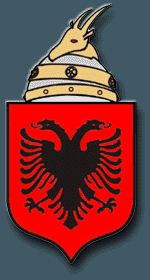
This is the Albanian National
Emblem (not the Albanian flag).
|
Albania (Albanian Shqiperia,
“Country of the Eagle”), republic in southeastern Europe, officially
known as the Republic of Albania. Lying along the northwestern edge
of the Balkan Peninsula, it is bordered by the
Adriatic Sea to the west, Greece to the south, the Former Yugoslav Republic
of Macedonia (FYROM) to the east, and the Federal Republic of Yugoslavia (FRY) to the north and
northeast. The Yugoslav republic of Montenegro lies to the north while the republic of Serbia lies to the northeast. Separated from
Italy by only 76 km (47 mi)
of the Adriatic, Albania, throughout its history, has been occupied
by Italian powers expanding eastward into the Balkans or by Balkan
powers expanding westward. In the 1500s Albania came under the rule
of the Ottoman Empire (centered in what is now Turkey), and did not
gain its independence until 1912. From 1944 to 1990, it was a staunchly
Communist state, and in 1991 Albania began its transition to a democratic
state and market economy. The capital and largest city is Tiranë. Land and Resources With a total
area of 27,529 sq km (10,629 sq mi), Albania is roughly the size of
the state of Massachusetts. The greatest distance from north to south
is about 345 km (about 215 mi) and from east to west about 150 km
(about 95 mi). Natural
Regions Albania is
a mountainous country in which about 70 percent of the land lies above
300 m (1000 ft). Its mountains, which form a broad backbone from northwest
to southeast, rise abruptly from the coastal lowlands to elevations
of more than 2400 m (8000 ft). In the north are the most rugged mountains,
where a massive limestone extension of the Dinaric Alps reaches inland for 40 km (25 mi) from nearby Montenegro.
In the central uplands lies Mount Korab, the country’s highest peak,
at 2751 m (9026 ft). Strong erosive forces have created bare rock
surfaces, deeply incised valleys, and a scarcity of meadowlands in
this region. South of the Alps, the uplands are lower and more rounded,
extending southeastward in a series of plateaus and ranges that merge
with the Pindus Mountains in northern Greece. The western
coastal region consists of low hills and lower reaches of valleys
that open onto the coastal plain. This is Albania’s most densely populated
area and comprises most of the land used for farming. Even here a
series of flat areas are interrupted by hill country. Most of the
soils are difficult to farm because of drainage and water-supply problems.
Only the younger, lighter soils near the many rivers are easily cultivated,
but are often flooded as well. Albania is subject to occasional earthquakes. Rivers
and Lakes Albania’s longest
river is the Drin, which originates at two headwaters in Serbia and the FYROM and flows
for about 280 km (175 mi) in Albania. Other major rivers include the
Seman, the Shkumbin, and the Aóös (Vjöse). Because most of Albania’s
rivers flow at high elevations, they are usually mountain torrents
by the time they reach the coastal plain. In the mountains, rivers
have cut deep gorges with near-vertical walls as high as 90 m (300
ft) above the water. The gorges make irrigation difficult, but are
well suited for the huge dams that give Albania and nearby countries
cheap hydroelectric power. Along the lower course of the rivers, irrigation
is also difficult because sediment-laden streams often break out of
their beds and shift channels. Irrigation is feasible only in valley
bottoms. Albania also shares three large lakes with neighboring states.
Lake Scutari in the north lies partly
in Montenegro, Lake Ohrid in the east lies partly in the FYROM, while Lake Prespa in the southeast
lies in Albania, the FYROM, and Greece. Plant
and Animal Life A little more
than one-third of Albania is forested with mixed stands of willow,
poplar, elm, pine, oak, and white beech trees. Many of the forests
near transportation routes have been heavily logged and some have
given way to sheep pastures. In these areas, the soil is either washed
or blown away during the summer drought, and even in humid months
the grass grows sparsely in clumps. Because of heavy grazing by livestock
in the summer and the summer drought, much of Albania is unfavorable
for wildlife. Wolves, deer, and boars have been pushed back into the
most remote forests. Wild fowl, however, are abundant in lowland forests. Natural
Resources Albania is
rich in natural resources. The southwestern part of the country is
well endowed with natural gas and petroleum. The northeastern region
has large reserves of mineral deposits including chromium, copper,
iron, and nickel. Large deposits of lignite (a soft, brown coal) are
found near Tiranë, and natural asphalt is mined near Selenicë. For
centuries the forests have provided fuel in wood and charcoal. Climate
Albania’s climate
varies with topography. The coastal lowlands have a Mediterranean
climate with arid, almost cloudless summers featuring high temperatures
both day and night. Winters are rainy but mild, and in the southern
lowlands freezing temperatures are rare. In the mountains rain falls
much more often in summer, and the northern regions experience more
humidity than the south. Temperatures may soar in the daytime, but
nights are much cooler. In winter the mountains, like the lowlands,
are subject to heavy and frequent thunderstorms, but in the mountains
storms are accompanied by heavy snow. The average
temperatures in August, the hottest month, range from 17° C (63° F)
to 31° C (88° F). In January, the coldest month, they range from 2°
C (36° F) to 12° C (54° F). December, the wettest month, has an average
rainfall of 211 mm (8.3 in) while the driest months, July and August,
receive only 32 mm (1.3 in) of rain. On the coast annual rainfall
averages 1200 mm (47 in), but it may be as great as 4060 mm (160 in)
in the mountains. Environmental
Issues Both the former
Communist government and new administrations have harvested timber
in vast quantities. As a result, many forests are degraded, wildlife
is threatened, and farms have taken over land once forested. The extraction
of oil and minerals has also created environmental problems, contaminating
air, soil, and groundwater, particularly in central Albania. Public
education about conservation, pollution controls, and recycling is
limited, and the government has focused most of its resources on economic
growth rather than environmental concerns. However, in the early 1990s
several environmental interest groups were established, and the government
created a committee to educate the public and offer solutions to environmental
problems. The People of Albania Population
and Settlement In 1994 Albania’s
official population estimate was 3,357,000, resulting in an average
density of 122 persons per sq km (316 per sq mi). More and more people
have left rural areas for urban ones, particularly in the northern
districts, such that in 1994 a little more than one-third of the population
lived in urban areas, compared to one-fifth in 1950. Albania has had
one of the highest birthrates in Europe since the end of World War
II (1939-1945) while the death rate has been one of the continent’s
lowest. A high rate of population growth was state policy under the
Communist regime, which viewed it as essential to Albania’s strength
and prosperity. Principal
Cities Tiranë, in
the central region, is the capital and largest city. Albania’s second
largest city, Durrës, lies on the Adriatic
coast to the west and is by far the country’s largest seaport. Other
large cities include Elbasan in central eastern Albania, Shkodër in the northwest, and the port of Vlorë in the south central region. Ethnic
Groups Albanians are
among the most ancient ethnic groups in southeastern Europe. Their
ancestors, the Illyrians, were an Indo-European people who settled
in the Balkans long before the Greeks. Modern-day Albania consists
almost exclusively of ethnic Albanians, who call themselves Shqipetars
(Sons of the Eagle). Only about 2 percent of Albania’s residents are
of non-Albanian heritage, most of whom are Greek. About 2.2 million
ethnic Albanians live outside the republic in Kosovo (a region in
Serbia), the western FYROM, and southern Montenegro. Albanians are
divided by the Shkumbin River into two major dialect groups: the Ghegs
in the north and the Tosks in the south. The Ghegs, who make up two-thirds
of Albanians, are less intermarried with non-Albanians than the Tosks,
who throughout history were more often subjected to foreign rule and
other foreign influences. In the past, the Ghegs were organized in
clans and the Tosks in a semifeudal society, but the Communists largely
erased both types of organization. Before World War II the Ghegs dominated
Albanian politics, but after the war many Tosks came to power because
the new Communist government drew most of its support from Tosks. Language
The official
language is Albanian. Because Albanian evolved from the extinct Illyrian
language, it is the only modern representative of a distinct branch
of the Indo-European language family. Tosks and Ghegs speak different
dialects of Albanian, but both groups can understand each other. Tosk
became the official standard dialect under the Communists and remains
so today. See Albanian Language. Religion
With 65 percent
of its population Muslim, Albania is Europe’s only predominantly Islamic
state. Orthodox Christians, living mostly in southern Albania, make
up 20 percent of the population, and Roman Catholics, mainly in the
north, make up another 13 percent. Religious divisions in Albania
are not significant, and religious tolerance is such that members
of the same family sometimes belong to different religions. Most Muslim
Albanians are traditional Sunnites, but about one-fourth belong to the Bektashi
sect, a tolerant, unorthodox order. The Communist
government outlawed all religions in 1967, making Albania the world’s
first officially atheist country. Places of worship were closed, church
property was confiscated, religious services were banned, and religious
practitioners were persecuted. The ban on religion was lifted in 1990.
Many churches and mosques have been rebuilt or reopened, and a growing
number of people express religious beliefs. Education
Illiteracy
in Albania, which had long been widespread, was dramatically lowered
by the Communists; by the 1990s illiteracy affected an estimated 10
percent of the population. Education is compulsory for children from
6 to 14 years old. In 1990, 96 percent of all school-age children
attended primary school and 70 percent attended secondary school.
Several universities, including the University of Tiranë (founded
in 1957), operate in Albania. The Communists encouraged education
for women, and by 1990, women made up 45 percent of secondary school
students (compared to 40 percent in 1970) and 50 percent of higher
education students (compared to 33 percent in 1970). Under Communist
rule, education was also used to indoctrinate students with Communist
beliefs. Before entering college students were required to work for
one year; after finishing their studies, another year of work and
military training was required. After Communism collapsed, reforms
removed politics and ideology from schools, although schools continue
to receive large subsidies from the state. Work and military requirements
were also dropped. Way of
Life Traditional
clothing consists of colorfully embroidered shirts and dresses and
in some regions loose-fitting pants for women. Traditional clothing
was discouraged under the Communists in favor of inexpensive, modern
clothing made by the state. Since the democratic changes in government,
people have more choice in clothing, particularly in urban areas.
Traditional costumes are still worn in many rural and upland areas,
especially among women. The Communists
greatly expanded housing in rural and urban areas. Urban homes were
owned by the state, consisting chiefly of apartment blocks with attached
cultural and recreational facilities and state-owned stores. In the
countryside dwellings were usually one- or two-story family houses,
mostly for peasants living on collective farms, and small apartment
blocks for workers on state farms. As a result of post-Communist reforms,
tenants in small apartments were allowed to own their homes free of
charge. People who lived in larger dwellings could buy them from the
state for small fees. Over the next few years, many state properties
became private and a market for private homes developed. Still, housing
construction in the mid-1990s did not keep pace with the country’s
high rates of birth and migration to cities. As a result, some cities
were overcrowded and the number of shanty dwellings grew. The Communists
ended much of the traditional, male-dominated clan system and guaranteed
equal rights to women. Aspects of the clan system survived, especially
in the highlands, but men there have considerably less authority today.
The legal age for marriage was 18 years old for both sexes and access
to divorce was equalized between spouses. However, virtually no birth
control was available to women because the state wanted them to bear
children. Since the democratic reforms, women have become more organized
and established their own associations. Nonetheless, women’s participation
in the country’s political life remains limited. For recreation,
many Albanians watch television, play sports such as soccer and volleyball,
and walk in the city centers. Under Communism, state-subsidized holiday
centers were provided for families, many of whom traveled to the coast
or visited the mountains during the summer. However, when the subsidies
were removed in 1993, vacations became too expensive for all but a
few Albanians. Even fewer can afford to visit foreign countries. Social
Problems Living standards
have improved in Albania since the collapse of the Communist system,
but the gap between rich and poor continues to grow. The newly rich
are mostly entrepreneurs who have taken advantage of growth opportunities,
while the newly poor are those who depended on the state welfare system
and, in the absence of that system, suffer. Homelessness and hunger
are higher now than under the Communists. Unemployment reached 40
percent in 1992 but by 1995 had declined to 15 percent. Democratic
reforms in the early 1990s also brought a growth in crime, in part
because controls once exercised by the state and police were lifted.
The police were quickly restructured and have succeeded in stopping
the worst excesses, but organized crime continues. Culture Albania’s distinctive
culture also borrows from the Greeks, Romans, Byzantines, Turks, Slavs,
and Italians, who conquered the Balkans. Despite the foreign influences,
Albanian culture retains a remarkable degree of homogeneity
(sameness in composition). Literature
Under Ottoman
rule (16th century to 20th century), Turkish and Greek Orthodox stories
and myths played an important part in Albanian folklore. Tales were
passed down through the generations in the form of heroic songs, legends,
and epics. This oral tradition helped the native language and national
identity survive until written texts emerged. The oldest known document
in the Albanian language dates to 1462. In the late 19th century,
under Ottoman rule, the brothers Naim and Sami Frasheri developed
an underground Albanian literature by combining linguistic purity
and patriotism. This nationalist movement inspired many writers in
later decades, including the lyric poet Gjergj Fishta. Another prominent
nationalist writer was Fan Noli, a Western-educated Orthodox bishop
and leader of the country during the 1920s. In addition to writing
books, Noli translated western European books and poems into Albanian.
Under the Communists, censorship was strict, topics permissible for
discussion were few, and as a result, the country’s literature was
deadened. After the collapse of one-party rule, literature was freed
of most censorship and many books are now published and distributed
in the country. Perhaps the best-known living Albanian writer is Ismail
Kadare, author of the novel The General of the Dead Army (1963). Art and
Architecture Painting in
Albania was strongly influenced by Byzantine art in the Middle Ages (5th century to 15th
century), although by the end of the early Renaissance (15th century
to 17th century) Italian influence was strong. The painting of icons
(religious symbols) grew as a form of both public, or displayed, art
and folk art. The style of icon painting, created in the mid-18th
century, remained virtually unchanged through the early 20th century.
Notable Albanian artists of the 20th century include Vangjush Mijo
and Androniqi Zenge, both of whom are credited with introducing Western-style
impressionism to Albania in the mid-1930s. Odhise Paskal, another
20th-century artist, sculpted Albanian heroes. Folk arts today include
clothing decorated with delicate silver ornaments, wood-crafted items
for the home, and woolen rugs. The oldest
architectural monuments in Albania date from the 1st millennium BC and were constructed by the Illyrians.
From the middle of the 1st millennium BC through the middle of the 1st millennium AD, the Greeks and Romans who occupied
Albania built structures still visible in urban and rural landscapes.
In the Middle Ages, Christian religious architecture emerged in Albania’s
Christian north while Islamic and Turkish-style architecture emerged
in the south. Until the mid-20th century, most Albanian cities were
dominated by two-story stone residences with tiled roofs. In wooded
regions, houses were made of boards rather than stone; in coastal
regions, they were clay, adobe, or reed with coatings of clay. Today,
mass-produced Soviet-style housing predominates in urban and suburban
settings while traditional architecture predominates in rural and
mountainous regions. Music
and Dance Like the literature
native to Albania, Albanian folk music often contains themes of honor,
loyalty, and courage. Styles range from the heroic songs of the mountains
to the more musically complex lieder (a type of ballad), which
is accompanied by instruments and common in the south. The most common
traditional instrument is the lahute (lute), which is similar
to the Slavic gusle. Also in the south, saze (small orchestras)
composed of four or five instruments play music for folk dancing on
special occasions. Notable folk musicians of the late 20th century
include Tefta Tashko, Maria Paluca, and Gjorgjija Filce. Two of the
most distinguished composers of Albanian music are Kristi Kono and
the writer, bishop, and political leader Fan Noli. Traditional dance
is still widely practiced, especially in more remote villages. Because
of Islamic influences, especially in the south, women and men often
do not dance together in public. Theater
and Film Theater was
neither popular nor widespread in Albania before World War I (1914-1918).
The first Albanian play, Emma, was written in 1887 by an Italo-Albanian,
Anton Santori, and dealt with themes of the Albanian diaspora (migration
to other countries). Instead of accurately portraying daily life,
prewar drama depicted the romantic patriotism of the past. Under the
Communists, theater became a weapon of propaganda, and new theaters
and plays with Communist themes were encouraged. The plays, however,
were subjected to more rigorous censorship than written literature,
thereby crushing much creativity and stunting the growth of a native
theater. Foreign theater companies were also banned. Nevertheless,
a few talented playwrights, including Loni Papa, emerged in this period.
In the mid-1990s theater continued to lag behind Albanian literature
in its development. Cinema is also
undeveloped. During the Communist period, films, like plays, focused
on heroics. Popular themes included the anti-Turk struggles of folk
hero Scanderbeg (also spelled Skenderbeg),
Albanian resistance to assimilation by foreigners, and the clash between
tradition and change. Although there are fewer political restrictions
on film today than in the Communist era, a lack of money and technical
resources continues to hamper the growth of Albanian film. Libraries
and Museums Albania is
home to many museums of archaeology; local, military, and natural
history; ethnography (the study of cultures); and religious and secular
(nonreligious) art. Notable museums in Tiranë include the National
Museum of Archaeology (founded in 1948). Throughout the 20th century
the holdings of Albania’s libraries have grown dramatically. The country’s
largest library, the National Library (1922) in Tiranë, acquired many
of its one million books through Communist confiscation of private
libraries. The library system at the University of Tiranë (1957) also
features a large collection. Economy Albania emerged
from the Communist era as the poorest country in Europe. Under the
Communists, the state controlled all economic activities; private
ownership and private enterprise were forbidden. Because the state
tended to invest in heavy industry, the popular demand for consumer
goods was neglected. Furthermore, the constitution did not allow other
countries to invest in or aid Albania. On the other hand, there was
little unemployment since the state guaranteed almost everyone a job. In the early
1990s Albania’s new, democratically elected leaders started a far-reaching
program to reform Albania’s economy. Many state businesses were privatized,
key decisions about production and demand were taken away from the
state, and restrictions on trade and foreign investment were lifted.
At first, between 1989 and 1992, the disruption brought by the end
of the Communist era and the start of market reforms led to a steep
economic decline with soaring unemployment and widespread poverty.
However, in 1993 Albania’s gross domestic product (GDP) grew by 11
percent; in 1994 by 7 percent; and in 1995 by 6 percent—the highest
growth in Europe. From 1992 to 1995 inflation dropped from a yearly
average of 226 percent to 7 percent, and by 1995 the state controlled
only 40 percent of the total economy. The rapid growth was due mainly
to a recovery in farming spurred by rapid privatization and land reforms. Foreign aid,
initially critical during the economic transformation, has become
less important since the recovery in farming. However, the country
still relies on tens of thousands of Albanians working in Greece,
Italy, and Germany who send hard currency home to support their families.
While living conditions for most Albanians have improved and consumer
goods and services are more available now than they were under Communism,
poverty is still extensive. Other problems included a failing infrastructure,
obsolete machinery, lack of raw materials, a shortage of skilled workers
and managers, and poor labor discipline. Labor
In 1990 the
labor force numbered about 1.6 million people, or more than half the
total population. More than one-third of these workers were women.
Nearly 50 percent of the labor force worked in agriculture; 24 percent
in manufacturing, mining, and public utilities; 7 percent in construction;
and the rest in transportation, communications, trade, public administration,
and various other services. The unemployment rate, which peaked at
40 percent in 1992, fell to 15 percent by 1995. However, as more people
migrated from the country to cities, cities experienced a job shortage.
As a result, many of the new city dwellers depend on state benefits
for survival. Under the Communist
regime, free labor unions were outlawed and the ruling party tightly
controlled the workplace. During 1991 the democratic government allowed
independent unions to form, the most important of which is the Union
of Independent Trade Unions of Albania. The former government-controlled
union is now the free Confederation of Albanian Trade Unions, to which
most state workers belong. Agriculture
Under the Communists,
agriculture was collectivized (worked by the people collectively)
and prices were strictly controlled by the government, which oversaw
120 state farms and 420 agricultural collectives. In the early decades
of Communist rule, large resources were spent on projects to reclaim,
irrigate, and fertilize farms. About half the labor force worked in
agriculture, and the country met nearly all food needs from its own
farms, as it still does today. By the mid-1970s Albania was self-sufficient
in grain production. Despite the successes, agricultural production
was hindered by lack of machinery, poor management, lack of incentives
for farmers, and the persistence of traditional farming methods. A series of
land reforms beginning in 1991 transformed Albanian agriculture. State
farms and cooperatives were taken apart, almost all arable land (about
one-fourth of the country) was privatized, and peasants were allowed
to raise crops and livestock for profit. In addition, a free market
for farm produce was established, and steps were taken to modernize
the farm sector. While Albania was almost totally dependent on foreign
aid for food during the transition years from 1991 to 1993, by 1994
the reforms began to pay off. Production on farms grew by 15 percent
that year, and farming grew from about one-third of GDP in the 1980s
to more than half of GDP by 1994. Important crops
are wheat, corn, sugar beets, sunflower seeds, tobacco, fruit, and
potatoes. Albanian farmers have shifted away from industrial crops
like cotton, partly because the country’s textile industry is declining.
Numbers of livestock, especially cattle, have grown, as has the dairy
industry. Meat, more affordable than it was under the Communist regime,
is becoming a more regular part of Albanians’ diets. In the mid-1990s
about half of Albania’s exports were unprocessed goods, with food
and cattle occupying a high percentage. However, in many villages
mules and donkeys were still used for transportation and cattle still
pulled farm tools. Forestry
and Fishing Roughly 36
percent of Albania is forested, mostly with willow, alder, tamarisk,
poplar, oak, maple, hornbeam, lime, elm, beech, and conifer. The country’s
forests provide wood and fuel, as they have for centuries. Since the
end of Communist rule, much of Albania’s timber harvesting and processing
has been performed either by privatized businesses once owned by the
state or by new businesses. The management of forests, however, remains
in state hands, and in the mid-1990s forests could be cut only for
domestic use. Despite Albania’s location on the Adriatic Sea, fishing
is not a significant industry, and domestic markets for freshwater
and saltwater food products are limited. Mining
Albania is
rich in mineral resources, including large reserves of chromium, copper,
and iron-nickel. The country also has smaller deposits of gold, silver,
bauxite, magnesite, and zinc. In 1994 chrome, found at Pogradec in
eastern Albania and in the Drin River valley, accounted for 18 percent
of all Albanian exports and was the country’s biggest earner of foreign
currency. Albania is the world’s third largest producer of chromium
and the only country in Europe with significant reserves, estimated
at more than 33 million metric tons of recoverable ore (5 percent
of known world deposits). In 1991 and
1992 mining production collapsed and the mining workforce was halved
to around 10,000 workers. Labor is now concentrated in chrome and
copper, where it is believed reserves can support production until
about 2025. Like the rest of the country’s industry, mining suffers
from outdated equipment and technology, disruption of production and
supply lines, and lack of managerial expertise. Moreover, most reserves
lie in deep deposits in remote and mountainous areas of Albania’s
north and east, making them more expensive to reach. The government
has begun to modernize the mining sector, mostly by attracting foreign
investment, but investors have not been easy to find. Manufacturing
Between the
early 1960s and the late 1980s Albania developed a diversified industrial
base, but when the Communist period ended, almost all manufacturing
stopped. Employment in manufacturing dropped from 325,000 in 1989
to 126,000 in 1993, and industrial output fell by 74 percent between
1990 and 1994. By the mid-1990s industry made up only 13 percent of
Albania’s GDP. Revival of industry is vital for the country’s recovery.
The country’s chief manufactured products include machinery and equipment,
cement, soap, furniture, bricks, footwear, textiles, cigarettes, and
electronic equipment. A growing percentage of the manufacturing sector
is owned privately, and the government continues to encourage privatization.
Because industry still relies on obsolete equipment and technology,
modernization has become a high priority for newly privatized firms. Energy
Because of
torrential rivers well suited for hydroelectric plants, Albania is
largely self-sufficient in energy. However, businesses and households
use more energy than in the past, and outdated and worn-out equipment
is hard pressed to meet the demand. Eleven hydroelectric plants, mostly
on the Drin, Mat, and Bistricë rivers, yield about 1650 megawatts
of power, or 86 percent of the country’s generating capacity. Albania
has moderate oil reserves located near the central Albanian town of
Berat. Of the estimated 490 million metric tons of reserves, about
10 percent has been extracted. The oil is pumped by pipeline to a
large refinery near Elbasan and to the seaport of Vlorë. Natural gas
is also extracted and some deposits of lignite are mined in the central
and southern mountain regions. Tourism
As a result
of the government’s isolationist policies, Albania had no tourist
industry until recently. However, the country’s Mediterranean coastline
and mostly unspoiled mountainous interior offer great tourist potential.
An estimated 30,000 tourists visited Albania in 1990, an increase
of more than 50 percent over 1989; the number continued to grow in
the mid-1990s. The major tourist destinations include Tiranë, the
southern coastal areas, the northern mountains, and several archaeological
sites. Most tourists are Albanian emigrants from the West as well
as Greeks, Italians, Germans, and other western Europeans. The country’s
one international airport in Rinas, near Tiranë, was renovated in
the mid-1990s. If tourism continues to grow, other facilities, services,
and infrastructure will also need improvements. Foreign
Trade In the two
decades after World War II, Albania traded almost exclusively with
other Communist states, mostly in Eastern Europe. Following a rift
with the Union of Soviet Socialist Republics (USSR) in 1961, Albania
shifted most of its trade to China until 1978, when a rift ended relations
with China. In the late 1960s Albania renewed some economic ties with
Western Europe, and after the fall of Communism, Albania conducted
most of its trade with the European Union (EU). Italy is Albania’s
most important trading partner, accounting for half of exports and
40 percent of imports. France, Greece, Germany, Turkey, Bulgaria,
and several states of former Yugoslavia are Albania’s other major
trading partners. In the economic
decline following the end of Communist rule both imports and exports
suffered, although by the mid-1990s both were again growing, with
imports dominant. Exports totaled $140 million in 1994, leaving Albania
with a trade deficit (the difference between exports and imports)
of $460 million, down $30 million from 1993. Usually, when a country
like Albania has a large trade deficit, it is cause for economic concern,
but following Albania’s recession, growing imports were seen as a
sign of economic recovery. Imports consist mostly of food and automobiles
as well as machinery, industrial equipment, fertilizers, and consumer
goods. Exports are mostly raw materials and fuels, including, in order
of importance, chrome and chrome products, copper, nickel, furs, tobacco,
bitumen, electricity, and petroleum. About 70 percent of all exports
now come from the private sector. Currency
and Banking Albania’s main
monetary unit is the lek (99.10 leks equal U.S. $1; 1996).
The central bank and bank of issue is the Bank of Albania, located
in Tiranë. Albania is one of the world’s few market economies with
no domestic private banks, although there are plans to privatize two
of the three commercial banks. Transportation
Albania’s archaic
transportation system is one of the biggest hurdles to economic growth.
The country has 18,000 km (11,000 mi) of roads, which connect most
towns and villages; however, the roads are in desperate need of repair
and expansion. Private cars were banned in Albania until 1991 when
there were only 50,000 registered vehicles, mostly belonging to the
Communist Party elite. By 1995 the country had about 160,000 cars,
and automobiles had become the largest single import. Bicycles are
still common and a bus system operates in most of the country. In
the more remote highlands, mules and donkeys are used for transportation.
Albania has 742 km (461 mi) of railroads, built in the 1940s. The
rail system connects mostly industrial and mining centers, is slow
and inefficient, and needs a thorough overhaul. Albania has
two main ports, Durrës and Vlorë. Durrës, 35 km (22 mi) from Tiranë,
handles 90 percent of Albania’s shipping. In 1996 and 1997 Rinas,
the country’s only international airport, received a $30 million renovation.
The growth of tourism has led to proposals for a second international
airport in southern Albania. Communications
During the
Communist era, all publications as well as television and radio broadcasting
were controlled by the state. The state appointed editors and journalists,
censored information tightly, and used press outlets as tools of propaganda.
Because of the extreme repression, no opposition publications appeared
until the closing years of Communist rule. After 1991 most restrictions
were lifted and an independent press began to function, although publications
are often tied to specific political parties. Television and radio
remain under state control, but the censorship is less severe than
during the Communist period. The most important newspapers include
the dailies Rilindja Demokratika, published by the Democratic
Party; Zeri I Popullit, once the major newspaper of the state,
now published by the Socialists; and Republika, published by
the Republican Party. Other major periodicals include the weekly Drita,
the monthly Nentori, and the independent, nonpartisan newspaper
Koha Jone. Albania’s telecommunications
system is inefficient and thinly spread across the country. In the
mid-1990s state-owned Albanian Telecom began a major program to upgrade
and expand the network. Most households have radios, and many have
televisions. Only a few thousand people, mostly the newly emerging
business class, have access to computers. Government From 1944 to
1991 Albania’s government was controlled completely by the Communist
Party, known from 1948 as the Albanian Party of Labor (APL). The party’s
preeminence was assured by the 1976 constitution, which defined the
APL as the “sole leading political force of state and society” and
named Marxism-Leninism as the country’s official ideology. Power was
effectively consolidated in one man, Enver Hoxha. He was first secretary,
or head, of the party’s Politburo (the policy-making body) from 1944
until his death in 1985. Hoxha ruled Albania with an iron fist and
stifled any dissention. The party’s control over society and public
institutions, which was near-absolute, was reinforced by the Sigurimi,
the secret police. After Hoxha’s
death in 1985, Albania began to emerge from its isolation. Anti-Communist
upheavals swept across Eastern Europe in 1989, and in 1990 Albania
legalized opposition parties. In 1991 a new interim constitution was
passed. The constitution created a multiparty parliamentary democracy
and guaranteed freedoms of speech, religion, press, assembly, and
organization. In March 1991 Albania held its first multiparty elections
in nearly 50 years; the elections were considered generally free and
fair. In 1994 voters rejected a new constitution that would have concentrated
power in the president. Executive
A president
serves as Albania’s head of state and commander-in-chief of the armed
forces. Elected by the parliament to a five-year term, this official
has the right to dissolve the legislature and call for general elections.
With the approval of the legislature, the president appoints the prime
minister, who is the head of government and chair of the Council of
Ministers, or cabinet. The prime minister and council of ministers
are in charge of the country’s economic, social, and cultural affairs.
The president and prime minister are jointly responsible for foreign
relations and security affairs. Legislature
Albania’s parliament,
the People’s Assembly, has one house with 140 deputies. The deputies
are directly elected to four-year terms by citizens older than 18
years. The assembly meets in regular session four times per year and
in addition to passing legislation approves the president’s appointment
of the prime minister and council of ministers. Judiciary
In 1992 Albania
extensively reorganized its judiciary. The new court system is headed
by the Supreme Court, whose members are elected by the People’s Assembly.
Below the Supreme Court are the appeals courts (one for every district
court) and below the appeals courts, the district courts. Judges in
appeals and district courts are appointed by a Higher Judicial Council,
which is headed by Albania’s president and includes the chair of the
supreme court and the minister of justice. A separate constitutional
court rules on constitutional matters and consists of nine members,
five elected by the assembly and four appointed by the president. Political
Parties The 1991 constitution
formally created a multiparty system, and several new parties emerged
before Albania’s first multiparty elections in 1991. The largest is
the Albanian Democratic Party, which won the country’s second and
third general elections held in 1992 and 1996. The Democrats advocate
a market economy, and the encouragement of foreign assistance and
investment. The Democrats won strong support from urban areas and
young people in the elections but in 1996 were accused of tampering
with voting procedures. The Socialist Party, which grew out of the
Albanian Party of Labor (APL), officially rejected Marxism-Leninism
as its guiding ideology and now supports gradual market reforms. The
Socialists were influential in rural areas and among older people
in the elections. Other parties represented in the People’s Assembly
include the Republicans, Social Democrats, the Democratic Alliance,
and the Unity Party for Human Rights, which represents the ethnic
Greek minority. Local
Government Albania is
divided into 12 prefectures, with prefects nominated by the prime
minister. Below the prefectures are 36 districts (rrethe) governed
by popularly elected local peoples’ councils. The councils administer
most of the economic, social, and cultural affairs of their districts.
The 36 districts are in turn subdivided into 310 communes and 43 municipalities,
which carry out local government. Social
Services Under the Communists,
rudimentary health care was free for the entire population; however,
the health care system suffered from outdated equipment, inadequate
hospitals, and a severe shortage of drugs. Under the new government,
all medical services are still offered free of charge, although facilities
remain below standard. Under the Communists,
mortality rates dropped sharply and a number of diseases, including
tuberculosis and malaria, were brought under control. Roundworm, a
parasite, was still widespread in the early 1990s, particularly among
rural children, and pneumonia and diarrhea remained the major causes
of infant mortality. Incidence of viral hepatitis was also on the
rise. Between 1990 and 1993, deaths in childbirth were cut in half,
in large part because abortion was legalized and pregnant women were
prohibited from working in heavy manual jobs. Albania’s state
social insurance system covers all workers free of charge. Women are
entitled to 360 days of maternity leave and receive 80 percent of
their salary while on leave. When workers are on sick leave, they
are paid between 70 and 100 percent of their salary. Men retire between
the ages of 55 and 65 years, women between 50 and 60. Retirement pensions
equal to 70 percent of the average monthly salary are provided for
the old and disabled. Defense
In 1994 the
armed forces of Albania included about 73,000 people, including 22,800
conscripts (draftees); 60,000 of the 73,000 troops belonged to the
army, 10,000 to the air force, and 3000 to the navy. The country’s
paramilitary forces numbered 13,500, including an internal security
service of 5000 and a people’s militia of 3500. Military service is
required at the age of 19 and lasts for 12 months. International
Organizations Since 1991
Albania has become a member of several international organizations
including the Organization
on Security and Cooperation in Europe (OSCE); all the bodies of the United Nations (UN) such as the UN Educational, Scientific
and Cultural Organization (UNESCO); and the International Criminal Police
Organization (Interpol). Albania also gained membership to the North
Atlantic Cooperation Council of the North Atlantic Treaty Organization (NATO) and has participated
in NATO’s Partnership for Peace (PFP) program. History Early
History Present-day
Albanians probably descended from Illyrian people who lived in the
southern Balkans long before Greeks, Romans, and Slavs migrated to
the region. During the 7th and 6th centuries BC,
the Greeks established several colonies along the Albanian coast,
including Epidamnus (present-day Durrës) and Apollonia (near present-day
Vlorë). By the 3rd century BC
the colonies began to decline and eventually disappeared. As the Greeks
left, the small Illyrian groups that predated them evolved into more
complex political units, including federations and kingdoms. The most
important of these kingdoms flourished between the 5th and 2nd centuries
BC. At the same
time, Rome was developing on the Italian peninsula, across the Adriatic
Sea from Illyria. The Romans saw Illyria as a bridgehead for eastern
conquests, and in 229 BC,
Rome crossed the Adriatic and attacked. By 168 BC
Romans had established effective control over Illyria and renamed
it the province of Illyricum. Rome ruled the region for the next six
centuries, but the Illyrians resisted assimilation and their distinctive
culture and language survived. Nonetheless, Illyrians gained significant
influence in the Roman armed forces, and several Illyrians became
Roman emperors, including Aurelian (AD 270-275), Diocletian (284-305), and Constantine the Great
(306-337). Christianity
was felt increasingly in Illyricum by the middle of the 1st century
AD, and in 58, Saint Paul placed an apostle
in charge of Epidamnus. Seats for bishops were later created in Apollonia
and Scodra (present-day Shkodër). Byzantine
Rule In 395 the
Roman Empire was split into a western and eastern empire, and the
lands of modern Albania became part of the eastern, or Byzantine,
Empire. Several Illyrians became Byzantine emperors, including Justinian I (527-565). By the 5th
century Christianity had become the established religion, and Albanian
Christians remained under the religious jurisdiction of the Roman
pope, despite being subjects of the Byzantine Empire. In the 5th century invading Visigoths, Huns, and Ostrogoths devastated the region, and between
the 6th and 8th centuries Slavic peoples settled in Illyrian territories.
The Slavs assimilated many of the Illyrians in what is today Slovenia,
Croatia, Bosnia and Herzegovina, and Serbia. However, the southern
Illyrian peoples, including those in modern Albania, resisted assimilation.
In 732 Byzantine emperor Leo III detached the Albanian Church from Rome and placed it under the patriarch
of Constantinople (now Istanbul). From the 8th
through the 11th century, Illyria gradually became known as Albania,
from the Albanos group that inhabited central Albania. Scholars have
been unable to determine the origins of the name Shqiperia
(Country of the Eagle), by which present-day Albanians refer to their
country. Scholars generally agree, however, that the name Shqiperia
replaced Albania in the 16th century. In the 9th century the Byzantine
Empire’s power began to weaken as Bulgarian Slavs, followed by Norman
Crusaders, Italian Angevins, Serbs, and Venetians, invaded the region.
After the 10th century a feudal system developed in which peasant
soldiers who had served military lords became serfs on landed estates.
At this time some of the region’s provinces became virtually independent
of Constantinople. When the Christian
Church formally split in 1054 into Eastern and Western churches, southern
Albania retained its ties to the Eastern, or Orthodox, Church in Constantinople
while northern Albania reverted to the jurisdiction of the Roman Catholic
Church in Rome. During the Middle Ages (5th century to 15th century)
Albanian cities expanded and commerce flourished, particularly in
the Adriatic region. With urban prosperity came the growth of art,
culture, and education. The Albanian language survived, but was not
used in churches, government, or schools; instead, Greek and Latin
remained the official languages of literature and culture. Ottoman
Conquest The Serb occupation
after 1347 under Stefan Dušan prompted a mass migration of Albanians
to Greece. Byzantine rule disappeared by the middle of the 14th century,
and in 1388 the Ottomans (centered in what is now Turkey) invaded
Albania. By 1430 the Ottomans had conquered Albania, but during the
1440s George Kastrioti (1403?-1468) organized the country’s feudal
lords to fight the Ottomans. Kastrioti, popularly known as Scanderbeg, successfully resisted Ottoman control for 25 years with military
help from Rome, Naples, and Venice. Albanian resistance collapsed
after Scanderbeg’s death, and the Ottomans reoccupied the country
by 1506. About one-fourth of the country’s population fled to Italy,
Sicily, and the Dalmatian coast on the Adriatic. Scanderbeg’s name
has been invoked throughout Albanian history to inspire national unity
and independence. Today he is revered as Albania’s greatest hero. During four
centuries of extensive rule, the Ottomans failed to control all of
Albania. In the highland regions, Ottoman power was weak, and the
Albanians refused to pay taxes or perform military service. The Albanians
staged several rebellions, partly in defense of their Christian faith.
At the end of the 16th century, the Ottomans began a policy of Islamicization
(conversion to Islam) as a way of preventing future unrest. By the
end of the 17th century, about two-thirds of the population had converted
to Islam, many to avoid the heavy tax levied against Christians. The
Ottomans also extended their control through a feudal-military system,
under which military leaders who were loyal to the empire received
landed estates. As Ottoman
power declined in the 18th century, the power of some military lords
increased. The Bushati family dominated most of northern Albania between
1750 and 1831 while Ali Pasa Tepelene ruled southern Albania and northern
Greece from 1788 to 1822. These local rulers created separate states
until they were overthrown by Ottoman sultan Mahmud II. A number of Albanians also rose to high positions in the Ottoman
government in the 18th and 19th centuries, with more than two dozen
becoming grand viziers (prime ministers). Albanian
Independence During the
19th century, many of the conquered peoples in the Balkans increasingly
wanted their own nations. In 1878 Albanian leaders met in the town
of Prizren, in Kosovo, where they founded the League of Prizren (Albanian
League) to promote a free, unified Albania in all Albanian-populated
territories. The league also sought to develop Albanian language,
education, and culture, and in 1908 Albanian leaders adopted a national
alphabet based on the Latin script. Between 1910 and 1912 Albanian
nationalists waged an armed struggle against the Ottomans, who had
refused to give Albania autonomy (self-rule). The Ottomans were simultaneously
attacked and, in 1912, defeated by Serb, Greek, and Bulgarian armies
in what was later called the First Balkan War (see Balkan Wars). Albania immediately
proclaimed its independence from the Ottoman Empire. At a conference
following the war, Great Britain, Germany, Russia, Austria, France,
and Italy (collectively known as the Great Powers) agreed to accept
Albanian independence, but because of strong pressures from Albania’s
neighbors, the Great Powers gave the Albanian-inhabited region of
Kosovo to Serbia and much of the Çamëria region to Greece. Roughly
half the Albanian population was left outside the country’s borders.
The Great Powers also appointed a German prince, Wilhelm zu Wied,
as Albania’s ruler, but he was in power only six months before the
outbreak of World
War I.
During the war, Austrian, French, Italian, Greek, Montenegrin, and
Serb armies occupied Albania, and the country lacked any political
leadership. At the Paris Peace Conference after the war, United States
President Woodrow Wilson vetoed a plan by Britain,
France, and Italy to partition Albania among its neighbors. In 1920
Albania was admitted to the newly-formed League of Nations, thereby gaining international recognition
as an independent state. During the
1920s Albania was deeply divided between two political forces. A conservative
class of landowners and tribal leaders led by Ahmed Bey Zogu wished
to maintain the status quo while liberal intellectuals, politicians,
and merchants wanted to modernize Albania. The liberals were led by
Fan S. Noli, a U.S.-educated bishop of the Orthodox church. In 1924
a popular revolt against the conservatives forced Zogu to flee to
Yugoslavia. Noli became prime minister of the new government and set
out to build a Western-style democracy. Six months later, suffering
from internal opposition and lacking international support, Noli was
overthrown by Zogu, with help from Yugoslavia. Zogu reigned for 14
years, first as president (1925-1928) and then as King Zog I (1928-1939).
Zog’s dictatorial rule was marked by economic stagnation, although
he helped create a modern school system and made the country somewhat
more stable. Zog failed, however, to resolve the problem of land reform,
and the peasantry remained impoverished. During Zog’s
reign, Italy exercised so much influence over Albania’s affairs that
Albania was virtually an Italian protectorate. In April 1939, shortly
before the start of World
War II,
Italy invaded and occupied Albania, sending Zog fleeing to Greece.
After Nazi Germany defeated Yugoslavia and Greece in 1941, Kosovo
and Çamëria were taken from those countries and joined to Albania,
which remained under Italian control until 1943 when German forces
took it after the Italian surrender. The wartime state disintegrated
in November 1944 when the Germans withdrew. Kosovo was then returned
to Serbia (by then part of Yugoslavia) and Çamëria to Greece. Communist
Rule During the
war, nationalists, monarchists, and Communists in Albania actively
resisted Italian, German, and Albanian fascism. The Communists eventually
prevailed, seizing Albania in November 1944 with help from Communists
in Yugoslavia. The secretary general (later first secretary) of the
Communist Party, Enver Hoxha, was installed as the
country’s new leader. Supported by impoverished peasants and some
intellectuals, the party launched a radical reform program that destroyed
the power of landlords and nationalized industry, banks, and commercial
properties. In doing so, the Communists consolidated their rule and
created a state-controlled socialist society. Agriculture was collectivized,
following the model established in the USSR by Joseph Stalin, and by 1967 almost all peasants worked
on collective farms. The Hoxha regime also gained firm control over
the northern highlands and largely eliminated the traditional patriarchal
clans and tribal leadership. Women gained a more prominent place in
the new order as they achieved legal equality with men. Initially,
Albania depended on Yugoslavia for economic and military aid, but
it feared Yugoslav political domination. In 1948, when Stalin expelled
Yugoslavia from the Communist bloc for ideological reasons, Albania
backed the Soviet leader. Hoxha also purged Albania’s pro-Yugoslav
faction, which was headed by Koci Xoxe, Hoxha’s chief rival. However,
when the USSR and China argued over control of the world Communist
movement in the early 1960s, Albania supported China, which Hoxha
viewed as more pure in its Communism. Hohxa was also disillusioned
with other Communist allies, whom he accused of abandoning the socialist
revolution and seeking accommodation with the capitalist West. In
1961 diplomatic ties were broken between Albania and the USSR. Soviet
aid, credits, and technical assistance, which had allowed Albania
to create a modern industrial and agricultural base and enjoy a better
standard of living, were cut off. China took the USSR’s place as Albania’s
main trading partner and supplier of economic aid. Until the late
1960s Albania remained virtually isolated from the rest of the world.
Following the Soviet invasion of Czechoslovakia in 1968, Albania sought
to protect itself by renewing ties with neighboring European states
and formally withdrawing from the USSR-led Warsaw Pact. During the 1970s Albania’s relations with China became strained
by China’s détente (reconciliation) with the United States. In 1978
China canceled its trade agreements with, and aid to, Albania. Albania
then pursued closer economic contacts with Europe, but in terms of
political and social ties, Albania remained one of the most isolated
countries in the world until the early 1990s. Under Hoxha’s
rule, political oppression was severe. In order to eliminate dissent,
all political parties except the Communist Party (formally, the Albanian
Party of Labor, or APL) were banned, and the regime periodically purged
potential opponents from the ruling party. Thousands were dismissed
from their jobs, imprisoned in labor camps, or killed. The state tightly
controlled and censored all public institutions and organizations,
including trade unions, the press, cultural associations, women’s
and youth organizations, and all economic enterprises. The Sigurimi,
the state security network, monitored the entire population and eliminated
any signs of dissent. Few foreigners were allowed into Albania, and
only the party elite could travel abroad. In 1967 all religious bodies
were banned, Christian and Muslim church property was confiscated,
and the country was declared the world’s first atheist state. The only signs
of opposition appeared within the ruling party itself. In 1981 Prime
Minister Mehmet Shehu died under mysterious circumstances; he was
suspected of leading a plot to unseat Hoxha. In 1983 the Sigurimi
executed a number of former party officials. When Hoxha died in April
1985, he was replaced as first secretary of the party by Ramiz Alia, who tried to preserve the Communist system while introducing
tentative reforms to revive the declining economy. Beginnings
of Democracy As Communist
rule in Eastern Europe collapsed in 1989, some Albanians demanded
more far-reaching reforms. The protesters included intellectuals,
members of the working class, and frustrated young people. In response
to growing unrest and public protests, Alia restored religious freedom,
cut back the power of the Sigurimi, and adopted some market reforms
and economic decentralization. In December 1990 the government endorsed
the creation of independent political parties, thereby ending the
Communist monopoly on power. The judicial system was reformed with
the reestablishment of the ministry of justice and the reduction of
capital offenses. Albanians were also granted the right to foreign
travel. Throughout 1990 thousands of Albanian citizens tried to flee
the country through Western embassies. A multinational relief operation
arranged for safe evacuation of more than 5000 Albanians, and 20,000
more sailed illegally to Italy in vessels seized at civilian ports. Meanwhile,
protests in Albania continued, leading to the removal of several hard-line
Communists from the government and party Politburo. At public demonstrations
in early 1991 several protesters were reportedly killed by the police.
In March 1991 a general amnesty for all political prisoners was declared,
and elections to the People’s Assembly took place in the same month.
The Communist Party and its allies won 169 of the 250 seats, while
the newly formed Democratic Party won 75. The Communist victory provoked
new public protests in which police killed four people in the city
of Shkodër. In April 1991
an interim constitution was passed, and the country’s name was changed
from the People’s Republic of Albania to the Republic of Albania.
A Communist majority in parliament elected Alia to the new post of
Albanian president and economist Fatos Nano became prime minister.
Following a general strike by thousands of workers, the government
resigned and a coalition government was created in June 1991. It included
Communists, Democrats, Republicans, and Social Democrats. Demonstrations
continued through the summer as protesters demanded the arrest of
former Communist leaders and full freedom for the media. In December
1991 the coalition government collapsed and an interim administration
was appointed. New elections
were held in March 1992, giving the Democrats 92 of the 140 seats
in the reorganized People’s Assembly. The Socialists (the renamed
Communists) won 38 seats, the Social Democrats 7, and the Greek minority
Unity Party for Human Rights 2. The assembly elected the leader of
the Democratic Party, Sali Berisha, president, and Berisha
appointed Aleksander Meksi premier. Under Berisha, several former
Communist officials, including Alia and Nano, were arrested, tried
for corruption and abuse of power, and sentenced to long terms. Many
observers believed the trials were unfair and Berisha had used them
to conveniently get rid of rivals. Both Alia and Nano were released
within a few years of their convictions. In November 1994 the Democrats
proposed a new constitution to the voters, who rejected it in a national
referendum. Opponents said the proposal would leave too much power
in the hands of the already-powerful president. The president was
also accused of being authoritarian for restricting press freedoms,
persecuting former Communist officials, and controlling the courts.
Government supporters charged that Socialists were trying to discredit
the new democracy. Relations with
the countries of the former Yugoslavia were also tense, particularly
over repression of the Albanian majority in Serbian Kosovo. In the
late 1980s Yugoslavia had ended Kosovo’s autonomy, and the Albanian
leadership in Kosovo declared the region independent from Yugoslavia.
Although the international community never recognized Kosovo’s independence,
Albania campaigned on Kosovo’s behalf and asked the United Nations
(UN) to send monitors to the region. The UN refused. In the mid-1990s
Albania feared that major unrest and a military crackdown in Kosovo
could lead to a massive outflow of refugees, destabilizing the entire
Balkan region. Albania also disagreed with the new FYROM over its
treatment of a large Albanian minority there. Albania’s leaders wanted
Albanians in the FYROM to have more representation in the government,
and wanted the Albanian language to have equal status with Macedonian.
Nevertheless, the two governments established diplomatic relations. General elections
were again held in mid-1996, but the victory by President Sali Berisha’s
Democratic Party was tainted by accusations of fraud. Opposition parties
eventually boycotted the parliament, which in early 1997 elected Berisha
to another five-year term. Also in early 1997, several fraudulent
investment schemes failed, costing thousands of Albanians their savings.
Although the government promised to partially reimburse many investors,
the combination of economic disruption and political scandal prompted
Albanians in several cities first to protest, then to riot. By March,
a sporadic rebellion had broken out and several parts of the country
were virtually ungoverned. The southern part of the country, including
the cities of Vlorë and Sarandë, was controlled by local militias
or armed citizens defending themselves against looters. In order to prevent the outbreak of an all-out civil war, President Berisha appointed a Socialist, Bashkim Fano, to lead a government of national reconciliation and also agreed to hold early general elections in June. The new administration appealed for an international force to help restore law and order in the country. However, the multinational contingent led by an Italian commander, which arrived in April, was only mandated to protect the delivery of humanitarian assistance to the most destitute areas of Albania. |
Dorian Kavaja | Penar
Musaraj
http://www.samiuweb.com
Tirane, ALBANIA