
Activity 1
| At table 1, you will take the directions and follow them step by step. | |
The questions to answer are:
How long does it take for one's hand temperature to warm after being placed on ice?
Predict which materials you think will best keep your hand from getting cold.
Which materials do you think will allow your body to cool the most?Group member 1: Place ice in the bowl from the cooler.
Group member 2: One member of the group will take the hand temperature before the hand goes on the ice and after it comes out. The temperature will be recorded every 2 minutes until the hand reaches the temperature prior to being placed in the ice.
Group member 3: One member of the group must place their hand on the ice for 2 minutes.
Group member 4: One member will record the temperature readings on a chart.
Group member 5: Chart the results using Graph Club computer program.
Repeat the procedure using different insulating materials: Fur, feathers, plastic, wood, aluminum foil, styrofoam, etc. Place insulating materials on top of the ice for each trial. Which materials protect the hand from becoming cold? Group members may take turns with the various materials and come to a conclusion together. They will present the results to the class.
Activity 2
Go to your group and brainstorm some ideas about what types of clothing are suitable for different climates. Then go to your group table to write a rough draft of your writing choice. You may choose 1, 2, or 3 below. Use your Alpha-smart Pro to complete your final draft. Wait for the teacher to download.
Choose one of the following for your writing assignment:
1. Thinking about the experiment you did yesterday, which material would be the best for clothing if you lived at the North Pole? Describe the clothing you would design with the material you choose. What would be the drawbacks and benefits of the material you chose?
2. Thinking about the experiment you did yesterday, which material would be the best for clothing if you lived in a very hot climate? Describe the clothing you would design with the material you choose. What would be the drawbacks and benefits of the material you chose?
3. Thinking about the experiment you did yesterday, which material would be the best for clothing if you lived right here? Describe the clothing you would design with the material you choose. What would be the drawbacks and benefits of the material you chose?
After doing a rough draft, use your Alpha-smart pro to type your writing assignment.
Download your story to Microsoft Works and make any corrections needed.
When you have made any corrections to your document, print it out and draw a picture to illustrate your clothing.
Activity 3
Each student will make a prediction and each student will have a thermometer to place in a cup to measure the temperature. After each student has written the data for his/her cup, the students will compare the results and come to a conclusion as a group.
At the table there will be a set of 5 different cups made of various materials. Which cup do you think will keep the liquid inside warmer longer? Write down your prediction at the top of the worksheet.
The teacher will provide the hot water for this activity. Please arrange the cups in a line on the table and wait for the teacher to bring the hot water.
After the teacher has poured hot water into the containers, please use the thermometers to measure how hot the water is.
Take a reading every two minutes for 20 minutes. At the end of the period, create a chart of the temperature in your container. Afterwards, compare the cups to determine which cup keeps water hot longer. Is it the one you predicted?
Activity 4
Melt an Ice Cube
Go to your group and brainstorm which method will melt your ice cube quickly.Take everyone's response and choose at least 3 ways the group decides will work the best.
Graph the results when finished using a computer program.
The students will discover the fastest way to melt ice and will find the best material to keep ice from melting.
Materials:
Ice cubes (same size)
Styrofoam cups
Paper
Cloth
Foam rubber
Paper towels
Plastic wrap
Foil
Paper Plates
Poster paper
Discuss states of matter - ice, water, steam.How do they change from one state of matter to another?
Ice melts - Why?
Have stuents predict how long it will take for an ice cube to melt if left lying on the table.
Divide the class into small groups.
Group members 1, 2 and 3 will work on the ice cube.
Group member 4 will record the data on the worksheet.
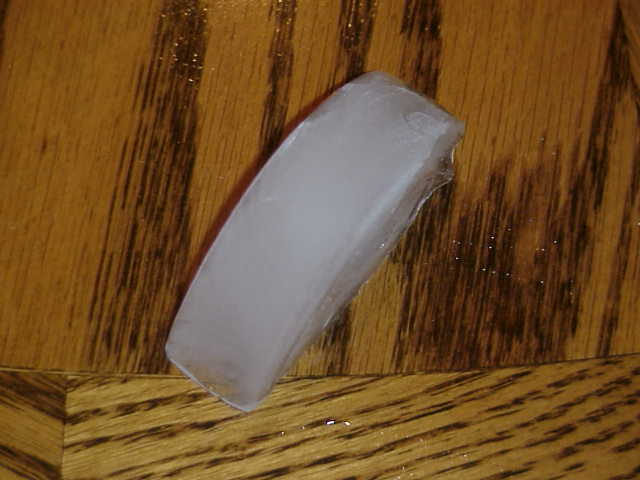
Group member 5 will put the information into a graph.Tell them the object of the lesson is to see how fast the team can melt its ice cube. Give each group one ice cube on a paper plate or in a plastic bag. No fire can be used and the cube cannot be broken into pieces. Record the time the students are given their ice cube on their worksheet. Have them record the time when the cube is completely melted. Write down everything each group did to make their ice cube melt. Determine which method worked the best by comparing the times for all the groups. Graph the data.
Give the group a chart which they fill out and complete as they do the activity.
They may use a computer, an Alpha-Smart Pro, a camera, or pencil and paper to write their conclusion.
Activity 5
Go to your group table and predict which color will be warmer. Take everyone's response and put the responses in the chart. When the activity is complete discuss the results and present your experiment to the rest of the class.
Heat and Color
Absorption of heat by colors
Students will observe that dark colors absorb heat faster than light colors.
Materials:
White and black styrofoam cups (or any type of can covered in white or black paper)
Thermometers
Water
Do dark colors absorb heat better than light colors?Group Members one and two: Take the black and white cups and pour equal amounts of tap water into both cups.
Group Member 3: Put a thermometer in each cup. Record the temperature on the worksheet.
Group Member 4: Put the cups outside for 30 minutes. Take the temperature again. Record it on the worksheet.
Group Member 5: Leave the cups in the sun, recording the results in 15 minute increments.
Whole Group: Examine the data and come to a conclusion about the difference the color made.
Using the video or digital camera, illustrate your experiment in a presentation to the rest of the class.





 Back
to ho
Back
to ho