New!
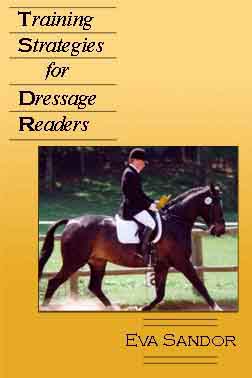
Excerpts from Training Strategies for Dressage
Readers
Her seminal article The Black Stallion: Racial
Machismo in Horses
intrigued scholars everywhere. Her articles about manure removal are classics
of muckraking journalism. Now, the dressage reading community
eagerly awaits the publication of Eva Sandor's newest book! Below...excerpts.

From the Introduction:
Talented readers simply "know" how
to do it. They can go from the short words of a Dover catalog to the bold,
rounded phrases of Podhajsky without a break, and think nothing of reading
under lighting conditions that would turn those of us less talented into squinty-eyed
bats. And as they have always been able to do this, they simply cannot understand
the plight of the vast majority of dressage readers, who struggle daily with
the logorrhea that spews at us from the shelves of Borders, Amazon.com and
Barnes and Noble.
From Slouching and Slumping
(Chapter 5):
This fault, the collapse of one side of the neck, is a particularly egregious
one because it inhibits the balanced functioning of both sides of the brain.
For example: readers who have collapsed to the right, thus using more of the
right eye, force all the information into the left brain. They are then liable
to answer the telephone with a greeting such as "Half halt! Do you feel
the contact?"
From Safety Equipment (Chapter
1):
A helmet is very important, as many books are quite heavy and can topple from
shelves at a moment's notice. Never forget that reading is a physical activity;
even an accomplished dressage reader is humbled, now and again, by the odd
paper cut.
From Correct Seat (Chapter
2):
One's seat is, of course, the foundation of all correct reading. How many
times have you seen a dressage reader at the local bookstore or library, decked
out to the nines in Armani eyeglasses, notepad, cup of coffee etc., who, nevertheless,
was unable to sit still for any longer than a child with a freshly spanked
bottom? And yet often, right beside her, is a nondescript individual who hurries
up to the shelf, chooses ten or twelve books, crouches down in the fashion
of a baseball catcher and reads them all, remaining as still as a statue
throughout the exercise. Would that every reader had such finesse, such control!
But the incredible precision and endurance which these talented readers possess did not come to them in a dream. They too began as the rest of us did, squirming and scowling our way through a few visualizations from Centered Riding. They simply developed a deep and comfortable way of sitting, and so can you.
Begin your schooling with a medium-sized, soft ottoman of the type shown in the photo. Do not be tempted to use the comfy chair; its contours can lead to slouching when the reader has not prepared herself correctly. Instead, sit on the ottoman lengthwise…
More From Slouching and Slumping
(Chapter 5):
It is all too easy to allow the head to "spin" or "swim"
in response to all the information which surges from the page. Take a moment
to get your head on straight; then proceed...
From Great Readers of the
Past (Chapter 9):
Bibliohippus was the very first Dressage Reader known to history. He read
everything written by his friend Xenophon almost as soon as it came off the
reed pen, often leaping up and rushing out into the stable yard with a cry
of "Wait!
Wait just a minute! I think I know what you mean!"
and returning with a jaunty "Well, I probably did it wrong..."
In the Middle Ages, of course, the tradition of Dressage Reading was almost lost. Thankfully it re-emerged during the Renaissance under the guidance of the Spanish Reading School. Today, the Spanish Reading School is located in Vienna, which is a bit odd as most people there read in German.
Reprinted by permission of the author. All excerpts (c)2000 by Kojak 'n' Babe Productions.