|
Summer
2001 Here's the G.A.P (Great Adventure People) tour description: "The fabled Ruta Maya connected a civilization that fused art, science and religion into elaborate stone cities that are now jungle-covered ruins. The colorful Indian markets of Guatemala and southern Mexico provide a present-day link to this ancient and mysterious civilization. This all-encompassing holiday combines the beauty of the highlands, the mystery of the great Mayan sites and crystalline waters and beaches of the Caribbean." Doesn't that just sound enticing? The emphasis of the trip was on past and present cultures, with opportunity to pursue one's own interests. This was my first trip on a "Tour" and it was fun. I'm not much of a "tour" person, but I didn't want to travel alone. There are pros and cons of tours, but I highly recommend GAP. We got to see a good balance of the "touristy" places and had enough free time to pursue our own interests. We did so much on the 3 week tour that I don't even know where to begin. We spent the 3 weeks traveling all over Mexico, Guatemala, and Belize to see the past and present Mayan cultures. We spent about 11 days in Mexico to see: Cancun (beach & tourist trap), Chichen Itza (ancient Mayan Ruins), Merida (colonial city), Palenque (ancient Mayan Ruins), San Cristobal (one of the oldest Spanish towns in Central America), and Playa Del Carmen (beach & tourist trap). We spent about 6 days in Guatemala to see: Panajachel (beautiful village near Lake Atitlan), Chichicastenago (colorful Indian Market), Antigua (colonial city & former capital of Guatemala), Flores (village), and Tikal (ancient Mayan Ruins). We spent about 4 days in Belize to see: San Ignacio (village) and Caye Caulker (Carribean Island). |
Mexico:
|
It was a center of Mayan culture from about 900-1200 AD. The exact reasons for the decline of the Mayan civilization are not known but it is thought the Mayan cities warred on each other in a rather bloodthirsty manner and this combined with overpopulation, exhaustion of the surrounding natural resources, and competition from surrounding peoples led to the collapse. |
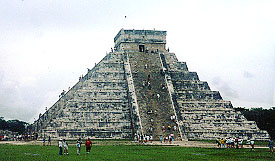
Ancient Mayan temple: El Castillo The pyramid was used as a calendar: four stairways, each with 91 steps and a platform at the top, making a total of 365, equivalent to the number of days in a calendar (solar) year The climb was quite a scare. I'm not afraid of heights, but I got a little scared when I was climbing the steep steps I just had to keep reminding myself to not look down. |
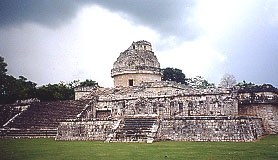
Ancient Mayan Observatory: El Caracol The Maya were accomplished astronomers and it is believed El Caracol was used to observe the moon, stars and the planet Venus. |
|
The highlight of Merida was seeing a SCORPION in my hotel room. I don't like scary looking critters and I'm so glad we don't have scorpions in Philly. |
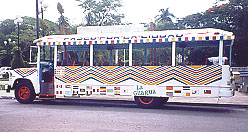
Tour Bus in Merida We had a free day in Merida and
I spent it Interestingly, the streets of Merida are all numbered. The streets running north-south have even numbers, while those running east-west have odd numbers. |
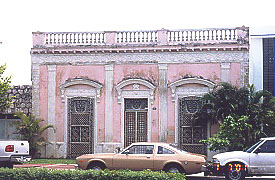
Colonial house in Merida I was really impressed by the diverse styles of architecture in Merida - Spanish, French, and Islamic influences. The bright house colors were impressive as well. You don't see many bright pink houses in America. |
|
The site was occupied from 100 BC to the end of the 9th century.
|
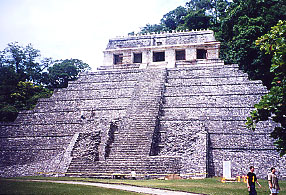
Temple of the Inscriptions in Palenque It's a monument for Pacal, the first great king of Palenque. Inside the temple are panels of inscriptions and Pacal's tomb. |
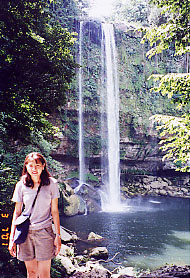
Misol-Ha waterfall near Palenque That's me in front of the waterfall. |
|
It's one of the oldest Spanish towns in Central America. In 1994, the Zapatista's took over the city to make a stand for indigenous people's rights. |
Mayan weaved table mats from Zinacantan Each village has a symbol to represent their community and industry in their and Zinacantan's symbol is the flower - one of their main exports. |
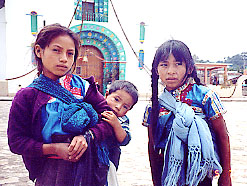
Mayan Indian girls in Chamula I was really shocked to see how well off most of the Mayan Indians were compared to Natives here in America. It wouldn't surprise me if the Mayan Indians (in a developing country) have a better standard of living than Natives here in America (the richest country in the world). It was nice to see Indigenous people with a strong sense of their traditional culture, even though they are losing it to tourism. |
Guatemala:
|
|
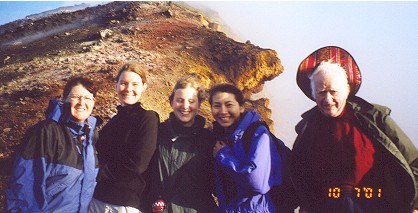
Volcano Pacaya!!!!! Pacaya (8,373 feet) is the most famous active volcano in
Guatemala. |
|
Tikal Tikal was occupied from 900-600 BC. It has been estimated that, during its peak, Tikal had around 10,000 inhabitants within a radious of 30 minutes walk from the center. Tikal has a nice tropical forest with interesting looking creatures. We wander through the forest and spotted Agoutis (rodents), Toucans (Fruit Loops bird), Ocellated Turkies (has been hunted to extniction in many regions of Central America), Ring-Tailed Coatis (similar to Racoon), and Spider Monkies. |
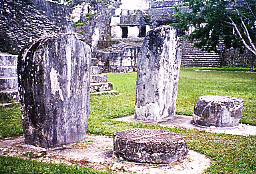
Sacrificial Alters |
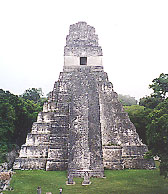
Mayan Temple The city has some of the highest temples in Maya territory. The tallest of Tikal's temples is 230 ft. |
Belize:
| Random thoughts:
Unfortunately, I didn't take many pictures of Belize. I didn't really like Belize that much, because I'm not really into hot/humid weather and beaches. The highlight for me was going to the Benque fair and experiencing some of the local culture. It was like a small town fair with amusement rides, games, and fireworks. Interestingly, Belize is full of monopolies. There's only 1 brand of beer: Beliken, 1 brand of toliet paper, 1 telephone company, and 1 energy company. |
|
|
|
|
|
|
Pre-Student Teaching
|
|
|
|
Boston |
Mayan
|
Grad |
Paintings
|
Australia
|
New Zealand
|
More Photos
|
|
[Main]
|
[About Me]
|
[Pictures] |
[Links]
|
[Resume] |