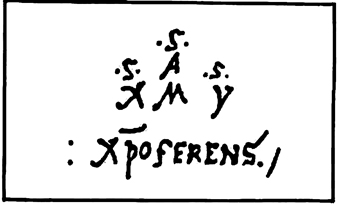
Above: Autograph of Columbus.
The Voyages of Christopher Columbus - a new translation from the Spanish into English of 'Los cuatro viajes del almirante y su testamento, Cristóbal Colón'*.
Translated by M.Kudrati MB BCh(Cantab)
Above: Autograph of Columbus.
The Voyages of Christopher Columbus II
|
CONTENTS
|
Replicas of the Niña, Pinta and Santa Maria |
To avoid too many notes, the course taken by Columbus in the 'Indias', and the geograhical reference of place names mentioned, can be followed on the navigational map provided at Map of the West Indies illustrating the voyages of Christopher Columbus.
[*The text in Spanish used for this translation can be viewed at Cristóbal Colón (edited by Ignacio B. Anzoátegui) in the Biblioteca Virtual Miguel de Cervantes. A short bibliography has been added after the translation.]
The first voyage to the Indias contd. - after Christmas, 1492, from the narration condensed by Fray Bartolomé de las Casas.
Thursday, 27th of December. - At sunrise, the king of that land came to the caravel. He told the Admiral that he had sent for gold, and that he wanted to collect all the gold before he went away, prior to requesting him not to go away. The king dined with the Admiral, together with one of his brothers, and another very close relation, both of whom declared that they wanted to go to Castile with him. Engaged thus, they came to report that the caravel Pinta was in a river at the cape of that island. Soon, the cacique despatched a canoe there, and the Admiral sent a sailor in it, for he loved the Admiral so much that it was marvellous. Already the Admiral understood the need to act with as much haste as he could muster for his return to Castile
Friday, 28th of December. - So as to issue orders and hasten the completion of the construction of the fortress, and organize the people who were to be left behind in it, the Admiral came on shore. It seemed to him that the king had seen him as he went in the boat, but had entered quickly into his house in dissimulation, and had sent a brother of his to receive the Admiral in order to take him to one of the houses, one which was the largest and the best in that town, of those he had given to the Admiral's men. Inside, there was, already prepared, a stage of palm fronds, where they sat down. Later, the brother sent one of his squires to inform the king that the Admiral was there, as though the king did not know that he had arrived, although the Admiral thought that he was feigning it, [-114-] in order to show him much more honour. As the squire apprised him of it, the cacique, he says, came apace to the Admiral, and put a great lump of gold on his neck that he brought held in his hand. He was there with him until late afternoon, deliberating on what had to be done.
Saturday, 29th of December. - The king's nephew came to the caravel at sunrise. He was very young, intelligent, and endowed with a strong constitution (as says the Admiral). As he always made an effort to find out where the gold was collected, he questioned everyone, because he now understood a little by using signs. That youth told him thus that a four day journey away there was an island to the east called Guarionex, and others named Mocorix, Mayonic, Fuma, Cibao and Coroay, in which there was endless gold. The Admiral wrote the names down and he thought that what he had said was from a brother of the king, who had quarrelled with him, as the Admiral understood. Also, at other times, the Admiral thought that the king had laboured to prevent him from realising where the gold had its source and was collected, so that he might not go there to barter or to buy it elsewhere. However, there is so much of it, and in so many places, even in this one and the same island of Española, that it is remarkable. At night-time, the king sent him a large, golden mask, and put in a request for a washbowl and a jug. The Admiral believed he asked for them to order other ones to be made, and he thus sent them.
Sunday, 30th of December. - The Admiral came on shore to dine, and arrived at a time when five kings subject to this king, who was called Guacanagari, had already arrived, all with their crowns, representing very high estate, such, says the Admiral to the Sovereigns, that their Highnesses would have been pleased to see their conduct. Upon his arrival on land, the king came to receive the Admiral, and he took him by the arm to the same house as on the previous day, where he had a platform and chairs on which he seated the Admiral. Shortly afterwards, he removed the crown from his head and he placed it upon the Admiral, and the Admiral took off a good necklace he had on his neck, made of agate and very beautiful glass beads of highly attractive colours, so that it appeared very fine in every part, and put it on him. [-115-] He took off a finely-grained cape, in which he had got dressed that day, and dressed him in it, and sent for some coloured boots which he made him wear on his feet. He also placed a splendid silver ring on his finger because they said that they had seen a silver ring on a sailor and he had made much of it. He left him very happy and content, and two of the kings who were with him came to where the Admiral was, and brought for the Admiral two large lumps of gold, one from each. While thus engaged, an Indian arrived to say that it had been two days since he had left the caravel, Pinta, at a harbour due east. The Admiral returned to the caravel, and Vicente Anes, the captain, declared that he had seen rhubarb, and that it was present on the island of Amiga, situated at the entrance of sea of Santo Tomé, that was six leagues away from there, and that he had recognised its root and its branches. They say that rhubarb projects some shoots outside the soil, and some fruits that resemble green mulberries, almost dry, and the small stalk that is near the root is quite yellow, and as fine as the best colour might be for use as paint, while, also, below the ground, the root is formed like a great pear.
Monday, 31st of December. - On this day, he occupied himself by ordering the storage of water and firewood for the departure to Spain, to give swift tidings to the Sovereigns so that they might despatch ships that would unearth what remained to be discovered. Already, the affair seemed so great, and of such substance, as to be a wonder, the Admiral says, and that he did not wish to leave until he had surveyed the whole of that land extending east, and proceeded along the entire coast, so as to know, also, he says, the route from Castile to it, in order to bring livestock, and other things. However, as he had been left with only a single ship, it did not seem wise to him to expose himself to the perils that could arise from exploration. He complained, in addition, that all this harm and inconvenience was due to being separated from the caravel, Pinta.
Tuesday, 1st of January of 1493. - At midnight, he despatched the boat to the islet, Amiga, [-116-] to fetch the rhubarb. It returned at vespers with a basketful of it. They did not bring more as they did not take a hoe to dig with; that which they brought was to show to the Sovereigns. The king of that land, he says, had sent out many canoes for gold. The canoe came that had gone to obtain knowledge of the caravel, Pinta, and the sailor, but they did not find it. That sailor mentioned that twenty leagues from there he had seen a king who wore two large lumps of gold on his head, but who took them off as soon as the Indians in the canoe spoke to him. He also saw a lot of gold on other people. The Admiral surmised that the king, Guacanagari, must have forbidden anyone from selling gold to the Christians, in order that all of it should pass through his hands. However, he knew the places, as said earlier, where it was present in such quantity as to be worthless. Also spices, as the Admiral says, are abundant, and worth more than pepper or maneguete*. He left, recommending to those he wished to leave behind, there, that they should obtain as much as they could.
[Note: *maneguete, which Las Casa said was found in Guinea, has been identified as Aframomum melegueta, a species in the ginger family, Zingiberaceae. The West African spice, commonly called 'grains of paradise', is a kind of pungent pepper.]
Wednesday, 2nd of January. - He left for land in the morning to say farewell to king Guacanagari, and to take his leave in the name of the Lord. He presented him with one of his shirts, and exhibited to him the power held, and the effects produced, from possession of the lombards. For this, he ordered one to be loaded, and to be fired at the side of the ship that was aground, because it was in keeping with the theme of the conversation about the Caribes, with whom they were at war. He saw how far the lombard reached, how it passed through the side of the ship, and how the stone went way beyond, far into the sea. He also rehearsed a skirmish with armed men from the ships, saying to the cacique that he should not be afraid of the Caribes even if they came. All this the Admiral did, he says, so that he might consider the Christians whom he left behind as friends, and to instil fear, so that he might be afraid of them. The Admiral took the king along with him to dine at the house where he was lodged, together with the others who accompanied him. The Admiral commended greatly to him Diego de Arana, Pedro Gutiérrez, and Rodrigo Escovedo, whom he left jointly as his deputies over the men he left there, so that everything might be well-regulated and governed, in the service of God and their Highnesses. The cacique showed much love towards the Admiral, and great emotion [-117-] upon parting, especially when he saw him proceed to embark. A confidante of that king told the Admiral that he had issued orders for a statue of pure gold to be made, as large as the Admiral himself, and that in ten days they were to bring it. He embarked with the intention of departing soon, but the wind did not give him the opportunity.
He left on that island of Española, that the Indians, he says, called Bohío, thirty-nine men at the fort and, he says, very close friends of that king Guacanagari. Above them, as his lieutenants, were Diego of Arana, a Cordovan, Pedro Gutiérrez, the King's steward, servant to the head butler, and Rodrigo of Escovedo, of Segovia, nephew of Fr. Rodrigo Perez, endowed with all the powers that he held from the Sovereigns. He left behind for them all the merchandise that the Sovereigns had commanded the purchase of, for bartering, which amounted to a lot. They were to use it to trade in, and to exchange for gold, along with all that which was on board the ship. He also left them gruel for a year, wine, a lot of artillery, and the ship's boat, so that they, being sailors for the most part, when they saw it as convenient, could go to the source of the gold, so that upon the Admiral's return he would find a lot of gold, and a place where he might establish a town, as that harbour was not to his liking. Most importantly, he says, the gold they brought over there came from the east, and the further east they went, the nearer they were to Spain. In addition, he left for them seed stores for sowing, and his officials, the public notary and the sergeant, a ship's carpenter, a caulker, a good artillery-man, who was knowledgeable in engines, a cooper, a physician, and a tailor, all, he says, men of the sea.
Thursday, 3rd of January. - He did not make a start today, because at night, he says, three of the Indians arrived from among those he brought from the islands that they had left, and they told him that the others, and their women, were coming at sunrise. The sea, also, was a little disturbed, and the boat could not make land. He resolved to set off the following day, with the grace of God. He said that if he had the caravel, Pinta, with him, he would have had, for certain, a barrel of [-118-] gold to take, as he would dare to follow the coast of these islands, which he did not dare to attempt on his own to obviate any inconvenience that might occur which would impede his return to Castile, and the information that he had to impart to the Sovereigns of all the things that he had discovered. If it proves true that the caravel, Pinta, arrived safely in Spain with Martín Alonso Pinzón, he said that he would not leave off doing what he desired, but as he did not have any knowledge of him, and as he might now go, and would be able to relate lies to the Sovereigns, so that they did not mete out the punishment to him that he deserved, as one who had behaved so badly, in having gone away without leave, and hindered the good things that could have been done, or be known from that time, the Admiral says, he trusted that our Lord would grant him the propitious weather, and for everything to be remedied.
Friday, 4th of January. - As the sun rose he weighed anchor, in light wind, and set the prow for the direction of N.W. in order to get out of the reefs by a different passage wider than the one by means of which he had entered. Those, and others, are very good to proceed ahead of the Villa de Navidad and all along for the greater depth, from three to nine fathoms. These two run from N.W. to S.E., and were large in terms of the reefs, extending from the Cabo Santo as far as the Cabo de Sierpe, a distance of more than six leagues, and a good three out into the sea, and another good three, above the Cabo Santo. For a distance of one league above Cabo Santo, the depth does not exceed eight fathoms. Within this said cape, on the eastern side, there are many shallows and channels which allow passage through for entry. The entire coast there runs N.W. to S.E., and is all beach, and for a good four leagues inland, very flat ground. Beyond this, there are very high mountains, all densely populated with large settlements, and pleasant people, as they showed themselves to the Christians. He sailed thus to the east, crossing the path of a very high mountain that might have been an island, but is not, because it shares a very shallow bank with the mainland. It had the shape of a very beautiful tent and he gave it the name of Monte Cristi. It is located exactly east of the Cabo Santo, and is eighteen leagues away. That day, the [-119-] wind being very light, he only got to within six leagues of Monte Cristi. He came across four very low and sandy islets, with a reef that stuck out a great deal towards the N.W., and extended a long way S.E. Within, there is a large channel that runs from this mountain a good twenty leagues to the S.E., which should all be of little depth, with many sand-banks, and inside this, along the whole coastline, many rivers which are not navigable, although the sailor the Admiral sent with the canoe, to obtain news of the Pinta, said that he saw a river in which ships could enter. The Admiral anchored here, six leagues from Monte Cristi, in nineteen fathoms, turning around towards the sea to distance himself from the many reefs and shallows that were there, where he stayed the night. The Admiral gives the advice that someone who has to get to Villa de la Navidad, upon meeting up with Monte-Cristi, ought to put himself at sea two leagues off land etc.; but as the terrain is now known, more about it is not included here. He concludes that Cipango was in that island, and that it had much gold, spices, mastic, and rhubarb.
Saturday, 5th of January. - When the sun was about to rise, he set sail with a land breeze. Later, an easterly blew, and he glimpsed on the S.S.E. side of Monte Cristi, between it and an islet, what seemed to be a good harbour to anchor for that night. He took a course due E.S.E., and, later, S.S.E. for a good six leagues, close to the mountain. In the passage along those six leagues he encountered seventeen fathoms of very clear depth, and as he progressed, thus, another three leagues with the same sounding. Afterwards, depth was lost to twelve fathoms until the snout of the mountain, and beyond the snout of the mountain, for one league, he encountered nine, all clear, with fine sand. He followed the route, thus, until he entered between the mountain and the islet, where the sounding was three and a half fathoms with low water, and he came upon a very singular harbour at which he anchored. He went on the boat to the islet, where he came across a fire, and a trace of fishermen having been there. He saw many stones there, painted in colours, or stone sculpted in such beautiful natural handiwork, as though, he says, for church edifices, or other royal works, such as those he had encountered on the isle of San Salvador. He also found in this islet many mastic plants on this island. [-120-] He says that this Monte Cristi is high, accessible, and very beautiful, with a most attractive shape. The whole countryside in its vicinity is very lovely lowland, and it stands alone, thus, high, so that, viewed from a distance it appears to be an island that does not communicate with any land. Further on, to the east of this mountain, he saw a headland twenty-four miles off, to which he gave the name Cabo del Becerro, extending from which to this said mountain, the sea was crossed for a good two leagues by some shallow reefs, although it looked like there were channels between them that would allow passage. Nevertheless, it would be better by daylight, and to take soundings with the boat first. From the said mountain to the east towards Cabo del Becerro, the four leagues are all sandy beaches, and the land is very low and beautiful, but the rest is all very high ground, with great and beautiful elaborate mountains. A mountain range runs from the N.E. to S.W. inland, the most beautiful he had seen, which seems just like the sierra of Cordova itself. Other towering mountains also appear far off, towards the south and south-east, with very large valleys, very green and beautiful, and with abundant streams of water all this in such incontrovertible quantity that he did not believe he added to it by even a thousandth part. He saw next, to the east of the said mountain, land that appeared to be another mountain, comparable to Cristi in magnitude and beauty. Beyond this, further due E. and N.E., it is not so high ground for a good hundred miles or so.
Sunday, 6th of January. - That port is sheltered from all winds, except for north and north-west but, he says, they are not so prevalent in that area, and even from these it is possible to seek shelter behind the islet, where it is three to four fathoms deep. At sunrise, he set sail to go further along the coast, all of which ran eastwards, except that it is necessary to be on guard against the many rocky and sandy banks that are along this coast. The truth is that amongst them there are good harbours and good openings, as their channels. After noon, a strong easterly blew, and he ordered a sailor to the top of the mast to look out for shallows, and he saw the caravel, Pinta, with the wind astern. It reached the Admiral, but not having anywhere to anchor because of the shallows, the Admiral turned back for Monte-Cristi, and travelled back the ten [-121-] leagues he had come, with the Pinta accompanying him. Martín Alonso Pinzón came to the caravel, Niña, in which the Admiral voyaged, to excuse himself saying that he had departed from him against his will, and providing reasons for that. The Admiral says, however, that they were all lies, and that on the night when they had separated from him, they had done so with much arrogance and covetousness. He did not know, the Admiral says, where they came by this arrogance and dishonesty from which they had made use of on that journey with him, and which the Admiral wished to mask so as not to make way for the evil deeds of Satan, and that he wished to impede that journey, as he had done until then. Had it not been for the mention by an Indian from amongst those who had been committed to his care by the Admiral to take with others on board his caravel, who had said to him that on an island, called Baneque, there was much gold, and as he had the fine and light ship, he would not have wanted to separate and go, leaving the Admiral thus. However, the Admiral’s wish was to stop and to follow the coast of the islands of Juana and Española, because it was all on the way east. After Martín Alonso had got to the island of Baneque he says that he did not find any gold, and he came to the coast of Española owing to information received from other Indians, who said to him that in that island of Española, that the Indians called Bohío, there was a large quantity of gold, and many mines. It was because of this that he arrived near the Villa de la Navidad, a journey of fifteen leagues, and more than twenty days having passed by then. Thus, it seems that the reports that the Indians gave were true, because of which the king, Guacanagari, sent the canoe, and the Admiral, the sailor, but that he must have gone by the time the canoe arrived. Here, the Admiral says that he bartered much gold, and that for the tip of a needle they gave him fine pieces of gold the size of two fingers and, at times, the hand, and Martín Alonso took half, and the other half was distributed to the crew. The Admiral adds, saying to the Sovereigns, "Thus it is, Princely Seigneurs, that I know our Lord miraculously ordained that ship to stay there, because it is the best place in the whole island to have as a base, and is closest to the gold mines". He also says that he knew of the presence of another large island behind the island of Juana, to the south, [-122-] which has a much greater quantity of gold than this one, to the extent that they picked up pieces larger than beans, and that on the island of Española they collected pieces of gold from the mines the size of grains of wheat. That island, he says, calls itself Yamaye*. The Admiral also knew that, towards the east, there was an island where women alone were present, which I learnt, he says, from many people who knew of it. Furthermore, that island of Española, or the other island, Yamaye, were a ten day journey by canoe from nearby mainland, which would be sixty or seventy leagues, and that the people, there, were clothed.
[Note: *Yamaye, the island of Jamaica.]
Monday, 7th of January. - This day he took on a breach that the caravel had, and caulked it, and sailors went ashore to bring firewood and found, he says, much mastic and wood-aloes.
Tuesday, 8th of January. - As a fresh easterly and south-easterly wind blew, he did not leave on the day. Instead, he gave orders for the caravel to be stocked with water, wood, and all the necessaries for the voyage, because although he had a mind to follow the whole coast of Española that could be voyaged in that direction, those that he had placed as captains in the caravels were brothers, namely, Martín Alonso Pinzón and Vicente Anes, and others who followed him out of pride and avarice, considering that everything was already his, and disregarding the honour that the Admiral had done and given to them. They had not and did not obey his orders, and had sooner done and said many unwarranted things against him, and Martín Alonso had left him from the 21st of November to the 6th of January, without any cause or reason except for his disobedience, all of which the Admiral had suffered and ignored in order to end his journey well, as much as to depart from such bad company, with whom, he says, he managed to dissimulate although they were lawless people, and albeit, he says, he took with him many good people, yet it was not time to mete out punishment. Therefore, he had decided to return with the greatest possible haste, and not to delay any longer. He got into the boat and went to the river, which joins it there, [-123-] a good league S.S.W. of Monte Cristi, where the sailors went to obtain water for the ship, and discovered that the sand at the very large and deep mouth of the river was, he says, all full of gold, and in such a measure that it was a wonder, since it was very fine. The Admiral thought in its course down the river it had become fragmented along the way because, he says, in a short while he found many grains as large as lentils; but for the minuteness, he says, there was a large quantity. As the sea was full, and the salty water was mixed with the sweet, he gave orders to ascend upriver in the boat as far as a stone's throw. They filled the barrels from the boat and, returning to the caravel, they found small pieces of gold had got into the hoops of the barrels, and the same in the hoops of the pipe. The Admiral gave the river the name of Río del Oro, which, past the entrance, is very deep inside, although the entrance is shallow, and the mouth is very wide. It is seventeen leagues from there to the Villa de la Navidad. In between, there are many other large rivers, in particular, three, which he thought must contain much more gold than that one, because they are bigger, whereas this one is almost as large as the River Guadalquivir at Cordova, and the distance from these to the mines of gold is barely twenty leagues. The Admiral says, furthermore, that he did not wish to take the sand that had so much gold, because their Highnesses owned it all exclusively, and beside the harbour of their Villa de la Navidad, and so as not to go amiss further, but to bring them the news, and to get rid of the evil company that he had, which was, as he had constantly said, an unruly crew.
Wednesday, 9th of January. - At midnight he hoisted the sails, with the wind S.E., and sailed due E.N.E. He arrived at a point, that he called Punta Roja, exactly sixty miles east of Monte Cristi. Sheltered by it, he anchored in the afternoon, three hours before it grew dark. There, he did not dare to leave at night, because of the many reefs, until they were known, because afterwards, the channels, which ought to be present, would be useful, since it has great depth, and is good anchorage, secure from all winds. The land, from Monte Cristi to where he had cast anchor, [-124-] is level highland, and very charming countryside, and behind them are beautiful mountains going east to west, all of which are so green and worked, that it is marvellous to regard its beauty, and it possesses many streams of water. There are many turtles in all of this land, and the sailors caught hold of some of them when they came on land to lay eggs at Monte Cristi, and which were as large as big, wooden, shields. On the previous day, when the Admiral went to the Río de Oro, he said that he saw three sirens* that rose well above the sea, but they were not as beautiful as when painted, which in some way possess the form of a human face. He adds he had seen some at other times, in Guinea, and on the coast of the Manegueta. He says that this night, in the name of our Lord, he will set off on his voyage without any further delay of any kind, and he does not want to get more annoyed with Martin Alonso until their Highnesses might get to hear the news of his voyage, and what he has done, "and afterwards I shall not suffer," he says, "deeds of evil people with little virtue, who presume to exert their will against the person who gave them their status, with little consideration."
[Note: *The sirens, or mermaids, were the manatees, or sea-cows, that live in the Caribbean Sea and in the larger rivers of South America. Along the coast of Guinea, a similar creature, the dugong, finds habitation.]
Thursday, 10th of January. - He departed from where he had anchored, and at sunset he came upon a river to which he gave the name Río de Grecia, three leagues to the south-east. He dropped anchor at the mouth, where the anchorage was good on the east side. In order to enter within, a bank has to be passed that is but two fathoms deep, and is very narrow. Within, there lies a fine enclosed harbour, except that it contained a lot of ship-worm, and the caravel, Pinta, on which Martin Alonso was, had gone and become very badly affected from it because, he says, he had been there bartering for sixteen days, and obtained a lot of gold, which was what Martin Alonso had wished. He, who, after he learnt from the Indians that the Admiral was on the coast of the same island of Española, and that he could not avoid him, had come back. He says that he wanted the entire crew of the ship to swear that they had been there for only six days. However, he says, his wickedness was such a public matter that it could not be covered up. He, the Admiral says, had made laws that reserved half of the gold that was bartered [-125-] or obtained, as his. When he had to go away from there, he forcibly seized four Indian men and two boys, whom the Admiral had ordered to be clothed and returned to land, so that they could go back to their houses, "which," he says, "is of use to your Highnesses, as much in this island, in particular, as in the others. Here, however, where your Highnesses already have your base, the people should be treated with due honour and favour, since on this island there is so much gold, good lands, and spices".
Friday, 11th of January. - At midnight he left the Río de Grecia with a land breeze blowing. He sailed four leagues east, as far as a cape that he called Belprado. From there, due S.E., there is the mountain to which he gave the name Monte de Plata, and her says it is eight leagues away. From the cape of Belprado to the E.1/4S.E., there is the promontory that he called that of the Angel, a distance of eighteen leagues. From this promontory to the Monte de Plata, there is a channel, and lands that are the best, and loveliest, in the world, all elevated and beautiful countryside, which extends a lot inland. Beyond, there is a mountain range that runs east to west, very grand and very beautiful. At the foot of the mountain there is a very good harbour, with an entrance fourteen fathoms deep. This mountain is very lofty and beautiful, and all of this is densely populated. The Admiral believed that it must have good rivers and much gold. There is a point from the Cabo del Ángel due E.1/4S.E., four leagues away, that he named after Hierro, and in the same direction, four leagues further on, there is a point that he called the Punta Seca. From there, again, in the same direction six leagues away is the cape that he spoke of as Redondo, and from there towards the east, there is the cape of Francés, where on the eastern side, there is a large bay, but it did not seem to him to have anchorage there. One league from there is the Cabo del Buen Tiempo, and from there, heading S.1/4S.E. for a good league, there is a cape that he called Tajado. He saw another cape from there towards the south that appeared to him to be fifteen leagues away. On this day he made great progress, because the wind and the currents were with him. He did not dare anchor for fear of shallows, and was thus hoving to all night.
Saturday, 12th of January. - At the crack of dawn, he sailed east in a fresh wind, and voyaged twenty miles thus, until daylight. [-126-] Afterwards, for two hours, he was to journey twenty-four miles. There, he spied land to the south, and went towards it, a distance of forty-eight miles. Taking due care of the ship, he says, he journeyed twenty-eight miles that night heading N.N.E. When he sighted land, he called a headland of it that he caught a glimse of, the Cabo de Padre e Hijo, because on its eastern side it has two overhanging rocks, one larger than the other. Later, two leagues further to the east, he saw what was a very grand and rather beautiful opening between two great mountains, through which he saw a huge harbour, fine, and with a very good entrance. However, as it was very early in the morning, and not to deviate from the route because, as the weather had, for the greater part, taken him east there, but then bore him N.N.W., he did not wish to slow down any more. He pursued the route east as far as a very high and beautiful cape, all of sheer stone, to which he gave the name of Cabo del Enamorado, and which lay thirty-two miles east of that harbour, that he named Puerto Sacro. In getting to it, he discovered another much more beautiful, higher, and rounder crag, all rocky, just like the Cabo of San Vicente in Portugal, twelve miles east of the Enamorado. After he came up level with the cape called Enamorado he saw, between it and another, that there is formed an immense bay, three leagues wide, and in the middle of it, there is a tiny islet. There is a good depth at the entrance as far as the land. He anchored, there, in twelve fathoms, and he despatched the boat to go on shore for water, and to see if they could exchange a few words, but all the people fled. He also anchored to see if all of it was land united with the Española, and whether what he said was a gulf might not be another island by itself. He was left alarmed by the island of Española being of such a great size.
Sunday, 13th of January. - He did not leave this port, not having a land breeze with which to leave. He had wanted to leave in order to go to another better harbour, because at that one he was a little exposed, and he wanted to stop somewhere in the face of the conjunction of the Moon with the Sun, that he anticipated on the 17th of this month, and its opposition to Jupiter and conjunction with Mercury, together with the Sun in opposition to Jupiter, which is a cause of great winds. He sent the boat [-127-] to land at a beautiful beach in order to obtain yams to eat. They came across several men with bows and arrows, with whom they stopped to speak. They bought from them two bows, and many arrows, and requested one of them to come to the caravel to speak to the Admiral who came, he says, and had a very ugly countenance, more than any other he had seen hitherto. His whole face was tinged with soot, just as in all parts they are accustomed to painting themselves in various colours. He wore all of his hair very long and gathered in, to be tied at the back, and then inserted into a receptacle of parrot feathers. He was as naked as the others. The Admiral surmised that he must be one of the Caribes who eat men, and the channel that he had seen on the previous day did form a division of land, and that it was an island by itself. He asked him about the Caribes, and he made a sign as to the east, not far from there, who saw him, the Admiral says, on the previous day, before he entered that bay. The Indian said to him that it had a great deal of gold, pointing at the poop of the caravel that was of a good large size, implying that the pieces there were equally large. He called gold, 'tuob', and he did not comprehend it when spoken of as 'caona', as they call it in the former part of the island, nor as 'nozay', the word used for it in San Salvador and the other islands. In Española, they call 'alambre', or crude gold, 'tuob'. Of the island of Matinino, the Indian said that it was wholly inhabited by women without men, and that there is much 'tuob' in it, that is gold or 'alambre', and that it lies further to the east of Carib. He also spoke of the island of Goanin, where 'tuob' is plentiful. The Admiral says that for some days earlier he had received reports from many people about these islands. The Admiral says, also, that in the previous islands, they lived in great fear of the Carib, and in some, they called them Caniba, but Carib in Española, and that they must be hardy people, because they rove among these islands, and eat the people they can obtain. He says that he understood some words, and therefore, he says, he infers certain things, but that the Indians whom he brought with him understood far more, as there was a difference in languages corresponding to the great distance between the lands. He issued orders for the Indian to be fed, and gave him pieces of green and red cloth, and beads of glass, of which they are very fond, and returned [-128-] him back to shore, telling him to barter gold if he had it, which he believed because of some small items on him that he had brought. When they landed the boat on the shore, there were a good fifty-five men behind the trees, naked, with their hair very long, just like the women wear theirs in Castile. At the back of the head, they wore crested plumes of parrots, and other birds, and each individual was armed with a bow. The Indian climbed down on to the shore and made the others leave their bows and arrows, and a very heavy piece of wood [...] which they carry instead of a sword. Afterwards, they came to the boat, and the men on the boat went on shore, to begin to buy the bows, arrows, and other arms, as those were the Admiral's orders. Having sold two bows, they did not want to proffer any more. Rather, they were disposed to attack the Christians and to get hold of them. They went running to grab hold of their bows and arrows from where they had laid them aside, and turned round with cords in their hands so as, he says, to tie the Christians. Seeing them come running towards them, and the Christians being primed, because the Admiral had always warned them of this, the Christians took the offensive, and attacked them. They said that they gave a heavy stab-wound in the buttocks to one Indian, and another, they injured in the chest with an arrow, whereupon seeing that little was to be gained, even though there were only seven Christians to fifty or more of them, they took to flight, so that no one was left, one abandoning his arrows here, another his bows there. The Christians would have killed many of them, he says, if the pilot who stood in as their captain had not prevented it. Soon after, the Christians returned to the caravel in their boat, and the Admiral being apprised, said that in one sense it weighed heavy upon him, but on the other it did not, because they harbour fear of the Christians, since without doubt, (he says), the people there are evil-doers, and that he believed that they were those from Carib, and that they ate human beings, and because should the boat come along that way, which he had left to the thirty-nine men in the fortress and the Villa de la Navidad, they will be afraid to do them any harm. If they are not Caribes, at the very least they must be from the borderland and with the same customs and devoid of fear, not like [-129-] the people on the other islands, who are cowards and do not stray beyond bounds. The Admiral says all this, and that he wished to capture some of them. He says that they made many smoke signals, as they did habitually in the island of Española.
Monday, 14th of January. - He had wished to send out a search party during the night to look for the houses of those Indians and to capture some of them, believing that they were Caribes, but for the strong east and north-easterly, and high waves in the sea. However, already, by day, they saw many Indian people on land. The Admiral, therefore, gave orders for the boat to go there, with well-prepared men in it. Soon, all of them came to the stern of the boat, and in particular, the Indian who had come to the caravel the day before, and to whom the Admiral had given the little items of barter. With this individual came a king, he says, who had given some beads to the Indian, which he gave to the men on the boat as a token of peace and security. This king, with three of his followers, entered the boat and came to the caravel. The Admiral bid them give him biscuit and honey, and presented him with a red cap, beads, and a piece of red cloth, as well as pieces of cloth for the others. He said that he would bring a mask of gold on the following day, affirming that there was a lot of it there, as in Carib and Matinino. Later, he returned them back to land highly contented. The Admiral says, in addition, that the caravels were making a lot of water from the keel, and complains much about the caulkers at Palos, how very poorly they had caulked them, and that when they had realised that the Admiral had detected their defective work, and that he wished to constrain them to make amends, they ran away. Nevertheless, despite the great amount of water that the caravels made, he trusted in our Lord, who had brought him, to return him through his kindness and mercy, as His High Majesty knew well how much controversy occurred, earlier, before it had been possible for him to be sent off from Castile, that apart from Him, no other person was in his favour, and because He knew him to the core, and that after Him, their Highnesses, whereas all the others had opposed him without any reason. He goes on to say thus: "And it is because of this the cause that the royal crown of your Highnesses does not have a hundred millions of revenue more than after I came to serve them, [-130-] making seven years, now, on the 20th day of January of this same month, and that more of that increase would materialise from now on into the future. However, the Almighty God will remedy all things". These are his words.
Tuesday, 15th of January. - He says that he wishes to depart, because he now gains nothing from any further delay, having passed by these disagreements (one ought to say the scandal of the Indians). He also says that he had learnt today, that the entire concentration of gold was in the region of Villa de la Navidad, belonging to their Highnesses, and that in the island of Carib, there was a lot of copper ore, as in Matinino, although it will be difficult in Carib, because those people, he says, eat human flesh, and that from there, it looked like their island. He was determined to go there as it was on the way, and to Matinino that, he says, was inhabited entirely by women, without men, to see the one and the other, and to seize, he says, some of them. The Admiral despatched the boat to shore, but the king of that land had not come, because, he says, the settlement was distant. However, he sent his golden crown, as he had promised, and many other men came with cotton, and bread made from yams, all with their bows and arrows. After they had done all the bartering, there came, he says, four youths to the caravel who appeared to the Admiral to give such a good account of all those islands that lay towards the east, along the same course that the Admiral had to follow, that he determined to bring them to Castile with him. Thereabouts, he says, they did not possess iron or other metals that could be seen although, in a short time, it is not possible to learn a great deal about a country, as much for the difficulty of language, which the Admiral did not understand, as for discretion, insofar as they do not know what he expected in a few days. The bows of these people, he says, were as large as those of France or England. Their arrows are very like the assegais belonging to the other people that he had visited so far, and are shoots of canes when they are planted, and which are kept very upright, with a length of a rod and a half or of two. Afterwards, they place a piece of sharp wood at the end, a span and a half long, and on this small wedge, some insert a fish's tooth, [-131-] while others, and the greater number, apply herbs. They do not shoot as in other places, but in a certain way that cannot cause much injury. They also had a lot of very fine, long, cotton there, and much mastic. The bows seemed to him to be made of yew, and there is gold and copper. There is, also, much 'aji'*, which is their pepper, but is valued more than pepper, and all of the people do no eat without it, as it is found to be very healthy. Fifty caravels might be loaded with it every year in Española. He says that there is lot of herbage to be found in that bay, the same as they had found in the gulf when he came upon the discovery, and he thought, therefore, that there were islands due east, in the direction of where he began to spot it, because he was sure that the weed grows in shallow water adjoining land. If so, he says, these Indias and the Canary islands were very close to each other, and for this reason he believed that they were less than four hundred leagues apart.
[Note: *ajis, would appear to be capsicum.]
Wednesday, 16th of January. - He departed from the gulf, that he called Golfo de las Flechas, three hours before daylight, with a land breeze. Afterwards, with a westerly wind, he swung the prow to the E.1/4 N.E., to head, he says, for the island of Carib. That was where the people were of whom all those islands and lands lived in dread of, because, he says, with their countless canoes, they went about in all those waters and, he says, ate the men that they could obtain. The route, he says, was shown to him by one of the four Indians whom he took the previous day at the Puerto de las Flechas. After they had sailed, in his view, sixty-four miles, the Indians indicated to him that the said island would be to the S.E. He ordered the sails to be pared, as he wished to take that direction. After sailing another two leagues, the wind became fresher, and very favourable to head for Spain. He noticed that the people began to feel sad because of the deviation from the route leading directly there, given the great amount of water leaking into both caravels, without any help except for that of God. He had to abandon the route which he believed led to the island, and he turned his bearings to head N.E1/4 E, for Spain. He sailed, thus, forty-eight miles, or twelve leagues, until sunset. The Indians told him that, along that route, he would find [-132-] the island of Matinino which, he says, was inhabited by women without men, and from which the Admiral wished very much to take, he says, five or six of them to the Sovereigns. However, he doubted that the Indians knew the route well, and he could not afford any delay, because of the risk from the water which the caravels were collecting. He says, also, that he was certain they were there, and that, at certain times of the year, men came to them from the island of Carib that, he says, was ten or twelve leagues away from them, and if they gave birth to a boy, they sent him to the island of men, but if a girl, they left her with them. The Admiral says that those two islands ought not to be more than fifteen or twenty leagues from where he had left, and thought that they were to the S.E., but that the Indians did not know how to indicate the direction to him. After losing sight of the headland of Española island, that he named San Theramo, and which was situated sixteen leagues to the west, he sailed twelve leagues due E.1/4 N.E. The weather was very good.
Thursday, 17th of January. – On the day before, the wind calmed a little at sunset. He voyaged for the duration of fourteen hourglasses, each the length of half an hour, or a little less, until the pass of the first quarter, and having travelled at four miles per hour, it was twenty-eight miles. Later, the wind stirred, and he sailed, thus, for all of that one quarter, or ten hourglasses, followed by another six, until sunrise, at eight knots per hour, and would have sailed, in all, eighty-four miles, or twenty-one leagues, bearing N.E1/4E., and a further forty-four miles, or eleven leagues, until sunset, due east. Here, a gannet came to the caravel, followed by another, later, and he saw a lot of local sea-weed.
Friday 18 of January. - In the night, he sailed bearing E.1/4 S.E. in little wind for forty miles, or ten leagues, and then thirty miles due S.E.1/4E, or seven and a half leagues, until sunrise. After the sun had risen he sailed all day, with little wind, E.N.E., N.E., and E., more or less, placing the prow at times facing N., and at others, the N.E. quarter. [-133-] Counting, thus, the one with the other, he thought that he might have covered sixty miles, or fifteen leagues. There seemed little herbage in the sea, but he says that the sea on the previous day, and on the day, appeared thick with tuna fish, which made the Admiral believe that it was from there that they swam into the 'almadrabas' at the harbours of Duke, at Conil and Cáliz*. A fisher, called a frigate-bird, which flew around the caravel, and later went off in a S.S.E. direction, made the Admiral think that there were some islands thereabouts. To the S.E. of the island of Española, he said, were the islands of Carib, Matinino, and many others.
[Note: *Almadrába, المضرابه, in Hispano-Arabic, was the name given, in Andalusia, to a tuna fishery, where they thrashed about and were 'beaten', because the tuna was caught in an elaborate trap of nets set in a maze which led to a central pool. The almadrábas, of Rota as well as those of Conil, near Cadiz, belonged to the Duke.]
Saturday, 19th of January. - In the night, he advanced fifty-six miles due N.1/4N.E., and sixty-four due N.E.1/4N. After sunrise, he sailed N.E., in a fresh south-westerly wind, and then to the N. quarter, covering eighty-four miles, or twenty-one leagues. The sea became thick with small tunas, and he came across gannets, frigates, and tropic-birds.
Sunday, 20th of January. - The wind calmed in the night, and, in spells of gusts of wind he voyaged, in all, twenty miles to the N.E. After sunrise, he went eleven miles to the S.E, and then N.N.E. another thirty-six miles, or nine leagues. He saw countless small tunas. The climate was, he says, very agreeable and gentle, like Seville in April or May, and the sea, he says, many thanks be to God, always very smooth. Frigate-birds, shearwaters, and many other birds appeared.
Monday, 21st of January. - The day before, after the sun had set he sailed N.1/4N.E., with the wind east and north-east. He must have proceeded at eight miles per hour until midnight, which would be fifty-six miles. Then, he continued N.N.E. at eight miles per hour, and for the whole night would amount to one hundred and four miles, or twenty-six leagues, bearing N.1/4N.E. After sunrise, he sailed N.N.E. with the same easterly wind, at times veering N.E., and covered [-134-] eighty-eight miles in the eleven hours that the day comprised, that is twenty-one leagues, except one lost because he went alongside the caravel, Pinta, to have words. He encountered much cooler weather, and he thought, he says, each day they were more so the further north he got, and, also, for the nights being much longer because of the constriction of the sphere. Many red-billed tropic birds, petrels, and other birds appeared, but not so much fish, he says, because the water was much colder. He saw a lot of weed.
Tuesday, 22nd of January. – On the previous day, after sunset, he bore N.N.E. in an easterly breeze, caught from the S.E. He progressed at eight miles per hour for the duration of five hourglasses, and three before the watch began, that was eight hourglasses altogether. Thus, they would have traversed seventy-two miles, or eighteen leagues. Afterwards, he sailed N.1/4N.E. for six hourglasses, which would be another eighteen miles. Later, four hourglasses for the second watch bearing N.E, at six miles an hour, that is three leagues to the N.E., and then, until sunrise, he went E.N.E. eleven hourglasses, six leagues an hour, or seven leagues*. After that, he sailed E.N.E. until eleven in the morning, thirty-two miles. The wind dropped afterwards and he did not, therefore, get any further on that day. The Indians had a swim. They saw red-billed tropic birds and a lot of herbage.
[Note:*an apparent error in the copy, substituting six leagues for six miles an hour]
Wednesday, 23rd of January. - In the night, there was a lot of fluctuation in the wind, but having checked everything, and paid attention in the way that good sailors normally do, and ought to do, he says he went N.E.1/4N eighty-four miles, or twenty-one leagues, that night. He waited frequently for the caravel, Pinta, since it was sailing badly, and at an angle, without much assistance gained from the mizzen due to the mast being in poor condition. He says that if its captain, Martin Alonso Pinzón, had been as concerned to equip himself with a good mast in the Indias, where many of such a kind were to be had, as he had been avaricious, when he separated from him, thinking of stuffing the ship with gold, he could have put it right. Many red-billed tropic-birds appeared, [-135-] and much herbage. The sky was very cloudy in those days, but the rain had kept off, and the sea had always been as smooth as a river, many thanks be given to God. After sunrise, he sailed freely into the N.E. for a certain part of the day, thirty miles, or seven and a half leagues, and for the rest, he went E.N.E. for another thirty, which is seven and a half leagues.
Thursday, 24th of January. – He voyaged through the night, in view of the very changeable northeasterly wind, forty-four miles, or eleven leagues. From sunrise until sunset, he was to proceed due E.N.E. for fourteen leagues.
Friday, 25th of January. - He steered E.N.E. for a portion of the night, a period of thirteen hourglasses, which came to nine and a half leagues. Then, he went N.N.E. another six miles. Upon sunrise, because of the calm wind, for the whole day he journeyed twenty-eight miles, or seven leagues. The sailors killed a tunny fish and a huge shark which, he says, they were badly in need of, since they had no food now except for bread, wine, and yams from the Indias.
Saturday, 26th of January. - This night he went E.1/4S.E. fifty-six miles, or fourteen leagues. After the sun rose, he sailed, at times, bearing E.S.E, and at other times, S.E., would have traversed forty miles by eleven o'clock in the morning. Later, he made another tack, and then went on a bowline towards the north, and until night, twenty-four miles, or six leagues.
Sunday, 27th of January. – On the previous day, after sunset, he sailed to the N.E., to the North, and to the N.1/4N.E, and at five miles per hour, for thirteen hours, it would come to sixty-five miles, that are sixteen and a half leagues. After sunrise, he bore N.E. for twenty-four miles, or six leagues, until noon, and from then until sunset, he would have gone three leagues E.N.E. [-136-]
Monday, 28th of January. - In the night he sailed E.N.E., and would have gone thirty-six miles, that is nine leagues. From sunrise until sunset, he went E.N.E. for twenty miles, or five leagues. The weather was temperate and mild. He saw red-billed tropic birds, petrels, and a lot of herbage.
Tuesday, 29th of January. - He sailed E.N.E., and by night, he bore S. and S.E., thirty-nine miles, or nine and a half leagues. For the whole of the day he would have covered eight leagues. The climate very temperate, like April in Castile, the sea very smooth, and the fish they call dorado* came on board.
[Note: *dorado is usually taken to mean the St. Pierre(Zeus faber), or John Dory, but 'dourado' (Sparus aurata) is probably meant here, the gilt-head bream, in English]
Wednesday, 30th of January. - All through this night, he advanced seven leagues to the E.N.E., and by day, he sped S.1/4S.E., thirteen and a half leagues. He saw red-billed tropic birds, much herbage, and a lot of tunny fish.
Thursday, 31st of January. - This night, he bore N.1/4N.E., thirty miles, and then N.E., thirty-five miles, or sixteen leagues. Upon sunrise, and until nightfall, he went thirteen and a half leagues due E.N.E. They saw tropic birds and petrels
Friday, 1st of February. - He traversed sixteen and a half leagues by night, and in the day he pursued the same path for twenty-nine and a quarter leagues; the sea very smooth, thanks be to God.
Saturday 2 of February. - He travelled E.N.E. in the night for forty miles, or ten leagues, and by day, with the same wind aft, he sped at seven miles per hour, so that in eleven hours he covered seventy-seven miles, that is nineteen and a quarter leagues. The sea very smooth, thanks be to God, and weather very mild. They saw so much floating herbage that, had they not seen it beforehand, would have made them fearful of reefs. They saw petrels.
Sunday, 3rd of February. - This night, going by the stern on a very smooth sea, thanks be to God, they would have gone twenty-nine leagues.[-137-] The North Star appeared to him to be very high, as in the Cape of San Vicente. He could not measure the altitude with the astrolabe, or the quadrant, because the motion of the sea did not allow him the room. He steered to the E.N.E. in the day, advancing at ten miles per hour, and thus, in eleven hours, twenty-seven leagues.
Monday, 4th of February. - On this night, he sailed bearing E.1/4N.E, travelling for part of it at twelve miles per hour, and for part, at ten. Thus, he traversed one hundred and thirty miles, or thirty-two and a half leagues. He encountered a very troubled and rainy sky, and it was rather cold, therefore, he says, he knew that he had not reached the islands of the Azores. After the sun had risen, he changed course and headed east. For the day as a whole, he covered seventy-seven miles, or nineteen and a quarter leagues.
Tuesday, 5th of February. - He sailed eastwards in the night voyaging, in all, fifty-four miles, or fourteen leagues less half. By day, he sped at ten miles per hour, and in eleven hours, he progressed one hundred and ten miles, or twenty-seven and a half leagues. They saw petrels and small sticks, a sign that they were near land.
Wednesday, 6th of February. – Sailed east in the night, at a rate of eleven miles per hour. In the thirteen hours of the night, he would have traversed one hundred and forty-three miles, or thirty-five and a quarter leagues. They saw many birds, and petrels. By day, he sped at fourteen miles per hour, thus progressing on that day one hundred and fifty-four miles, or thirty-eight and a half leagues; so that they made, between day and night, seventy-four leagues, more or less. Vicente Anes said in the morning, today, he had left the island of Flores to the north and Madeira to the east. Roldán said that the island of Fayal, or San Gregorio, was to the N.N.E. and Puerto Santo to the east. There seemed a lot of herbage about. [-138-]
Thursday, 7th of February. - He sailed due east on this night and, proceeding at ten miles per hour, in thirteen hours, thus, one hundred and thirty miles, or thirty-two and a half leagues. By daytime, at eight miles per hour for eleven hours, the distance covered would be eighty-eight miles, or twenty-two leagues. The Admiral, on the morning of this day, was sixty-five leagues to the south of the island of Flores, and the pilot, Pedro Alonso, voyaging to the north, was passing between the islands of Tercera and Santa Maria, and to the east he passed to windward of the island of Madeira, twelve leagues from the north side. The sailors saw weed of another kind than in the past, one which is found plentifully in the Azores. Later, he saw the kind seen before.
Friday, 8th of February. - In the night, he went due east at three miles per hour awhile, and then steered E.1/4S.E. going twelve leagues for the whole night. From sunrise to noon he coursed twenty-seven miles. Afterwards, until sunset, as many others, that is thirteen leagues S.S.E.
Saturday, 9th of February. - For a spell in the night he went three leagues S.S.E., then S.1/4S.E., followed by N.E., until ten in the morning, another five leagues, and afterwards, until nightfall, he journeyed nine leagues east.
Sunday, 10th of February. - After sunset, he sailed all night bearing east for one hundred and thirty miles, or thirty-two and a half leagues. The sun having risen, he journeyed at nine miles per hour and, thus, he made ninety-nine miles, or twenty-four and a half leagues, in eleven hours.
In the caravel of the Admiral, Vicente Yáñez, and the two pilots, Sancho Ruiz and Pedro Alonso Niño, and Roldán, charted and pinpointed their positions. All of them passed far ahead of the Azores to the east in their maps, and to the north, none caught the island of Santa Maria, which is the last of all the islands of the Azores. Earlier, they would have been five leagues ahead of it, or in the area of the island of Madeira, or of Puerto Santo. The Admiral, however, had found his position to be way off their course, [-139-] being much further behind than them, because that night he had positioned the island of Flores* to the north, and to the east he aligned himself with Nafe**, in Africa, and passed leeward to the island of the Madeira, by […] leagues to the north. Thus, they were closer to Castile than the Admiral by a hundred and fifty leagues. He says that, by the grace of God, from when they catch sight of land, it shall become clear who was in the right direction. He says here, also, that earlier he had gone two hundred and sixty-three leagues from the island of Hierro upon arrival before they saw the first kind of weed etc.
[Note: *Flores is an island in the archipelago of the Azores.
**Nafe, in the Portulans of Joan Martines, of which an original copy exists in the British Museum, dated 1579, is located at modern Casablanca الدار البيضاء - ad-dar al-baida). It is a Portuguese corruption of the town called Anfa(أنفا) by the Arabs, which was situated on a promontory on the Atlantic coast of Morocco.]
Monday, 11th of February. – He proceeded along the route by night at twelve miles per hour, and he counted thirty-nine leagues for all of that, and for the whole day, sixteen and a half leagues. He saw many birds, from which he believed he was close to land.
Tuesday, 12th of February. – He sailed due east at six miles per hour in the night, traversing seventy-three miles, or eighteen and a quarter leagues, until daylight. Hereabouts, the sea began to swell, and became tempestuous. Had the caravel, he says, not been very sound and well-prepared, he would have feared its loss. By day, he coursed eleven or twelve leagues, with a great deal of effort and risk.
Wednesday, 13th of February. - From sunset until daylight, he worked hard against the wind, and the very high, stormy sea. There were flashes three times towards the N.N.E. that, he says, was a sign of a great tempest that was to come from that direction, or from its opposite. He moved by mast alone for the most part at night, but then opened some sail, and would have advanced fifty-two miles, or thirteen leagues. In the day, the wind was a little milder, but soon strengthened, and the sea became terrible, with crossing waves that tormented the ships. He would have journeyed fifty-five miles, or thirteen and a half leagues.
Thursday, 14th of February. - During the night the wind increased, and the waves were dreadful, each one against the other, [-140-] as they crossed and hindered the ship, which could neither move forward, nor rise from in-between them, and so they broke on it. He carried the mainsails very low, by which means, alone, he delivered himself a little from the waves. He moved, thus, for three hours, and traversed twenty miles. The wind and sea grew ever stronger and, perceiving the great danger, he began to sail by the stern, from where the wind carried him, because there was no other course. Then, the caravel, Pinta, in which Martin Alonso was, also began to run, and disappeared, although the Admiral had flashed lights, and the other had responded to him all night until, it seems, he could not withstand the force of the storm, and he found himself removed from the Admiral's path. During the night, the Admiral bore E.N.E., for fifty-four miles, or thirteen leagues. Upon sunrise, the wind blew stronger, and the crossing sea was more dreadful. He lifted only the mainsail, but low, so that the ship rose from among the waves that crossed, to avoid them drowning the ship. He steered a path due E.N.E., and then N.E, and would have gone, thus, for six hours, and a distance of seven and a half leagues. He ordered lots to be cast for a pilgrim to go to Santa Maria de Guadalupe*, bearing a candle of wax, five pound in weight, and made everyone pledge that the person on whom the lot fell would accomplish the pilgrimage. He bid them bring for this as many chick-peas as there were people on board the ship, to mark out one of them by making a cross with a knife, and to place them in a cap, well shaken up. The first to insert his hand and retrieve the chick-pea with the cross was the Admiral. The lot thus fell upon him and he was duly chosen as the pilgrim obliged to go and fulfil the pledge. Another lot was cast, to send a pilgrim to Santa Maria de Loreto**, which is in the province of Ancona, the Pope's territory, and is the house where Our Lady had performed, and performs, numerous and awesome miracles. The lot fell upon a sailor from Puerto de Santa Maria, who was called Pedro de Villa, and the Admiral promised to give him money for expenses incurred. Another pilgrimage was approved for someone to be sent to keep vigil for a night in Santa Clara de Moguer***, and to have a mass said, for which they returned to casting chick-peas, including one with a cross. The sort landed [-141-] upon the self-same Admiral. After this, the Admiral and all the crew vowed, upon first reaching dry land, to go in shirts, all joined together in a procession, and render prayers in a church that would be dedicated to Our Lady.
[Note: *The Royal Monastery of Santa Maria de Guadalupe is in Guadalupe, Spain. The monastery began in the late 13th century, after a shepherd from Cáceres, named Gil Cordero, discovered a statue of the Madonna by Guadalupe River, possibly having been hidden there by local inhabitants from Moorish invaders in 714ACE.
**Loreto is a town in the Italian province of Ancona. In 1493 a huge church was being built in Italy on a hill overlooking the Adriatic Sea. The church was named after a nearby laurel grove ('lauretum' in Latin), and according to legend, the house of the Virgin Mary in Nazareth was miraculously transferred to Loreto after Acre fell to the 'Sarracens'.
***Moguer is located in the province of Huelva, Andalusia, Spain. The year 1333, after being taken from the Moors in 1239-1240, was a new departure for the current town. It played a large part in equipping the 'Niña', and the Niño brothers played a vital role on board the ship during the voyage of discovery by Columbus.]
Besides the general or common pledges, each one made his own special vow, because none thought to escape, all considering themselves to be lost, in keeping with the terrible storm that they endured. The danger that the ship was exposed to was made worse by the lack of ballast, as the load was by now lighter, with the provisions consumed, and the water and wine drunk. The greedy enjoyment of the propitious time that they had among the islands had not allowed the Admiral the completion of his intention to order ballast in the island of Mujeres, which he had intended to visit. The measure that was taken in the face of this necessity was, when they got the opportunity, to fill the barrels that they had emptied of water and wine with sea-water, and with this they availed themselves.
The Admiral writes down here reasons that made him afraid that our Lord might not, in fact, wish him to perish there, and others, that gave him hope by which God would deliver him into safety, so that such information as he bore for the Sovereigns might not be lost. It seemed to him that the keen desire he had to bring these new findings, which were so important, and to show that he had truly come up with the discovery of that which he had discussed and expressed, put him in the greatest fear of not succeeding, and that every mosquito, he says, was able to disturb and impede him. He ascribed this to his little faith, and his lack of confidence in Divine Providence. On the other hand, he was comforted by the reward that God had bestowed upon him by granting him such a victory, in discovering what he had discovered, and that God had fulfilled all his desires, having got him through much adversity and contrariness in his meetings in Castile. As he had placed his objective, and directed all his affairs to God before, who had heard him, and given him everything that he had asked of him, he should believe that he would grant him the accomplishment of the enterprise begun, and bring him into salvation. Especially as, since he had freed him for the outward journey, when he had greater reasons for fearing the difficulties [-142-] from the sailors and people he bore with him, all of whom were with one voice determined to turn around, and stood up against him raising objections, and it was God everlasting who had given him strength and courage to resist all, and other things of great wonder that God had shown in him, and through him, in that voyage, besides those which their Highnesses knew from the people of his house. Therefore, he says, he should not fear this storm. However, his frailty and anguish, he says, "have not left me reassured in spirit". He says, furthermore, that it also caused him great pain that he left his two sons placed in Cordova for their studies, orphaned without father or mother in a strange land, and that the Sovereigns would not know the services that he had performed for them in that voyage, along with such prosperous tidings that he brought to them, by which they might move to succour them. For this, and so that their Highnesses knew how our Lord had granted him victory over all that he desired from the Indias, and that there were no storms in those regions which, he says, is possible to infer from the plants and trees that germinate and grow right into the sea. Therefore, in case he perished in the storm and that the Sovereigns might have a report of his voyage, he took a parchment and wrote everything down that he could on it of all he had discovered, entreating much the person who might find it, to take it to the Sovereigns. He wrapped this parchment in waxed cloth, very well-tied, and gave orders for a large, wooden, barrel to be fetched. He placed it in it, without anyone suspecting what it was, thinking only that it served a devotional purpose. Thus, he bid them throw it into the sea. Afterwards, with the heavy showers and gusts, the wind changed into a westerly and he moved, thus, solely by the foresail for five hours in a very troubled sea, progressing two and a half leagues to the N.E. Out of fear, he had left off the mainsail, lest a wave of the sea carried the ship off wholly.
Friday, 15th of February. - The previous day, after sunset, the sky began to clear in a band to the west, and gave signs that the wind was going to blow from there. He unfurled the bonnet of the mainsail. The sea was still extremely high, although it was in the process of diminishing. He moved [-143-] at four miles per hour, bearing E.N.E., and in thirteen hours of the night, it came to thirteen leagues. After sunrise, they saw land. It appeared to them by the prow to be E.N.E. Some declared that it was the island of Madeira, others that it was the rock of Cintra, in Portugal, adjoining Lisbon. The wind soon veered E.N.E., while the sea came in very high from the west. Five leagues separated the caravel from land. The Admiral, from his charts, found himself to be beside the islands of the Azores, and thought that this was one of them. The pilots and sailors now positioned themselves by the land of Castile.
Saturday, 16th of February. - All night he tacked to bestride the land that was already recognisable as an island. At times, he steered N.E., at others N.N.E., until sunrise, when he headed south to arrive at the island which they did not see, now, because of a very cloudy sky. From the stern, he saw another island that would have been eight leagues away. After sunrise, until nightfall, he went facing land so as to reach it, but with a lot of wind, and a surging sea. At the time of Salve, which is the entrance into night, some of them saw a light to leeward, and it seemed that it ought to be the island first sighted the day before. All night, he sailed tacking to windward, and getting himself as close as possible to see whether, at sunrise, he saw any of the islands. In the night, the Admiral got a little rest, as he had not slept, nor could have slept, since Wednesday, and had been left very numb in his legs from constant exposure to the cold and the damp, and with little to eat. The sun having risen, he sailed S.S.W., and he reached the island at night, but because of the greatly overcast sky failed to discern it as an island.
Monday, 18th of February. - The previous day, after sunset, he circumnavigated the island to see where he might anchor, and to exchange words. He cast one anchor that was soon lost. He reverted to the sails, and all night he tided over. After sunrise, he got to the north part of the island once again, and where he thought he could moor with one anchor. He then sent a boat on shore, to exchange words with the inhabitants of the island, and they found that [-144-] it was the island of Santa Maria, one of those making up the Azores, and they told them of the port where the caravel was to be positioned. The islanders said that they had never witnessed such a storm as the one in the last fifteen days, and that they were astonished by how they had escaped, for which, he says, they gave many thanks to God, and rejoiced greatly at the news which informed them that the Admiral had discovered the Indias. The Admiral says that his course had been very accurate and that he had plotted the charts well, for which they gave many thanks to our Lord, although their projection had been a little forward. Notwithstanding, he had been sure that he was in the area of the islands of the Azores, and that this was one of them. He says, also, that he pretended to have travelled further en route to make the pilots and sailors miss the target in their chart, so as to let him be the lord of that route to the Indias, as, indeed, he is, since none of them ascertained their position en route, and therefore, nobody could be sure of his path to the Indias.
Tuesday, 19th of February. - After sunset, three men from the island came to the shore and called out. He despatched the boat, in which they returned bringing hens and fresh bread. It was Shrovetide, and they brought other items sent by the captain of the island, named Juan de Castañeda, saying that he knew him very well, but since it was night, he did not come to see him. However, as soon as it was light he would come with more refreshment, and bring with him three men from the caravel who remained there with him, and whom he had not sent back on account of the great enjoyment he derived hearing about matters related to his voyage from them. The Admiral bid them show the messengers great honour, and ordered beds for them to sleep in that night, since it was late, and the town far away. Furthermore, on the previous Thursday, when he had found himself in the distress of the storm, and they had made their vows, including the one in which, in the first land where there was a house of Our Lady, they would emerge in shirts, etc., he thought it fit that half the crew should go and redeem it at a small church, resembling a hermitage, that was by the sea, whilst he would go later, with the other moiety. Seeing that it was secure territory, and relying [-145-] on the offers made by the captain, and in the peace that Portugal observed with Castile, he asked the three men to go into town and fetch a clergyman to say mass for them. The group went in shirts, in accordance with the vow, but whilst at prayer, the whole town emerged, on horseback and on foot with the captain, and took them all into captivity. Later, even as the unsuspecting Admiral waited until eleven in the morning for the boat so as to leave in order to fulfil the pledge with the remaining crew, seeing that they did not come, he had a suspicion that they were being held, or that the boat had been wrecked, as the entire island is surrounded by very high rocks. The Admiral could not view this, because the hermitage was behind a promontory. He weighed anchor, and set sail as far as the hermitage, and he saw many horsemen who had dismounted, carrying arms, enter the boat, and they came to the caravel to arrest the Admiral. The captain stood up in the boat and asked the Admiral for assurance of safety. He said he gave it, but what subversion was this, that he saw none of his men in the boat? The Admiral added that he might come aboard the caravel, and that he would do all that was demanded of him. The Admiral feigned, in pleasant language, to bring him on to the caravel, and to seize him, in order to recover his men, not realising that it violated the assurance of his safety, because having made the offer to him of peace and security, he was to break it. The captain, since he came, he says, with evil intent, lacked the faith to come on board. Seeing that he was not minded to come to the caravel, he asked him to declare the reason why his men had been detained, since this would influence the King of Portugal, as in the land of the Sovereigns of Castile the Portuguese received great honour, and they entered and remained safe, as though they were in Lisbon. Moreover, the Sovereigns had given him a letter of recommendation addressed to all the princes, lords and men of the world, which he would show to him if he were to come alongside, and that he was their Admiral of the Oceanic Sea, and Viceroy of the Indias, which now belonged to their Highnesses, of which he would show the articles, confirmed by their signatures, and stamped with their seals, which he informed him of from a distance. Also, the Sovereigns were in much love and friendship with the King of Portugal, and had commanded him [-146-] to show all the honour he could to the ships from Portugal that might be encountered, and that if he did not wish to give him his men, it would not stop him going to Castile, as he had more than enough men to sail as far as Seville, and he and his people would be punished severely for creating this incident. Then the captain and those with him replied that they did not recognise the King and Queen of Castile there, or their documents, nor were they afraid of them, besides which they would have him know that he was in Portugal, in an almost threatening manner. Having heard this, the Admiral was stirred deeply, and he says he wondered whether some altercation had occurred between the two kingdoms after his departure, and that it was insufferable that he could not respond by reasoning with them. After that, the captain turned, he says, to raise his voice from afar, and he said to the Admiral to go to the harbour with the caravel, and that everything that he did, and had done, had been on orders issued by the King, his Lord. The Admiral held, as witnesses of this, those who were in the caravel, and then the Admiral turned round to call out to the captain and to all of them, and gave them his word, and promised, such as it was, that he would neither descend from, nor leave the caravel, until he had carried off a hundred Portuguese to Castile, and depopulated that entire island. Thus, he returned to anchor in the harbour where he was first, because of the weather, and the wind, which was too adverse to do anything else.
Wednesday, 20th of February. - He commanded the ship to be repaired, and to fill the barrels with sea-water for ballast, because he was in a very poor harbour, and was afraid that they might have to cut the cables, and so it happened. Consequently, he set sail for the island of San Miguel, although there was no harbour anywhere in the Azores good enough for the weather that prevailed then, and he had no other recourse but to escape out into the sea.
Thursday, 21st of February. - He left that island of Santa Maria the previous day for that of San Miguel, to see if he could find a harbour where he could last out such bad weather as there was, with a lot of wind and high seas, and he went until nightfall without being able to sight one or another land, due to the highly overcast sky, and the poor visibility caused by the wind and the sea. The Admiral says that he was [-147-] not very pleased, as he had but three sailors, only, who were seasoned men, while the rest of them, there, did not know anything about the sea. He hove to for all of that night in very stormy conditions, and in great danger and difficulty, but in which our Lord did him the favour that the sea, or its waves, came from just one quarter, because had they arrived crosswise, as they had done in the past, he would have suffered far greater hardship. After sunrise, as he could not catch sight of the island of San Miguel, he decided to return to Santa Maria, to see if he could recover his men, the boat, the mooring cables, and the anchors that he had left there.
He says that he was amazed by such bad weather, as there was in those islands and regions, because in the Indias he had sailed for the whole of that winter without anchoring, and had always had good weather. Not even for an hour had he seen a sea that he could not sail in with ease, but in these islands he had suffered such a heavy tempest. The same thing had happened to him in the outgoing voyage as far as the Canary Islands, but having passed them, he had always encountered an atmosphere, and a sea, of great moderation. In conclusion, the Admiral says, that the holy theologians and the wise philosophers rightly said that paradise on earth lies at the furthest end of the East, because it is the most temperate place. So, then, these lands that he had newly discovered is, he says, the end of the Orient.
Friday, 22nd of February. – On the previous day, he anchored at the island of Santa Maria, in the place, or harbour, where he had cast anchor first. Presently, a man came, waving his cap from some rocks that bordered thereabouts, telling them not to go away from there. Soon the boat arrived with five sailors, two clerics and a scrivener. They asked for security, which the Admiral gave, and they came aboard the caravel. As it was night, they slept there, and the Admiral, as far as possible, extended the honour due to them. In the morning, they demanded that he show them the empowerment of the Sovereigns of Castile so that they could establish how, with their authority, he had made that voyage. The Admiral felt that they did this to show that they had not, in fact, erred, in what they had done, but that they had been right, and since they had not been able to have the person of the Admiral, whom they ought to have tried to get into their [-148-] hands as they came with the armed boat, except that they did not see their moves turning out well for them, they were in fear of what the Admiral had said and threatened to do, which he actually did intend to do, and thought of bringing into action. In the end, in order to retrieve the men whom they held, he had to exhibit to them the general charter of the Sovereigns, a document of recommendation to all princes and lords, together with other articles. Having given them what he possessed, they went back on shore contented, and shortly afterwards, they released all the men, and the boat. From them he got to know that, if captured, the Admiral would have never been let off free, because it was what the captain had said the King, his Lord, had ordered.
Saturday, 23rd of February. - The previous day, the weather began to get better. He weighed anchor and proceeded to circumnavigate the island to looking for good anchorage, and to obtain wood, and stone for ballast, but he could not come to anchor until the hour of compline.
Sunday, 24th of February. - In the late afternoon of the previous day he was at anchor to pick up wood and stone, but because the sea was very high, the boat could not make land. At the time of bringing in the first watch of the night, a westerly and south-westerly began to blow. He gave orders for the sails to be hoisted because of the great danger present in those islands in anticipating a south wind whilst at anchor, and in it veering quickly round from south-westerly to southerly. All the same, seeing that the conditions were favourable for heading to Castile, he stopped taking in wood and stone, and bid them steer east. He voyaged until sunrise, which for six and a half hours, at seven miles per hour, would be forty-five and a half miles. From sunrise until the sun went down, travelling at six miles per hour, for eleven hours, they traversed sixty-six miles, and with forty-five and a half at night, one hundred and eleven and a half in all, and, therefore, twenty-eight leagues.
Monday, 25th of February. - After sunset on the previous day, he sailed due east at five miles per hour. In the thirteen hours of that night, he would have covered sixty-five miles, or sixteen and a quarter leagues. From when the sun rose to until its going down, he journeyed a further sixteen [-149-] and a half leagues in a calm sea, thanks be to God. A very large bird came to the caravel that appeared to be an eagle.
Tuesday, 26th of February. - After sunset on the previous day, he sailed on the route due east, with the sea smooth, thanks to God. For most of the night he sped at eight miles per hour, and covered one hundred miles, or twenty-five leagues. After sunrise, with slight wind, he came across heavy showers. He put enough behind him to amount to eight leagues to the E.N.E.
Wednesday, 27th of February. – That night, and for the day, he was off course on account of contrary winds, huge waves, and rising sea. He found himself one hundred and twenty-five leagues from the Cape of San Vicente, eighty from the island of Madeira, and one hundred and six from Santa María. He was very distressed from experiencing such a storm now that he was so close to home.
Thursday, 28th of February. - During the night he proceeded in the same way, with variable winds from the south and S.E., from one direction to another, N.E. and E.N.E., and in this manner for the whole day.
Friday, 1st of March. - In the night, he steered E.1/4N.E. for twelve leagues, and raced E.1/4N.E. by day, twenty-three and a half leagues.
Saturday, 2nd of March. - In the night followed his course, E.1/4N.E., twenty-eight leagues, and by day, twenty leagues.
Sunday, 3rd of March. - After sunset he sailed along his route due east. A whirlwind passed by, that tore all the ship's sails, and he saw himself in great peril, but God wished to deliver him. He cast lots to send a pilgrim, he says, to Santa Maria de la Cinta, in Huelva*, to be accomplished in a shirt, and the sortition fell on the Admiral. All of them also vowed to fast on bread and water for the first Sabbath day after they landed. He had progressed sixty miles before the sails were ripped, and afterwards, they voyaged on mast alone, because of the extremely tempestuous winds and sea, which gnawed at them on both sides. They saw signs of being close to land. All pointed to being near Lisbon. [-150-]
[Note: *Huelva, is a town in southwest Spain, near the Gulf of Cádiz and the Portuguese border, and the church mentioned still stands there.]
Monday, 4th of March. - At night, they suffered terrible torment and they thought that they were lost because of the sea that came in on both sides at them, the winds that seemed to raise the caravel up in the air, the sky above that poured down water, and lightning, that flashed in many places. He prayed to our Lord to preserve him, and he continued, thus, until the first watch, when our Lord showed him land, the sailors having sighted it. Then, so as not to arrive on land before discerning by sight whether some harbour or place could be found whence they could deliver themselves, he set the mainsail, having no other solution, and to move forward a little, albeit in great danger, in plying the sea. God watched over him, thus, until daylight, which, he says, was accompanied by endless trouble and fear. Came the day, he recognised the land as the rock of Cintra, that is next to the river of Lisbon, which he decided to enter because he had no other choice. So terrible was the storm that its effects had been felt on the town of Cascaes, which is at the entrance of the river. The townsfolk, he says, were all saying prayers for them that morning, and after he was inside, people came to see them wondering how they had survived. Thus it was that, at the third hour, he came to pass by Rastelo, within the river of Lisbon, where he learnt from sea-faring folk that they had never experienced a winter with so many storms, and that twenty-five ships had perished in Flanders, while others had been stuck there for four months, unable to depart. Soon afterwards, the Admiral wrote to the King of Portugal, who was nine leagues away from there, stating how the Sovereigns of Castile had bid him not to hesitate from entering ports belonging to his Highness and ask for what he required of money, and that the King might grant him the freedom to repair to the city of Lisbon with the caravel, because some rogues, believing that he had brought a lot of gold, being in some deserted harbour, would be in a position to commit some mean acts, and, also, so that it might be known that he did not come from Guinea, but from the Indias.
Tuesday, 5th of March. - Today, after the master of the grand ship belonging to the King of Portugal was also anchored in Rastelo, and with the best artillery equipment and munitions that, he says, he had never seen in a ship before, the master of the ship, one named Bartholomew [-151-] Diaz of Lisbon, came in an armed boat to the caravel. He asked the Admiral to get into the boat so as to give an account to the representatives of the King, and to the captain of the afore-mentioned ship. The Admiral replied that he was the Admiral of the Sovereigns of Castile, and that he did not give such accounts to any individuals, nor would he leave the ship, or fleet, on which he was, unless it was by force of arms which he was unable to withstand. The master responded by saying that he might send the master of the caravel. The Admiral said that not the master, or any another person, unless compelled, would go, because he held, in every way, that granting leave for another person to go was tantamount to himself going. This was the custom of the Admirals of the Sovereigns of Castile, rather to die before surrendering themselves or any of their men. The master then adopted a milder tone and said that, since his mind was made up, it would be as he wished, but he requested that he might bid them show him the documents from the Sovereigns of Castile, if he had them. The Admiral was pleased to show them himself and, soon, he returned to the ship and gave a report to the captain, who was called Alvaro Dama. He, with much ceremony, accompanied by drums, trumpets and bugles, making an occasion out of it, came to the caravel, conversed with the Admiral, and offered to do all that he asked of him.
Wednesday, 6th of March. - It being known that the Admiral had come from the Indias, so many people came from the city of Lisbon to see him on this day, and to set eyes upon the Indians, that it was wonderful, and for the marvels that they had all given rise to, they gave thanks to our Lord, saying that it was on account of the great faith held by the Sovereigns of Castile, and their desire to serve God that His Sublime Majesty had granted all this to them.
Thursday, 7th of March. - Today, an infinite number of people came to the caravel, including many chevaliers, and amongst them were agents of the King. Everyone was eternally grateful to our Lord for such fortune and growth of Christianity that our Lord had granted to the Sovereigns of Castile which, he says, was deserved by their Highnesses because they had laboured and exercised themselves for the expansion of the religion of Christ.
Friday, 8th of March. - Today, the Admiral received a letter from the King of Portugal, through D. Martin of Noroña, [-152-] in which he requested him to come to where he was, because it was not favourable for the caravel to depart. He did as asked, to avoid suspicion, since he did not wish to go, and went to spend the night at Sacanben. The King commanded his agents to see to it that all the needs of the Admiral, along with his men, and the caravel, should be met without payment, and everything should be done in accordance with the wishes of the Admiral.
Saturday, 9th of March. - Today, he left Sacanben to go to where the King was, which was at the valley of Paraíso, nine leagues from Lisbon. He was unable to get there until nightfall because it rained. The King* ordered him to be received by his chiefs very honourably, and the King also received them with much honour, and was very favourably disposed towards him. He bid him take a seat, and exchanged kind words, offering to give all orders that might fully accomplish the desires of the Sovereigns of Castile, and in their service, and more than for his own sake. He indicated that he was very pleased with the happy conclusion of the voyage, and in what had been done, and moreover, he understood, in terms of the treaty** which existed between the Sovereigns and himself, that the conquest belonged to him. The Admiral, in reply to this, said that he had not seen the capitulation, nor knew of anything else, except that the Sovereigns had commanded him not go to La Mina, or to all of Guinea, and that it had been ordered to be proclaimed thus in all the ports of Andalusia before he departed. The King answered graciously that he held it for certain that there would be no need of mediation by a third party. He handed him over for hospitality to the prior of Clato, who was the most high-ranking person there, from whom the Admiral received very many kindnesses and favours.
[Note: * The King here was the reigning monarch, João II, thirteenth King of Portugal (1455 - 1495 ACE).
**The Treaty of Alcaçovas was signed by Portugal (1479), and by Spain (1480), in which Ferdinand and Isabella, the Sovereigns of Castile, ceded all rights to explore and control territory on the coast of Africa, and only kept a hold on the Canary Islands.]
Sunday, 10th of March. - After mass today, the King returned to say to him that if he required anything it would be provided forthwith. He conversed at length with the Admiral about his voyage, constantly asked him to be seated, and treated him with much respect.
Monday, 11th of March. - Today, he took his leave from the King, who said a few things to him to be said, on his behalf, to the Sovereigns, always with a display of great affection. He departed after dinner, and he despatched with him D. Martin de Noroña, [-153-] and all those chevaliers who came to accompany him, and to do him the honour for a good stretch of the road. Afterwards, he arrived at a monastery of Saint Anthony, which overlooks a place called Villafranca, where the Queen was staying. He went to pay homage, and to kiss her hands, because she had sent a message to him asking him not to go until he had seen her. In attendance with her was the Duke and the Marquis, from whom the Admiral received great honour. The Admiral left her at night, to go and sleep at Llandra.
Tuesday, 12th of March. - Today, while he was setting off from Llandra for the caravel, a squire from the King came and offered, on his part, that if he wanted to travel to Castile by land it could be done whereby he would lodge him, order provision of riding-beasts, and all else that might be necessary. When the Admiral took leave of him, he asked him to provide him with a mule, and another to his pilot, who was with him, and he says, for the pilot who asked for a reward of twenty espadines*, as the Admiral understood. All that he did, he says, was being expressed, so that the Sovereigns might become aware of it. He arrived at the caravel in the night.
[Note: *an 'espadim' was a small Portuguese gold coin]
Wednesday, 13th of March. - On this day, at eight o'clock, with the tide in full swell, and the wind blowing N.N.W., he weighed anchor, and hoisted sails for Seville.
Thursday, 14th of March. - On the previous day, after sunset, he pursued his route due south, and before sunrise, he found himself over Cabo de San Vicente, which is in Portugal. Then, he sailed to the east, for Saltes, and voyaged all day in light winds until, now, he was by Furón
Friday, 15th of March. - The previous day, after sunset, he sailed on his route until daytime in light wind, and at sunrise, he found himself over Saltes. At midday, with the tide rising, he entered by the barrier of Saltes, until he lay within the harbour from where he had departed on the 3rd of August, in the year before. Thus, says he, who now finished this record, save that he had the intention of going to Barcelona by sea, to the city where he was informed their Highnesses were staying, so as to present an account to them of his entire voyage [-154-] which our Lord had allowed him to carry out, and wished to bring to light through him. Certainly so, besides which he knew and believed strongly and firmly, without any scruples, that His Sublime Majesty is the maker of all good things, and that all is good, except sin, and that nothing can be vouchsafed nor imagined without His consent. "I know this about the voyage", says the Admiral, "that he has revealed it miraculously thus, as can be perceived from this record, for the many miracles indicated that He made manifest in the voyage, and in me who, for as long a time as I was in the court of your Highnesses, was faced with argument and counter-argument of so many leading figures of your house, who were all against me, supposing that this deed was folly. I trust in our Lord, now, that it will be the greatest honour for Christianity that has ever appeared so lightly". These are last words of Admiral Don Cristóbal Columbus on his first voyage to the Indias, and the discovery of them.[-155-]
The second voyage to the Indias - Columbus started on his second voyage to the Indies from Cadiz, on the 25th September, 1493,. It is in the form of a memorandum sent by Columbus to the sovereigns through Antonio de Torres.*
[Note: *Antonio de Torres accompanied Columbus out on his second voyage, and he created him 'alcaide' of Isabella. He returned to Spain in early 1494, bearing news and the document, the translation of which follows, in a fleet of 12 ships. He sailed out again to Isabella in the same year with some of the requested items. In 1500, named as 'registrar in the parts of Barbary(Berbería)', he was despatched to Cabo Bojador (رأس بوجدور - ra´s Būyadūr) in the Western Sahara, and subsequently appointed Governor of the Canary Islands.]
A memorandum intended for the Catholic Sovereigns that the Admiral gave to Antonio de Torres.
What you, Antonio de Torres, captain of the ship, Marigalante, and governor of the city of Isabela, should say and beg for, on my behalf, to the King and Queen, our Lords, is as follows:
Firstly, having furnished the letters of introduction that you take from me for their Highnesses, you will kiss, on my behalf, their royal feet and hands, and you will commend me to their Highnesses, as to King and Queen, my natural Lords, in whose service I wish to terminate my days, since you will be able to say this at far greater length to their Highnesses, in accordance with what you have seen and know of me.
Item: You will say that one wishes, by the letters that I write to their Highnesses, and even Father Fray Buil*, and the Treasurer, they will be able to understand everything that has been done here after our arrival, and this in full detail, and extensively. Withal, you shall say to their Highnesses that, for my part, it has pleased God to grant me such grace in their service that, up to here, I do not find any diminution of, nor have found it in anything that I have written, or said, or affirmed to their Highnesses in previous days. Rather. by the grace of God, I hope that it will appear even more clearly, and very soon from the work, because the matter of spices at the margins of the sea alone, without having entered the interior of the land, offers such traces and opinions of them, that it is right to expect much better results. The same applies to the mines of gold, because from only two who went out in discovery, each one by himself, without stopping there, as they were few people, discovered so many rivers so occupied with [-156-] gold that in any one of them that they saw, they collected samples to show which were readily picked by hand, and they say so many things about its abundance that I am unable to express, or to write about them, to their Highnesses. Nevertheless, since Gorbalán, who was one of the discoverers, goes there, he will describe what he saw although, here, there remains the other, called Hojeda, servant of the Duke of Medinaceli**, a very discreet and a very fine, young man of much reserve, who without doubt, and even beyond comparison, discovered a lot more, according to the record of the rivers which he brought, saying that in each one of them there is something that is unbelievable. Therefore, their Highnesses may give thanks to God, since he has treated them so favourably in all things.
[Note: *In the second voyage, the Catholic Sovereigns had expressly asked for a religious cleric to voyage with Columbus, "...a que se conviertan a nuestra Santa Fe Católica, y para ayuda a ello Sus Altezas envían allí el devoto padre Fray Buil juntamente con otros religioso que dicho Almirante consigo ha de llevar". In Hispaniola Island, Fray Buil was appointed one of four cousellors, but he showed his discontent with the management soon after. Later, he commandeered a ship from Bartholomew, the brother of Columbus, to sail back to Spain with his grievances.
**The 1st Duke of Medinaceli (from the Arabic place name, 'madīnah' and 'salīm', or 'salim city'), Don Luis de la Cerda (1438 - 1501), was probably the first to help Columbus when he went to Spain in 1485.]
Item: You will say to their Highnesses how, in what has already been written about to them, that I wished, greatly, in this fleet, to be able to send to them a larger quantity of gold of which one might have hoped to have collected here, had most of our people that are here not suddenly fallen ill. However, as this fleet cannot now be detained here any longer, whether because of the great cost involved, or because the time is right to go in order to be able to return those who are to bring the things that are in very short supply here, since if they had delayed in getting away from here, they would not be able to return by May; besides which, if I had wished, along with the healthier individuals that are available here, drawn from sailors and from the people on the land alike, to venture out on a journey to the mines or rivers at present, there are many difficulties, and even dangers, as it is twenty-three or twenty-four leagues away from here, and there are harbours, and rivers to cross, and then such a long road; furthermore, in order to have enough time there that would be required to collect the gold, it would be necessary to take a lot of provisions, which they could neither carry on our backs, nor have beasts of burden available here that might make up for this insufficiency; the roads and the passages, also, are not so ready, and one wishes they had begun to be prepared so that they could be traversed. Moreover, it was immensely difficult to leave the sick behind, here, in so open a location, and in huts, with the provisions and foodstuffs being on land. Although these Indians have shown themselves to the discoverers, and show themselves each day, to be very simple and without wickedness, nevertheless, since [-157-] they come here amongst us every day, it would not be prudent to place them at risk, and perchance, to lose these people and the foodstuffs, which an Indian with a firebrand could accomplish by setting huts on fire, because they come and go all the time, by night and by day. Owing to them, we maintain guards in the camp while the settlement is exposed and defenceless.
In addition: As we have seen in those who went to explore on land, whereby most of them fell sick after their return, and some who even had to return from the road, it was also a cause for concern lest something of that nature might happen to those who would journey out now, from among these healthy individuals who are at hand, and be exposed, consequently, to two dangers there; the one, to suffer there the same situation of not having a house, or any protection from that cacique, whom they call Caonabó who is, according to all reports, a very wicked and insolent man, and who, seeing us there, thus wasted and ailing, might undertake that which he would not have dared otherwise, had we been healthy. To this difficulty is added another, which is to bring here what gold we happen to find, because either we would have to bring in a small quantity, and make a daily journey out and back, placing ourselves open to the hazard of disease, or it would have to be sent with a group drawn from the people, with the attached risk of loosing it.
Thus you will say to their Highnesses, that these are the reasons, at present, why the fleet has not been delayed, and why I have not sent to them gold beyond the samples. However, trusting in the mercy of God, who in and for everything has guided us up to now, these people will convalesce rapidly, as they do already, since the land supports them only in some sections, where they get up soon. Certainly, if they had some fresh meat to convalesce with, they would all be on their feet very quickly, with the help of God, but although still more of them would have recovered already by this time, nevertheless, they will recover. With these few healthy beings that remain here, every day, they are committed to shut off the people by placing some form of defence for them, and to safeguard the provisions. It will be finished in a few days, as only low earth walls have to be there, so that when asleep, the Indians do not fail us by undertaking anything even if the thought should occur to them. They did so to the others who had been left there, [-158-] through poor security; since they were few, and because of the greater opportunities that they gave to the Indians, to have and to do what they did, they dared to set about and cause damage to them, which they would not have done, had they seen them in a secure position. This accomplished, soon the intention will be to go to the rivers mentioned, either by taking the road, and searching for the best expedients that there might be, or by the sea, rounding the island, as far as that part from where, it is said, it ought not be more than six or seven leagues until the said rivers, in a way that the gold can be collected in safety, and be held securely in some fortress, or tower, that is then built there to hold it gathered together for the time when the two caravels will return here so that, soon, at the first available opportunity for sailing this route, it is sent safe and sound.
Item: You will say to their Highnesses, as was said earlier, that the cause of the illnesses most common of all, is the change of water and air, because we see that it spreads to all, in succession, but endangers few. Therefore, the maintenance of health, after that due to God, is that these people be provided with the foodstuffs that they are accustomed to in Spain, because neither they, nor those who come anew, will be able to serve their Highnesses, if they are not healthy. This supply has to last until the grounds here have been laid down for what is sown and planted, I say, of wheat, barley and vines. Little of it has been done this year, because it could not done before setting up base, and no sooner was it established when the very few labourers who were here fell ill. Even if they had remained healthy, they had so few animals, and they were so thin and feeble, that they could do but little. Nevertheless, they have grown a few things, more in order to try out the soil, which appears to be wonderful, by means of which one might hope for some assistance in our necessities. We are confident, as the trials demonstrate, that wheat, like vines, germinate very well in this soil, but the fruit is yet to be expected which, if it shares the properties shown by the speed of germination of the wheat, and of a few vine shoots that were inserted, is certain to be no less here than Andalucia, or Sicily, or with cane sugar, because the [-159-] small amount that was inserted has taken. For it is certain that the beauty of these islands, including the highlands, mountain ranges, and waters, like that of the valleys, where there are capacious rivers, offers such a view that no other land the sun warms can offer a better sight, or be so beautiful.
Item: You will say that because a lot of wine that the fleet brought was spilt on this journey, and this, according to what they say, mostly through the fault of the poor work carried out by the coopers in Seville, the greater diminution do we have here now, or expect to have, of wines from this; and how I wish that to secure more time we had biscuits, as well as wheat, but it is necessary that some reasonable quantity is despatched also, since the route is long, and not every day can be foreseen. Also some sides, I said of bacon, and other cured meat that is better than that we have brought on this voyage. Of sheep, live, and even early lambs and ewe lambs, more females than males, and some small yearling calves and heifers are needed, that arrive each time a caravel is sent here. Also, some she-asses and donkeys, and mares, for work and sowing, as none of these animals exist here which can assist man, or be worthwhile for him. Since I also have doubts lest they miss their Highnesses, or their officials and ministers in the absence of an express order, that they provide us with it now, as it is necessary for it to come with this first transit, for in the consultation and the response the time ripe for the ships to set off might elapse, when it is necessary that they are here for the whole of May. You will say to their Highnesses how I charged you, and asked that the gold which you take there be pledged or placed in the power of some merchant in Seville who divides it, and puts the 'maravedís' that will be needed to load two caravels with wine, wheat, and the other things that you will take as listed in the memorandum, and that the same merchant take or send this gold to their Highnesses, that they see it, receive it and make payment for what has been divided and set aside for the consignment, so that they load the two caravels with the aforesaid. Also, to give solace and to encourage these people who remain here, that they exercise their utmost to be returned here for the whole month of May so that the people, [-160-] before beginning summer, see and obtain some refreshment from these things, especially for their illnesses. Things, of which we are in very short supply here, are raisins, sugar, almonds, honey, and rice that has to arrive in large quantities, of which very little came, and what came has been consumed or spoilt, and even most of the medicines that were brought over from there, for the hosts of those suffering illness, as stated already. Things, for the sake as much of the healthy as for those ailing, as mentioned, for which you thus carry memoranda signed by me, and which to fulfil, if the money is enough, or at least to despatch what is most needed now, so that the two ships can bring the said items soon, and of what remains you will procure with their Highnesses that other ships might bring them as soon as it is at all possible.
Item: You will say to their Highnesses that as no common language is available here by means of which these people can be made to understand our holy faith, as their Highnesses desire, and even amongst those of us who are here, having the wish that they will work as hard as they possibly can, with these ships, at present, are sent some of the cannibals, men and women, and boys and girls, who their Highnesses could order to be put under the authority of people with whom they could learn the language better, training them in matters of service, and, gradually, asking them to exercise a little more care with them than in other slaves, so that they teach one another, but that they might not speak or see each other except much later, for they will learn more quickly, there, than here, and they will become better interpreters, as one wishes, also, that one will not stop doing what can be done here. It is true that in keeping with these people maintaining little verbal contact, those of one island with those of another, there is some difference between them in language, depending on whether they are closer or further apart, and because, from amongst the other islands, those of the cannibals are much larger and more densely populated, it would seem here, that to take males and females from them and send them to Castile can be nothing but right, because they have to give up, for once, that inhumane custom which they have, of eating human beings. Also, there in Castile, understanding the language, they will receive the baptism much more quickly, to the benefit of their souls. Even among these people, [-161-] who do not have the same customs, it would earn great credit for us upon seeing that we seized and took into captivity those from whom they usually receive injuries, and who are so terrified at the mere sight of the man. Assure their Highnesses that the arrival and sight of this fleet, here, in this land, thus united and splendid, has given very great authority to it, and security for matters arising in the future, since all the people on this large island, and the others, observing that good treatment will be accorded for good things and punishment meted out for bad ones, will become obedient, and shall rapidly be in a position to be commanded as vassals of their Highnesses, just as one wishes that these, now, are found to be men who not only perform up to the level that a man might want them to reach, but that they, of their own accord, apply themselves to everything that they understand might please us. Their Highnesses can remain certain that over there, amongst Christian princes, no less has the arrival of this navy earned a great reputation in many respects, for the present as well as for the future, but which their Highnesses will be better able to surmise, and to understand, as I know not how to put it in words.
Item: You will say to their Highnesses that for the benefit of the souls of these said cannibals, and even for those who are here, it has come to mind that as many more as are brought over, the better it would be, as in so doing, their Highnesses could be served in this way: that, seeing how much need there is here of livestock and beasts of burden, for the provision of the people who have to stay here, and for the good of all these islands, their Highnesses will be able to license and to permit a sufficient number of caravels to come here every year, and bring over the said livestock, and other supplies and things to multiply the camp, and be useful on land; this, at prices reasonable for the costs incurred by those who have brought them, could be paid for in slaves drawn from these cannibals, people fierce to a degree, willing, well-proportioned, and with a very good understanding, and who, relieved of that one cruelty, we believe will be better than any other kind of slaves, a habit which they will lose as soon as they are away from this land, and of them many can be obtained by means of rowing boats which they know how to make here. However, [-162-] I assume that on each caravel that arrives from their Highnesses, there will be placed a person who can be relied upon to forbid the caravels from landing in any other part or island, except here, where all the merchandise is to be unloaded and loaded. With regard to the slaves they are taken, their Highnesses could even exercise their rights over there. For this, you will bring, or send, a response, because the preparation that is necessary can be made here with greater confidence, should it appear well to their Highnesses.
Item: You will also say to their Highnesses that it is more profitable, and less costly, to charter the ships, as do the merchants for Flandres, by tonnage, and not in any other way. Therefore, I entrusted you, from this point of view, to charter the two caravels that are to be despatched shortly. Similar arrangements could be made for all the others which their Highnesses might send, if they are satisfied with that plan. However, I do mean to say this in connection with those who are to come with their license for the trade in slaves.
Item: You will say to their Highnesses that, that in order to mitigate some greater expense, I bought these caravels that you bear with the memorandum, to keep them here with these two ships, namely, the 'Gallega', and the other, the 'Capitana', which I bought, agreeing with the master of it, at a price at three-eighths of that quoted on these copies you take, signed by my hand, in the said memorandum. The ships will not only grant authority and great security to the people who have to be in the interior and to have intercourse with the Indians in order to collect the gold, but even more for any other dangerous eventuality, whatever it might be, that might be met with from these unknown people, besides which the caravels are required to discover mainland, and other islands that lie in-between, here and there. You will also beseech their Highnesses that they order the payment of the 'maravedís' that these ships cost, at the time promised for them when due, because, undoubtedly, they will more than make up for their costs, as I believe and trust in the mercy of God.
Item: You will say to their Highnesses, and you will beseech them on my behalf, as humbly as possible, that it please them to reflect well that which, by letters and other documents, they will see at greater length, concerning the peace, [-163-] tranquillity, and concord of those who are present here, and that, therefore, in matters involving service of their Highnesses, they select such individuals who will not be mistrusted, and who consider the purpose for which they are sent, rather than their own interests. In this, since you have seen and know all these matters, you will speak and relate to their Highnesses the truth regarding all the things as you understand them. The provision that their Highnesses order be carried out on this matter is to arrive with the first ships, if possible, to the end that no harm is perpetrated here in affairs that are conducted much in the service of their Highnesses.
Item: You will describe to their Highnesses the site of this city, and the beauty of the province around, as you have seen it and understand it, and how I have made you 'alcaide'* of it, by the power invested in me of their Highnesses, to whom you will humbly beseech that, in some measure of satisfaction for your services, they approve of the said provision, as I, too, hope for the same from their Highnesses.
[Note: 'alcaide' (sing.), from the Arabic, القائد (al-qā’id), was employed widely throughout the middle ages to denote the governor of a Spanish or Portuguese stronghold.]
Item: Since Mosén Pedro Margarite, servant of their Highnesses, has been of good service, and, I hope, will be so likewise in the future in matters that will be entrusted to him, I have had the pleasure of him remaining here, as, also, that of Gaspar and Beltrán, for being known servants of their Highnesses when it comes to charging them with matters requiring confidence. You will entreat their Highnesses, and especially for the said Mosén Pedro, who is married and has children, to stipulate for him some commendation in the order of Santiago, of which he has the insignia, so that his wife and children have something to live on. In the same manner, you will give them an account of Juan Aguado, servant of their Highnesses, and how well and diligently he has served in everything that he has been asked to do. I beseech their Highnesses, on his behalf, and those mentioned above, to consider them for commendation and rewards.
Item: You will speak to their Highnesses of the dedicated work that Doctor Chanca has put in on behalf of so many sick people, who with the organisation of the provisions, yet still makes himself available with great zeal and kindness in everything that he fulfils in his office. Their Highnesses left to me the salary that I was to give to him here, since, being here, it is certain that he can neither demand, nor obtain anything from anyone for his work, [-164-] as he did in Castile, or could obtain, being at ease, and living in a manner impossible for him here. Thus, although he swears that what he earned there amounted to more, besides the salary their Highnesses granted him, I cannot afford more than fifty thousand maravedís for the work that he accomplishes for every year while he is to stay here, for which I entreat their Highnesses to bid him to draw his pay from here. This, also, because he says and declares, that all the physicians of their Highnesses who are in royal attendance when travelling, or engaged in similar things, usually have, as of right, a day of remuneration, a twentieth, calculated for the whole year for each person. However, I have been informed, and as they tell me, that this might be so, the custom is to give a certain stipulated sum to them, at will, and by order of their Highnesses, in compensation for this day of remuneration. You will beg their Highnesses to order provision for this, as much in the salary, as in this custom, by means of which this doctor has reason to be content.
Item: You will speak to their Highnesses of how much Coronel is a man to serve their Highnesses in many things, and how much he has served until now in all that is most necessary, and how much we feel the lack of him now that he is ill. Having served in such manner, it is right that he senses the fruit of his service, not only in rewards to come later, but in his current pay, in a way that he, and those who are here, feel that he benefits from his service to them. The difficulties that have to be dealt with here in gathering this gold are such as not to be belittled in people who show so much diligence. Furthermore, because of his capability, he has filled for me, here, the post of 'alguacil mayor' of these Indias, but as in this capacity the salary goes in 'carte blanche', I beg their Highnesses to exact a promise to augment it in proportion to his greater service, with due consideration of his services, and to confirm for him the post that I have offered him here, by providing it for him as an entitlement in law.
In like manner you will say to their Highnesses, how the bachelor, Gil García, came here to be 'alcalde mayor' (principal judge), and has been neither assigned nor stipulated a salary. He is a useful person, very literate, and diligent, and is much needed here. I beg their Highnesses to order a salaried rank and assignation for him, be means of which he [-165-] can sustain himself, and that he may freely draw the money for his pay from here.
Item: You will say to their Highnesses, as I have already written in letters, that this year I do not believe it to be possible to make exploratory trips until this gold, from the rivers where the gold has been found, has been deposited in the proper place at the service of their Highnesses. Later, this can be accomplished much better, because nobody can do it as well as I can in my absence or in the service of their Highnesses, since however well it might be done, there is an uncertainty depending on the person who oversees it by his presence.
Item: You will say to their Highnesses how the squires of horses that came from Granada, in the review which they presented in Seville, demonstrated good horses, but on embarking, I did not see them because I was a little unwell, and they put on board some instead, that the best of them did not seem worth more than two thousand maravedís, for they sold the others and bought these, and in a way that is done to many people in the shows of Seville, as I saw only too well. It seems that Juan de Soria, after being given the money as payment, in his own interest substituted others in place of those which I thought to find here, and I find pedigrees that I had not seen previously. In this he has committed a great misdeed, in such a way that I do not know if I should complain of him only, seeing that these squires have had their costs paid so far, besides their wages, and also of their horses, and it is done so at present, and that they are people who, when they are sick, or do not feel like it, do not want their horses to be used except by themselves. Their Highnesses did not wish to buy these horses unless they were in the be employed for something that was done by horses, which at present is not much the case. It seems, therefore, that it would be better to buy the horses, as they are worth so little, and so as not to be involved in these daily disputes. To conclude, that their Highnesses decide this as might be in their interests.
Item: You will say to their Highnesses how more than two hundred people have arrived here without pay, and they include some who serve well, and the others, who [-166-] are here, are even asked to do so in like manner. As for these first three years it will be a great boon to have a thousand men here, to settle and to place this island and rivers of gold in a position of great security, and even if there were a hundred horsemen, nothing would be lost by it, but, rather, that it seems necessary; however, in the case of these horses, their Highnesses will be able to stay their ruling on them until the gold is despatched. All the same, their Highnesses should say to these two hundred people who have come without pay, whether they will be pleased to pay them like the others serving well, because they are certainly necessary, as I have said from the start.
Item: As the cost of these people can be alleviated somewhat through industry, and by methods that other princes have used among different people, to better allow for the expenditure that might accrue here, it appears that it might be well to bid the ships that will come here to bring, besides the other items meant for ordinary maintenance and as medicines, shoes, and leather to order them to be made, shirts, ordinary, and others, doublets, linen, tunics, stockings, and cloth for dresses, at reasonable prices; other things, also, such as conserves, that are neither included as rations nor for conservation of health, items which all the people here would receive in lieu of part of their pay. Also, if this is purchased there by loyal ministers, who look to serve their Highnesses, some savings could be made. Therefore, you will inform yourself of the will of their Highnesses around this subject, and if it will appear to them to be in their interest, it ought to be put into action soon.
Item: You will also say to their Highnesses that inasmuch as, yesterday, in the review that was carried out, the people were found to be very much without arms, which occured partly, I believe, due to the exchange that they made there, in Seville, or in the harbour, when they left behind those who presented themselves with arms, and got hold of others, for a small return in exchange for them. It seems, then, that it would be a good thing that an order was made for two hundred suits of armour, a hundred arquebuses, a hundred crossbows and munitions*, which is the one thing that we have most need of, so as to be able to hand out all these weapons to those who are unarmed.
[Note: The word used in the text is 'almacén', which is of Arabic origin, from the word, المخزنن, ('al-makhzan'), denoting a store-house, and often used for a munitions dump.]
Item: For some of the tradesmen who have come here, such as bricklayers and other ranks, who are married, but have their wives there, and who want [-167-] their wives to be given what pay is owed to them, or to the person to whom they will send their attestations in order to purchase for them articles which they need here, I beseech their Highnesses to allow them to do this, because it is in their interests that these are provided for here.
Item: Also, besides the items sent for from there as requested in the signed memoranda that you take thus from me, as much for the upkeep of the healthy as well as the ill, it would be very much to the good for fifty barrels of molasses to be obtained from the island of Madeira, because it constitutes the best foodstuff in the world, and the most salubrious, and as each barrel usually costs no more than two ducats, without the casing; and if their Highnesses give instructions that on their return some caravel passes by that way, it will be able to buy them and, also, ten chests of sugar that are much needed, for it is the best time of the year, I say, between now and the month of April to mention it and have good reason to do so. Perhaps their Highnesses might give the order asking for it so that no one might know the location of the place where it is wanted.
Item: You will say to their Highnesses that although the rivers have it in quantity, as those who have seen it assert, nevertheless, the truth of it is, that the gold is not produced in the rivers but from the ground, and the water running through the mines brings it mingled with the sand. While it has been discovered in so many of these rivers, and though some of them are immense, others are so small that they are almost springs rather than rivers, merely two fingers deep, and in which the source from where they arise is soon found. Therefore, it will not only be profitable for the washers to collect it from the sand, but the rest, also, by digging it out from the ground, which will give the best quality, and in greater amounts. Consequently, it would be well for their Highnesses to despatch washers, and those who go down the mines, back there, in Almadén*, so that in one form or another, the work is carried out. All the same, we shall not anticipate them here, but hope with the washers we have here, and with the help of God, if once the people are in sound health, to gather a good quantity of gold for the first caravels that might voyage.
[Note: *Almadén, a town in Spain, south of Madrid, owes its name to the Arabs, and is the Arabic word, المعدن, ('al ma’din'), or mine. This rich source of cinnabar, in the area of La Mancha, New Castile, was known also to the Romans as a source of mercury ore.]
Item: You will beseech their Highnesses most humbly, on my behalf, [-168-] that they might graciously accept my much commended Villacorta, who, as their Highnesses know, has served me greatly in this business with much goodwill, and, from what I know of him, is a diligent and loyal person in their service. It would be a great favour to me if he is granted some position of trust for which he is suited, in which he can show his wish to serve, and his diligence. You will secure this in a way that Villacorta knows that the work that he did for me, in which I had need of him, has benefited him in this.
Item: That the said Mosén Pedro, Gaspar, Beltrán, and others, who have remained here, holding command of caravels that have now returned, have not enjoyed any pay. As they are persons who can be charged with matters of importance, and requiring confidence, and the pay has not been determined for them that ought to be different to the rest, you will beg their Highnesses, on my behalf, to decide what ought to be given every year, or monthly, as might be best served.
Given in the town of Isabella, 30th day of January, 1494 A.D.*
[Note: Columbus landed at Cadiz, at the end of his second voyage, on 11 June, 1496.]
[-169-]
The Admiral's letter to the Catholic Sovereigns, or the third voyage.
Most serene, most high and most powerful princes, King and Queen, our Lords:
The Holy Trinity moved your Highnesses to this enterprise of the Indias, and for its infinite bounty made me messenger of it, by which I came with the embassy to their royal presence, moved as towards the most exalted Christian princes, and as those who laboured so much for the faith, and for its increase. People who heard of it regarded it as impossible, and considered the capital to be beyond the goods of fortune, thereby throwing away the key. I expended on this six or seven years of heavy toil, showing to the best of my abilities how much of service it could provide for our Lord in this, by disclosing his holy name and faith to so many peoples, all of which was a thing of much excellence, immense fame, and enduring remembrance for great sovereigns. It was also necessary to speak of matters temporal, where I showed them writings of so many worthy, wise men of faith, who wrote histories, and who related that in these parts there were many riches, and it was necessary, in the same way, to include in this the words and the opinions of those who wrote about and charted the world. In short, your Highnesses decided that this might be put into action. Here, they showed the great courage that they have always manifested in every great matter, because all those who had heard of it and listened to this dialogue had, with one voice, held it up for ridicule, except for two friars, who remained forever unwavering. For my part, although it was tiring for me, I was well-assured that this would be realised no less, [-170-] and I am so, continually, because it is true that everything will pass away, but not the word of God, and all that he said will come to be fulfilled; regarding which he so clearly spoke concerning these lands through the mouth of Isaiah, in so many places in Scripture, affirming that his holy name would be divulged to them by Spain. I departed, then, in the name of the holy Trinity, and returned, very quickly, having experienced all that I had said at hand. Your Highnesses sent me out again, and in little space, I say, not for [...] I discovered for them, by divine virtue, three hundred and thirty three leagues of terra firma, at the end of the Orient, and seven hundred named islands, besides those discovered in the first voyage. I subdued the island of Española for them, the boundaries of which exceed those of Spain, and in which the inhabitants are beyond count, all of whom might pay tribute to them. Then, mischievous talk, and belittlement of the enterprise, begun there, was engendered, because I had not sent ships loaded with gold forthwith, without any consideration of the shortness of time, or the other that I mentioned, of so many obstacles. I believe it will be either for my sins or for my salvation that I was placed in abhorrence, and beset with obstacles, in what I said or required. Therefore, I decided to come to your Highnesses, and register my surprise at everything, and to show them the reason that lay behind everything. Thus, I told them of the settlements that I had seen, in which, or from which, they would be able to save many souls, and brought to them their obligations to the people of the island of Española, for they were obliged to pay tribute, and held them to be their lords and sovereigns. I brought for them ample demonstrations of gold, and of how they possessed very sizeable mines and grains, and, likewise, of copper. I brought for them the many kinds of spices, which would take too long to describe, and I told them of the great quantity of brazil wood, and other, innumerable things. All this was to be of no advantage with some people who looked for gain, and they began to malign the affair, but did not enter into a discussion of the service rendered to our Lord by so many souls being saved; nor did they say that this was an aggrandisement of your Highnesses of the finest calibre fashioned by any princedom hitherto, because the trouble and expense were for the spiritual and temporal, and that [-171-] it could not be that, in the course of time, Spain might not obtain great benefits from here on, since the signs were seen when they wrote of these parts so obviously, that one would also come to see the fulfilment of all others; nor did they speak of undertakings that great princes of the world used to increase their renown, as did Solomon, by sending an expedition out from Jerusalem to the end of the Orient in order to look upon mount Sopora*, which detained his ships for three years, and which your Highnesses now possess in the island, Española; nor of Alexander, who sent out an expedition to observe the government of the island of Taprobana(Sri Lanka) in India, or Caesar Nero**, to view the sources of the Nile, and the reason why they increased in the summer, when water is scarce, and many other grand projects that were carried out by princes, and which affairs are given to princes to enact; nor was it of value to say that I had never read that Sovereigns of Castile had ever possessed lands outside of it, or that this, here, is another world than that in which the Romans, Alexander, and the Greeks, laboured, in order to possess them through great manoeuvres; nor to mention the present Sovereigns of Portugal, who showed great courage in support of Guinea and its discovery, and spent gold and people in such quantity that, when counted, it would indicate that half as much as the kingdom itself had died in Guinea, yet who persisted until it ended for them as it appears now, which though begun a long time ago, returns very little financially to them; they also dared to make conquests in Africa and to keep alive their ventures in Ceuta, Tangier and Asíla and Alcázar, joining the Moors continually in battle, and all at great cost, solely to promote the interests of sovereignity, to serve God, and to enlarge His estate.
The more I spoke out, the more they redoubled their censure, manifesting in it their loathing, without considering how worthy it seemed throughout the world, and how much good was said by all the Christians of your Highnesses in having undertaken this venture, that there was none great or small who did not want of it a report. Your Highnesses will answer me by smiling to themselves and saying that I ought not to care one jot, because they gave neither authority nor credence to those who spoke badly to them of this enterprise. [-172-]
[Note: * Sopora, Sophora, or Mount Ophir, from the Septuagint, (28
καὶ ἦλθον εἰς Σωφηρὰ…- Κεφάλαιον Θ'; Βασιλειών Γ'), variously identified as Sofala, in East Africa, in the Far East, as by Josephus, or Arabia, where Sheba was located. The ships arrived once every three years with the gold and other items. (22… μία διὰ τριῶν ἐτῶν ἤρχετο τῷ βασιλεῖ ναῦς ἐκ θαρσὶς χρυσίου καὶ ἀργυρίου...- Κεφάλαιον Ι'; Βασιλειών Γ').I set off in the name of the holy Trinity, Wednesday, 30th of May, from the town of San Lúcar*, much exhausted from my voyage, for I had hoped for rest when I left these Indias, that it doubled my pain. I sailed to the island of Madeira by an unaccustomed path, so as to avoid the embarrassment that might have arisen from a French naval fleet which was on the look-out for me at the Cape of San Vicente. From there, I proceeded to the Canary islands, and departed from there with one ship, and two caravels. I sent the other ships along the direct route to the Indias, and to Española island. Meanwhile, I sailed to the south with the intention of reaching the equinoctial line, and from there, to follow the west until the island of Española lay to my north. Having arrived at Cape Verde Islands, falsely named, as they are so dry, that I did not see anything green in them, and the people were all so ill, I did not dare to stop there, I steered due S.W, instead, for four hundred and eighty miles, that is one hundred and twenty leagues, where, at nightfall, the North star was in place at five degrees. There, the wind deserted me, and I entered a hot spell so intense, and of such severity, that I thought the ships and men would burn in front of me, and all at once it brought such disorder, that there was nobody who dared to descend beneath the hatch to repair the vessel or for maintenance. This fierce heat lasted eight days; the first day it was clear, but for the next seven days it rained, and was cloudy, yet, it was no help to us, but I believe, certainly, if the sun had been like it was there to start with, there would have been no escape of any kind whatsoever.
[Note: * San Lúcar is a seaport in the northwest of Cádiz province, in southern Spain. The year of departure was 1498 ACE.]
I recalled that, sailing to the Indias, when I passed a hundred leagues to the west of the islands of the Azores, I found, there, a change of temperature, and this is so from north to south; and I determined that, if it pleased our Lord to grant me the wind and good weather, I could leave where I was, by ceasing to head further south, and not turn back, either, but only to sail westwards; insofar as to go along this line would be to arrive, hopefully, to where I would find its temperateness, as I had encountered when I sailed in the latitude of the Canaries. If it was thus, then I could go more to the south. It pleased our Lord after these eight [-173-] days to grant me a fair easterly wind. I pursued the west, but I did not dare to deviate down south, since I encountered an enormous alteration in the sky and the stars, but I did not find any change in temperature. Thus, I decided to continue onwards, always exactly westwards, in line with the mountains of Sierra Leone, with the intention of not changing the route until I considered that we had made land, and once there, to repair the ships, to renew, if possible, the maintenance, and to take water that was failing on board. At the end of seventeen days, during which our Lord gave me a prosperous wind, at noon, on Tuesday, the 31st of July, we saw land come into view, which I had anticipated for the previous Monday. I had kept that one course until then, but at sunrise, lacking water as none was left, I resolved to go to the Indias of the Cannibals, and I took that course. Then, as His Sublime Majesty has always been merciful to me, a sailor climbed up the main-sail to verify, and saw three adjoined mountains to the West. We said the 'Salve Regina' and other texts and all gave many thanks to our Lord. Then, I abandoned the route north, and turned to make land, whereupon, at the time of compline, I reached a promontory which I called the Cape Galea, after having given the name Trinidad to the island. It would make a very fine port there if it had possessed depth; there were houses, people, and very beautiful grounds, as lovely and green as the gardens of Valencia in March. I was disheartened when I could not enter the harbour, and I ran the length of this coastline as far as the west. Five leagues further on, I found a very good depth, and I anchored. On the following day, I hoisted sails to go along the same path, looking for a harbour only to redress the ships, take on water, and treat the wheat, and the provisions that were carried on board. Whilst there, I took in a barrel of water, and with it, I journeyed thus until I arrived at the cape, and there I found shelter from the east, and a good depth. I, therefore, gave orders for the anchors to be dropped, to have the vessel repaired, to take on board water and wood, and for the men to disembark, and get some rest for the suffering which they had endured for so long a time.
I named this point, Arenal, and there, I discovered the entire ground covered in tracks made by animals that had legs like a goat, and although it would seem, therefore, that there were many, I did not see any except for a dead one. [-174-] On the following day, a great canoe came from the east, with twenty-four men, all youths, fully loaded with arms, bows, arrows, and shields. They, were all youths, as I said, of a goodly disposition, and not black, but whiter than the others I have seen in the Indias, with very attractive movements, beautiful bodies, and with hair worn long and plain, cut in the fashion of Castile. Their heads were bound with a well-worked cloth of dyed, woven cotton, which I mistook to be an almaizar*. Other cloths of the same kind were worn around the waist, and with which they covered themselves in place of a loin-cloth. When this canoe arrived, it sounded from very far away, and neither I, nor anyone else, understood them, except that I asked them to signal that they should come closer to us. More than two hours elapsed in this, and if they approached a little nearer, they soon altered their course again. I made them display basins and other shining objects to them, to entice them to come closer, and after a good long while, they managed to come nearer than they had hitherto. I very much wished to have words with them but it seemed to me that I did not have anything to show to them that might tempt them to come closer, except that I made them bring a tambourine up to the quarter deck so that they would play it, and asked for some youngsters to dance, thinking that they would draw nearer to take a look at the merry-making. As soon as they saw them play and dance, however, they all dropped their oars and picked up their bows, drew their strings, and as each one held close his shield, they began to shoot arrows at us. The playing and dancing stopped at once, and I soon gave orders to fire some of our cross-bows. They parted from me, and went more towards the other caravel, and suddenly, they had got to beneath its poop. The pilot joined in with them, and gave a smock, and a cap, to the one who appeared to be their leader. It was arranged that he would go to speak with him on shore there, where they soon went to with the canoe, and waited for him. He did not wish to go without my permission, but when they saw him coming towards the ship in the boat, they returned back into their canoes, and were gone, never to be seen again, nor the others present on this island.
[Note: *Almaizar, (from the arabic, almayzár - المئزر ), is an arabo-hispanic word, denoting a wrap used in Moorish Spain.]
When I reached this point of the Arenal, there was a large gap, there, of two leagues, from west to east, formed by the island of Trinidad with the land of Gracia. Having to enter it in order to pass to the north, [-175-], a very great roar was present, made by secondary currents which traversed that mouth. I believed that it might be due to a shallow reef and rocks, and that because of these, it would not be possible to enter within. Behind this current, there were others, one after the other, and all sounded a mighty roar, like waves of the sea breaking and crashing onto rocks. I anchored at the aforesaid point of Arenal, outside the said opening, and found that the water flowed from the east to the west with as much fury as the River Guadalquivir does during its inundation. It does this continuously, by night and day, so that I believed I could not turn back because of the current, or forwards because of the shallows. At night, too, quite late on, standing by the side of the ship, I heard a most terrible roar that came from the direction of the south towards the ship. I stopped to look, and saw the sea rising from west to east, in the proportion of a hill, as high as the ship, and which still advanced, little by little, towards me. At its crest, there ran a thread of current that came roaring with a very loud noise, accompanied by the violent roar made by the other secondary currents that, as I said, seemed to me like waves yielding against rocks. I feel the bodily fear caused by it to this day, that the waves would overturn my ship when they arrived beneath it. It passed by, and came up to as far as the gap, where it paused for a long space of time. On the following day, I sent boats out to take soundings, and found the deepest part of the mouth to be six or seven fathoms in depth, with those secondary currents flowing continually, some entering, others leaving. It pleased our Lord to grant me a fair wind, and I went through that mouth inside. Presently, I encountered tranquillity, and for verification, some sea-water was drawn up, and I found it to be sweet. I sailed northwards, then, as far as a very high mountain, some twenty-six leagues from this point of Arenal. There were two, very high, headlands there, one on the eastern side, which belonged to the same island of Trinidad, and the other on the west, forming part of the land which I spoke of as Gracia. At this place, there was a very narrow strait, much more so than that made by the point of Arenal, but it had very similar currents, while the water made the same roar as at the point of Arenal; like it, also, the sea was composed of fresh water there. Until then, I had not [-176-] exchanged words with any of the inhabitants of these lands, but I very much wanted to, and in pursuit of this, I sailed the length of the coast of this land due west. The further I progressed, the more I found the sea-water to be sweeter, and the more agreeable. Having traversed a great distance, I arrived at a place where the ground seemed to be tilled. I dropped anchor, and sent the boats ashore. They found that the people had fled recently, and they found the whole mountain covered with monkeys. They came back, and as this appeared mountainous, it seemed to me that further on towards the west, the terrain would be more level, and as this was inhabited, that it, too, would be populated. I gave orders for the anchors to be weighed, and I sped along this coast until the end of this chain of mountains. There, I anchored by a river, and presently, many people arrived, and told me that they called the land, Paria, and that from there, further west, it was more densely populated. I took four of them, and, subsequently, headed west. After eight leagues further to the west, beside a point that I named Aguja, I hit upon some of the most beautiful lands in the world, and, also, highly populated. I arrived there of a morning, at three o'clock, and seeing the greenery and the loveliness, I decided to anchor and take a look at the people. They soon came in canoes to the ship, to ask me, on behalf of their king, to come ashore. When they saw that I did not care for this, an infinite number of them came in canoes, many wearing pieces of gold on their breasts, and others, pearls, attached to their arms. I was much delighted when I saw them, and tried hard to find out where they were found. They told me that it was there, and, also, in a northern part of that land.
I wanted to stay there, but the supplies that I had brought, wheat, wine, and meat, for the people whom I had left behind here, had become so stale, that I only sought to get as far as to put them safely under cover, and not to stop for anything else. I tried to obtain those pearls, and sent out boats to land on shore. These people are many in number, and are all very good-looking, with the same colour as the others before them, and very tractable. Those of our men who went ashore found them to be very friendly, and they received them with much honour. They relate that, as soon as the boats arrived on shore, [-177-] two leading personalities came, whom they believed to be father and son, accompanied by all the people. They took them to a very large house made of two fronts, and not round, like a field tent, as the others are. Inside, there were many seats, on which they made them take a seat, and others on which they sat themselves. They made them fetch bread, many kinds of fruits, and wine of many kinds, white and coloured, but not of grapes. It should to be a product of different kinds, one of one fruit and another of another one, but, equally, of maize, which is a seed-crop with an ear like a cob, some of which I brought there and which, by now, there is already a lot of in Castile; and it seems that the one I considered better was taken for greatest excellence, and they set it upon it great value. All the men stayed together at one end of the house, and the women at another.
Both parties were greatly grieved on account of not being understood, they in questioning the men about our country, and ours in getting to know theirs. Then, after they had dined at the house of the eldest, the young man took them to his, and offered them more of the same. Afterwards, they put themselves in their boats and came to the ship. I soon weighed anchor because I was very hard-pressed to restore the provisions lest I should lose them, having procured them with so much toil, and also to recover, myself, from feeling ill through keeping myself awake for so long, for although my voyage to discover the terra firma was at least thirty-three days without getting any sleep, and I was deprived of sight for so long, my eyes were not damaged, nor did they become so blood-shot, or accompanied by as much pain, as now.
These people, as I already said, are all of a very comely stature, tall in body, and have very delicate movements. Their hair is very long and plain, and they wrap their heads with some beautiful, worked cloth, as mentioned before, and which appears to be like silk from afar, or like a Turkish mesh. Others wear a larger, fitted cloth with which they cover themselves instead of a loin-cloth, the men, thus, the same as women. These people are of a paler colour than others seen in the Indias. All wore something at the neck, and the arms, according to the fashion in these lands, and many had worn gold pieces hung from the neck. [-178-] Their canoes are very large, better structured than the others had been, and lighter. Amidst each one, they have an apartment, like a room, in which I saw that the chiefs, and his wives, journeyed. I called the place, 'Jardines', since it conformed, thus, to that name. I attempted to find out where they collected the gold, and they all indicated to me a land bordering them on the west, that was very elevated, but not far. However, they all told me not to go, because they ate human beings there. I took this to mean, then, that they were speaking of cannibals, and that they would be like the others. Later, I reflected that it was possible they had said this because there might be wild animals there. I also asked them where they obtained the pearls from, and they, again, indicated to me that it was a place to the west, and to the north, behind the land where they were. I left off trying this out because of the supplies, the illness afflicting my eyes, and the large ship that I am in, which is not made for a task such as this.
Time was short, and it passed entirely in inquiries. We returned to the ships around the time of vespers, as I said already. Soon, I weighed anchor, and headed west. I did likewise on the following day, until I found that no more than three fathoms of depth was present, entertaining the belief that all of this was an island, and that I could leave by the north. With this in mind, I sent a light caravel on ahead, to see if there was an exit, or whether it was shut in. It proceeded for a long distance, thus, until a very large gulf, which appeared to have four other, mid-sized, channels, and from one of which there emerged an immense river. They found a constant depth of five fathoms, while the water tasted very sweet, in such quantity, and of a kind that I have never drunk the likes of. I was very displeased when I saw that there was no way out northwards, nor could I advance to the south, or to the west, as I was surrounded in all directions by land. I weighed anchor, and turned back to leave for the north by the opening that I described above, but could not return to the settlement where I had stayed before, because of the currents that took me off course. Throughout the cape, right to the end, I always came across water that was fresh and clear, and it carried me very strongly to the east, towards the [-179-] two channels that I spoke of above. I then conjectured, that the secondary currents and those mounds of water that came forth and entered into these mouths with such a mighty roar, was a struggle taking place between the fresh and the salty water. The fresh water drives out the other so that it might not enter, and the salty water, so that the other might not leave. I conjectured, there, where these two mouths are, that at one time had been land in continuity with the island of Trinidad and with the land of Gracia, as your Highnesses will be able to see from the painting that I send along with this. I left by this northern mouth, and I found that the fresh water always triumphed; and when I passed, aided by the force of the wind, while I was on one of those mounds of water, I encountered fresh water in those currents of the part from inside, and salt on that outside.
When I sailed away from Spain to the Indias I soon found, in passing a hundred leagues to the west of the Azores, an enormous change in the sky, and the stars, in the temperature of the air, and in water of the sea, and in this matter, I have been very attentive in noting this occurrence.
I find that, from north to south, having traversed the hundred leagues of the islands mentioned, that the compass needles, which had stood for northeast, soon afterwards deviate a whole quarter northwest of the winds. This occurs upon arrival, there, at that line, as though a horizon had been crossed. Similarly, I found the sea replete with herbage of a kind that appears to be like pine branches, and laden with fruit resembling lentiscus. It is so dense that on the first voyage I thought it was a shallow reef, and that it would prove dry for the ships. Until arriving at this line, not a single branch is to be found. I also found, upon reaching there, a very smooth and level sea, and even when the wind is strong, it never causes a swell. Likewise, I find, within this line towards the west, the sky to have a very mild temperature, with very little discrepancy in its measure, whether it is in winter, or in summer. When I am there, I find that the North star describes a circle, which has a diameter of five degrees; while 'the watchers'* are on the right side, and the star is then in its lowest state, after which it continues to rise until it gets to the left side, when it is five degrees again. From there, it begins to descend [-180-] until it returns, once again, to the right side.
[Note: *'Las guardas', here translated as the watchers, are usually considered to be the two brightest stars in the constellation of Ursa Minor.]
Now, I came hither from Spain to the island of Madeira, and from there, to the Canary islands, and thence, to the Cape Verde Islands, where I ventured upon the voyage to sail south until below the equator, as I said earlier. Situating myself to be in line with the parallel that passes through the mountains of Sierra Leone in Guinea, I encountered such intense ardour, and the rays of the sun to be so hot, that I thought we would be set alight. Although it poured with rain for me, and the sky became very gloomy, I faced this oppression without respite, until our Lord provided a favourable wind and put me in mind of sailing to the west, moved by this impetus, so that upon getting to the line of which I spoke, I might find a change in the temperature. After I managed to get on to this line, I soon encountered a much milder temperature of the atmosphere, and the more I voyaged further ahead the more this increased; I found no agreement in this, however, with the stars.
I discovered, there, that at nightfall, I had the North Star at an elevation of five degrees, when 'the watchers' were above the head; afterwards, at midnight, I found the star at a height of ten degrees and, at dawn, 'the watchers' were at the bottom, fifteen degrees.
The tranquillity of the sea was in agreement, but not the vegetation. The matter of the North Star excited great wonder in me, and I returned to this on many nights, to reappraise its appearance with great care using the quadrant, and I always discovered that the lead-weight fell, with the line, at the same point.
I regard this as a new phenomenon, and it may well be confirmed that the sky should be so different across what is such a small distance.
I have always read that the world, land and water, was spherical, and that the authorities and observations of this position that Ptolemy, and all the others, wrote about, provided and showed confirmation of this, as in the eclipses of the moon, and other observations that they made from east to west, such as the elevation of the pole from north to south. Now, however, I have seen such a lack of correlation, as I already mentioned, that I am, therefore, minded to believe this about the earth, [-181-] that it is not of a rounded shape, as they write, but, rather, in the form of a pear which is everywhere rounded, except where it holds the stalk, where it protrudes more, similar to a very rounded ball, which at one spot was shaped as though it had placed on it, there, the teat of a woman, and that this part of the stalk might be the highest and nearest to the sky, which is situated below the equinoctial line in this oceanic sea, at the furthest end of the Orient. I call this the end of the East where all the lands and islands cease to be. In support of this, I harness all the reasons inscribed above regarding the line that passes one hundred leagues to the west of the islands of the Azores, from north to south; for in traversing from there to the west, the ships voyaged gently rising towards the sky and, thus, enjoyed, then, the milder temperatures, and the mildness of which affected the compass needle by a quarter of the wind; the further one goes on ahead and the more one is raised, the more it deviates to the northwest, and it is this elevation that causes the variation in the circle described by the North star, with 'the watchers'; and the more one passes adjacent to the equinoctial line, the more one will rise in height, and the greater will be the discrepancy in these said stars, and their circles. Ptolemy, and the other wise men, who wrote about the earth, believed that it was spherical, imagining that this hemisphere is rounded, like the one in which they were located, and has its centre at the island of Arín*, which lies below the equinoctial line, between the Arabian gulf, and that of Persia; and that the polar circle passes in the west over Cape St. Vicente, in Portugal, and in the east, it passes by Cangara**, and the Seras***. In that hemisphere I encounter no difficulty, except for the fact that it might be as rounded as they claim, for this other one, I say, resembles the half of a pear, which although well-rounded, contains the high piece, or, as I have already said, like the teat of a woman, on a rounded ball. Likewise, this half part was not noted by Ptolemy, and the others who wrote about the earth, because it was unknown. They only made projections based on the hemisphere where they were located, which is roundly spherical, as I said above. Now that your Highnesses have sent out expeditions to sail, conduct research, and to explore, it makes itself very obvious because, on this voyage, when I was twenty degrees to the north of the equatorial line, [-182-] it was in the region of Hargín****, and the countries nearby; the people there are dark, and the land very burnt. After I got to the Cape Verde Islands, I found the inhabitants of those lands to be much darker, and the further south I went, the more the extreme was reached, so that when I was in the area that is Sierra Leone, where the North star was five degrees more elevated at nightfall, the people were black to the utmost extent. Afterwards, I sailed to the west into such extreme heat, but passing beyond the line of which I spoke, I found an increase in moderation, which progressed to such an extent that when I arrived at the island of Trinidad, where the North star, at twilight, was, again, five degrees higher in my estimation, that there, and in the land of Gracia, I found the most agreeable temperatures, and the trees very green, and as beautiful as the land and trees in the gardens of Valencia, in April; and the people, there, are of a delicate stature, paler than the others that I have seen in the Indias, with hair that is long and straight, and they are also more astute, with greater intelligence, and are not cowardly.
[Note: *Arín, mentioned by Columbus was a mystery until Reinaud showed the confusion that had arisen from at least three, different, mediaeval, cosmographic views of the world, that is to say, the Indian, the Arabian, and the Roman, as interpreted by translators, such as Gerard de Cremona, in Toledo in the 12th century, and Roger Bacon, in France and England. The full story is as fascinating as it is instructive, but far too detailed to enter into here. Suffice it to say that Arin, or even 'Arym' in the 'Opus Majus' by Bacon, when seen through the writing of Al Biruni, indicate the same place as present day Ujjain, in India, which from ancient times was the centre of the Indian 'world', and which, probably by a series of muddles and diacritical omissions, became Azin, and thence, Arin and Arym, representing the 'centre mondial' of the Arab world, sometimes spoken of as the 'cupola of Arin', or 'cupola of the world', in Arabic, قبة الارض , ('qubbat al-ard'). The confusion was multiplied by the apparent similarity, when written in Arabic, of Ujjain, Azín, and Ptolemy's mid-point on the inhabited polar circle, of Syene
(Συήνης) . Thus came about the statement by Roger Bacon: "Meridianum vero latus Indiae descendit a tropico Capricorni, et secat aequinoctaliem circulum apud Montem Male(c)um et regiones ei conterminos et transit per Syenem quae nunc Arym vocatur" ('Opus Maius'). It was complicated further by the equinoctial centre, which was located by some at Essina island (Ἔσσινα ἐμπόριον) , near Zanzibar, almost half-way between the easternmost and the westernmost meridians as described by Ptolemy. Further details can be read in the prefatory chapters to J.T. Reinaud's 'Géographie', by Abū al-Fidā'i Ismā'īl ibn 'Alī.The sun was then in Virgo, above our heads and theirs; so that all of this arises from the extremely mild temperature that exists there, which is a result of it being the highest place in the world, and nearest to the sky, as I related. I, therefore, declare, that the world is not spherical, but maintains this discrepancy that I mentioned, which occurs in this hemisphere, where the Indias, and the oceanic sea, fall in, and its extremity lies below the equinoctial line. Much support can be adduced that it is so, because the sun, when our Lord created it, was in the first point of the east, or the first light arose there in the east, in the same place as where the earth is most elevated. Although the opinion of Aristotle was that the Antarctic pole, or the land that lies beneath it, is the highest part of the earth, and that closest to the sky, other philosophers contest it, saying that it was the part that lay below the Arctic pole. For these reasons, it seems that they understood that a part of this world was superior, and nearer to the sky than the other, but they did not tumble on to this form that I described [-183-] below the equatorial line, which is not surprising because they did not have any reliable reports about this hemisphere, only very fanciful ones, open to argument, because nobody had ever gone, or been sent in search of it, until now that your Highnesses ordered the exploration, and the charting, of the sea and the land.
I found that there where these two mouths face each other, as I said, along a north to south line, they have a distance between them of twenty-six leagues, in which I could not be erroneous because I measured it with a quadrant. From these two openings, that are situated in the west, to the gulf that I mentioned, which I named the 'Gulf of Pearls', there are sixty-eight leagues, each four miles long, as is normally the case when at sea. From this gulf the water flows continually in great strength towards the east, and it is on account of this that these two mouths struggle with the salty water. In the southern mouth, the one that I called the 'Serpent', I found, when it grew dark, that I had the North star approximately five degrees high, whereas in the northern one, which I called the 'Dragon', they amounted to almost seven. I also found that this aforesaid 'Gulf of Pearls', which is west of 'The West', [...] of Ptolemy, nearly three thousand and nine hundred miles, which amounts to nearly seventy equinoctial degrees, calculating each one as fifty-six and two third miles
The Holy Scriptures testify that our Lord created Paradise on earth, and placed in it the tree of life, from which emerges a spring that gives rise in this world to four principal rivers: the Ganges in India, the Tigris, and the Euphrates, in [...] which are separated by the mountain range, and they make Mesopotamia, and go on to flow in Persia, and the Nile, that arises in Ethiopia, and flows into the sea in Alexandria*.
[Note: *See the biblical account of the four rivers in Chapter 2, verses 10-14 of Genesis. According to Las Casas, Columbus was impressed by an account of the noisy, torrential downpour of the waters of Eden as they drop into a lake, as related by Bartholomeus Anglicus in 'De Proprietatibus Rerum', and wrongly attributed by him to ecclesiastical authorities. It was a book which Columbus was familiar with. For detail, see 'A history of the life and voyages of Christopher Columbus', by Washington Irving, (1828), although Irving would also seem to have misidentified the author, stating him to be the same as Glanville(Bartholomeus de Glanvilla), who came a century after Bartholomew of England.]
I have neither encountered writings, in Latin or in Greek, which authoritatively state the situation in this world of the earthly Paradise, nor seen it in any map of the world, except when located by the strength of argument. Some placed it where the sources of the Nile are, in Ethiopia. Others, however, having travelled across all these lands, did not find support for it [-184-] in the mildness of the atmosphere, either in the elevation towards the sky, so as to make it possible to deduce that it was there, or that the waters of the deluge had reached there, which had risen up to the top, etc. Some heathens wished to imply that it was in the Islas Fortunatas, which are the Canary Islands, etc.
St. Isidore*, Bede**, Strabo***, the master of 'Historia Scholastica'****, St. Ambrose******, Scotus*******, and all the sane theologians are united in saying that the earthly Paradise is in the Orient, etc.
[Note: *St. Isidore, (c. 560 – 636), of Seville, says in "de Asia in qua est paradisus": "Paradisus est locus in orientis partibus.. .Non ibi frigus, non estus, sed perpetua aeris temperies." - Etymologiarum xiv. 3.
**Venerable Bede (c. 673 – 735), Benedictine monk in Northumbria, England, says: "...in orientale parte orbis terrarum sit locus paradisi, quamvis longissimo interjacente spatio, vel Oceani, vel terrarum, a cunctis regionibus quas nunc humanum genus incolit secretum." - 'Hexameron Sive Libri Quatuor In Principium Genesis'; Beda Venerabilis
***Walafrid Strabo*, (c. 808 – 849), one time Abbé of Reichenau, in Germany, repeats Ambrose, and others, in the 'Liber Genesis' under his Latin name, Walafridus Strabo Fuldensis.
****The author of sermons called the 'Historia Scholastica' was a French cleric called Petrus Comestor, (died ca.1178).See Caput XIII, titled 'De paradiso et lignis ejus'.
*****Saint Ambrose(c. 337/340 – 397) was bishop of Milan. On Paradise, he says in his 'Hexameron':
"..loci electi ex uniuerso mundo in quo est positus. De quo quidem loco scriptum est quod nonnulli uolunt quod in orientali parte orbis terrarum sit locus paradisi, quamuis longissimo interiacente spacio, uel occeani uel terrarum, a cunctis regionibus, quas nunc humanum genus incolit secretum. Unde nec aquae diluuii quae totam nostri orbis superficiem altissime cooperuerunt, ad eum peruenere potuerunt. Quod quidem ex eo maxime uidetur quod Enoch, ante diluuium in paradisum translatus, submergi non potuit."
******Scotus, would refer to Blessed Duns Scotus, (c.1266 – 1308), whose views I have not been able to trace. Johannes Scotus Eriugena, who lived in the ninth century, is now considered to have been an Irish teacher. His treatment of Paradise was quite unliteral, "paradisum non localem terrenumve quendam locum esse nemorosum, sed spiritualem, germinibus virtutum consitum, et in humana natura plantatum", as he states in 'Periphyseon (De Diuisione Naturae).'
The debate on the physical, spiritual, or combined interpretation of Paradise, which included an attempt to reconcile some of the views mentioned above, and also those of St. Augustine, was set out in Question 102, (Of man's abode, which is paradise) in the First Part of the 'Summa Theologica' of Saint Thomas Aquinas, (b. ca. 1225 -1274).]
I consider it to be very certain that the sea-waters take his course from east to west, with the skies, and that when they pass through this region, here, they take a much more rapid course, which is why they have eroded so much of the land. It is for this reason that there are so many islands here, and they themselves bear testimony of this, since all, without exception, lie lengthwise from west to east, and northwest to southeast, that is a little higher and lower, and narrow from north to the south, and northeast southwest, which is contrary to the other directions mentioned, and here, in all of them, rare things are born, because of the delightful moderation that comes to them from the sky, by being the highest part of the world. The truth is that, in some parts, the water does not appear to take this course. However, this is not the case except in special places where it encounters land and it seems, then, to proceed in different directions.
Pliny writes that the sea and the land, all forms a sphere, and suggests that this oceanic sea comprises the largest quantity of the water, and that it faces the sky, while the earth lies below, and sustains it. One is blended with the other, like the kernel of a nut is embraced by a thick covering. The writer of 'Historia Scholastica' says about Genesis that the waters are very scant, and that, although when they were created they covered the whole earth, they were vaporisable, like mist, and that after they solidified and were condensed, they occupied much less space. Nicolas de Lira* agrees with this. Aristotle says that this world is small, that there is very little water, and that it can be easily crossed from Spain to the Indias. Averroes confirms the same, and Cardinal Pedro de Aliaco** claims it, citing authority for this statement in Seneca, and who in confirming them says that Aristotle could have been privy to many worldly secrets [-186-] owing to Alexander the Great, and Seneca, by means of the Emperor, Nero, and Pliny, through the Romans, because they all spent money and men, and put a great deal of effort into finding out the secrets of the world, and to hand them over to be understood by ordinary people. The same cardinal gives to these greater authority than to Ptolemy, other Greeks, or Arabs, reaffirming the statement that the waters might amount to little, and that the area of the world covered by the water might be small, with respect to that maintained on the basis of Ptolemy and his followers. He brings to bear on this the authority of Esdras***, in his third book, where he says that of the seven regions of the world, six have been discovered, and one is covered by water. As an authority, he is approved by the sainted, who lend weight to the third and fourth book of Esdras, like, for instance, St. Augustine, and St. Ambrose, in his 'Exameron', where he claims that "There, my son Jesus shall come, and my son Christ shall die." They say that Esdras was a prophet and, likewise, Zacharias, father of St. John, and 'El Braso' Simon, authorities also quoted by Francisco de Mairones****. As for the aridity of the land, much has been experienced, far more than common folk believe, and this is unsurprising, because the more one advances, the more is known.
[Note: *Nicolas de Lyre, (ca. 1270/80-1349), was a French Franciscan theologian, whose work, informed by a proficiency in Hebrew, is mainly on biblical exegesis. He was an important source for Luther, hence the epigram, 'Si Lyra non lyrasset, Lutherus non saltasset'.
** Petrus de Alliaco, as mentioned in the note on Aryn, represented the views of Bacon, possibly held by others too, to Columbus.
***2Esdras; 6:42 "Upon the third day Thou didst command that the waters should be gathered in the seventh part of the earth." This verse, and most of the citations referred to in this passage, can be found in Pars Quarta of the 'Opus Maius' by Roger Bacon. Bacon refers to Seneca, see Nat. Quaes. VI; [8, 3] and to Pliny, Natural History [8.16-17], in his argument against the opinion of Ptolemy, that a quarter of the total world was inhabited. Far more is habitable, he says, and this "water, the Ocean, extends from the west of Spain to the east of India, which is no great distance. The [eastern] boundary of India must, then be far east of the half-way point on the equator on the other side of the earth; indeed, it must be quite near the western boundary of Spain." (translated by Herbert M. Howe).
****Franciscus de Mayronis, (1288 - ca. 1328), was also a French Franciscan scholar, and a pupil and follower of Duns Scotus.]
I return to my subject of the land of Gracia, the river, and lake that I found there, so large that it might be called a sea more than a lake, since a lake is a stretch of water, which when extensive, is said to be a sea, as invoked for the sea of Galilee, and the Dead Sea. I say that if this river does not come from the earthly Paradise, it arises and proceeds from an endless land, and thence the south, of which not much note has been taken until, now, but I believe very firmly established in my mind, that where I speak of is the site of earthly Paradise, and I rest on reasons, and authorities, mentioned above.
May it please our Lord to grant long life, health, and freedom to your Highnesses, by means of which they can continue such a noble venture as this. It appears to me that our Lord in this is served greatly, Spain grows much in grandeur, and all Christians obtain a lot of solace and pleasure, for the name of our Lord will be made known here. In all the lands to which sail the ships of your Highnesses, [-187-] I end up issuing orders to plant a high cross, and all the people I encounter, I inform of the state of your Highnesses, and how their seat is in Spain. I speak to them of our holy faith, the best that I can, and of the belief in the holy mother Church, which has its members everywhere in the world. I tell them also about the courtesy, and the nobility of all Christians, and the faith that they have in the holy Trinity. May it please our Lord to cast off from memory the people who have opposed, and continue to challenge, such an excellent venture, and who resist, and will go on resisting, so as to prevent it from going ahead, without considering the immense honour and grandeur it signifies for the royal status of your Highnesses throughout the world. They only know how to engage in malicious talk about it, by counting its cost, and that ships were not sent over loaded with gold at once, without considering the short period of time involved, or the many difficulties, as have been experienced here, nor reflecting that in Castile, at the court of your Highnesses, there are people every year who leave having earned more as their reward from estate duties, each one of them amounting to a greater sum than is required to be expended on this. They do so, likewise, without considering that no royal person of Spanish descent ever won any land beyond it, until now that your Highnesses have gained another world here, where our holy faith can be increased so greatly, and from where so many benefits shall be derived, so that although the ships loaded with gold have not been sent, yet ample samples have been sent of it, and of other things of value, by means of which it can be surmised that, in a short time, much benefit will accrue. Nor do they do take note of the great courage of the princes of Portugal, who for such a long period prosecute the Guinean venture, and continue that of Africa, in which half the population of their kingdom has been consumed, yet in pursuit of which, the King, now, is more determined than ever. May our Lord grant us this in what I have said, and put them in a frame of mind to consider all that I have written, which is not a thousandth part of what I could have written of the acts of princes who have occupied themselves in matters of learning, conquest, and permanence.
All this I say, not only because I believe that the intention of your Highnesses is to continue in this whilst alive, and that I hold what was said to me in reply once by [-188-] your Highnesses in conversation about this to be very firm, or because I have detected any alteration in your Highnesses, but, rather, from fear of what I have heard from those of whom I speak, inasmuch as dripping water on a stone eventually makes a hole in it. Your Highnesses replied to me with that high-mindedness that is known throughout the world, and told me not be affected by them in any way, because their intention was to continue this venture, and to support it, even if the only outcome of it was stones and rocks, and that the cost incurred by it amounted to nothing, for much more had been expended on other things not so great, and that they held it all to be very well-spent in the past, or that which might be spent in the future, as they believed that our faith would increase, their royal seigneury enhanced, and that those who spoke ill of this venture were no friends of their royal estate. Now, while that they come with this report of these lands which I have newly discovered, and about which I have the deep-seated feeling in my soul that it is the earthly Paradise, the 'Adelanto' will proceed with three ships, well-equipped for this, to take a look further ahead, and they shall make all the discoveries that they can of those parts. In the meantime, I will send to your Highnesses this letter, with a pictorial depiction of the land, and they will decide what is fit to be done in it, and forward their command to me, which shall be carried out, helped by the holy Trinity, with every diligence, and in a way that your Highnesses might be served well, and which gives them pleasure. Thanks be to God. [-189-]
The Admiral's letter to the Catholic Sovereigns, or the fourth voyage.
Most serene and most high and mighty princes, King and Queen, our Lords:
From Cadiz I went across to the Canaries in four days, and thence, to the Indias, in sixteen days, from where I wrote. My intention was to get going on my voyage as quickly as possible, since I had sound ships, the men and the provisions, and my route was to the island of Jamaica, but I wrote this in Dominica. Until there, the weather was good for the asking but my entry that night, here, was accompanied by a great storm that has chased me ever since.
When I arrived at Española, I sent the package of documents, and a request for the favour of a ship in exchange for my dineros, because the other that I brought was not navigable, and would not tolerate sails. They accepted the documents, and you will know if they have made a reply to them. For my part, I had to ask myself to depart from there, since I could not get to or land ashore. The hearts sank of the men who were with me, for fear that I might take them far away, and in expressing it, that in the event of some danger presenting to them, there would be no help there, and, even, that they might experience some great affront. Also, whoever felt like doing so said that I would have to hand over the lands that I obtained to the commander.
The storm was terrible, and in that night it dismembered my ships. Each one was taken to the limit, without any hope, save of death, and each one of them was certain that the others were lost. Who was born, not exempting Job, who might not have succumbed in desperation, when, for my salvation, and that of my son, brother, and friends, at such a time I was denied land, and the harbours, [-190-] which I, by the will of God, had gained for Spain, sweating blood?
I come back to the ships which, thus, the storm had taken from me, and left me all on my own. Our Lord restored them to me when it pleased him. The 'Sospechoso' had cast off to sea, in order to escape as far as the island; the 'Gallega' lost its boat, along with a large part of the supplies. The one I was journeying in, miraculously moving painfully onwards, was saved by our Lord, so that not even a straw bale suffered any damage. My brother journeyed in the 'Sospechoso', and he, apart from God, was its deliverance. In this storm, crawling on all fours, so to speak, I brought myself to Jamaica. There the high seas changed into a calm, whence a strong current bore me as far as the Jardín de la Reina* without seeing land. From there, I sailed towards terra firma when I could; where the wind rose, accompanied by a terrible current, against me. I struggled with them for sixty days, but, in the end, I could gain no more than seventy leagues.
[Note: * Queen’s Gardens, a group of islands south of Cuba, named thus by Columbus in his previous voyage, as related above.]
All this time I did not enter a harbour, nor could I have, and the tempestuous sky, with the incessant downpour, thunder, and lightning never gave me any respite, so that it seemed like the end of the world. I reached the Cape of Gracias a Dios and, from there, our Lord granted me a propitious wind and current. This was on the 12th of September. Eighty eight days had passed for me without any let up in the dreadful storm, and all the while with neither sun nor stars to be seen at sea. I held on to my ships, exposed, with their sails torn, and anchors lost, together with the rigging, the hawsers, the boats, and much of the provision; and with the men very weak, all penitent, making numerous religious pledges, and no less of other votive offerings, and vows to go on pilgrimage. Often, they got to the point where they made confessions to each other. Other tempests had been witnessed, but none that lasted as long, nor with so much fear. Many men became thoroughly disheartened, on more than enough occasions, and whom we kept going by force. The distress of my son, who I had there with me, nigh wrenched my soul, and all the more to see him at such a tender age of thirteen years, in so much toil, and having to endure it for so long. Our Lord gave him strength of a kind that he even revivified the others, and in his work he discharged himself as though he had been at sea for eighty years, and this was a comfort to me. I had fallen ill, and was on numerous occasions at death's door. From a little booth, that I had ordered to be made above deck, I commanded the route. My brother was [-191-] in the ship which was in worse condition, and more dangerous. My grief was immense, and was made all the greater as I had taken him against his will because, in terms of prosperity for me, little has been gained from twenty years of service which I have served with so much labour, and with so many risks, and yet, to this day, I do not possess a roof in Castile; should I wish to eat, or to sleep, I have nowhere except for the inn, or tavern, and for most of the times lacking enough to pay for the charges. Another regret tears my heart out most treacherously, and it is to do with Don Diego, my son, whom I left in Spain so much of an orphan, and deprived of my honour, and estate, although I was certain that there, the princes being just and benevolent, would restore everything to him, and more besides.
I arrived at the land of Cariay*, where I stopped to repair the ships, restore the provisions, and to allow the men, who had become very weak, a breathing space. I, who, as I already mentioned, had arrived at the point of death many times, got to know there of the mines of gold which I sought, in the area of Ciamba. Two Indians took me to Carambaru**, where the people wander about naked, and wear a mirror of gold at the neck, but they neither wish to sell it, nor give it in exchange. They listed for me many places on the sea-coast where they told me there was gold, and mines. The last was named Veragua, at a distance of twenty-five leagues from there. I departed with the intention of trying to get to all of them, and having already reached halfway there, I learned that there were mines a two day journey away. I decided to go and take a look at them, the eve of Saint Simón and Judas, which was to be the date of departure. That night, there rose up such high wind and seas that it became necessary to speed towards wherever it wished us to go, with the Indian guide for the mines always with me.
[Note: *Cariay, by the San Juan River of Nicaragua.
**Carambaru (Almirante) is in the area of a bay along the Caribbean coast of Panama and Costa Rica.]
In all these places where I had been, I had found everything that I had heard to be true. This convinced me, therefore, that it would also hold true for the area of Ciguare, which, according to them, is a nine day journey by land heading west. They say that there is infinite gold, there, and that they wear coral in their heads, and bracelets on their feet and their arms made from it, that are rather thick; with it, also, they decorate and inlay chairs, chests, and tables. In addition, they said that the women there wore necklaces hanging down from the head to the shoulders. All the people in these parts are unanimous in what I report, and say it to such an extent that I would be happy with merely a tenth of it. Moreover, [-192-] all were familiar with the pepper plant. In Ciguare, they are used to trading in fairs and markets; the people recount it in this way, and they showed me the manner and form which they employ in barter. Others say that their ships carry bombardments, bows and arrows, swords and armour, and that they walk about clothed; that on land they have horses, practise war, wear rich garments, and possess good things. They also say that the sea surrounds Ciguare, and that, from there, it is ten days to the river Ganges. It seems that these lands are to Veragua, as Tortosa to Fuenterrabía, or Pisa to Venice*. When I parted from Caramburu, and arrived at the places I mentioned earlier, I found people with the same abiding customs, except that the gold mirrors which they had, they exchanged one for three falconer's bells, although they were over ten or fifteen ducats in weight. In all their habits, they resemble those of the people of Española. They collect gold using other methods, although they are tantamount to nothing, when compared with those of Christians. This that I have said is what I hear. What I do know, for myself, is that in the year ninety four, I sailed twenty-four degrees westward in a period of nine hours, and could not have been in error, because there was an eclipse; the Sun was in Libra, and the Moon in Aries**. Also, this that I now knew by word of mouth, I had known at length from writings. Ptolemy was believed to have revised Marinus well, but now his description is found to be rather closer to the truth***. Ptolemy located Catigara twelve lines beyond his West, which he fixed two and a third degrees away from the Cape of San Vicente in Portugal. Marinus constituted the earth and its ends in fifteen lines. Marinus, on Ethiopia, ascribes to it more than twenty-four degrees parallel to the equinoctial line, and now that the Portuguese have sailed there, they discover him to be right. Ptolemy says that the most southern land is the first terminus, and that it is no lower than fifteen and a third degrees. The world is small; the dry areas make up six parts of it, and only the seventh is covered by water; experience has now shown this, and I wrote of in my other letters, along with quotations from the Holy Scriptures, regarding the site of the earthly Paradise, which is approved by the holy Church****. I declare that the world is not as large as ordinary people maintain, and that one degree of the equatorial line is fifty-six and two thirds miles, but this can be touched upon very [-193-] minutely. I leave this to one side, insofar as it is not my intention to discourse on that subject, but, rather, to give an account of my arduous and laborious voyage, although it may well be the noblest and the most beneficial one.
[Note: *That is, separated by a narrow stretch of land.
**The eclipse was recorded by him as occurring on February 29, 1494. Thus, he estimated that the interval between the middle of the island Jamaica in the Indies and the island of Cadiz in Spain is seven hours and fifteen minutes.
***Marinus of Tyre, Μαρίνος ο Τύριος, (ca. 70 - 130 AD), was a Phoenician geographer and cartographer. He placed his 'zero' meridian at the Islands of the blessed (Las Islas Fortunatas or Cape Verde islands). His data was corrected by Ptolemy. Claudius Ptolemaeus, Κλαύδιος Πτολεμαίος, (ca. 83–168 AD), the Roman geographer, who also located his prime meridian 2 1/2 degrees west of Cape St. Vincent, when he compiled data for his 'Geopgraphia'. For Cattigara see note in the third voyage.
****Much of this is touched upon in the third voyage, and in the notes added to it.]
I say, then, that on the eve of St. Simon and Judas, I raced to wherever the wind bore me, unable to resist it. In one haven I sheltered for ten days from the great commotion of the sea and the sky. I decided, there, not to turn back for the mines, but to regard them as already won. I departed, to continue my voyage, in the rain. I reached the harbour of Bastimentos where I went in, but against my will. The storm and the strong current beset me there for fourteen days; later, I departed, and with no improvement in the weather. After I had journeyed fifteen leagues with great effort, I was violently pushed back by the wind and the current. Returning to the harbour I had left from, I found Retrete along the way, where I was drawn in, sated by the risks and the vexation, and thoroughly tired, myself, the men, and the ships. I halted there for fifteen days, as that was the wish of the remorseless weather; and just when I believed it to have abated, it recommenced. There, I changed my decision to return to the mines, and to occupy myself with something until the weather became fit for my voyage and its direction. I had gone four leagues when the storm returned, and exhausted me to such and extent that I no longer knew anything for my part. There, from the injuries, my sufferings were renewed; for nine days I wandered lost, and without hope of life. Never had the sea been seen to be so high, so hideous and seething with foam. The wind countenanced no movement ahead, nor gave way to allow a run to be made for some headland. It stopped me, there, in that sea made bloody, boiling like a cauldron set on a huge fire. The sky had never been seen so dreadful; one day and night, it burned like a furnace, and the rays cast such a glow, that all the while I watched to see if it had taken from me the masts and the sails. They came with such terrifying intensity that we all thought they would cause the ships to melt. All this time it poured down incessantly from the sky; not so much to say it rained, rather that it was an inundation, like a second deluge. The men were so worn out that they wished for death to remove them from such suffering. The ships had twice lost the boats, the anchors, and the hawsers, and they were exposed, without sails.
When it pleased our Lord, I returned to Puerto Gordo, where I made amends the best that I could. I turned, once again, [-194-] towards Veragua for my expedition, although this was not to turn out to be the case for me. The wind and the tides were still contrary. I almost reached the place from before, but, there once again, the wind rose against me, and the currents head-on. I returned, once more, to the harbour, since I did not dare await the opposition of Saturn, with seas so ruinous along a hardy coast, as it usually brings on stormy or rough weather. This took place on Christmas day, at the time of Mass. I came back, once again, to the place I had left, thoroughly exhausted; and with the onset of the New Year, I returned to the fray, but although the weather was good for my voyage, the ships were not sea-worthy, and the men were dying, or ill. On the day of Epiphany, I arrived at Veragua, by now, out of breath. There our Lord provided for me a river, and a safe harbour, although the entrance had barely ten spans of depth. I got myself in with difficulty and, on the following day, was reminded of my good luck; if I had found myself on the outside, I would not have been able to get in because of the reef. It rained incessantly until the 14th of February, offering me neither opportunity of going inland, nor of help in any other respect. Whilst now feeling secure, on the 24th of January, the river suddenly became swollen and violent, and broke my mooring cables and land stays, and would have carried the ships off, for, certainly, I saw them in greater danger than ever. Our Lord, however, helped us as he always did. I do not know if anyone else experienced greater trials. On the 6th of February, while it was raining, I sent in seventy men into the interior; five leagues away, they discovered many mines. The Indians, who accompanied them, took them to a very high hill where, in showing to them in every direction, as far as the eye could see, they said there was gold present in every part; towards the west, they said, it took twenty days to reach the mines, and they named the towns, and places where there was more or less of it. I came to know, later, that the Quibian, who had provided these Indians, had asked them to go and show the mines which were distant, and of someone else, an opponent; in his own town, however, a man could gather gold in ten days, if he wished, as much as a child could carry. I bring along with me the Indians, his servants, who can testify to this. The boats reached the place where his settlement is situated. My brother returned with these men, all bringing gold that they had collected in four hours, that was there in that state. The quality should be good, since [-195-] none of these men had ever seen mines, or much gold, before. Most of them were seamen, and almost all, youths. I had a lot of material for construction at hand, and a lot of supplies. I established dwellings, and gave a lot of gifts to the Quibian, which is how they address the lord of the land. I knew well enough, however, that the accord would not last: they were very rustic, our men very importunate, and I had taken possession of his territory. After he saw the deeds accomplished, and the traffic, so lively, he became determined to burn them, and put us all to death. His intention did not work according to plan; I seized him, women, children, and servants, although their imprisonment lasted only for a short time. The Quibian made his escape from a trustworthy man, to whom he had been handed, with a troop of men; and the children escaped from the ship's master, to whom they had been given for safe-keeping.
In January, the mouth of the river had become blocked. In April, the ships were all eaten up by shipworm, and could not be kept afloat on water. At this time, a channel was made by the river, whereby I removed three of them which were without content, with great difficulty. The boats went back inside for salt and water, but the sea turned high and ugly, and left no way out. The Indians were many and united, and they fought them, and killed them in the end. My brother, and the other men, were all in a ship that was within. I, very much alone, was outside, on that rough coast, with a raging fever, and in such a state of fatigue; any hope of escape had died. I got up, thus, labouring apace, as high as I could, and shedding tears, I called out in a fear-stricken voice, most urgently, the chiefs of war of your Highnesses, in all four directions, for succour, but they never answered my call. Tired, I went to sleep, sighing to myself, when I heard a very tender voice saying: "O fool, and slow to believe, and to serve your God, God of all! What did He do more for Moses, or for David, his servant? Since you were born, He has always taken charge of you with the greatest of care. When He saw you at an age which pleased Him, He made the world resound wonderfully with your name. The Indias, which are so rich a part of the world, he gave to you to keep as yours; for you to divide as it pleased you, and empowered you to do so. For the hindrances of the oceanic sea, which were kept shut by such strong chains, He gave you the keys; you were [-196-] obeyed in so many lands, and from those which were Christian, you gathered such honourable fame. What did he do more for the people of Israel, when he rescued them from Egypt? Or for David, who from a shepherd he made king in Judea? Turn to Him, and recognise your error now. His mercy is infinite. Your advanced age will not be an impediment to any great undertaking; He has created many of the grandest primogenitures. Abraham was over one hundred years old when He caused Isaac to be born, and nor was Sarah young in years. You call out for help, uncertainly. The reply comes, who has afflicted you so much and so many times, God or the world? The privileges and promises that God offers, He neither breaks, nor says, after having accepted the service rendered, that His intention was not this, but was to be understood in another way, nor calls for sufferings to dye the necessity. He keeps his word to the letter, and everything that He promises, He fulfils many times over. Is this not remarkable? I have told you what your Creator has done for you, and does for all men. For now, he half reveals the reward for these trials and dangers that you have endured in serving others." Lying moribund, thus, I heard everything, but had no answer in words as definite, except to lament my errors. He finished His speech, whoever it might have been, by saying, "Be not afraid, have faith. All these tribulations are recorded in marble, and not without reason".
I got up on my feet when I could. At the end of nine days, the weather was fine, but not for attempting to rescue the ships on the river. I collected the people who were on shore, and all the rest of them that I could, because there were not enough to leave any behind, and to man the ships. I wanted to maintain the settlement with them all, if your Highnesses but knew. The fear that no ships would ever arrive there determined this for me, and the knowledge that when assistance is required, it should be provided for all. I departed, in the name of the holy Trinity, on the night of Easter, with the ships rotten, worm-ridden, and full of holes. There, in Belén, I left one ship and numerous things. In Belpuerto I did the same. I then had only two left, in the same condition as the others, and without boats or supplies having to face a passage of seven thousand miles by sea, and cross the water, or to perish along the way with my son, my brother, and so many crewmen. Let them, now, who habitually cavil and reprimand, while speaking from there in safety, respond, [-197-] saying, "Why did you not do such and such there?" I would wish upon them this day's journey. I fully believe that a day with a different kind of taste awaits them; for our faith it is nothing.
I arrived on the 13th of May in the province of Mago*, which is separate from the land of Cathay, and from there I set off for Española. I sailed for two days in fine weather but, afterwards, it became contrary. The route that I took was to shun the many islands, so as not to incommode myself in their shallow reefs. The rough sea drove into me, and I had to turn back bereft of sails. I anchored at an island, where, at a stroke, I lost three anchors, and at midnight, when it seemed that the world had become shrouded, the mooring ropes on the other ship broke, and it landed on me; it was a wonder we did not end up split asunder. It was the anchor, or what I had left of it, next to our Lord, that preserved me.
[Note: *Mago(Mango), was Cuba, which Columbus believed formed part of mainland China. Mangi, as southern China, was described by Marco Polo, a book which Columbus annotated in detail.]
At the end of six days, in fair weather, I started back on the route. Voyaging thus, with the entire rigging now lost, with the ships more riddled by worms than a honeycomb, and the men so thoroughly disheartened and derelict, I reached a little further beyond where I had arrived earlier. There, I turned to recover my fortunes again. I stayed on the same island, in a much safer harbour. After eight days, I resumed the voyage, and I arrived at Jamaica at the end of June, constantly accompanied by sniping winds, and with the ships in a worse condition. With three pumps, basins and boilers, and with all hands available, it was not possible to win the battle over the water that entered the vessel, or to obtain some measure against the harm done by shipworm. Committed to the voyage, so as to bring myself closest to the island of Española, a distance of twenty-eight leagues, I was to wish not to have started. The other ship, almost waterlogged, raced in search of a harbour. I persisted on the course at sea with difficulty. My ship was almost deluged, and it was only by a miracle that our Lord brought me to dry land. Who will believe what I write of here? Yet, I declare that I have not expressed a hundredth part of it in this letter. Those who were with the Admiral will testify to this. If it pleases your Highnesses to grant me the favour of the help of a ship that is over sixty four tons, with two hundred quintals of biscuits, and some other provisions, it will be enough for me to take myself, and this crew, from Española to Spain. Jamaica, I have already said, is not more than twenty-eight leagues from Española. [-198-] In any case, I was not to go there, even if the ships might have made it there, as I have already said that it was ordered by your Highnesses that I was not to arrive there. If this ruling has been of any benefit, God knows. This letter is sent through, and by the hands of, Indians. It will be an extraordinary thing if it reaches there.
I say, regarding my voyage, that there were one hundred and fifty men with me, in which there is an ample sufficiency of pilots and experienced sailors; none of them can give a reasoned account of where I was, or came from. The explanation is very much at hand. I set off above the settlement of Brasil, in Española. The storm did not allow me to pursue the course that I desired, and I was forced to go where the wind blew me. On that day I became very ill, and nobody had sailed in the region we were faced with. The wind abated, and the sea, and after some days, the storm gave way to calm, and great currents. I was to arrive at an island that I spoke of as the Bocas, and from there, towards mainland. No one can offer an accurate account of this, as there is no adequate rational explanation; since it was to be swept by the tide without sighting land for so many days. I followed the coastline of the mainland, but based on a pair of compasses and skill. There is no one who can say below which part of the heavens, or when it was, that I came from there to Española. The pilots thought we had come to a stop at the island of St John, whereas it was in the land of Mango, four hundred leagues further to the west of where they said. Let them make a reply if they know where the location is of Veragua. I say that they can neither give an alternative explanation, nor an account, except that they went to a land where there is much gold, and verify that; but the course remains unknown in order to return there. It would be necessary, in order to get there, to explore it as though it were for the first time. There is an astrological causation and certainty, and to someone who understands this, it will be adequate. It resembles a prophetic vision. If the Indians do not steer their ships except by the stern, it is not so because of poor construction, or that they are bulky, but because the strong currents that arrive there, together with the wind, ensure that nobody can persist in sailing with the bowline, as in one day they would lose what they might have gained in seven; I would not be able to take out a caravel, even if it were a Portuguese one with lateen sails. This is the reason why they do not sail except with this breeze, and in the expectation of having to wait at times for six to eight months [-199-] in a harbour. Nor is it a wonder, as something similar happens in Spain frequently.
The people, of whom Pope Pius writes, according to the location and indications, have been discovered, but not the horses, breast straps, and bridles of gold*; this is not surprising, because the coastal lands, there, call for nothing except fishermen. I did not stop there, however, because I was journeying in haste. In Cariay, and in those neighbouring lands, there are great, and very frightening, sorcerers. They would have given the world so that I might not stay there for an hour. When I reached there, they presently sent to me two highly made-up girls. The older was barely eleven years old, and the other, seven. Both were so uninhibited, that they might not have been, rather, some whores. They brought, clandestinely, powder for casting spells. Upon their arrival, I asked for them to be adorned with our articles, and soon returned them to land. On a mountain, there, I saw a sepulchre, as large as a house, highly worked, and the body uncovered, contemplating in it. They spoke to me of other arts which were of greater excellence. They have plenty of animals, both, large and small, and very different to those of ours. I had two pigs given as a present, and an Irish dog did not dare trust them. A cross-bowman had injured an animal that looked like a monkey, except that it was much bigger, and had the mouth of a man; it had been pierced through by an arrow from the neck to the tail, and since it was fierce, he had needed to cut off an arm, and a leg; the pig, on catching sight of it, shrank back, and took to flight. When I saw this, I asked for the 'begare'**, as it is called there, to be thrown at the pig where it was; in meeting up with it, being dead, as it were, and the arrow still in the body, it flung its tail at the snout, and fastened upon it very ferociously, and with its remaining hand, it grasped him by the back of the neck, as though an enemy. The behaviour of such an unusual and formidable wild animal made me describe all this. Many kinds of animals are to be found, but they all die of 'barra'. I saw numerous, extremely large fowls that had down like wool; lions, stags, does, and many others, and also birds. When I voyaged across that sea in adversity, in some men the superstition was introduced that we were under a spell, and which possesses them to this day. I found other men who ate human beings; it was divulged by the ugliness of their gestures. They say there are great mines of copper; axes are made [-200-] from it, other worked, cast, metals, [coinage], and forges, along with all the apparatus of a silversmith, including crucibles. In that place, they wander about clothed; and in that province I saw large sheets of cotton, laboured over with very fine work, and others painted with brushes in very subtle colours. They say that in parts of the interior, towards Cathay, they have them woven in gold. Failing the language, all these lands, and what they contain, is not apprehended that quickly. The settlements, although densely populated, all have their own distinct language, to the extent that they understand each other no more than we do the people of Arabia. I believe that this may be so for these savage people on the sea-coast, but not for the country inland.
[Note: *Pope Pius II, or Enea Silvio Piccolomini, (1405-1464), apparently recounts in 'Historia Rerum ubique Gestarum'(1477) a passage, derived in substance from 'The Histories' of Herodotus, a description of the Massagetae, an ancient Iranian people, which in the translation is as follows:
"1.215.- for their head-dresses and girdles and belts round the arm-pits they employ gold as ornament: and in like manner as regards their horses, they put breast-plates of bronze about their chests, but on their bridles and bits and cheek-pieces they employ gold." The Histories: Herodotus.
[
When I discovered the Indias, I said that it was the richest seigneury in the world. I talked of gold, pearls, precious stones, spices, and their trade and markets, but because all this did not materialise as quickly, I incurred blame. For this, I bear as my punishment now, that I may not speak, except of what I hear from the natives of the land. One thing, however, I dare to mention, as there are so many witnesses, is that I saw more evidence of gold in this land of Veragua in the first two days than in four years in Española; and that the lands which make up the area could not be finer, or more cultivated, nor occupied by inhabitants more timid; and moreover, with a good harbour, a lovely river, and defensible from the world. In all of this there is security for the Christians, and assurance of their lordship, along with great expectation of honour and increase for the religion of Christianity; furthermore, the route to it will be as troublesome* as for Española, because it is to be with the wind. Your Highnesses are as much lords of this, as of Jerez, or Toledo, and their ships, which might go there, will be going to their own house. From there, they will remove gold; in other lands, in order to obtain what they have in them, they would either have to take it, or else have them return empty; and on land, it is necessary for their persons to rely on a savage. Regarding the other matter which I desist from expressing, I have already stated why I kept it to myself. I do not speak, thus, or repeat my affirmation declared threefold in all that I have ever said or written about it, or that I have this from the source. The Genoese, Venetians, and all people who have pearls, precious stones, and other valuable things, take them as far as the ends of the world in order [-201-] to exchange them, and to convert them into gold. Gold is most excellent; from gold, treasure is made, and with it, whoever possesses it has whatever he desires in the world, and gets to a position where he can propel souls into paradise.
[Note: *reading 'grave' in the text used; the variant reading of 'breve', in other texts, would translate the route as 'short']
The lords of these lands which belong to the region of Veragua, when they die, are buried with the gold which they possessed, along with the body; so they say. They brought to Solomon, in a single voyage, six hundred and sixty-six quintals of gold, besides what the maritime merchants brought, and what was paid to him in Arabia. From this gold he forged two hundred lances, and three hundred shields, and made the platform of gold, adorned with precious stones, that was to be above all of them; and many other items of gold, and numerous, very grand vessels, and rich ones made with gemstones. Josephus, in his 'History of Antiquity'*, records it. It is also recounted in the 'Chronicles' and 'The Book of Kings'. Josephus has it that this gold was obtained in the Aurea. If it were so, I say that those mines of the Aurea are linked, and that they match these of Veragua which, as I said above, extends twenty days to the west, and they are at an equal distance from the Pole, and the Line. Solomon bought all of that, gold, gem-stones and silver, but, here, they can order the collection of it if it pleases them. David, in his will, left three thousand quintals of Indian gold to Solomon, in order to help build the temple which, according to Josephus, was from these same lands. Jerusalem and Mount Sion are to be rebuilt by the hands of Christians. Who it is to be, God announces through the mouth of the Prophet in the fourteenth psalm**. The Abbot, Joaquin, said that the fulfilment of this would emerge from Spain. St. Jerome indicated the way to the holy woman. The Emperor of Cathay some time ago sent for wise men to inform him of the Christian faith. Who shall it be, who will offer himself for this? If our Lord brings me to Spain, I commit myself to take him there, in the name of God, in safety.***
[Note:*The stories referred to here can be found in Book VII,(Chapter 13), and Book VIII (Chapters 6, 7) in the English translation by William Whiston of 'The Antiquity of the Jews', written by the Jewish historian and Roman citizen, Josephus, (AD 37 – c. 100). In the translation, Solomon sent stewards to the land "that was of old called Ophir, but now the Aurea Chersonesus, which belongs to India, to fetch him gold", and in the following chapter, it was the source of 'precious stones', and 'wood'. The Aurea Chersonesus ('Golden Peninsula') is depicted in the 15th century redrawing of Ptolemy's world map as a peninsula in South East Asia, between India and China, and separating the bay of the Ganges from the 'Magnus Sinus' of the South China Sea.
**For the specific references to the Bible, see the earlier note on Ophir. The allusion to the fourteenth psalm is obscure.
***Many of the other prophetic inferences would appear to have been drawn from Isaiah, and another work by Petrus de Alliaco, which is named by Columbus in the prologue to his 'Libro de las profecías', the apocalyptic 'De concordia astronomice veritatis et narrationis historice'. He also mentions the priest, Joachim, 'Calabrés', in the prologue, who he claims foretold that someone from Spain 'había de reedificar la casa del monte Sión'. Known for his visionary writings and drawings, Joachim is now thought to have had many works wrongly attributed to him. Recently, the view has been that this particular prophecy owes its existence to Arnau of Vilanova, the mediaeval alchemist and physician. However, his supposed authorship is, in turn, open to question in many instances.]
These people who have come with me have undergone incredible dangers and difficulties. I beg your Highnesses, since they are poor, to order them to be paid soon, and to grant favours to each one, according to the quality of his person, as I can assure them that, to my belief, they bring the best news that has ever reached Spain. Although the gold that the Quibian of Veragua has, and that which exists in other [-202-] regions, according to the available information amounts to a lot, it did not seem sensible to me, nor to be of service to your Highnesses, to acquire it by means of pillage. Good regulation will avoid outrages and ill repute, and will see to it that all of it will come to the treasury, without loss of a single grain. In one month of fine weather I might have finished my entire voyage; lacking the ships, I did not persist, in the hope of returning to it, but for everything in your service, I trust in Him who made me, and I shall be alright. I believe that your Highnesses will remember that I wanted to ask for the ships to be made anew, but the shortness of time did not allow an opportunity for this, and certainly, I had fallen short in what I was accomplishing.
I hold this venture, the mines on this scale, and seigneury, as more important than everything else that has been done in the Indias. This son is not to be handed over into the care of a stepmother. I cannot recall to my mind Española, Paria, and the other lands, without tears in my eyes. I believed that they would set an example to the others; on the contrary, they are in a low state, although not dead yet. The illness is incurable, or very protracted; let him who brought this about come now with the remedy, if he can, or if he knows of one; in undoing, every one is an expert. Gratitude and promotion were always customarily accorded to those who exposed themselves to bodily dangers. It is not reasonable that those who have been so much against this enterprise, along with their sons, should enjoy the benefit. Those who went from the Indias, escaping the troubles, and speaking ill of them and of me, have returned with entitlements; it is now thus ordered, in Veragua, a bad example, profitless in trade, and for the administration of law. It was this fear, along with numerous other situations which I foresaw clearly, that made me entreat your Highnesses before I came to discover these islands and mainland, to allow me govern them in their royal name. It pleased them to do so; I was granted by privilege and settlement, under seal and oath, to bear the title of viceroy, admiral, and governor-general of all, and they assigned the limit of one hundred leagues beyond the islands of the Azores and the Cape Verde islands, by a line that passes from pole to pole, and gave me extensive power over this, and all that might yet be discovered. The document states it in far greater detail.
The other most famous affair is crying out for recognition, [-203-] saying: he has been estranged until now. The seven years that I was at your royal court, when whoever I spoke to about this venture, one and all, said it was a farce. Now, even tailors plead to voyage out in discovery. It inclines one to believe that they go for plunder, and are given licence for it, that their gains are at the expense of my honour, and do much harm to the venture. It is right to render to God what is his, and to Caesar what belongs to him. This is a proper dictum, and just. The lands that are subject to your Highnesses, here, are greater and richer than all the other Christian lands. After I, by divine will, had placed them under your royal and exalted sovereignty, and at the point of deriving the greatest revenue, while still expecting ships so as to come to your sublime presence in triumph, and bearing great news of gold, very confident and in happy spirits, I was suddenly imprisoned, thrown with two brothers in a ship, loaded with irons, bodily denuded, and handed out very ill treatment, without being summoned, or found culpable in law. Who would have thought that a poor stranger would raise himself in such a place against your Highnesses, without cause, or support from another prince, but being alone amongst your vassals, and subjects, and with all my sons at your royal court? I came to serve when I was twenty-eight years old; now, I have not a hair on myself that is not grey, my body is infirm, and whatever I had left over for them is exhausted, taken from me, and sold, along with that of my brothers right down to the shirt, without being heard or seen, to my great dishonour. It encourages the belief that this was not done by royal decree. The restitution of my honour, and repair of the harm suffered, together with the punishment of those responsible, will loudly ring your royal nobility; and the same, again, for those who robbed me of my pearls, and those who have done damage to this admiralty. It will be the greatest virtue, an exemplary fame, if you do this, and it will bequeath its glorious memory to Spain, coupled with that of your Highnesses as just and grateful monarchs. Such sound intention that I have always had in the service of your Highnesses, faced with an insult so imbalanced, does not allow my soul the freedom to be silent, even if I were to wish it. I beg your Highnesses to pardon me.
I am, indeed, as lost as I have stated. I have wept until now for others; now, may heaven have mercy upon me, and may the earth weep for me. In this temporal world I do not have [-204-] even a small coin for an offering; for the spiritual, I have left off, here, in the Indias, the form in which this is recited. Alone in this pain, infirm and awaiting death every day, surrounded by a host of savages, full of cruelty, and hostile towards us, I am so removed from the blessed sacraments of the Holy Church, that my soul will be forgotten, should it separate from the body here. Let him who has truth, charity and justice, weep for me. I did not set out on this voyage of discovery to gain honour or wealth; that is certainly true, because the hope in all of this had long since been dead. I came to your Highnesses with a sound idea, and sincere enthusiasm, and I do not lie when I say this. I humbly beseech your Highnesses that, should it please God to deliver me from here, you will commend my journey to Rome, and other pilgrimages. The life and exalted estate of which may the Holy Trinity watch over and increase.
Given form in the Indias, on the island of Jamaica, the 7th of July, 1503 (AD).
[-205-]
Last Will and Testament (of Christopher Columbus)*
[Note: *'Last Will and Testament' of Christopher Columbus, dated February 22, 1498, is taken from the archives of Seville, and is a copy of an unknown original. The notarised codicil of Valladolid(1506), dictated in the year of his death, is translated below, after this will of 1498.]
In the name of the holy Trinity, which gave me repute, and afterwards reached me with the perfect intelligence that enabled me to voyage and to go to the Indias from Spain, traversing the oceanic sea to the west, as I announced to the King, Ferdinand, and the Queen, Isabelle, our Sovereigns. It pleased them to grant to me the method, and to equip me with men and ships, and install me as their admiral of the aforesaid oceanic sea, by an imaginary line which they ruled to mark a hundred leagues beyond the Cape Verde Islands and those of the Azores, that ran from pole to pole; beyond it, further to the west, I was to be their admiral; as, also, of the islands and the mainland that I might have found and discovered from then on, and in the future, to be the viceroy, and governor of these territories; and to be succeeded in these said offices by my eldest son, and likewise in successive generations, for all time; and that I might have the tenth of everything that was to be found, had, or earned, in this admiralty; and, likewise, the eighth part of the territories, and all other things, together with the salary rightly taken for occupying the positions of admiral, viceroy and governor, and with all the other entitlements appertaining to the aforesaid offices, just as everything contained at much greater length in this, my privilege and settlement, which I hold from their Highnesses.
Moreover, it pleased our Omnipotent Lord, that in the ninety-second year, I discovered the mainland of the Indias, and many islands, amongst which is Española, which the Indians call Ayte, as do the Monicongos* [-206-] of Cipango. Afterwards, I went back to Castile, to their Highnesses, who turned to me to embrace the enterprise, and to continue to settle and to explore; thus it was that our Lord granted me victory, by means of which I conquered and made tributary the people of Española that has a boundary of six hundred leagues. I discovered many islands occupied by cannibals; and seven hundred (leagues) to the west of Española, amongst which is situated that island of Jamaica, which we called Santiago; and three hundred and thirty-three leagues of mainland to the south, and due west, besides the one hundred and seven to the north, which I had discovered during my first voyage; along with many islands, as will be seen at length in my documents, my memoranda, and the navigational maps. Since we hope in high God to have, before a long period of time, a good and large revenue from these islands and mainland, of which, for the reasons mentioned above, belong to me the said tenth and the eighth, together with the remuneration and rights aforementioned, and because we are mortal, and it is proper that every individual ordains, and leaves declared to his heirs and successors, that which he owns, or shall own, it seems right to me, then, to compose of this eighth part of the lands, the offices, and the revenue, a rightful hereditament**, in accordance with what I shall state here below.
[Note: *Monicongos are not found in the standard Spanish dictionaries. Apart from the present context, the earliest reference that can be found is in the great national poem of Chile by Alonso de Ercilla y Zúñiga, (1533 - 1594), 'La Auricana', in which they are mentioned as an African people:
"mira los trogloditas belicosos,
y los que baña Gambra en su corriente:
mandingos, monicongos, y los feos
zapes, biafras, gelofos y guineos." - Canto XXVII;
In the testament, the reference must be to darker 'cannibals' living in Cipango, the name used for Japan by Marco Polo, as mentioned earlier, and by Columbus for the mainland which he had discovered. For further detail on the Monicongos, see the note by José Toribio Medina in the centenary edition of 'La Araucana: ilustraciones', Santiago de Chile, Imprenta Elzeviriana, 1917.
**rightful hereditament and primogeniture have been used throughout this testament for the Spanish word 'mayorazgo']
Firstly, my son, D. Diego, shall succeed me, and if our Lord disposes of him before he has had children, then it is to pass in succession to D. Fernando, my son; and if he is disposed of by our Lord without having had a son, or I, another son, my brother, D. Bartolomé, is to succeed, and afterwards his older son; and if he should happen to be disposed of by our Lord without an heir, that it will pass into succession to D. Diego, my brother, being married, or by able to marry, who is to be succeeded by his older son, and so on from generation to generation, in perpetuity and for all time, commencing with D. Diego, my son, and from him, passing on to his children, from one to another in perpetuity, or failing his son, to succeed D. Fernando, my son, as has been said, and, likewise, his son, and to continue from son to son for always, he, and the above-mentioned, D. Bartolomé, if it should come to him, or to D. Diego, my brothers. Thus, may it please our Lord that, after this primogeniture has been handed down over a period of time to one of the said successors, he comes to record legitimate men as heirs [-207-], who has the said primogeniture, and who succeeds them; and that the closest relative to the person who had inherited it succeeds him in inheritance, in whose authority it was lawfully acquired, and is a man who is legitimately called, and has always been called by his father and his named predecessors, as bearing the name of Colón. The hereditament is one which is in no manner to be inherited by any woman, except if neither here, nor in another corner of the world, a man of my true lineage cannot be found, who might be named, and so names himself, and his predecessors, as Colón. If this should transpire (may God not wish it so), then in such a case it should be the woman who is the nearest in relationship and consanguinity to the person who thus obtained the said hereditament; and that this shall be upon conditions which I will state below, which are to be understood as to apply, also, to my son, D. Diego, as to every one of the above-mentioned, or whosoever shall succeed each one of them, who is to fulfil them; and should they not fulfil them, in such a case, that they shall be deprived of the said hereditament, and it shall pass on to a relative closest to such a person in whose authority it was lawfully acquired, for not having fulfilled what I shall state here; and the person, thus, who shall also acquire it, if he will not meet these said conditions that I shall state here below, or if he is deprived of it, and another person closest to my lineage has it, he should keep the said conditions, that they may thus last in perpetuity, and will stay in the manner written above, for all time. This penalty (of forfeiture) is not to be understood in minutiae that might be invented for litigation, but for some weighty consideration that touches upon the honour of God, or of myself, and of my lineage, since that I which leave ordained is to be carried out generously, entirely as I say, all of which I entrust to the administration of law. I beg the holy Father, who is now, or who is to succeed in the holy Church, in the present, or when the need arises for this, my compact and testament, to be administered by his holy office and orders, that he orders it in virtue of obedience, and under penalty of papal excommunication, and for it never to be distorted in any form. In like manner, I petition the King and the Queen, our sovereigns, and their eldest son, Prince John, our Lord, and to those who shall succeed him, for the services which I have rendered to them, and for being just, that it shall please them neither to agree, [-208-] nor to allow, that this, my compact and testament, be distorted, but that it remains and is kept, thus, in the manner and form that I have laid down, for all time, because it is in the service of God Almighty, and root and foot of my lineage, and a record of the services which I have performed for their Highnesses; which, having being born in Genoa, I came to undertake here in Castile, whereby I discovered for them in the west of the mainland, the Indias, and the above-mentioned islands. Likewise, I beg their Highnesses that, in the absence of legal action, they neither question nor delay but order summarily that this, my entitlement and testament, is valid, and is executed just as it might be and is contained. I similarly beg the great lords of the kingdoms of his Highness, and those of the council, and to all others who have or shall have the charge of justice or of regulation, that it shall not please them to permit this, my will and testament, to be without force and virtue, but is fulfilled as laid down by me; as much for being very just, as for being a person titled, and as one who has served the King and Queen, and the kingdom, to hold valid all that is to be ordained and bequeathed for a testament or compact, and hereditament and primogeniture, and not suffer it to be broken in anything, whether in part or in whole.
In the first instance, D. Diego, my son, and all those who shall succeed and follow me in descent, as, likewise, my brothers, D. Bartolomé, and D. Diego, will bear my arms, which I shall leave behind at the end of my days, without intermingling anything else with them other than as they are, and that they will affix their seal in their impress. D. Diego, my son, or whoever shall inherit this primogeniture, after having inherited it and come into possession of it, will sign with the signature, which I use at present, that is an 'X' with an 'S' above, and an 'M' with a Roman 'A' and an 'S' at the top, with its lines and points, as I compose now, and as will be seen by my signatures, which is the topmost, and with an 'S' above it, followed by a Greek 'Y', of which many will be found, and will be apparent from this.
He shall only write the admiral, albeit other titles might be granted him by the King or be won. This is to be understood for the signature, and not in his stated entitlements, where he shall be able to write all his titles as he wishes. Only in the signature will he write the Admiral.[-209-]
The said D. Diego, or whoever shall inherit this primogeniture, shall have my offices of admiral of the oceanic sea, on the western side of a line that was ruled, based on an imaginary line running from pole to pole, by his Highness, one hundred leagues beyond the islands of the Azores, and a similarly beyond those islands of Cape Verde, beyond which they commanded, and made me their admiral at sea, with all the privileges which the D.Henrique enjoys in the admiralty of Castile, and their viceroy and governor absolute, for always and ever, in all the islands and the mainland already discovered or to be discovered, for myself and for my heirs, as appears at greater length for my exemptions, which I hold, and for my relinquishments, as I stated above
Item: The said D. Diego, or whoever shall inherit the said primogeniture, will redistribute the revenue that might please our Lord to be rendered unto him in this manner, under the stated punishment
Firstly, he will give from all that the primogeniture yields now and for all times, a quarter every year, to be had and collected as of and for D. Bartolomé Colón, Adelantado (Governor and Chief Justice) of the Indias, my brother, and this until he has from its revenue enough in maravedís, to meet his provisions, and the trouble that he has had and has, in order to serve in this primogeniture; this said million will be taken, as has been stated, each year, if this quarter part amounts to as much, if he encounters no another eventuality; however, obtaining some or all of the revenue, that from then on and in the future, he does not take the said million or part of it, except from henceforth, that he will have this quarter part mentioned until the said amount of a million, if it reaches there; and as much as he has from revenue apart from this quarter part, whatever the sum of maravedís of known revenue accruing from properties that could be leased, or offices perpetual, this said amount will be discounted that he will have, thus, from the revenue, or could have from the said properties or perpetual offices; and from the said one million will be reserved any dowry or capital that he shall have together with the woman whom he marries; thus, because of all that he shall receive with his said wife, it is not the intention that anything has to discounted from the said million, except for what [-210-] he might gain or obtain besides this capital from his wife; and afterwards, please God, that he, or his heirs, or whoever shall be descended from him, has one million of revenue from properties and offices, if it should render it, as was stated, neither he, nor his heirs, shall have anything more from the quarter of the said primogeniture, and it will belong to D.Diego, or whoever shall inherit it.
Item: D. Fernando, my son, shall have from this said revenue of the said primogeniture, or of another quarter part of it, a million every year, if all of this quarter appears as such, until such time that he has two millions of revenue in the same form and manner as said for D. Bartolomé, my brother, he and his heirs, just as D. Bartolomé, my brother, and his heirs will likewise have the said million, or the part that will be short of it.
Item: The said D. Diego and D. Bartolomé will make arrangements so that D.Diego, my brother, has from the revenue of the said hereditament as much of it with which he can maintain himself honestly, as my brother which he is, for whom I leave nothing definite, because he wishes to belong to the church, and they shall give him what will seem reasonable, and this is to be in an undivided large lump sum, before anything is given either to my son, D. Fernando, or to my brother, D. Bartolomé, or to their heirs, and, also, commensurate with the amount that the said hereditament yields. Should any discord arise from this, then in such a case it is to be referred to two of our relations, or to other good persons who, if they adopt the one, and he another view, and if they are unable to agree, that the two said arbiters choose another good person who is above suspicion for all the parties concerned.
Item: All this revenue that I instruct be given to D. Bartolomé, D. Fernando, and to D. Diego, my brother, they shall have and be given it, as I said above, insofar as they are loyal and faithful to D. Diego, my son, or to the person who shall receive the inheritance, they, and their heirs; and if it is found that they were opposed to him in anything that touches and is contrary to his honour, and contrary to the increase of my lineage or the said hereditament, in word or deed, because of which there might arise and was disgrace and humiliation of my lineage, and damage done to the said hereditament, or any one of them, then the person shall [-211-] receive nothing from then on; they might, therefore, always be faithful to D. Diego, or whoever shall receive the inheritance.
Item: Since, in principle, when I arranged this hereditament, I had thought of apportioning it, and that D. Diego, my son, or whoever else shall inherit it, would share the tenth part of the revenue from it as a tithe, and in glorification of the Almighty Everlasting God, amongst needy people, to this end I state, now, for my intention to proceed and to progress in the future, and so that His Sublime Majesty is of help to me and to those who shall inherit this here, or in the other world, that the said tithe, therefore, be paid at all times in this way:
Firstly, of the quarter of the revenue from this hereditament from which I enjoin and order that D. Bartolomé be given until he has revenue of one million, it is to be understood that the said tenth of the entire revenue of the said hereditament is part of that million. Thus, as the revenue of my brother, the said D. Bartolomé, shall increase, because it is to be discounted from the revenue of the fourth part of the hereditament, some or all, that all the above-mentioned revenue is to be examined and computed in order to know how much a tenth of it amounts to; and the part that is not contained within, or exceeds that which D. Bartolomé shall have to have to make up the million, will belong to people of my lineage in discount of the said tenth for those who might be in most need, and requiring it the most, mindful as to give it to a person who does not have fifty thousand maravedís of income; and if he who has less reaches the limit set of the sum of fifty thousands maravedís, he is to have the part that will seem appropriate to two people chosen over this matter, together with D. Diego, or whoever shall receive the inheritance. It is, therefore, to be understood, that the million which I instruct be given to D. Bartolomé has entered in it the above-mentioned part of the tenth of the said hereditament, and that I wish, and enjoin, for all the revenue from the hereditament to be distributed to those of my relations closest to the said hereditament, and who are most in need; and after the said D. Bartolomé has one million from its revenue, and when nothing is owed to him from this said quarter part, then and beforehand, the account be seen and verified by the said D. Diego, my son, or the person who receives the said hereditament, along with the other two persons here, [-212-] who I shall nominate, in such manner that at all times the tenth of this entire revenue is given and is had by the neediest from among people of my lineage who may be here, or in any other part of the world, where they are to be diligently sent and searched for, and that it is from the said quarter part of which the said D. Bartolomé has to have the million: for which I count, and I grant in discount the said tenth, for the sake of calculation, so that if also the aforesaid quarter part shows an overflow, that this is received by the most needy, as I have already stated; and if it is insufficient, that D. Bartolomé has it, until his goes on rising, leaving the said one million, in part or in whole.
Item: The said D. Diego, my son, or the inheritor, shall appoint two people who are the most closely related to my lineage, persons of good character and authority, who will inspect this said revenue and its amount with all diligence, and will ensure payment of the said tenth of the said quarter part from which is derived the million given to D. Bartolomé to the most needy amongst my lineage who may be here, or in any other part; and that they will conduct their inquiries for them with much diligence, and be answerable for it with their souls. Also, because it might happen that the said D. Diego, or the person who receives the inheritance, does not wish on some grounds which would expose his own wealth, or honour and sustenance of the said hereditament, for the entire revenue from it to be known, I enjoin him, nevertheless, to provide the said revenue upon the charge of his soul, and to them I enjoin, upon charge of their consciences and of their souls, that they do not report or publish it, except when it might be the wish of the said D. Diego, or the inheritor; solely to ensure that this tenth is disbursed in the form that I have stated above.
Item: So that there should not be any differences in the choice of these two closest relatives who will have to act with D. Diego, or with the person who inherits, I declare, now, that I choose D. Bartolomé, my brother, for one, and D. Fernando, my son, for the other, and that as soon as they begin to enter into this, they shall be obliged to nominate two other persons who might be the closest to me in lineage, and of great trustworthiness, and that they, also, will choose another two when they have to begin [-213-] to transact this deed. Thus, it shall be passed on from some to others with much diligence, in this as in everything else involving government, goodness, and honour, in the service of God, and for the said hereditament, forever and always.
Item: I instruct the said D. Diego, my son, or the person who shall inherit the said hereditament, to always have and maintain a person from our lineage in the city of Genoa, who has a house and a wife there, and that he authorises an income for him whereby he can live honestly, as befits a person so allied to our lineage, and that he has a foothold and a base in the said city like a citizen born there, so that he will be able to obtain help and favour from this city for matters of need him, since it was from there that I departed, and was born in it.
Item: The said D. Diego, or whoever shall inherit the said hereditament, should despatch, by means of exchange or in any other way that he can, all the money which he saves from the revenue of the said hereditament, and that with it he purchases in his name, and of his heir, some 'comperas'*, that are called 'logos'*, held by the office of San Jorge**, which at present yield a return of six for a hundred, and it is money which is very secure, on the grounds of what I shall relate here.
[Note: *Each 'compera' was a debt issue, which was divided into units called luoghi, valued at 100 lire.
**The bank or company('ufficio', in Italian) of Saint George was a financial institution of the republic of Genoa. It was founded in 1407, and is one of the oldest of chartered banks. Ferdinand and Isabella also maintained accounts there]
Item: Since it is appropriate, in the service of God, and for the well-being of his honour, that a person of wealth and estate is perceived to be as such, and for him to see to the resources of himself and his property, any money kept in San Jorge is very safe there, and Genoa is a noble city, not only powerful because of the sea. Furthermore, from the time that I stirred myself to sail in discovery of the Indias, I went with the intention of entreating the King and the Queen, our sovereigns, that the wealth which was obtained of their Highnesses from the Indias was fixed, so as to be spent in the conquest of Jerusalem, and I beseeched them accordingly. If they do so, it will be timely, and if not then, all the same, the said D. Diego, or the person who is to inherit, is to put together for this intention as much money as he possibly can, in order to go with the King, our Lord, if he is to go to Jerusalem to conquer it, or to go alone with the greatest might that he has, so that it should please our Lord, that if he holds this intention, to grant him such equipment that he shall be enabled to do, and does so; if he does not have it for total conquest, to give to him, at the very least, some part of [-214-] it. Thus, as he accumulates and makes capital from his assets in the places of San Jorge in Genoa, and where it multiplies until he possesses a sufficient quantity that it seems to him, and he realises, that he will be able to perform some good deed with this for Jerusalem, that I believe that, after the King and the Queen, our sovereigns, or their successors, see that they are determined in this, that they will be moved to do so for their Highnesses, or will provide them the help and the means, such as to a servant and vassal, who will do it in their name.
Item: I command my son, D. Diego, and all those who are my descendants, but especially the person who will receive this hereditament, which, as I said, comprises the tenth of everything that is found and is to be had in the Indias, and the eighth part at the other end of the lands and revenues, the sum of which, along with my rights from the offices of admiral, and viceroy and governor, is greater than twenty-five per cent., - I say, that with all the revenue from this, together with their persons and their utmost capability, they feel obliged and place themselves in support and service of their Highnesses, or their successors, completely and faithfully, as far as to lose and to spend their lives and estates for the sake of their Highnesses, because it was their Highnesses who, after God, our Lord, gave to me the initial wherewithal, and enabled me to conquer and to attain this hereditament; although I came to their kingdoms to invite them into this venture, and for a long time they did not provide me with the means to put it into action, this is hardly to be wondered at, as this venture was undreamt of by the whole world, and there was nobody who believed in it; which is why I am so greatly indebted to them, and because, afterwards, they always conferred upon me much honour and increment.
Item: I order the said D. Diego, or the person who shall own the said hereditament, that if in the church of God, for our sins some schism arises, or out of tyranny any person, of whatever rank or estate he might be, or was, should wish to dispossess it of its honour or wealth, that under the above-mentioned penalty he lays at the feet of the holy Father, unless he might be heretical (which God does not wish), their person or persons in determination, and make themselves available for acts of service with all their might, revenue, and estate, in seeking to be free from [-215-] the said schism, and to prevent the church from being despoiled of its honour and wealth.
Item: I order the said D. Diego, or the person who shall own the said hereditament, that he always labours for and procures the honour, the good, and the increase, of the city of Genoa, and puts all his energy and resources in defending and augmenting the good and the honour of its republic, not acting in disobedience to the church of God, or the high estate of the King and Queen, our Sovereigns, and of their successors.
Item: The said D. Diego, or the person who shall inherit or be in possession of the said hereditament, of the quarter part from which I said above is to be distributed the tenth of all the revenues, at the time when D. Bartolomé and his heirs have been conceded the two millions, or part of them, and some of the tenth has to be disbursed amongst our relatives, shall, along with the two persons who with him will be members of our family, be obliged to distribute and spend this tenth in marrying young girls of our lineage who might be in need of it, and to favour them as much as they can.
Item: At a time in which the circumstances allow, he shall order construction of a church, that shall be named 'Santa María de la Concepción', at the most suitable place on the island of Española, and which has a hospital appointed in the best possible manner, like those in Castile and in Italy, and that a chapel is ordained in it, in which they will recite masses for my soul, and for those of our forefathers and successors, with much devotion; may it please our Lord to give us as much revenue as to enable everything that I have said above to be fulfilled.
Item: I order the said D. Diego, my son, or to the person who shall succeed to the said hereditament, to strive to maintain and sustain in the island of Española four accomplished masters of sacred theology, with the intention and the application of work and routine, so as to labour for the conversion to our holy faith these peoples of the Indias; and when it might please our Lord that the revenues from the said hereditament be multiplied, that similarly, the teachers and devout persons multiply, and that he labours to turn these people into Christians, and not to harbour for this purpose any misgivings about spending everything that might be necessary. Also, in commemoration of what I say, and everything said above, [-216-] there should exist a monumental relief of marble in the said church of the 'Concepción', in the most public place, so as to be a permanent reminder of this that I declare to the said D. Diego, and to all the other people who might see it; which monument shall bear an inscription that will express this.
Item: I rule for the said D. Diego, my son, or to the person who shall receive the said hereditament, that each time and whenever he has to make confession, he first shows this pact, or a copy of it, to his confessor, and requests him to read it all to him, so as to have grounds for examining him on the fulfilment of it, and that it might be the instrument of much good, and of comfort to his soul.
Thursday, in 22 of February of 1498. - The Admiral.
The codicil of Valladolid(1506)
In the noble town of Valladolid, on the 19th day of the month of May, in the year of the birth of our Saviour, Jesus Christ, 1506, with before me, Pedro de Hinojedo, cameral notary of their Highnesses, provincial notary of their court and chancellery, and secretary and public notary in all their realms and seigneuries, and the witnesses of the records of Sr. D. Cristóbal Colón, admiral, viceroy and governor-general of the islands and mainland of the Indias already discovered and to be discovered, which he said that he was, said: that being infirm of body, inasmuch as he had made a testament before a public notary, that he now revises and has revised this said testament, and passes and has passed it as genuine, and if it was necessary, he grants his consent, and has granted it anew. Now, adding to this afore-mentioned testament of his, he has written in his handwriting a document which before me, the said notary, he showed and presented, that he said was written by himself in his own handwriting and signed in his name, and that he had granted his consent, and grants his consent to all the contents of this said statement, to before me, the said notary, according to the manner and form in which it was contained in the said document, and all the injunctions contained therein, so that they are executed and held valid as his last and final will.
In order to complete the said testament which he had and has made, and consented to, and everything that is contained in it, each thing and part of it, he was appointing, and appointed, as the administrators and executors [-217-] of his purpose, his son, D. Diego Colón, his brother, D. Bartolomé Colón, and Juan de Porras, treasurer of Biscay, so that all three of them fulfil his testament and all that is contained in it, and in this said document, including all the injunctions, legacies, and obsequies contained therein. He declared, therefore, that he was giving, and gave, all sufficient authority, and that he was granting, and had granted before me, the said notary public, all the contents of the said document; and to those present he said that he was requesting, and had requested, that they be witnesses to it. Witnesses who were present, and named and solicited for everything that he declared were the bachelor Andrés Miruena, and Gaspar de la Misericordia, neighbours of the said town of Valladolid, and Bartolomé de Fresco, Álvaro Pérez, Juan Despinosa, Andrea and Hernando de Vargas, Francisco Manuel and Fernán Martínez, servants of the said admiral. His concern about the said document which was written in the letter and hand of the said admiral, and signed in his name, word for word, is this which follows:
When I left Spain in the year five hundred and two (1502 ACE), I put in place with due legal process a hereditament of my properties, and of that which then seemed to me to accomplish my purpose in the service of eternal God, and the honour of myself, and my successors; that document I left to Frey D. Gaspar, in the monastery of Las Cuevas at Seville*, along with other documents of mine, and my privileges and letters that I have from the King and Queen, our Lords. That ordinance I approve and confirm by this statement, in which I write a greater fullness and declaration of my intention, and which I ask to be fulfilled just as I declare here and as contained, of that which should be fulfilled as it stands, because I make no other, that it may not be duplicated.
[Note: * The Spanish Convent is properly called Monasterio de Santa María de las Cuevas. It stands on the Isla de la Cartuja, an island on the Guadalquivir River, in Seville. Christopher Columbus planned his voyage to the west in the same monastery. 'Frey' signified a friar belonging to the military order of Franciscans.]
I appoint my dear son, D. Diego, as heir to all my property and offices which I hold in perpetuity, and which I constituted as the hereditament, and should he not have a son as a male heir, that my son, D. Fernando, shall inherit it in the same manner; and should he also not have a son as a male heir, that my brother, D. Bartolomé, shall inherit in the same manner, and likewise, if he too should not secure a son as a male heir, my other brother shall inherit it; therefore, it is to be understood, thus, for it to be handed down from one to [-218-] the other family member most closely related to my lineage, forever and always. No woman is to receive the inheritance unless, without fail, no man can be found, and if this should occur, it should be the woman most closely tied to my lineage.
I also order my son, the said D. Diego, or whoever shall be the inheritor, that he neither thinks nor presumes to diminish the said hereditament, only to increase and add value to it; it should be realised that the revenue which he shall receive is to serve, through his person and estate, the King and Queen, our Lords, and for the increase of the Christian religion.
When I was of service to the King and Queen, our Lords, in respect of the Indias (I say served since it seems that I, by the will of God, our Lord, presented them with it, I might say, as something that was mine, because I urged their Highnesses on their account, while they were undiscovered, and the passage to them unknown to all those with whom they were discussed), and in order to embark on a voyage of exploration, for which their Highnesses neither spent, nor were inclined to spend, more than a million maravedís, besides offering my opinion and my person, it was necessary for me to finance the rest; it, therefore, pleased their Highnesses that I obtained, as my share of these Indias, islands and mainland that are to the west of a line which they ruled be drawn one hundred leagues beyond the islands of the Azores and those of the Cape Verde, and which extends from pole to pole; for my part, I was to acquire the third and the eighth of everything, and a further tenth of that which is contained in them, as is shown at greater length in the said privileges of mine, and my letters of favour.
As no revenue has been obtained until the present time from these Indias, so that I might apportion it as I shall speak of here, below, and as one hopes in the mercy of our Lord that it might be very large, it shall be my intention that my son, D. Fernando, has from it one and a half million every year, and my brother, D. Bartolomé, one hundred and fifty thousand maravedís, and D. Diego, my brother, a hundred thousand maravedís, because he belongs to the church. I cannot say this in definite terms, however, because until now I have not had, or have a known income, as has been said before.
As a larger formulation of the above-mentioned, I declare that my will is that the said D. Diego, my son, receives [-219-] the said hereditament with all of my assets and offices, as and in the form stated, and like I possess them now. I state that, out of all the revenue that he might obtain on account of the said inheritance, he creates ten parts of it annually, and that one part of these ten he distributes amongst our relatives, to those who will appear to have the greatest need for it, and the impoverished, and in other pious works. Afterwards, out of the nine parts, he shall take two of them and divide them into thirty-five parts, from which my son, Fernando, shall receive twenty seven, D. Bartolomé, five, and D. Diego, my brother, three parts. Moreover, as I stated above, although it is my desire that D. Fernando, my son, receives one and a half million, D. Bartolomé, one hundred and fifty thousand, and D. Diego a hundred thousand maravedís, as I do not know how this shall be, because, hitherto, the revenue of the said hereditament is neither known, nor has a given figure, I ask that the arrangement that I spoke of above is followed until it shall please our Lord that the aforesaid two parts of the said nine will be sufficient, and will increase in such measure that in them will be contained the said one and a half million for D. Fernando, one hundred and fifty thousand for D. Bartolomé, and a hundred thousand for D. Diego. Then, when it should please God that this is so, or if the said two parts, by which is meant the nine mentioned above, reach a sum total of one million seven hundred and fifty thousand maravedís, that all the surplus is for, and shall be received by D. Diego, my son, or whoever is the inheritor; and I ask and I entreat the said D. Diego, my son, or whoever shall inherit it, that if the revenue from this said hereditament should increase a lot, it would please me if the part that was just mentioned, here, for D. Fernando and my brothers, is increased.
I declare that I make a primogeniture, in his name, of the part which I rule should be given to my son, D. Fernando, to which his eldest son shall succeed, and, thus, handed down from one to another in perpetuity, without being able to sell, exchange, give, or transfer it in any manner whatsoever, and that it shall be in the same form and manner stated for the other hereditament that I have I made out to D. Diego, my son.
I say to D. Diego, my son, and require from him that insofar as he has revenue from the said hereditament and inheritance which can support three chaplains in a chapel, that it should be built; [-220-] they shall say three masses daily, one in honour of the holy Trinity, another for the conception of our Lady, and one other for the souls of all the deceased faithful, for my own soul, and that of my father, my mother, and my wife. Should he have sufficient means, he should make this chapel venerable, and add to the orations and prayers in honour of the holy Trinity, and if possible, it is to be situated on the island of Española, which God granted to me miraculously, and standing where I invoked it, that is, in the valley named 'de la Concepción'.
I say and order D. Diego, my son, or whoever receives the inheritance, to pay all the debts that I leave, here, in a memorandum, in the form that is stated there, and others in addition, which might appear to him are my dues . I enjoin him that I have commended to him Beatriz Enríquez, mother of D. Fernando, my son, to provide for her so that she can live honestly, as a person to whom I am so greatly indebted. This is to perform the discharge of my conscience, as this weighs very heavily upon my soul. It is not proper to describe the reasons for it here.
Given substance on the 25th of August of 1505. Christo ferens continues:
Witnesses who were present and saw all the above-mentioned made over and granted by the said lord admiral, according to and as is said above: the said Bachelor of Mirueña, and Gaspar de la Misericordia, neighbours of the said town of Valladolid, and Bartolomé de Fresco, Alvar Pérez, Juan Despinosa, Andrea and Fernando de Vargas, Francisco Manuel, and Fernán Martinez, servants of the said admiral. I, too, the said Pedro de Hinojedo, secretary and public notary mentioned, in one with the said witnesses, was present in all the abovementioned. To conclude, therefore, I affix here this, my sign as such, and in testimony of the truth, Pedro de Hinojedo, Notary.
List of certain persons to whom I wish to be given, from my property, the contents of this memorandum, without anything being taken away from it. It should to be given in such a form that the person who ordered it to be given remains anonymous.
Firstly, to the heirs of Jerónimo del Puerto, father of Benito del Puerto, Chancellor in Genoa, twenty ducats, or their value. [-221-]
To Antonio Vazo, merchant of Genoa, who used to live in Lisbon, two thousand and five hundred Portuguese reals, which are a little over seven ducats, at the rate of three hundred and sixty five reals per ducat.*
[Note: *The real (meaning: "royal", plural: réis) was the unit of currency of Portugal from around 1430 until 1911. From the reign of Manuel I (1495–1521), the "real", previously silver, coincided with the switch to minting coins from copper. The cruzado, a gold coin, was similar to the Italian ducat, and appreciated in value from 254 reis, when first struck by King Alfonse V, (1438-81), to the equivalent of 400 reis by 1517.]
To a Jew who dwelt by the gate of the Jewish neighbourhood in Lisbon, or for him to send for a priest, the value of half a mark of silver.*
[Note: *The mark, as well as being a variable coin, was a unit of weight used for measuring precious metals, with one mark equal to 50 castellanos in gold, or to 8 oz. of silver.]
To the heirs of Luis Centurión Escoto, Genoese merchant, thirty thousand Portuguese reals, those which are valued at three hundred and eighty five reals per ducat, which amounts to sixty five ducats, more or less.*
[Note:*The text has sesenta, but the actual figure, 78 ducats, would agree more with setenta. ]
To the heirs above, and to the heirs of Paulo de Negro, of Genoa, one hundred ducats, or their value. Half of these are to be given to one lot of heirs, and the other half, to the others.
To Baptista Espíndola, or his heirs, if he is dead, twenty ducats. This Baptista Espíndola, is the son-in-law of the above-mentioned Luis Centurión, and was the son of Master Nicolao Espíndola of Locoli de Ronco*, who, by way of indication, was living in Lisbon in the year 1482.
[Note:*Ronco Scrivia, a commune in Genoa.]
Therefore, this said record and deposition mentioned above, I, the public notary, certify was written in the exact wording of the said testament of the said D. Cristóbal, in credence of which I have signed it in my name. Pedro de Azcoytia.
Explanation of symbols:
[…] is used throughout in the text for enclosing a number of the page, and, when unnumbered, to indicate a gap, or an absent name in the text.
Short bibliography(including links to the books):
 The Northmen, Columbus and Cabot, 985-1503; by Eric, Julius Emil Olson, Edward Gaylord Bourne,1946Select letters of Christopher Columbus: with other original documents, relating to his four voyages to the New world, translated by Richard Henry Major, Hakluyt Society, 1847.A history of the life and voyages of Christopher Columbus by Washington Irving, 1828Colección de documentos ineditos relativos al descubrimiento relativos al descubrimiento, conquista y organización de las antiguas posesiones españolas de ultramar; by Real Academia de la Historia (Spanish), 1894Cristóbal Colón, Libro de las profecías: Introduccion Traduccion Y Notas; by Christopher Columbus, Kay Brigham, 1992
Translated by M.Kudrati MB BCh(Cantab)
Return to the first voyage to the Indias
| © M. E. Kudrati, 2009:This document may be reproduced and redistributed, but only in its entirety and with full acknowledgement of its source and authorship |
|---|
For text of original historical documents related to this site
visit HATI ZA KALE NA ZA LEO

 Reference Map