Most people experience changes in sleep patterns with aging. Older persons sleep more lightly than they did as younger adults. We are more easily aroused from sleep as we get older, or inotherwords, we sleep more lightly and wake up more often each night. We tend to spend more time in bed but get less fulfilling sleep. Also, older persons may be more inclined to take naps during each day. Because the sleep at night is less consolidated, with frequent brief awakenings, many elderly people wrongly think they don't sleep at all at night. The total daily sleep of individuals will on average decline from 7-8 hours in young adulthood to 6-7 hours in more mature life. However, the total time in bed tends to increase in the elderly. Before age 40, we spend only 1-2% of bedtime awake; after 70, 12-15% of bedtime is awake.
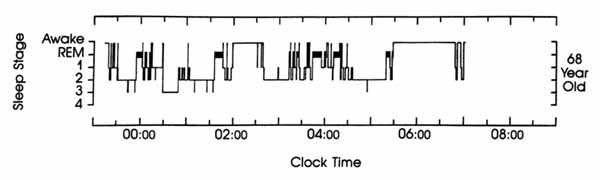
Figure explaining "sleep in elderly persons"
In an older adult, sleep is much more fragmented. There are many more arousals to the wakeful state throughout the night, shown as the line reaches "awake". There is a relative absence of the deepest sleep in Stages 3 and 4, and also more transitions thorough the very light Stage 1.
Some special problems of adulthood that cause insomnia are:
1. Medical problems, such as arthritis, bronchitis and other respiratory disorders, chest pain from coronary artery disease, and gastritis or acid reflux disease
2. Medications affecting sleep, such as antidepressants, stimulant medicines, tranquilizers, Parkinson disease medicines, and decongestants
3. Lifestyle changes with retirement: individuals who retire should not sit around doing nothing all day. Lack of stimulation during the day will result in depression and very fragmented, unfulfilling sleep. Sleeping late in the morning may promote nighttime insomnia.
Interested readers are referred to:
"No More Sleepless Nights" by Peter Hauri and Shirley Linde, 1990.
"How to Get a Good Night's Sleep" by Richard Graber, 1995.