|
|
|
|
|
|
||||
|
What are some of the many causes of excessive daytime sleepiness?
We have all experienced the feeling of tiredness after a night of insufficient rest. The body can readily recover from very occasional sleep deprivation by extra sleep the next day. For adults, it is generally better to have naps last for 30 minutes or less, leaving deepest sleep for the consolidated night sleeping period. Persons who feel sleepy virtually every day, however, need to have the problem evaluated by a physician, preferrably one who is well versed in the many possible causes of daytime sleepiness.
The majority of us are at least a little bit sleep deprived. A simple way to tell if you are lacking sufficient sleep is to consider how you would react in a situation that is not very stimulating. Do you, for example, tend to nod off in a lecture or meeting or while watching T.V. and make the excuse that the situation caused you to feel sleepy? Have you ever nodded off while driving, only to be aroused by hearing the tires on the off-road turf or by a chance street sound? Do you struggle to get up in the morning? Do you fall asleep as soon as your head hits the pillow? These signs of tiredness mean that you are sleep deprived.
Teenagers and college students who are tired during the school day commonly have some form of sleep deprivation. A late time to bed is often related to a very busy daytime schedule complicated by homework, lessons and sports activities, computer preoccupation, phone and T.V. The last priority for these students is sleeping time. If it is simply impossible to honor the need for more sleep during the week, the only alternative is extra sleeping-in time on weekends, but this approach has the disadvantage of causing a change in the regular day/night timing of sleep.
Some persons believe they are sleepy all the time even though to others it appears the sleeping time is sufficient or even excessive. These persons usually need to be evaluated for a more serious sleeping problem in a sleep laboratory.
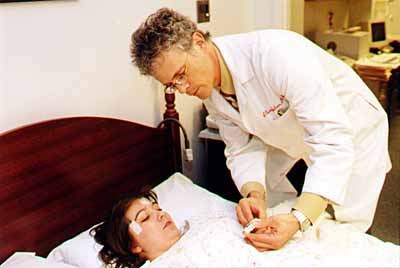
A doctor adjusting a device clipped outside the patient's finger. The device will measure the oxygen level in the blood while the patient sleeps.
1. Narcolepsy is a condition of an abnormal need for sleep in combination with a REM sleep abnormality. The person with narcolepsy may have the ability to fall asleep very quickly at almost any time.
2. Snoring can be a very mild and insignificant problem or it can be a very important indicator of much more serious breathing abnormalities. Even persons who are convinced they are sleeping fine while snoring loudly are often not sleeping well because the brain picks up on sounds and may briefly awaken during the snoring time. A sizable number of persons who snore also have apnea, or complete cessation of breathing, during sleep. This condition must be evaluated by a sleeping expert.
3. Medicines can relate to sleepiness during the day. Use of sleeping pills can cause a hangover the next day. Some antidepressants, decongestants, blood pressure medicines, and tranquilizers may cause drowsiness. Withdrawal from stimulants including coffee, coke, or other drinks with caffeine may initially cause drowsiness during the day, but getting off daytime caffeine may allow a return to more normal sleep at night.
4. Hypersomnia is a condition of needing more than the average amount of sleep. While 3/4 of persons need 7-8 hours of sleep normally, 5-10% of people need 9 or more hours of sleep to achieve normal function during the day. These people are otherwise normal in every way.
5. Restless Legs is a condition of frequent need to move the legs for some uncontrollable reason. The sleeping problem with restless legs can result from the inability to initially get to sleep or from periodic arousals over night due to the movements. The problem can be as annoying for a sleeping partner, who experiences insomnia from the physical arousal, as it is disturbing for the kicker, who may be unknowingly awakening him- or herself repeatedly. Treatment often involves use of a combination of exercise and a medicine to relax the muscles.
6. Insomnia can certainly be a source of daytime sleepiness. Solving the insomnia problem at night should help to eliminate the daytime problem.
7. Sleeping time disruptions can occur from jet lag and shift work and result in excessive sleepiness during the day. These problems are a much more common occurrence in the current day and age and often require creative solutions.
The interested reader is referred to the following excellent book summarizing many concerns related to daytime sleepiness:
"Power Sleep" by James B. Maas, 1998.For further information you may wish to contact Dr. Scheer by e-mail.
|
Copyright ©
1996-2005
Dr. Steven Scheer, MD. All rights reserved.
No part of this publication may be reproduced, downloaded, stored, or transmitted in any form or by any means, including copies or prints, written or oral, without prior permission in writing from the copyright proprietor.
Thank you for your visit